From Guilt-Driven Hosting to Firm House Rules: Reclaiming Your Couch

Finding Clarity in the 8:47 p.m. Doorway Pause
“You’re the friend who always says ‘of course’ in the moment—and then lies awake doing math on your own generosity the second the door closes.”
I said it gently, watching Jordan’s face do that tiny flinch people do when a sentence lands too close to home.
She was 28, Toronto tired, the kind that isn’t about sleep as much as it’s about never fully coming down. She told me she lived off Queen West in what she called “a shoebox that somehow still echoes.” And she described the moment that had finally pushed her to book a reading: 8:47 p.m. on a Tuesday, key half-turned in her lock, hearing a second voice inside her apartment before she even stepped in.
“The hallway smells like someone’s takeout,” she said, almost laughing. “The overhead light buzzes. My phone is warm from doomscrolling. And my shoulders go up like I’m bracing for… I don’t know, impact.”
Her friend had started “crashing for a couple nights” after a rough patch. Now it had become night after night. Jordan wanted to be supportive. She also wanted her living room back. She feared that a boundary would make her look selfish—like she’d be the villain in somebody else’s story.
Guilt was the loudest emotion in the room. Not abstract guilt—guilt that lived in her body like a clenched jaw, shoulders pulled tight, and a low-level agitation at home, like she couldn’t fully exhale in her own living room.
“I’m not trying to be cold,” she said. “I just want my space back.”
I nodded. “It makes sense that you feel guilty—your empathy kicks in faster than your boundaries. Let’s see if we can turn this into something clear and doable. Not a personality change. A plan. A small journey to clarity.”

Choosing the Compass: The Celtic Cross · Context Edition
I invited Jordan to take one slow breath with me—not as a ritual for the universe, but as a way to bring her nervous system into the present. While I shuffled, I asked her to hold the question in plain language: “My friend keeps crashing on my couch—how do I set a boundary?”
“Today,” I told her, “we’ll use a spread called the Celtic Cross · Context Edition.”
If you’ve ever Googled how tarot works and found nothing but mystical fog, here’s the practical version: a good spread doesn’t predict your life—it organizes your reality. This issue isn’t just about a script; it’s also about what makes the script feel impossible in the moment. The Celtic Cross is perfect for that because it maps the present dynamic, the immediate blockage, the deeper psychological hook, and the real-world environment pressures—then it ends with integration and best next step (not a fate sentence).
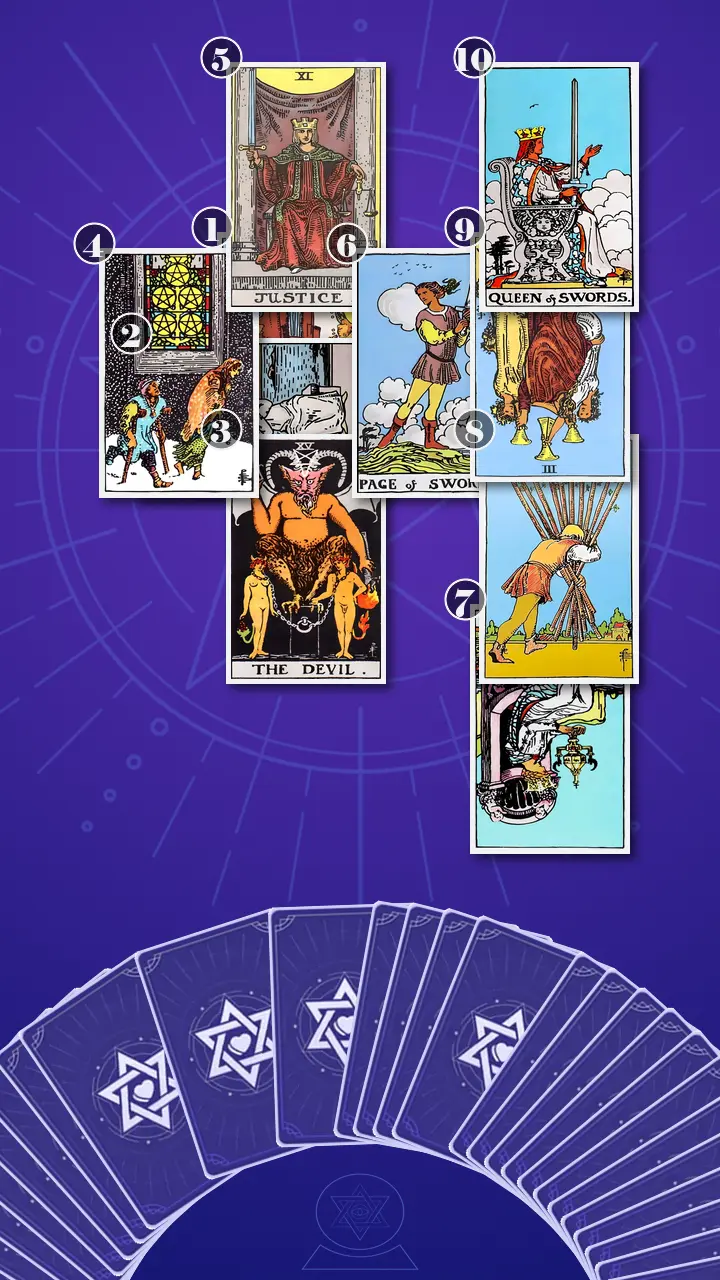
I pointed to the structure as I laid the cards: “The first card will show the current boundary dynamic. The second shows what’s actively blocking you. And the last card—position ten—will be the boundary style to embody, the clearest next step you can actually hold.”
Reading the Map: When “Helping” Turns Into an Open Tab
Position 1 — The current boundary dynamic: how the couch-crashing situation is functioning day to day and what it costs you.
Now flipped over, the card representing the current boundary dynamic was Six of Pentacles, reversed.
I tapped the image lightly. “Your living room has turned into an open-ended safety net: ‘sure, just tonight’ keeps auto-renewing. You’re paying with space, routine, and quiet—WFH calls, dating plans, workouts—while they get stability without a shared plan. The vibe is generosity that no longer feels chosen, because the terms were never said out loud.”
Reversed, this card is an energy imbalance: giving that has slipped from chosen into compulsory. The generosity isn’t wrong; the lack of structure is what’s draining it. It’s like an open tab you never agreed to—each “one more night” adds up until the nice thing feels like debt.
Jordan let out a short laugh that had a bitter edge. “That’s… brutal. Accurate, but brutal.” She rubbed her jaw like she’d just noticed she’d been clenching.
“Not brutal,” I said. “Honest. The card is showing why you’re feeling resentful: you’re giving without a clear agreement, so your nervous system treats it like a silent contract you can’t renegotiate.”
Position 2 — What is actively blocking the boundary: the immediate challenge that keeps you from saying the clear thing.
Now flipped over, the card representing what is actively blocking the boundary was Two of Swords, reversed.
“The blockage isn’t that you don’t know what you want—you do. The blockage is the moment-by-moment avoidance: drafting the text, deleting it, hinting, cleaning loudly, waiting for the perfect tone. It keeps you stuck in the same loop where the conversation feels bigger every day you don’t have it.”
This is Air energy in blockage: communication and decision-making are there, but jammed. The blindfold isn’t ignorance; it’s self-protection. Reversed, it’s that protection starting to fail—so you feel scattered, snappy, exhausted.
I described what she’d already told me in a split-screen, because the card practically begged for it:
Screen A: “I should say something.”
Screen B: “Not tonight. Not like this. I’ll wait for the right moment.”
And then the modern blindfold: Notes app draft → delete → draft again with three apologies → delete → send a meme, because it keeps things “normal.”
Jordan stared at the table, eyes unfocusing the way they do when someone is replaying a week in their head. She nodded once, slow. “Peace-now versus peace-later,” she murmured. “I keep choosing peace-now.”
“Exactly,” I said. “And the cost is that your home stops being restorative. You’re not avoiding conflict—you’re postponing it while paying interest.”
Position 3 — The psychological root: the deeper hook (guilt, obligation, fear of being ‘the bad friend’) driving the pattern.
Now flipped over, the card representing the psychological root was The Devil, upright.
“Under the logistics is a belonging fear: you’re not just afraid they’ll be upset—you’re afraid you’ll be cast as uncaring. That fear chains you to over-accommodating, like your worth as a friend depends on being a backup plan. The trap is internal: you feel obligated even when you technically have a choice.”
This is attachment energy in excess. Not love—attachment. The part of you that whispers, “If I set a limit, I’m not a good friend,” then treats that thought like a law.
I leaned back and let my own work show for a second—the Jungian part of me that listens for the story under the story. “The Devil often isn’t a villain outside you. It’s the internal deal you didn’t realize you made.”
Jordan swallowed. Her fingers tightened around her mug, then loosened. “I can literally see the group chat,” she said. “Like… them telling it as ‘Jordan kicked me out when I was struggling.’”
“That’s the chain,” I said softly. “Guilt is information, not instruction.”
Position 4 — What started it: the context that made saying yes feel necessary or urgent at first.
Now flipped over, the card representing what started it was Five of Pentacles, upright.
“This started with a real moment of need: a rough patch, nowhere to go, and you couldn’t bear the idea of them being out in the cold. That first yes came from genuine compassion—and it’s why part of you still feels cruel imagining an end date. The origin story matters, but it doesn’t have to define the forever plan.”
This is Earth energy in hardship. The lit window in the card is your empathy. You saw a friend on the cold side of life and you opened a door.
Jordan’s eyes went glossy for a moment. “The first night, they showed up with a bag. I couldn’t… not.”
“You did a human thing,” I said. “And now you’re being asked to do the next human thing: make it sustainable.”
Position 5 — Your conscious aim: what you believe a ‘fair’ or ‘right’ boundary would look like.
Now flipped over, the card representing your conscious aim was Justice, upright.
“What you’re aiming for is a fair agreement, not a moral verdict. You want a boundary that says: my home has rules, and your situation has next steps—but those are different things. The ‘right’ move is a clear timeline and a consistent follow-through that respects both of you as adults.”
Justice is Air energy in balance: clean truth, clear terms. I’ve seen this card in salary negotiations, breakups, roommate talks—any place where kindness needs structure to stay kind.
My mind flashed briefly to my old life training staff on cruise ships: when emotions ran high and space was tight, the only thing that prevented chaos was clarity. Cabin rules weren’t “mean.” They were what kept 4,000 people from melting down at sea.
Jordan exhaled through her nose. “So… not ‘am I a good person.’ More like… ‘what’s a fair agreement.’”
“Exactly,” I said. “Justice is asking you to stop putting your worth on trial.”
Position 6 — The next opening: what’s likely to help the conversation happen and shift the pattern soon.
Now flipped over, the card representing the next opening was Page of Swords, upright.
“The opening is a simple, scheduled conversation: a 15-minute talk in daylight hours where you lead with one headline sentence before any explaining. It might feel edgy, like your voice is a little shaky, but it’s the first clean move that breaks the pattern—because you’re finally saying the thing you’ve been acting around.”
This is Air energy in activation. The Page doesn’t wait to become fearless. The Page moves with wind in their hair and nerves in their hands.
“Hints are exhausting,” I told her. “A headline is kind.”
Jordan nodded, and I could see the smallest shift: not confidence yet—just willingness. The kind where you think, Okay. I can do fifteen minutes.
Position 7 — Your role in the dynamic: your emotional default and how it impacts your ability to hold a limit.
Now flipped over, the card representing your role in the dynamic was Queen of Cups, reversed.
“You’re emotionally over-responsible: you scan their face, tone, and mood like it’s your job, then soften your boundary mid-sentence to keep them comfortable. You end up carrying guilt for feelings that aren’t yours to manage. Your empathy is real—but it becomes self-erasure when the boundary depends on whether they react well.”
Reversed, Water becomes porous. Your compassion leaks into caretaking. The energy is in excess: too much attunement, not enough separation.
Jordan’s shoulders rose, then she caught herself and dropped them. “I literally change the sentence while I’m saying it,” she admitted. “If their face shifts, I start apologizing.”
“That’s the Queen reversed,” I said. “She’s not wrong to feel. She’s just trying to manage weather that isn’t hers.”
Position 8 — External reality: the home environment pressures and practical burdens that make this unsustainable.
Now flipped over, the card representing external reality was Ten of Wands, upright.
“The environment pressure is brutally practical: extra noise, extra cleaning, extra household coordination, less privacy, and a constant low-level ‘hosting’ mode. Even if they’re grateful, your apartment’s capacity is finite, and you’re carrying the load mostly alone—mentally and materially.”
This is Fire energy in overload. Ten wands is too many. Not because you’re weak—but because your arms are already full.
Jordan’s mouth tightened. “I eat in my room,” she said quietly. “Like I’m renting a corner of my own place.”
“That’s the card,” I said. “When you carry everything, you can’t see the path—only tasks.”
Position 9 — Hopes and fears: what you’re afraid will happen socially or relationally if you set the boundary.
Now flipped over, the card representing hopes and fears was Three of Cups, reversed.
“You’re afraid one boundary will become ‘a whole thing’ in your social world: awkward brunch energy, side texts, mutual friends taking sides, you being labeled unsupportive. So you try to manage the narrative by staying overly accommodating. But the real protection here is clarity—because group harmony built on your resentment isn’t actually harmony.”
This is Water energy in distortion: connection strained by unspoken feelings. It’s the moment a group chat goes quiet after someone finally says something real.
Jordan winced. “I’ve been on AITA Reddit at 1 a.m. like… ‘What if I’m actually the worst?’”
“That makes sense,” I said. “But we’re not crowdsourcing your boundaries from the internet. We’re building them from consent and capacity.”
When the Queen of Swords Spoke: The Boundary That Doesn’t Beg
Position 10 — Integration and best next step: the boundary style to embody and the clearest way to move forward.
When I reached for the final card, the room went noticeably quieter. Even the city noise outside—streetcar rattle, a distant horn—felt like it softened for half a beat. This was the card that would tell us how to move from feeling stuck into actionable advice.
Now flipped over, the card representing integration and best next step was Queen of Swords, upright.
“You embody a calm, clean boundary: one sentence with a date, said without stacking apologies, and followed by consistent action. You pause after you say it. You don’t negotiate against yourself in real time. If you want to offer support, it’s a specific alternative (helping research options, a ride to a viewing), not continued access to your home by default.”
Air here is in maturity. Not sharpness for sport—clarity as protection.
And this is where my own toolkit came in—the thing I used to teach on ships when a hundred cultures, personalities, and expectations collided in one floating city. I call it Social Role Switching: you don’t become colder, you become intentional. You choose a mode.
“Jordan,” I said, “you’ve been living in Supportive Mode, full-time. That’s why your kindness has turned into resentment. The Queen of Swords asks you to switch into Assertive Mode for one conversation—like a clear ship policy. Not personal. Not a debate. Just the structure that keeps everyone safe.”
She started to speak, then stopped—like her throat had temporarily frozen.
Setup (the stuck moment): I could see it on her face: she was back in that hallway with her key half-turned, listening for whether her friend was inside—like she needed to prepare herself before she even entered her own place. She wanted the “perfect” wording that would guarantee no backlash, no awkwardness, no guilt hangover.
Delivery (the line that cuts through the fog):
Not endless explanations—choose one clear line and hold it like the Queen of Swords’ upright blade.
I let the sentence sit between us.
Reinforcement (the body learning it’s allowed): Jordan’s breath caught—just for a second—like her lungs had been waiting for permission. Her eyes went wide, then unfocused. A micro-flash of memories crossed her face: the paper plate on the duvet, the Netflix intro sound through the wall, the sound of couch springs during a WFH call. Her jaw unclenched so suddenly she touched it, surprised. Her shoulders lowered, then she did another thing I always look for: her hands, which had been gripping her mug, loosened one finger at a time.
Then the complicated part: her brows pulled together, and there was a flicker of anger—not at me, but at the trap. “But if I don’t explain,” she said, voice tight, “won’t I look cruel?”
I nodded, steady. “That’s the Devil talking in a different outfit. Here’s the Justice piece: a boundary isn’t a breakup with your values—it’s the sentence that makes your kindness sustainable. And your home rules don’t require a jury—just your consistency.”
I leaned in slightly, lowering my voice the way I used to when a whole lounge was too loud and someone needed one clear instruction. “Now, with this new lens—think back to last week. Was there a moment when you said yes at the doorway, or after a sad story, where this one sentence would have changed your body immediately?”
Jordan blinked fast, then nodded once. “Sunday. 9:41. They told me another hard thing and I offered tea like I was trying to pre-pay for the boundary.” She gave a shaky exhale. “I could’ve just said the date.”
That was the shift—moving from guilt-driven silence toward uncomfortable clarity in one direct talk. Not magically fearless. Just cleaner. This was the first real step in her emotional transformation: from bracing and over-managing to grounded self-respect.
The One-Line Policy: From Insight to Actionable Advice
I looked at the full spread again and told her the story it was clearly telling: an open-ended favor (Six of Pentacles reversed) got stuck in avoidance (Two of Swords reversed) because guilt and belonging fear tightened like a chain (The Devil). The origin was real compassion (Five of Pentacles), and her values were trying to find fairness (Justice). The opening was small and doable (Page of Swords): schedule the talk. The internal pattern was over-caretaking (Queen of Cups reversed), the external reality was overload (Ten of Wands), and the fear was social fallout (Three of Cups reversed). The resolution wasn’t to become harsher—it was to become clearer (Queen of Swords).
The cognitive blind spot was simple and incredibly common: Jordan had been treating clarity like something she needed to earn with perfect wording and extra kindness. But the spread kept pointing to the same transformation direction: shift from hinting and hoping they’ll self-correct to naming a clear, time-bound limit and house rule in one calm, direct conversation.
“Let’s make this real,” I said. “We’ll use a cruise-ship principle I trust: Maritime Social Protocol. Onboard, if you don’t state the policy, you end up enforcing it in chaos. On land, it’s the same. We state it early, calmly, and we don’t renegotiate it in the hallway at midnight.”
- Write the 2-sentence boundary draft (Tonight, 3 minutes)Open Notes and write: “I can’t host after Friday. I can help you look at two next-step options on Wednesday night.” Keep it exactly two sentences—date + bounded support.If you feel the urge to add ten justifications, pause and keep the draft short. You’re aiming for clarity, not a courtroom brief.
- Send the scheduling text (Within 48 hours)Send one text that does one job: “Can we talk for 15 minutes tomorrow after dinner? I need to go over a plan for the rest of this week.” No explaining in the text—save it for the talk.Lower the difficulty: do it in daylight hours or right after dinner, set a 15-minute timer, and pick a neutral spot like the kitchen table—not the couch.
- Use the “clean delivery” script (Before the talk, 5 minutes)Practice your headline line out loud three times: “I can’t have you staying here after Friday.” Then use my ready-to-use boundary script: make eye contact, slow your speech, and add one “I need…” sentence if necessary: “I need my space back and I’m not able to host.”Expect resistance in your body first (tight throat, rush of adrenaline). Pause, breathe once, and repeat the headline line verbatim—same words, same tone.
“And after the talk,” I added, “send a short recap text—two to four lines—so the agreement isn’t held together by vibes. That’s Queen of Swords practicality.”

A Week Later: The Quiet Proof
Eight days later, Jordan texted me a screenshot—not of a dramatic confrontation, but of a calm recap message she’d sent after the 15-minute kitchen-table talk. The last line read: “Thanks for understanding.”
“They didn’t love it,” she wrote, “but they didn’t explode. And I slept a full night. This morning my first thought was still ‘what if I was mean?’—but then I laughed a little. Because I can breathe in my living room again.”
That’s what I love about this work: tarot doesn’t hand you a fantasy. It hands you a map. Jordan didn’t become a different person. She became a clearer version of herself—supportive, but no longer available by default.
When you’re scared that one firm sentence will make you look selfish, it’s easy to stay quiet—until your own home starts feeling like a place you can’t fully exhale.
If you didn’t have to earn your boundary with perfect wording or extra kindness, what’s the simplest time-bound limit you’d feel willing to say out loud this week?
Every reading at AceTarot is a Journey to connect with inner wisdom and empower next step.
Learn more about our Journey to Clarity.