From Splitwise Guilt to Clean Closure: Naming Numbers Without Apology

Finding Clarity in the 9:07 p.m. Splitwise Buzz
If you’re a late-20s city person who can design a clean UX flow at work but still freeze at a Splitwise reminder like it’s a relationship referendum, you’re not alone—this is comparison fatigue’s quieter cousin: money-admin guilt.
Taylor (name changed for privacy) sank into the chair across from me and did that tiny half-smile people do when they’re trying to act casual about something that’s been chewing a hole through their week. She was 28, a junior UX designer in Toronto—smart, quick, and exhausted in that specific way you get when your brain won’t close a tab.
She described it like a scene she’d watched too many times: 9:07 p.m. on a Wednesday in her shoebox condo, streetcar hum leaking through the window, blue TV glow on the wall. She finally goes horizontal on the couch and feels her phone warm her palm—then the Splitwise push notification pops up. Her stomach tightens. Her shoulders brace like she’s about to take a test she didn’t study for. She opens the app ‘just to check’… again.
‘I don’t mind paying,’ she said, staring at the edge of my table instead of my eyes. ‘I just hate the weird part after. Why does asking for twenty dollars feel like asking for a favor?’
I watched how her hands kept re-gripping her tote strap—tight, release, tight again—like her body was trying to hold two truths at once. Warm friendships. Fair numbers. And the core tug-of-war snapped into focus: wanting friendships to feel easy and equal vs fearing you’ll be judged as petty or difficult if you name the numbers.
Her guilt didn’t sound like a thought. It sounded like a reflex. Like a crumpled receipt in her pocket that keeps poking her thigh all day—small, sharp, impossible to ignore—until she either over-explains a text in Notes or overpays at the next hangout to buy the feeling of being ‘easygoing’ again.
‘Let’s not try to brute-force you into not caring,’ I told her gently. ‘Let’s do something more useful. We’ll map the loop—what triggers it, what it’s protecting, and what clean next steps look like. Today is a journey to clarity, not a personality audit.’

Choosing the Compass: The Horseshoe Spread for a Friendship Logistics Loop
I invited Taylor to take one slow breath—not as a mystical ritual, but as a gear shift. The kind you do before you send a risky email: you’re not changing reality, you’re changing your nervous system’s grip on it. While she held the question in mind, I shuffled until the deck felt quiet under my thumbs.
‘Today, we’ll use the Horseshoe Spread,’ I said. ‘It’s seven cards laid in an arc. I like it for recurring patterns—especially the kind that spike fast and repeat, like a Splitwise reminder anxiety loop.’
For you reading this: the Horseshoe Spread works because it traces a curve. It shows how the past trains the present, exposes what’s hidden underneath the behavior, names the central blockage, then moves through environment, advice, and integration. It’s not about predicting a dramatic ending. It’s about identifying the hinge where a loop can actually change.
‘In this spread,’ I told Taylor, ‘the first card is the old template—how you learned to manage fairness. The middle cards show the live loop and the hidden belief that freezes you. The top is the main obstacle—the thing turning logistics into guilt. Then we come down the other side: what your environment rewards, what your clearest move is, and what a sustainable rhythm looks like.’
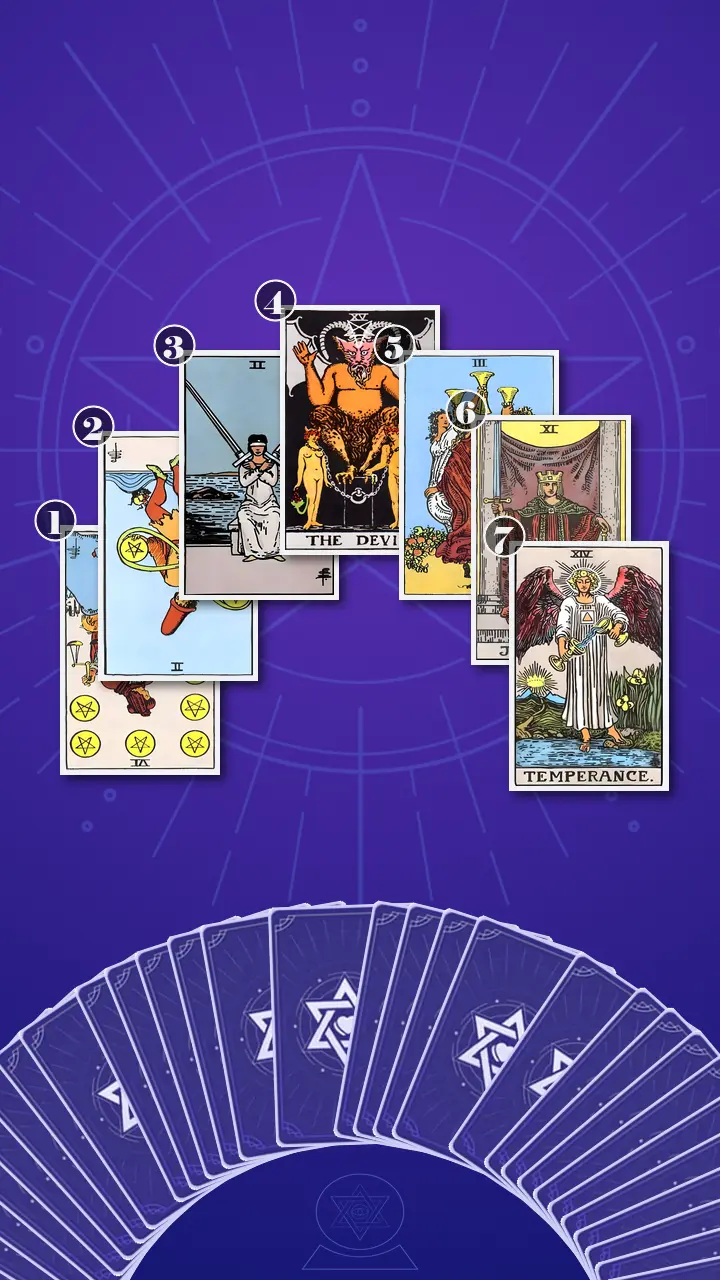
Reading the Arc: From Tilted Scales to a Thumb Hovering Over “Send”
Position 1 — Past pattern that trained the current loop
Now turning over is the card representing Past pattern that trained the current money-and-friendship loop (early imbalance template).
Six of Pentacles, reversed.
I pointed to the image’s tilted scales, the one-way flow of coins. ‘This card is what happens when “being generous” becomes fused with keeping the peace. In modern life, it looks like this: you offer, “I’ll just put it on my card,” because it’s faster—and you genuinely like being generous. But later, when repayment is slow, you feel a sting you don’t show. You start remembering who ordered what and replaying the moment you said “don’t worry about it,” like you accidentally signed a contract you didn’t mean to sign.’
Reversed, the energy is a blockage in the giving/receiving circuit. Not a lack of kindness—more like kindness with unspoken strings, even if you didn’t intend the strings. The coins still move, but the agreement doesn’t. Fairness gets negotiated through vibes instead of named rules.
Taylor let out a small laugh that wasn’t happy. ‘Okay, that’s… brutal. But yeah. I’ll say “don’t worry about it” and then I do worry about it.’ Her smile faded as quickly as it arrived, like her face remembered it wasn’t safe to be annoyed.
Position 2 — The current, observable loop when the reminder hits
Now turning over is the card representing The current, observable loop behavior when the Splitwise reminder hits (what you do and feel in real time).
Two of Pentacles, reversed.
‘This is the juggling,’ I said, tapping the infinity-loop ribbon in the illustration. ‘After work, you’re on the couch toggling between Splitwise, your bank app, and your messages. You do the math again even though the app already did it. You’re trying to juggle friendship vibes, personal finance, and self-image all at once—so you keep the tabs in motion rather than choosing a clean action (pay or request) and letting it be done.’
Reversed, the Two of Pentacles is overload. The energy isn’t “busy”; it’s unresolved. Like leaving a browser tab open that keeps draining your battery in the background. The choppy sea behind the figure? That’s Toronto life: constant small shared costs, constant group plans, constant micro-admin that never feels like it has a natural ending.
Taylor nodded without looking up, and I saw her shoulders rise almost imperceptibly—as if the memory of that push notification was enough to make her brace right here in my room.
Position 3 — Hidden inner conflict keeping you from a direct message
Now turning over is the card representing Hidden inner conflict or unspoken belief that keeps you from a direct settle-up message.
Two of Swords, upright.
‘This is the freeze response in a blazer,’ I said. ‘You have the message drafted. It’s literally ready. But your thumb won’t hit send because once it’s sent, you can’t edit the vibe. So you stay “chill” on the outside and locked up on the inside—crossed arms, crossed thoughts, stuck between wanting fairness and fearing judgment.’
Upright, the Two of Swords is self-protection. The blindfold isn’t ignorance; it’s control. If you don’t send it, nothing can go wrong. Except… nothing can get better, either. Still water, narrow moon: a quiet stalemate that looks calm until you live inside it.
‘I always think there’s one perfect sentence that will make it not weird,’ Taylor admitted. ‘Like if I can explain it perfectly, then it won’t… change how they see me.’
I felt my own inner flashback—years ago on transoceanic voyages, training crew to read “energy shifts” in crowds. The smallest frictions—unspoken expectations, tiny resentments—would swell in the middle of an ocean because there was nowhere to escape each other. On land, we call it “adult friendships are logistics” and pretend it’s a hot take. At sea, it’s survival.
Position 4 — The main blockage turning logistics into guilt
Now turning over is the card representing The main psychological blockage that turns logistics into guilt and freezes action.
The Devil, upright.
The room went quieter, the way it does when someone says the true name of the thing. ‘This is the chain scene,’ I said softly. ‘Loose chains—meaning you’re not truly trapped by the amount. You’re trapped by what you think it says about your worth.’
And the modern-life translation landed exactly where Taylor lived: ‘A $18 balance hits your nervous system like a moral verdict. You start thinking: if you ask, you’re difficult; if you don’t, you’re “good.” So you bargain—pay extra, cover the next thing, be extra chill—because it buys temporary relief. The cost shows up later as resentment and a private sense of being used (even when no one asked you to do it).’
Devil energy is compulsion. Not because you’re dramatic. Because shame is sticky. It convinces you that belonging is something you earn by swallowing discomfort.
I mirrored her inner monologue out loud—slow, without judgment: ‘If I ask, I’m stingy. If I don’t, I’m resentful. If I pay extra, I’m “safe.”’
Taylor’s reaction came in a three-beat chain. First: a tiny freeze—her breath paused, fingers stilled mid-fidget. Second: her eyes lost focus for half a second, like a mental replay started. Third: a sharp exhale escaped her, quiet but unmistakable. ‘Oh… yeah,’ she said. ‘That’s literally it. It’s not even about the math.’
‘Exactly,’ I replied. ‘This is the shadow-binder. In Jungian terms, the “Good Friend” persona—easygoing, generous, never a buzzkill—has a shadow: unspoken resentment and fear of being seen as “a lot.” The Devil isn’t telling you you’re bad. It’s showing you where guilt is holding the leash.’
And I added one more sentence, direct enough to be useful: ‘Stop paying extra to buy peace—pay (or ask) to close the loop.’
Position 5 — External influence: the friend-group vibe
Now turning over is the card representing Social context: how friend-group dynamics and “keeping it fun” pressure shapes your choices.
Three of Cups, upright.
‘Your environment is celebration mode,’ I said. ‘Birthdays, “just one drink,” spontaneous dinners, weekend plans. The vibe is: don’t make it awkward. So money talk feels like walking into a party with a clipboard.’
This card isn’t accusing your friends. It’s naming a social container. The energy here is reward: the group rewards ease and spontaneity. And that means the person who brings up logistics can feel like they’re breaking the spell—even if, long-term, that spell is exactly what keeps the resentment alive.
Taylor’s mouth tightened. ‘And I hate being the buzzkill. Especially in Toronto. It already feels like everyone’s one flaky calendar invite away from disappearing.’
‘That’s real,’ I said. ‘But we’re not going to solve it by making you smaller.’
When Justice Spoke: A Number Is Not a Personality Statement
Position 6 — Advice: the clearest, self-respecting approach
I held the next card for a beat before turning it over. ‘This is the hinge,’ I said. ‘The one that changes the pattern.’
Now turning over is the card representing The most practical self-respecting approach to close the loop with clarity (script/stance/boundary).
Justice, upright.
I felt Taylor lean forward without realizing she’d moved. The illustration is simple: scales and a sword, a figure facing forward. No flinching. No apology.
‘Justice reframes this entire question,’ I told her. ‘It asks you to separate facts—who owes what—from narratives—what it means about you. It’s the opposite of The Devil. Where guilt binds, clarity frees.’
I switched into the metaphor that always lands with people who live in their phones: ‘Think of Justice as a shared Google Calendar invite. Brief. Clear. Not emotionally loaded. And here’s the pivot: A number is not a personality statement.’
This is where I used my Energy State Diagnosis—the tool I trust when a situation feels “too big” for what it is. I said, ‘Let’s locate the energy leak in 3D: environment, relationships, self.’
‘Environment: the push notification arrives when you’re finally trying to rest—your body reads it as an interruption and threat. Relationships: your friend group’s unspoken rule is “keep it chill,” so any admin feels like risking closeness. Self: the belief is “If I bring this up, I’ll look stingy and people will pull away.” That’s the leak. Not the $18. The belief.’
Taylor swallowed. ‘So what do I do? Like… literally, what do I say?’
The Aha Moment (Setup → Delivery → Reinforcement)
Setup: You know that moment: you’re finally horizontal on the couch after work, and a Splitwise notification lands like a tiny accusation. Your stomach tightens, your shoulders brace, and suddenly you’re rewriting a two-line text like it’s a performance review.
Delivery:
Stop negotiating your worth through guilt, start naming the number with calm fairness, and let Justice’s scales and sword do the work of clean clarity.
I let the sentence sit between us for a breath—like a door clicking into place.
Reinforcement: Taylor’s reaction didn’t come as a clean sigh of relief. It came as a layered wave. First, her face went still—eyes slightly wider, as if her mind had to re-file years of “being nice” under a new label. Then her gaze dropped to the table, unfocusing, the way it does when someone is watching an old memory with new subtitles: the dinner bill on Ossington, the quick ‘don’t worry about it,’ the later jaw clench on the walk home. Finally, her shoulders lowered a millimeter at a time, like a coat slipping off. She exhaled, and there was nerves in it—because clarity is a kind of responsibility—but there was relief too.
‘Justice doesn’t ask you to be colder,’ I said quietly. ‘It asks you to be simpler.’
I slid my notebook toward her as if I were putting facts on a courtroom table and leaving stories in parentheses. ‘Here’s your two-minute script. One sentence. One number. One link. Then you’re done.’
And I asked the question that seals insight into memory: ‘Now, with this new lens—number vs meaning—think back to last week. Was there a moment when you reopened Splitwise, drafted the text, and didn’t send it… where this would have changed how your body felt?’
Taylor’s eyes went glossy, not with sadness exactly—more like the shock of realizing she’d been working a second job in her head. ‘On the TTC Monday,’ she said. ‘I kept app-juggling like I was looking for permission. If I’d just… named the number… I would’ve been done in two minutes.’
‘That,’ I told her, ‘is you moving from guilt-driven people-pleasing into boundary-based clarity. Not overnight. But right now, in this moment.’
Position 7 — Integration: keeping money neutral and friendships warm
Now turning over is the card representing Integration: what it looks like to keep money neutral and friendships warm if you practice the advice consistently.
Temperance, upright.
The angel pours between two cups, one foot on land, one in water. ‘This is the kitchen scene,’ I said, and I felt my Venetian upbringing rise in the metaphor the way it always does. ‘In Venice, you don’t fight the canal currents. You regulate them. You keep the flow clean so the city can keep living.’
Temperance is balance as a practice—not a personality trait. In modern life, it’s not a dramatic “money talk.” It’s a small routine: once a week you reconcile, send requests, pay what you owe, and close the app. You learn to hold two truths—care and fairness—without swinging between overpaying and resentment.
Taylor’s face softened. ‘So it becomes… normal.’
‘Yes,’ I said. ‘And generosity hits different when it’s a choice, not a cover-up.’
The One-Page “Justice Sheet”: Actionable Advice for the Next 48 Hours
I looked at the arc of the whole spread and told Taylor the story it was already telling.
‘You learned an old template where fairness had to stay silent to stay kind (Six of Pentacles reversed). Now city life keeps feeding you tiny shared costs, and you cope by juggling and rechecking to avoid a clean “stop-and-send” moment (Two of Pentacles reversed). Underneath, you freeze because sending makes it real and uneditable (Two of Swords). The real blockage is that guilt turns money into a worth test (The Devil), and your friend group vibe rewards ease over logistics (Three of Cups). Justice is your antidote—facts over stories. Temperance is how you make it livable: a small rhythm that keeps the canal clear.’
Then I named the cognitive blind spot gently, because blame would only feed the Devil. ‘Your blind spot is thinking you have only two options: swallow it to keep it warm, or bring it up and become “the difficult one.” The spread shows a third option: warm and clear. Logistics, not verdict.’
‘Here are your next steps,’ I said, making them small enough to actually happen on a weeknight.
- The 2-minute Justice ScriptOpen the one Splitwise item you’ve been avoiding. Take one slow breath. Send exactly one sentence (no apology, no backstory): ‘Hey! Splitwise says it’s $18.40—mind settling when you get a sec? Link: [Splitwise link].’If you feel the urge to add five exclamation points, that’s your cue to stop. One sentence protects you from turning it into a feelings conversation.
- Facts vs Story (30 seconds)Before you hit Send, do a quick check: Fact = amount + date. Story = ‘They’ll think I’m stingy’ / ‘This will ruin the vibe.’ Put the story in parentheses in your head, like a footnote—not the headline.Expect the ‘stingy’ thought to show up. Your job isn’t to argue with it; it’s to act with clarity anyway.
- 24-hour No-Rechecking RuleOnce you send (or once you pay what you owe), close Splitwise and don’t reopen that item for 24 hours. If your body spikes, put your phone face-down for 60 seconds and let the wave pass without forcing yourself to ‘feel fine.’Use a tiny modern cleanse to break the compulsion: spend that 60 seconds organizing 10 photos in your camera roll (a mini “digital detox” that gives your hands something neutral to do).
- The Temperance WindowCreate a weekly 15-minute ‘money admin’ calendar block (Sundays at 4:30 p.m., for example) for Splitwise + Interac e-Transfers/Wealthsimple Cash + quick requests. Keep your reusable script pinned in Notes as ‘Money admin script.’The point is rhythm, not perfection. If you miss it, you’re not back to zero—you just choose the next window.

A Week Later: Ownership, Not Awkwardness
Five days later, Taylor texted me a screenshot—not of a dramatic confrontation, just a clean little message bubble with a link. Under it she wrote: ‘I sent the one-sentence thing. My stomach did the whole tight-drop for like 30 seconds. Then… nothing exploded. She paid. I didn’t spiral. I cannot believe I’ve been paying the “resentment fee” on top of the actual money.’
She added one more line that made me smile: ‘I still felt a tiny “what if they think I’m petty?” in the morning. But I laughed at it. Like, okay brain—thanks for the vintage fear. We’re doing logistics now.’
That’s what I mean by a Journey to Clarity. Not certainty. Ownership. The moment you stop treating a number like a moral verdict, and start treating it like shared admin, your friendships get to breathe again—because your boundaries are explicit, not silently negotiated.
When a tiny Splitwise reminder can tighten your stomach like you’re about to be judged, it’s not ‘just money’—it’s the pressure to keep friendships effortless by swallowing the awkwardness alone.
If you treated the next settle-up as shared logistics (not a verdict on your personality), what’s the smallest, cleanest sentence you’d be willing to send?