From Break-Text Overthinking to Self-Respect: Defining Access in Dating

The TTC Heartbeat Monitor
You tell yourself you’re being mature about “space,” but you’re also checking your phone like it’s a heartbeat monitor every time the TTC stops at a station.
Jordan (name changed for privacy) sat across from me with her tote bag still on her shoulder, like she hadn’t fully decided whether to stay or bolt. She was 28, Toronto-rushed, eyeliner sharp, hands not. Every thirty seconds her fingers twitched toward her phone, then stopped mid-air like she’d touched a hot stove.
She described the moment that broke her week: 8:41 a.m., TTC Line 1 heading downtown. Harsh carriage lights. A phone screen smudged with fingerprints. The train squealing around a curve. And that text—“Let’s take a break.” No timeline. No plan. No “can we talk Friday.” Just a sentence that landed in her body like an elevator dropping a floor.
“I keep drafting a boundary text in Notes,” she said, voice low. “Then I delete it and send something breezy. I don’t want to be dramatic, but I also can’t live in limbo.”
I watched her thumb hover over an invisible keyboard. Her chest rose high and shallow, like she’d been holding her breath since that message arrived. Uncertainty isn’t just a thought—it was a physical thing in her: a tight chest and restless hands reaching for the phone, like her nervous system was trying to refresh its way into safety.
“We can make this simpler,” I told her, gentle but steady. “Not by forcing an outcome—by finding clarity about your next boundary. Let’s draw a map through the fog.”

Choosing the Compass: The Transformation Path Grid (6)
I’m Alison Melody—radio host by day, tarot reader by night, and always a student of how sound and attention change the body. Before I touched the cards, I asked Jordan to take one slow breath with me—nothing mystical, just a nervous-system handrail. Inhale for four. Exhale for six. The room got quieter around her, like someone turned down the gain.
“Today,” I said, “we’re using a spread I built for exactly this: the Transformation Path Grid (6) · Context Edition.”
For you reading this: I chose it because the real question here isn’t “Will they come back?” It’s “What boundary is my next step after an ambiguous ‘let’s take a break’ text?” This six-card grid forces a clean progression—present imbalance, the mental loop, the deeper fear, the fairness principle, the exact boundary action, and then integration. It keeps the focus on agency. No outcome-prediction. Just actionable advice you can use this week.
I also told Jordan what to expect: “The top row shows what’s happening and why it sticks. The bottom row is your pivot: principle, action, and how your body settles after you choose clarity.”
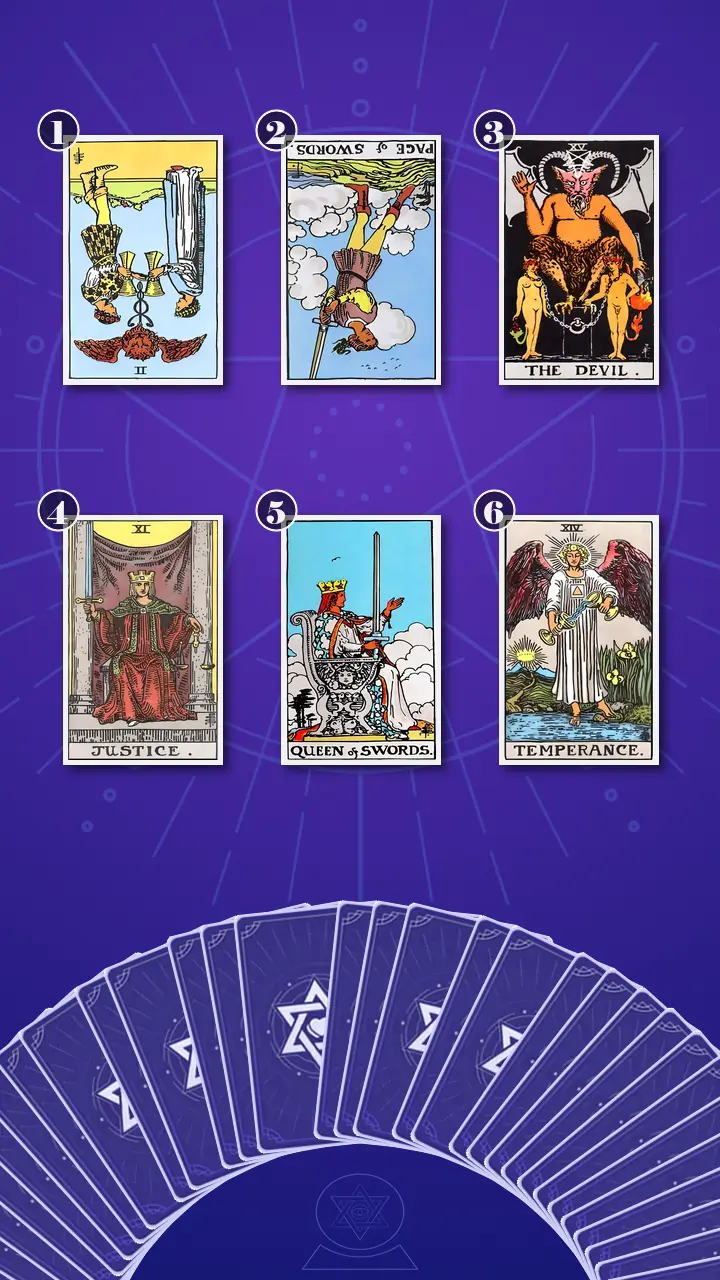
Reading the Map: From Limbo to Language
Position 1: The Relationship Bond Right Now
“Now we’re turning over the card that represents what the ‘break’ dynamic is doing to the relationship bond right now—the observable imbalance,” I said.
Two of Cups, reversed.
“This is like you’re treating ‘the break’ as a shared agreement you both signed,” I told her, “but you’re the only one acting like there are terms. You’re still offering relationship-level access—quick replies, emotional reassurance, being ‘understanding’—while the other person keeps it open-ended.”
In reversed form, the Two of Cups isn’t “no connection.” It’s unequal connection—Water energy destabilized. The bond technically exists, but it’s not being held equally, so your body stays braced like it’s walking on black ice.
I let that land, then mirrored what I’d been watching in her hands. “It can look like this: you flip the phone face-up, refresh, check Stories, feel a phantom buzz that isn’t there—and your inner split-screen says, ‘I’m giving space’ while your nervous system whispers, ‘I’m on call.’”
Jordan gave a tight nod, then surprised herself with a small laugh that tasted bitter. “That’s… wow. That’s exactly what I’m doing. It’s almost cruel how accurate that is.”
Position 2: Your Immediate Reaction to Uncertainty
“Now we’re turning over the card that represents your immediate mental/behavioral reaction to uncertainty—the pattern that keeps you stuck,” I said.
Page of Swords, reversed.
“Your brain turns into a surveillance team,” I said, keeping my voice calm on purpose. “Rereading the thread. Interpreting tone. Checking online activity. Screenshotting the text for friends. Trying to solve ambiguity like it’s a puzzle.”
Reversed, this Page’s Air energy isn’t balanced curiosity—it’s blocked clarity. It’s mental vigilance with no landing strip. The mind keeps scanning for clues instead of asking for terms, which prolongs the limbo the Two of Cups showed.
I could practically hear her internal operating system, so I said it out loud in short loops: “Maybe they meant… unless… but then… what if… I shouldn’t… I can’t…”
Jordan winced—then her shoulders dropped a millimeter, like relief showed up the moment the pattern was named without judgment.
“You’re not ‘too much’ for wanting terms—you’re just done paying for connection with uncertainty,” I added, because she needed to hear the permission in plain language.
As a music therapist, I also ask a question most tarot readers don’t: “What have you been playing on Spotify since that text?”
She blinked. “Honestly? Like… a soft healing playlist at work, then a rage run playlist on the way home.”
“That’s your pulse,” I said—my Music Pulse Diagnosis in real time. “Your system is swinging between soothing and fight mode because it’s trying to regulate something that’s undefined.”
Position 3: The Fear Under the Silence
“Now we’re turning over the card that represents the underlying fear the ‘break’ message hooks into—what you’re protecting,” I said.
The Devil, upright.
“The fear underneath is that clarity will cost you belonging,” I told her. “So you accept uncertainty as the price of staying connected. Your phone becomes the modern chain.”
I named the micro-scene gently but unflinchingly: a charger cable by the bed like a literal tether; the compulsive reach; the stomach drop when you see they watched your Story; the instant relief when you shrink your need into ‘All good, take your time.’
Jordan exhaled long, like air had been trapped behind her ribs for days. “That’s the fear,” she said. “That’s it.”
“And just so it’s clear,” I said, “the limbo isn’t proof you’re unworthy—it’s information about what this dynamic can (and can’t) hold.”
Position 4: The Fairness Principle You Need to Name
“Now we’re turning over the card that represents the boundary principle that needs to be named—what ‘fair’ and ‘clear’ looks like for you,” I said.
Justice, upright.
I’ve worked in radio studios long enough to respect structure: when the red light turns on, you don’t improvise the legal IDs. You have the terms. You know the timing. You know what happens if you miss the mark. When I saw Justice, my mind flashed to that exact calm: clarity isn’t a mood—it’s a framework.
“This is the moment you stop asking, ‘What do they mean?’ and start asking, ‘What is fair to me?’” I said. “Timeline. Contact rules. What happens if it stays vague.”
Then I gave her the line I wanted her nervous system to memorize: “A boundary isn’t a threat. It’s a definition of access.”
Justice is disciplined Air—truth with steadiness, not heat. And you can feel it in the body: when ambiguity becomes defined options, your shoulders stop living by your ears.
Jordan’s mouth softened. “I could actually do that,” she said, like she’d found a light switch in a room she thought had none.
When the Queen of Swords Spoke
Position 5: Your Next-Step Boundary This Week (Key Card)
“We’re turning over the most important card in this reading,” I said, and I felt the room get strangely still—the way it does right before a live segment starts and even the HVAC seems to pause.
Queen of Swords, upright.
“Your next step is one clean, calm message that defines access,” I said. “Not a paragraph. Not a TED Talk. A time frame, contact rules, and what you’ll do if those terms can’t be met. You’re not trying to convince them—you’re stating what you require to participate.”
Jordan swallowed. I could see her mind rushing to the same old cliff edge: If I ask for terms, they’ll disappear.
In my head, I pictured her commute scene—the tenth reread of “let’s take a break,” thumb hovering, chest tight—trying to find the right way to be so she didn’t get abandoned. That’s the trap: turning yourself into an audition tape for someone else’s availability.
Stop auditioning for clarity; speak your boundary like the Queen of Swords—clean, direct, and centered.
I let silence do its work. Jordan’s reaction came in three waves: first, a freeze—her breath caught, eyes fixed on the card like it was suddenly too bright. Then the cognitive shift—her gaze went slightly unfocused, like her brain replayed every time she’d deleted the honest text and sent the “chill” one instead. Finally, the release—her shoulders dropped and she let out a shaky, half-laugh exhale.
“But if I do that,” she said, and there was a flash of anger under the fear, “doesn’t it mean I’ve been doing it wrong? Like… I’ve been making myself smaller on purpose.”
“It means you did what you thought kept you safe,” I said. “And now you’re ready for a safer strategy.”
Then I turned my sound-based toolkit into something she could actually follow. “Let’s build a Breath Soundtrack for the moment you write it,” I said. “Set a ten-minute timer. Put on something steady—around 60–70 BPM, no lyrics. Breathe in for four, out for six, like a slow drum loop. Your job isn’t to be fearless. Your job is to be clear.”
“Now,” I asked her, “with this new lens—was there a moment last week when you almost asked for terms, but backed down? What would have felt different in your body if you’d remembered you weren’t auditioning?”
She stared at her hands, then unclenched them. “Thursday night,” she said. “I typed it, and I deleted it. If I’d had this… I think I would’ve at least left it on the screen.”
“That’s the shift,” I said—naming it explicitly. “This isn’t just a dating question. It’s the move from phone-checking uncertainty and ‘being chill’ as self-protection to calm self-respect and direct boundary communication.”
And because I could see her about to talk herself into softening it again, I added the bridge sentence from her own language: “Stop auditioning for clarity. Ask for it.”
Position 6: Integration After You Set the Boundary
“Now we’re turning over the card that represents how to integrate emotionally after you set the boundary—self-regulation and closure,” I said.
Temperance, upright.
“After you set the boundary, the work becomes pacing your attention so your life stops orbiting their reply,” I told her. “Phone-check windows. Evenings planned around you. And a rule that you don’t negotiate boundaries at midnight.”
Temperance is the careful pour between two cups: enough feeling to be honest, enough structure to stay steady. I offered her a practical sound-based support, too—my White Noise First Aid. “If your brain spikes at night,” I said, “use brown noise or gentle rain at a low volume. Not to numb you—just to lower the background static so you can sleep.”
“Peace isn’t silence,” I reminded her. “Peace is structure that your nervous system can trust.”
From Vibes to Terms: Actionable Next Steps
I leaned back and stitched the whole grid into one story so Jordan could feel the logic, not just the emotion: the Two of Cups reversed showed a bond running on unequal access; the Page of Swords reversed showed how her mind tried to earn safety through data-gathering; the Devil revealed the bargain—If I stay easy, I stay chosen; Justice restored the principle—fair terms and accountability; the Queen of Swords turned that principle into a clean message; and Temperance promised she could regulate afterward, regardless of the reply.
The blind spot was simple and painful: Jordan had been treating clarity like something she had to deserve by being low-maintenance. The transformation direction was equally simple: from decoding to defining. From waiting for permission to feel secure, to choosing a standard for access.
“Let’s make it so specific you can do it on a Tuesday,” I said.
- The Three-Sentence ‘Define Access’ TextIn Apple Notes, draft three sentences: (1) the time frame you can agree to (example: ‘I can do a two-week break’), (2) the contact rules you need (example: ‘no late-night check-ins; we’ll talk on X date’), (3) your consequence if it stays vague (example: ‘if we can’t agree on terms, I’ll step back fully and stop contact’).Set a 10-minute cap. If you start rewriting for tone, stop at three sentences anyway—clarity beats perfection.
- Send It From a Regulated Time (Not Midnight)Pick a sending window when your body is steadier—after a meal, after a walk, or after you’ve been off the TTC for a bit. Turn on Do Not Disturb for 30 minutes after you hit send so you don’t stare at the screen waiting for the typing bubbles.If your chest tightens, do one minute of the Breath Soundtrack: inhale 4, exhale 6, like a slow metronome.
- Temperance Pacing: Phone-Check Windows + One Noise CutFor seven days, set two phone-check windows (example: 12:30 p.m. and 8:30 p.m.). Outside those windows, keep the phone out of reach. Mute their Instagram Stories for the week so you stop turning social media into a clarity machine.If muting feels like too much, start smaller: unpin the iMessage thread and turn off message previews. You’re reducing noise, not punishing.
Before she left, I added my BGM Prescription—three tracks, not as magic, but as a way to give her nervous system something steadier than the refresh button: one instrumental around 60 BPM for drafting the text, one brown-noise track for sleep, and one “confidence commute” playlist (mid-tempo, no heartbreak lyrics) for the TTC so her body wasn’t rehearsing panic twice a day.

A Week Later: The Quiet Proof
Six days later, Jordan texted me a screenshot—not of their message, but of hers. Three sentences. Clean. Specific. No apology tour. “My hands were shaking,” she wrote, “but I sent it after a walk like you said. And I didn’t follow up.”
Her update wasn’t a rom-com ending. It was something better: she slept a full night, then woke up with the first thought still flickering—What if I was too much?—and this time she noticed it, exhaled, and didn’t pick up her phone.
That’s what a real Journey to Clarity looks like in my work: not certainty on demand, but ownership over access, time, and emotional labor—so your body can finally stop living in standby mode.
When a “let’s take a break” text lands with no timeline, it can feel like your whole body is stuck in a waiting room—wanting dignity and clarity, but bracing for the moment you ask for it and everything disappears.
If you let “a break” be defined by your self-respect (not your fear), what’s the smallest term you’d want to name first—time frame, contact rules, or what you’ll do if those rules aren’t respected?