From Freeze-and-Dread to One Honest Sentence: Repairing Friendships

The Line 1 Text That Made Her Thumbs Forget
If you’ve ever put your phone face down after a “we need to talk” message, opened Notes, drafted three replies, then decided you’ll “answer later”… and felt worse every hour you waited—Casey was already living inside that loop when she booked a session with me.
She came to me from Toronto, 27, junior marketing manager, the kind of person who can keep a client thread calm and still hit deadlines—until friendship conflict shows up and her body acts like the stakes are a courtroom verdict.
She described it like a timestamped memory: 8:47 PM on Line 1 heading home, fluorescent lights buzzing overhead, the car rocking just enough to make her stomach float. Her phone screen was too bright in the dim subway. A text popped up: I’m upset with you.
“My throat clamps,” she said, and as she spoke she touched the base of her neck like she could still feel the grip. “I breathe like… only the top of my lungs. And my hands go weirdly still. Like I can’t type.”
Then the contradiction—clean, painful, and familiar—landed between us: she wanted closeness and repair, and at the exact same time she feared anger and rejection. Wanting connection vs. fearing the heat of conflict. It’s the kind of career-crossroads feeling, but in relationships: decision fatigue, except the decision is whether to exist in the conversation as a full person.
“The second someone’s mad,” she told me, “my brain just turns off. And then later I’m in Notes like it’s my unofficial crisis hotline.”
Her dread wasn’t an abstract feeling. It sounded like a subway tunnel in her chest—loud, echoing, and impossible to get a clean signal in. That’s how a freeze response in friendships often arrives: not as drama, but as sudden Airplane Mode.
I nodded. “Let’s make this practical,” I said, keeping my voice steady the way I used to on transoceanic voyages when a passenger’s nervous system was louder than the waves. “Today isn’t about judging the pattern. It’s about finding clarity—so the next time the tone shifts, you don’t disappear to feel safe. We’ll map what’s happening, where you learned it, and what your next step can be.”
Choosing the Compass: The Celtic Cross · Context Edition
I invited Casey to take one slow breath in through her nose and out through her mouth—not as a mystical ritual, but as a clean transition. The kind that tells your body, We’re here. We’re not sprinting. While she exhaled, I shuffled slowly, letting the rhythm do what it’s always done for me: create a container.
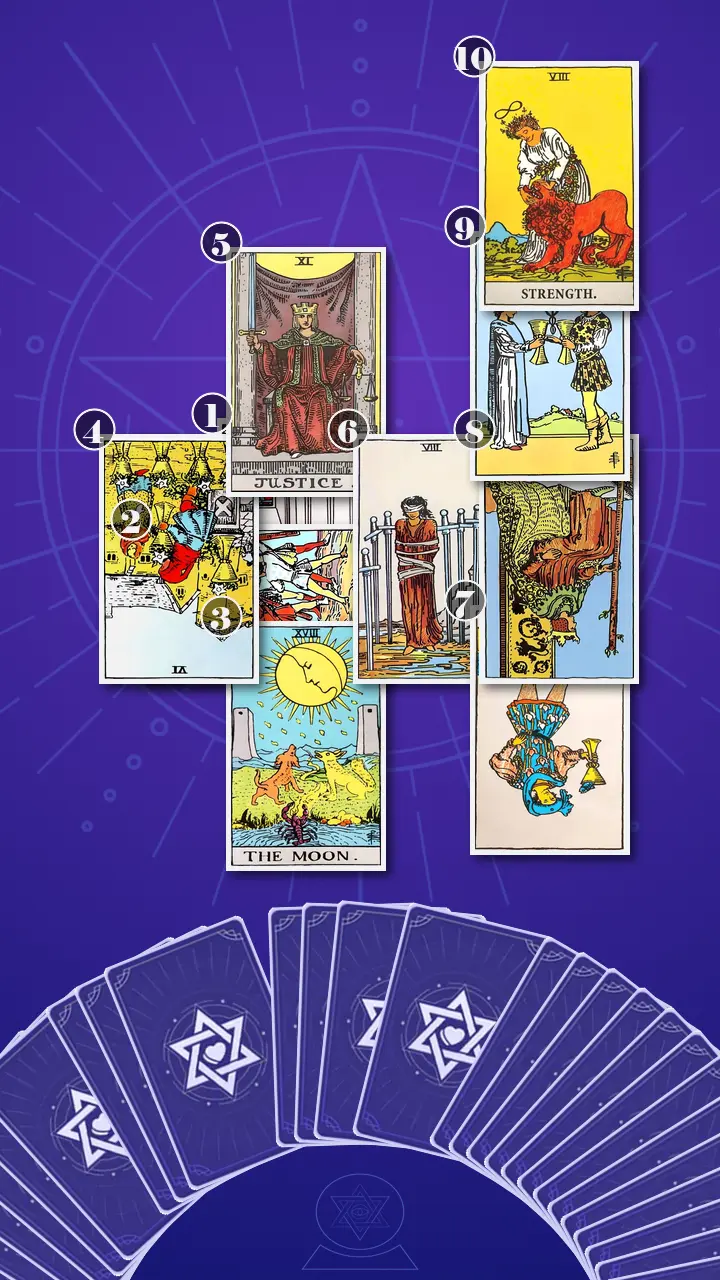
“Today,” I said, “we’re using the Celtic Cross · Context Edition.”
For readers who wonder how tarot works in a situation like this: this spread is useful because it doesn’t just describe the moment you freeze. It links the visible behavior (numbing out) to the hidden driver (the childhood template), then shows the likely next loop (the spiral), and finally gives an integration direction—an embodied practice instead of a fate prediction.
And there’s one key adjustment: the last card isn’t framed as a fixed outcome. It’s framed as Integration, because this question isn’t “Will my friend forgive me?” It’s “What pattern is this—and how do I change it?”
I told Casey what to expect: “The first card anchors what ‘going numb’ looks like in real time. The crossing card shows what makes repair feel impossible to enter. A root card points to the childhood weather underneath. And the final card gives us the healthiest direction to build—like a headlamp on a dark path.”
Reading the Map: From Silence-as-Safety to Words-as-Repair
Position 1: Presenting pattern — what ‘going numb’ looks like in real time
“Now we turn over the card that represents your presenting pattern: what ‘going numb’ looks like in real time when your friend is mad,” I said.
Four of Swords, upright.
This is the card of protective shutdown. The image is containment: a figure lying still, as if retreat is the only safe room left. And there’s that one sword suspended above—like the conversation hovering over you even when you’ve gone quiet.
I translated it into Casey’s exact Tuesday-night behavior: “This is like when you get ‘I’m upset’ and your whole system chooses stillness—phone face down, shoulders tight, thumb hovering. You tell yourself you’re ‘taking space,’ but really you’re trying to make the pain pause.”
Energetically, this is Blockage—not coldness. Your mind and voice withdraw to prevent something: judgment, escalation, abandonment.
Casey let out a short laugh that didn’t reach her eyes. “Okay,” she said, a little bitter. “That’s… brutal. But accurate.”
I didn’t rush to soothe it away. “It’s accurate because it’s intelligent,” I said. “Your nervous system found a way to keep you safe. The question is what it costs you now.”
Then I offered her a phrase I’ve learned to use gently—because it reframes without shaming: “Silence can feel safe—but it can also be a slow leak in the relationship.”
Position 2: Primary tension — what makes repair feel hard to enter or stay in
“Now we turn over the card that represents your primary tension: what makes the repair conversation feel hard to enter or stay in.”
Five of Wands, reversed.
Five of Wands is friction—multiple perspectives jostling for space. Reversed, it’s not clean conflict. It’s conflict energy that can’t move. No room to breathe. No clear point of entry. That’s why you freeze: your system can’t find a safe lane.
In modern life, I told her, it’s like group chat politics: you try to stay “the chill one,” neutral, low-maintenance—until someone calls you out and suddenly you have no language for disagreement that doesn’t feel like a breakup.
Energetically, it’s Deficiency of directness, and Excess of internal pressure. You don’t metabolize tension through a sentence; you metabolize it through avoidance and self-editing.
“So I’m not… bad at conflict,” she said slowly. “I’m just… not entering it?”
“Exactly,” I said. “You’re wrestling a fog.”
Position 3: Childhood-rooted driver — the deeper emotional template under anger
“Now we turn over the card that represents your childhood-rooted driver: the deeper emotional template that gets activated under anger.”
The Moon, upright.
The Moon is not about you being irrational. It’s about ambiguity feeling dangerous—because at some point, it was. The path between the towers isn’t lit by daylight logic. It’s lit by instinct. The body moves first. Words come later, if at all.
I kept it “flashback without details,” because you don’t need to relive a whole childhood to name a pattern: “This card shows unpredictable emotional weather. A child learns, ‘If I misread the room, something bad happens.’ So adult disappointment gets coded as an emergency.”
Casey stared at the card, then blinked hard. Her shoulders rose, held, then dropped a millimeter—like her body recognized itself and didn’t know whether to be relieved or exposed.
“My dad wasn’t… dramatic,” she said. “But when he was mad, he went quiet. Like you could feel it in the house.”
I nodded. “That’s Moon training,” I said softly. “Not loud danger. The kind that makes you scan for threat in silence.”
Position 4: Recent past influence — the old relational script you fall back into
“Now we turn over the card that represents the recent past influence: the old relational script you tend to fall back into when conflict appears.”
Six of Cups, reversed.
Six of Cups is childhood memory and relational templates. Reversed, it often shows “kid logic” spilling into adult rooms. In real life: you hear disappointment and your system reaches for an old tool—staying sweet, staying small, going quiet so nothing gets worse.
I said it plainly, because clarity loves plain language: “This is the younger version of you stepping in. The one who believes: sweetness equals safety. And it worked then. In adult friendships, it can turn into self-erasure.”
Casey’s mouth tightened, not in anger—more like she was holding back the urge to agree too fast. Then she admitted, “I can feel myself getting… overly nice. And then later I’m resentful. Like, ‘Why didn’t I get to say my side?’”
“That resentment is information,” I told her. “It’s the adult you wanting an equal seat at the table.”
Position 5: Conscious aim — what you want to be true about how you handle conflict
“Now we turn over the card that represents your conscious aim: what you want to be true about how you handle conflict and repair.”
Justice, upright.
Justice is where your clarity lives. Scales and a sword: balance and clean language. It’s the part of you that’s tired of mind-reading and ready for terms.
I translated it into a Toronto-2026 communication truth: “This is going from vibes-based communication to receipts-based communication. Still kind. Just grounded. What happened, what you assumed, what you need next.”
Energetically, Justice is Balance. Not over-apology. Not cold detachment. Balanced accountability.
And I let one of the phrases land, because Casey needed it like a handrail: “Accountability isn’t self-erasure.”
Her eyes flicked up to mine—quick, surprised. “I’ve never had that sentence,” she said. “It’s always been like… if I’m accountable, I have to disappear.”
I had an inner flash of my old work on cruise ships: the way we’d calm a tense deck-side dispute between strangers from different cultures. The solution was never “be nicer.” It was structure: pace, clear terms, respectful tone. Justice isn’t a feeling. It’s a framework.
Position 6: Next likely internal loop — what happens if the pattern continues
“Now we turn over the card that represents your next likely internal loop: what tends to happen next if the current pattern stays unexamined.”
Eight of Swords, upright.
This is the blinking cursor trap. It’s the thought: Anything I say will make it worse. The bindings look tight, but they’re loose. The cage feels absolute, but there’s space to step out—one small movement at a time.
I used the scene-class analogy I hear constantly in modern conflict avoidance: “Four of Swords is phone face down—retreat. Eight of Swords is you staring at the cursor like it’s judging you. Trigger → blank → panic math → delay → relief → self-hate.”
Energetically, it’s Excess mental control attempts—trying to solve the whole friendship in one message—paired with a Deficiency of micro-action.
I said the line I wish everyone had tattooed on their Notes app: “Don’t solve the whole friendship. Ask one clear question.”
Casey exhaled through her nose like she’d been holding her breath for the last six positions. A tiny nod. Not fixed. But less trapped.
Position 7: Your stance — how you relate to your emotions and voice inside conflict
“Now we turn over the card that represents your stance: how you relate to your own emotions and voice inside the conflict moment.”
Page of Cups, reversed.
The Page of Cups is vulnerable truth—feelings that show up unexpectedly, like the fish popping out of the cup. Reversed, it’s the moment you dismiss your own feeling as embarrassing, dramatic, or unsafe. You flatten.
In real life, I told her, it’s like you start typing “That hurt me,” then you delete it and replace it with “Totally understand.” Or you send a thumbs-up reaction because it’s not wrong and it ends the moment.
Energetically, it’s Blockage of emotional expression—self-protection that accidentally makes you sound distant.
Casey swallowed. I watched her throat move and thought, There’s the body cue again. “It’s like I’m scared to have feelings in real time,” she admitted.
“Or,” I offered, “you’re scared of what someone might do with your feelings.”
Position 8: Environment — the external climate as you experience it
“Now we turn over the card that represents your external climate as you experience it: what the friendship dynamic is asking you to respond to.”
King of Wands, reversed.
This card can feel like heat without containment: intensity, impatience, a tone that crowds out nuance. Whether or not your friend intends it, your body experiences it as dominating. It makes your freeze more likely.
Energetically, it’s Excess fire in the environment—too fast, too hot—colliding with your Air shutdown. That’s when you start performing the perfect reply instead of pacing the conversation.
I said it directly: “You’re allowed to pace the conversation, not perform it.”
She gave me a look that was half relief, half disbelief—like she’d been waiting for permission that shouldn’t need to be granted.
Position 9: Hopes and fears — what’s truly at stake
“Now we turn over the card that represents your attachment stake: what you most hope for and most fear losing in this rupture.”
Two of Cups, upright.
Two of Cups is mutuality. Equal exchange. Not one person shrinking so the other can stay comfortable. This is what Casey wants beneath the dread: a repair where both people matter.
Energetically, this is Balance in Water—reciprocity, warmth, a relationship sturdy enough to hold disappointment.
“I don’t just want the fight to end,” she said quietly. “I want to still feel… chosen.”
“That’s honest,” I said. “And honesty is where real repair starts.”
When Strength Held the Lion: The Sentence That Changes the Pattern
I let the room get a little quieter before the final card. Outside my window, the city sound softened into a distant hush—like the world stepped back to make space for what mattered.
“Now we turn over the card that represents your integration: the healthiest direction and practice to build a new response pattern,” I said. “This is the headlamp.”
Strength, upright.
Strength isn’t toughness. It’s regulated courage. It’s staying embodied when intensity is present—inside you and across from you. The gentle hands on the lion aren’t yanking or letting go. They’re holding.
And this is where I brought in one of my signature tools—the one I’ve seen change lives on ships, in workplaces, and in friendships: Social Role Switching. “Casey,” I said, “right now your system only knows two modes when someone is mad: Disappear Mode (freeze) or Appease Mode (over-apologize). Strength is a third mode. It’s what I call the Steady Mode: supportive enough to stay connected, assertive enough not to abandon yourself.”
Setup: You see “I’m upset with you” pop up, and suddenly your hands go still. Phone face down. Notes app open. Three drafts later, you’re staring at a blinking cursor like it’s judging you.
Not “I have to go numb to stay safe,” but “I can hold the lion gently and stay in the conversation.”
Reinforcement: Casey’s face changed in layers. First, a freeze—her eyes fixed on the card like she was rereading a message that finally made sense. Then her pupils widened slightly, and her breathing caught for a half-second, the way it does right before tears or anger or both. Her hands—resting on her lap—curled into small fists, then slowly opened, palm by palm, like she was testing whether it was safe to have fingers again. Her shoulders dropped with a tiny tremor, not dramatic, but real. She shook her head once, almost annoyed. “But if I stay,” she said, voice tight, “I could still say the wrong thing.”
I kept my tone calm—Supportive Mode first—then shifted gently into Assertive Mode: “Yes. And saying one true thing doesn’t require a perfect script. It requires pacing.” I paused, letting that settle. “Now, with this new perspective, think back to last week—was there a moment when the tone shifted, and this idea could’ve helped you feel different?”
She stared past me for a second—eyes unfocused, like a memory replaying—then exhaled. “Thursday,” she said. “I could’ve just said… ‘I hear you. Can we talk about one specific moment?’ Instead of disappearing for six hours.”
That was the bridge: from freeze and dread toward uneasy honesty in small doses. From outsourcing safety to the other person’s mood toward a steadier self-respect in repair conversations.
The One-Page Justice Note: Actionable Advice for the Next Text
I pulled the whole spread together for her in one clean story, the way I would brief a crew team before a high-stakes event: Four of Swords shows how silence became safety. Five of Wands reversed shows conflict getting stuck rather than spoken. The Moon and Six of Cups reversed show the childhood weather and kid logic—sweetness, smallness, scanning for withdrawal. Justice shows her adult self craving structure and fairness. Eight of Swords shows the after-freeze cage: the cursor, the mind-reading, the no-win thinking. Strength shows the new practice: hold intensity gently, stay present, say one honest sentence. Two of Cups reminds us why it matters: mutuality, not survival.
“Here’s the blind spot,” I said, because naming it is part of finding clarity: “You’ve been treating your friend’s anger as something you must end immediately to be safe. That turns repair into performance.”
Then I named the direction: “Your shift is this: from trying to end the other person’s anger to naming one feeling and one clear request while staying present. Not louder. Not colder. More honest.”
I offered her a small, practical set of next steps—built from Justice + Strength—and I anchored them in a strategy I’ve used for years across cultures and high-emotion environments: my Maritime Social Protocol. On a ship, you don’t win tension by speeding up. You win by creating a respectful container: pace, clarity, and one doable next move.
- The 90-Second Lion HoldBefore you touch the keyboard: phone down for 90 seconds, feet on the floor, one hand on your chest or throat. Name one body cue (“my throat is tight”) and one feeling-word (“scared,” “overwhelmed,” “sad”).If your brain says “there’s nothing to say,” treat numbness as data—not a verdict. Pick the least dramatic feeling-word that’s still true.
- The Justice Text Template (Fact / Assumption / Request)Open Notes and write three lines: (1) Fact: what happened. (2) Assumption: what you’re telling yourself it means. (3) Request: one specific next step. Then send a container text like: “I want to understand. Can we talk about one moment that bothered you?”Set a 5-minute timer. You’re not writing an essay. One clean message beats a 12-paragraph apology you never send.
- A Ready-to-Use Script for When Intensity SpikesIf the tone feels too hot, switch into Assertive Mode with a slow, simple line: “I’m here, and I want to work through it. I need us to slow down so I can respond clearly.” If you’re flooded, send a time-bound pause: “I want to respond well—can I get back to you by 7pm?”Practice it once in a voice memo so your body recognizes the cadence. You’re building a new reflex.

A Week Later: The Quiet Proof
A week later, Casey messaged me—not a long update, just a screenshot and a sentence: “I did the 90 seconds. My throat was tight. I wrote one line. I sent it.”
Her text to her friend was simple and almost boring in the best way: I hear you. I’m feeling overwhelmed, and I want to understand—can we talk about one specific moment?
She told me the conversation wasn’t perfect. She still felt shaky afterward. But she didn’t disappear. And when she went to bed that night, she slept—then woke up with the first thought still being, What if I did it wrong? Only this time, she exhaled and thought, But I stayed.
That’s the Journey to Clarity I care about: not predicting a friendship’s fate, but watching someone move from a blank mind and a tight throat toward grounded communication—one paced, present sentence at a time.
When someone’s upset, it can feel like your whole belonging is on trial—so you go quiet not because you don’t care, but because you’re trying not to lose the relationship by being ‘wrong’ in real time.
If you didn’t have to earn safety by disappearing, what’s one honest sentence you’d be willing to try the next time the tone shifts?
Every reading at AceTarot is a Journey to connect with inner wisdom and empower next step.
Learn more about our Journey to Clarity.