The Delta-App Refresh Loop That Shifted Into a Two-Sentence Boundary

Finding Clarity in the iMessage Draft Olympics
You’re a late-20s NYC professional who can book a flight in 90 seconds, but needs three hours to answer one “Send me your itinerary” text—classic parent–adult child boundary guilt.
Alex (name changed for privacy) sat down across from me and didn’t even take her coat fully off, like her body still expected a follow-up notification to hit. “It’s not even a huge ask,” she said, but her voice had that careful tightness people get when they’re trying to sound reasonable while feeling cornered.
As she described it, I could see the scene without trying: 11:38 PM on a Thursday, in a Brooklyn studio with the radiator hissing—her lying on top of her comforter, phone screen warm in her palm, flipping between the Delta app and a half-written iMessage. Blue light sharp in her eyes. The room faintly sour-sweet with old takeout containers. Her chest tightening as she typed “Of course—” and then backspaced. Her thumb hovering like she was about to ask permission.
“My mom wants my flight info,” she said. “Like, flight number, times, sometimes my seat. She says it’s ‘just for safety.’ And I get it. But I don’t want to feel tracked. If I say no, it turns into a whole thing. If I say yes, I’m mad at myself for days.”
Guilt sat in her body like a strap pulled too tight across her chest—tight enough that even breathing felt like agreeing to something.
I nodded and let that land. “We’re not here to prove you’re a good daughter,” I said, gentle but direct. “We’re here to find a safety boundary you genuinely consent to—one that protects your autonomy and keeps the relationship from turning into a recurring negotiation. Let’s draw a map through this fog and get you to clarity.”

Choosing the Compass: A Relationship Spread for Family Boundaries
I asked Alex to take one slow breath before we touched the cards—not as a mystical ritual, but as a nervous-system handoff. The body can’t set clean boundaries while it’s bracing for impact. I shuffled slowly, the way I used to on transoceanic voyages when anxious travelers asked me to “just tell me what happens.” The point was never prediction. The point was orientation.
“For this,” I said, “I’m using a Relationship Spread—a simple relationship tarot spread for communication dynamics and boundaries.”
For readers who wonder how tarot works in a situation like this: this is the smallest structure that still separates two viewpoints (you vs. your mom), names the repeating loop you keep getting stuck in, and then shows both the resource you can lean on and the emotional blockage that keeps the issue feeling bigger than a flight number. It’s a boundary-focused relationship spread—less about “what will she do,” more about “what’s the pattern, and what are the next steps?”
I pointed to the layout. “The first card is you—what happens in the first ten minutes after her request hits your phone. The second is your mom—what she’s trying to accomplish from her perspective. The center is the shared family script. Then we’ll look at what can help you hold a middle-way boundary, what binds you with guilt, and finally, the cleanest way to respond.”
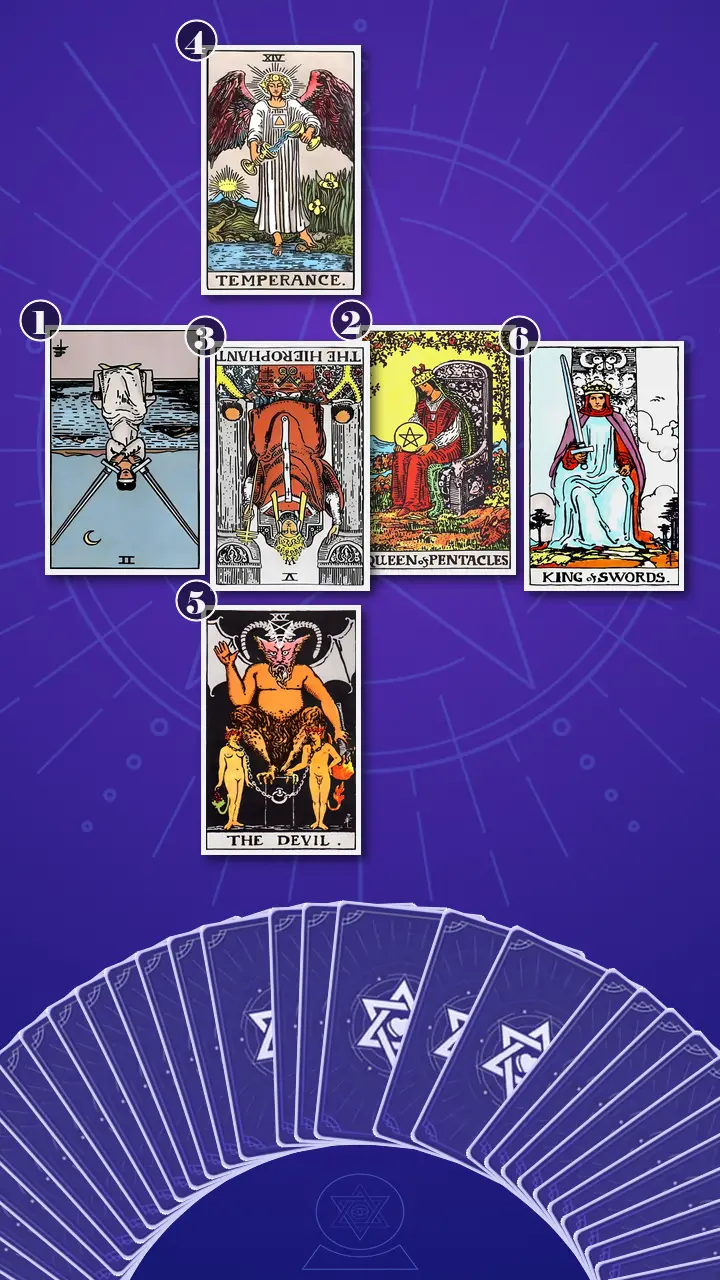
Drafts in the Dark: Reading the First Three Cards
Position 1 — Alex’s current boundary posture
“Now flipped over,” I said, “is the card representing Alex’s current boundary posture: what you are doing (or not doing) right now when the request comes in.”
Two of Swords, reversed.
“This is like,” I told her, “it’s 11:40 PM and you’re doing the iMessage Draft Olympics: you paste the flight number, delete it, add three ‘I totally get it’ disclaimers, then don’t send anything. You’re not choosing a boundary—you’re trying to engineer a zero-conflict outcome, and the indecision is quietly exhausting you.”
Reversed, this card isn’t calm restraint—it’s blocked Air: the mind spinning, drafting, rehearsing, trying to predict her reaction before you say one sentence. The energy is a stalemate that’s started to leak. You either over-share to end the discomfort, or you freeze and delay until it explodes later.
I watched her jaw flex when I said it. Then she gave a small laugh that had no humor in it. “That’s…,” she said, and swallowed. “That’s too accurate. Like, it’s almost mean.”
I kept my voice warm. “You don’t need a dissertation to have a boundary.”
Her eyes dropped to the card. Her fingers worried the edge of her sleeve, then went still—like her body was realizing it had been gripping something for hours.
Position 2 — Mom’s current stance
“Now flipped over,” I said, “is the card representing your mom’s current stance: what her request is trying to accomplish from her perspective.”
Queen of Pentacles, upright.
“From her side,” I said, “details are a comfort object. She isn’t picturing your autonomy—she’s picturing worst-case scenarios and trying to calm her nervous system with something concrete: a flight number, a time stamp, a plan. It’s care expressed as logistics, not necessarily a desire to micromanage.”
This is Earth energy in balance—nurturing, practical, protective. The shadow here isn’t evil. It’s that Earth can reach for the tangible when the intangible is scary. If she can hold the facts, she can hold the fear.
Alex’s shoulders dropped a millimeter. “That’s… fair,” she admitted. “I don’t think she’s trying to ruin my life. I just don’t want to feel like I have to report in.”
Position 3 — The shared script between you
“Now flipped over,” I said, “is the card representing the shared script: the unspoken rule that defines how ‘safety’ and ‘authority’ are handled between you.”
The Hierophant, reversed.
“This is the inherited policy nobody remembers writing, but everyone still follows,” I told her. “The conversation slips into an old script: ‘Parents ask, kids comply.’ ‘For safety’ becomes the trump card that ends the discussion, and suddenly you’re arguing like you’re requesting permission to travel instead of stating how you communicate as an adult.”
I leaned forward slightly. “And here’s the reframe that matters: ‘Safety’ isn’t a free pass to bypass consent. Not in romantic relationships, not in friendships, and not in families.”
She blinked, like the sentence had turned the room’s lighting up a notch. “That’s exactly it,” she said, quieter. “It’s like ‘for safety’ means I can’t say no.”
“That’s the Hierophant’s shadow,” I said. “Access granted by authority instead of chosen by agreement.”
When Temperance Spoke: Mixing Care With Consent
Position 4 — What can help (Key Card)
I paused before turning the next card. The radiator in my studio clicked, then went quiet. “We’re flipping the core of this reading,” I told her. “The resource that makes a middle-way possible.”
“Now flipped over,” I said, “is the card representing what can help: the relationship strength or resource that allows a middle-way boundary.”
Temperance, upright.
“This is the negotiated bridge,” I said. “You propose: ‘I’m not sharing flight numbers, but I will text when I land and when I get to my hotel.’ It’s not a compromise that drains you; it’s a balanced plan you can repeat. You’re mixing care and privacy in a ratio you can actually live with.”
Temperance is balanced integration. Not excess, not deficiency. A steady pour between two cups. One foot on land, one in water—one foot in care, one foot in privacy.
Alex’s first reaction wasn’t relief. It was resistance—quick, sharp. “But if I offer that,” she said, voice rising, “isn’t that basically admitting she was right to ask?”
I didn’t flinch. “No,” I said. “It’s you deciding what you consent to—because you want to live with it, not because you’re being pressured. That’s adulthood. You can offer reassurance without surrendering access.”
This is where I used one of my own lenses—what I call Generational Echo Mapping. Growing up around the Venetian canals, you learn quickly how sound travels: a shout becomes an echo, an echo becomes a chorus, until you can’t tell which voice is yours.
“Listen,” I told her, “to the echo in this dynamic. Your mom’s anxiety hits the water, it bounces off old family walls, and it comes back to you as: ‘Prove you’re safe.’ Your nervous system hears that echo as: ‘Earn your belonging.’ Temperance is you changing the acoustics—so the message becomes adult-to-adult: ‘We agree on what safety communication looks like.’”
Her mouth opened, then closed. She stared at the angel pouring between cups like it might finally explain her whole week.
Here was the setup, the familiar loop: she was back in that late-night spiral—airline app open, iMessage draft half-written, chest tight—trying to write the one message that won’t make her worry and won’t make her feel tracked.
Stop treating this like a yes-or-no loyalty test, and start mixing care with consent—like Temperance, you decide the ratio that keeps you steady.
The sentence hung in the air. Alex’s body did that three-step micro-shift I’ve seen thousands of times—on ships, in offices, in therapy rooms. First: a tiny freeze, her breath stopping halfway in. Second: her gaze went unfocused for a beat, like a memory replaying—the “just for safety” text, the heat in her face, the draft she never sent. Third: a slow exhale that seemed to come from behind her ribs, and her shoulders dropped like someone had finally put down a heavy bag she didn’t realize she’d been carrying.
“Wait,” she whispered, and her eyes went wet, annoyed at themselves. “So it’s not… I’m not choosing between being cruel and being tracked.”
“Exactly,” I said. “This is you moving from guilt-driven over-explaining and vigilance to grounded confidence in an adult safety plan with clear consent. Not perfect confidence—just enough to send the text.”
I tapped the table lightly. “Now—use this new lens and think back to last week. Was there a moment when this would’ve changed how you felt?”
She nodded immediately. “Sunday. JFK. She called twice. I caved and turned on Find My for ‘just the day.’ I hated it.”
“Temperance would’ve offered you a third option,” I said. “A check-in plan is not the same thing as access.”
Then I gave her the reinforcement practice, simple and concrete. “Do a seven-minute Two-Sentence Script draft,” I said. “One sentence stating what you won’t share. One sentence offering a specific check-in you will do. Read it out loud once. If your chest tightens, we shorten it—we don’t justify it. The goal is clarity, not forcing yourself through panic.”
Position 5 — What binds you (the guilt-chain)
“Now flipped over,” I said, “is the card representing what binds you: the main challenge that makes the boundary hard to hold without guilt or escalation.”
The Devil, upright.
“This is the sticky part,” I said. “The guilt chain: the fear that if you don’t comply, you’ll be labeled selfish, unsafe, or ungrateful—and that label will cost you closeness. So you either hand over too much to buy peace, or you freeze and delay until it becomes a bigger blow-up. Either way, your privacy becomes the price of belonging.”
I framed it the way her nervous system would recognize. “It’s like a subscription you forgot you signed up for,” I told her. “Quietly draining you every month.”
And I let both tracks speak, because that’s how it feels: Track A says, It’s fine, it’s just a flight number. Track B says, Why do I feel owned?
“If the only way to keep peace is to give up privacy, that peace is expensive,” I said.
Alex swallowed hard. Her fingers gripped her water glass, then loosened. “I’ve never had words for that,” she said. “But yes.”
“And notice the chains in the card are loose,” I added. “You technically can stop. Your nervous system just doesn’t believe you can—yet.”
Position 6 — How to respond (the clean next step)
“Now flipped over,” I said, “is the card representing how to respond: an actionable boundary and communication style you can use next time.”
King of Swords, upright.
“This is the copy/paste policy,” I told her. “A clear out-of-office message. A seatbelt click. Calm, direct, repeatable.”
King of Swords is Air energy in balance: clarity without hostility. Structure without coldness. It says: don’t debate your adulthood. State your terms.
“Clarity is kinder than constant negotiation,” I said, watching her face soften as if her jaw finally got permission to unclench.
She hesitated, then gave me the real-world obstacle—practical, messy, honest. “But I can’t just stop responding,” she said. “If I don’t answer, she’ll call. Then she’ll text my aunt. Then it’s a group chat thing.”
“Good,” I said. “That’s not you being dramatic. That’s the system.” I paused, then gave her a coaching adjustment. “So we build a boundary that accounts for escalation. You don’t have to disappear. You just have to stop adding information under pressure.”
The Two-Sentence Script and the Bollard Line
I pulled the whole story together for her in plain language: the Two of Swords reversed showed the draft-loop paralysis and over-explaining reflex; her mom’s Queen of Pentacles care wanted something tangible to hold; the Hierophant reversed revealed the outdated family Terms of Service where “for safety” equals authority; Temperance offered the bridge—care mixed with consent; the Devil named the emotional fee; and the King of Swords gave us the repeatable boundary language.
The blind spot, I told her, was this: she was treating her boundary like a courtroom argument—if she could just present enough evidence, she’d be “allowed” to have privacy. But the transformation direction was cleaner: move from over-explaining and negotiating your privacy to stating a clear boundary plus one concrete alternative safety practice you genuinely consent to.
I used one of my favorite boundary tools from the Venetian docks—my Bollard Marking Method. A bollard is the piling you tie a boat to; it’s not there to punish the water. It’s there so the boat doesn’t drift into chaos when currents change.
“We’re going to mark your bollards,” I said. “So you have a line you can tie to when her anxiety surges.”
- Write your Travel Check-In Plan (7 minutes)In your Notes app, create a reusable draft titled “Travel Check-In Plan.” Two sentences only: (1) what you won’t share (e.g., flight number / seat / real-time location), (2) what you will do (e.g., text when you land + when you arrive at your hotel).If you feel the urge to add a paragraph, that’s the Two of Swords loop. Keep it to two sentences—then stop.
- Mark your bollards: 3 No’s + 2 Yes’sMake a quick “privacy line” list: 3 items you do not share (flight number, seat, live location) and 2 items you’re okay sharing (city + “landed” text, hotel name after you arrive).Think of it as a consent-based safety plan: predictable and boring on purpose. Boring is stable.
- Repeat once, then pauseIf she pushes back, repeat the same two sentences once—no new details. Then take a 30-minute break before replying again (even if she escalates).If your chest gets tight, regulate first and reply second. Warm tone, identical content.

A Week Later: The Quiet Proof
A week later, Alex texted me a screenshot—not of a boarding pass, not of a flight number. It was her Notes app. Title: “Travel Check-In Plan.” Two sentences. Clean. Almost boring.
“I sent it,” she wrote. “She didn’t love it. But I didn’t spiral. And I didn’t turn on location sharing. I still felt shaky after… but then I slept.”
In my mind, I saw the bittersweet kind of victory that actually lasts: she slept through the night, but in the morning her first thought was still, What if I handled it wrong?—and then, just as quickly, she breathed out and thought, No. I handled it like an adult.
This is what a Journey to Clarity often looks like in real life: not a magical resolution, but a new structure—care without surrendering autonomy, and a check-in plan that doesn’t become access.
When a “just for safety” text hits and your chest tightens, it’s not only about the flight—it’s the split-second panic that saying no might cost you love, even when you’re just asking for adult privacy.
If you didn’t have to earn “good daughter” points, what’s one small safety check-in you’d actually choose—just because it feels aligned for you?
Every reading at AceTarot is a journey to connect with inner wisdom and empower your next step. The stories shared here are psychological mirrors, not private records—crafted to reflect universal emotional loops and help you find your own clarity. Learn more about our Journey to Clarity.