When Mom Texts “Are You Free?”: Trade Excuses for a Boundary Sentence

Finding Clarity in the “Are You Free?” Buzz
You see “Are you free?” from your mom and your body answers before you do—tight throat, braced stomach, and an instant “I’m busy” draft (hello, people-pleasing boundaries).
Taylor (name changed for privacy) settled into the chair across from me like she’d been holding her breath since the elevator. She was twenty-seven, Toronto-based, the kind of early-stage marketing coordinator who lives inside a blur of Slack pings and “quick questions,” and whose personal time already feels like something she has to guard with her elbows.
She described it like a timestamped clip she could replay on demand: Sunday night, 8:41 PM. Sweatpants. Laptop half-open to Monday’s deck edits. The condo kitchen light too white, the HVAC hum making the room feel thin. Her phone buzzed on the coffee table—Are you free?—and her thumbs started typing before her mind had even finished reading.
“It’s like… I don’t even know what she wants yet and I already feel guilty,” she said, looking at her own hands like they were the ones betraying her. “So I lie. I say I’m busy. Then I’m patching it with follow-ups and I feel gross. But if I say ‘not free,’ it feels like I’m breaking a rule.”
The guilt wasn’t abstract on her. It sat in her throat like a tight collar, and in her stomach like she’d braced for a drop that never came—like standing under a doorframe during an earthquake drill, waiting for impact that might not happen.
I nodded, slow and steady, the way I do when someone’s nervous system is already sprinting. “We’re not here to label you a good or bad daughter,” I told her. “We’re here to understand why your body goes into panic-lawyer mode over one text—and to find a truthful, workable response that doesn’t cost you your autonomy. Let’s treat this as a Journey to Clarity: we’ll map what happens, why it happens, and what your next clean step is.”

Choosing the Map: The Transformation Path Grid (6) · Context Edition
I invited Taylor to take one slow inhale and one longer exhale—not as a ritual for luck, but as a gear shift. Then I shuffled until the sound of the cards softened into something even, like distant rain.
“Today, we’re using a spread called the Transformation Path Grid (6) · Context Edition,” I said.
For you reading along—this is one of my go-to layouts for repeating micro-events that hijack your whole week: a text, a ping, a vague request that becomes a full-body response. The grid is simple on purpose: situation → obstacle → root → catalyst → action → integration. It separates what’s happening on your screen from what’s happening in your learned family wiring, so you can change the behavior without turning it into a trial against your mom.
I pointed to the top row. “These first three cards tell us: what you do in the first 30 seconds, what thought-trap squeezes your options, and what older rule is driving the guilt.” Then I tapped the bottom row. “These next three show the pivot: the principle that interrupts the loop, the exact communication move to practice, and what this can feel like once your nervous system learns the new rhythm.”
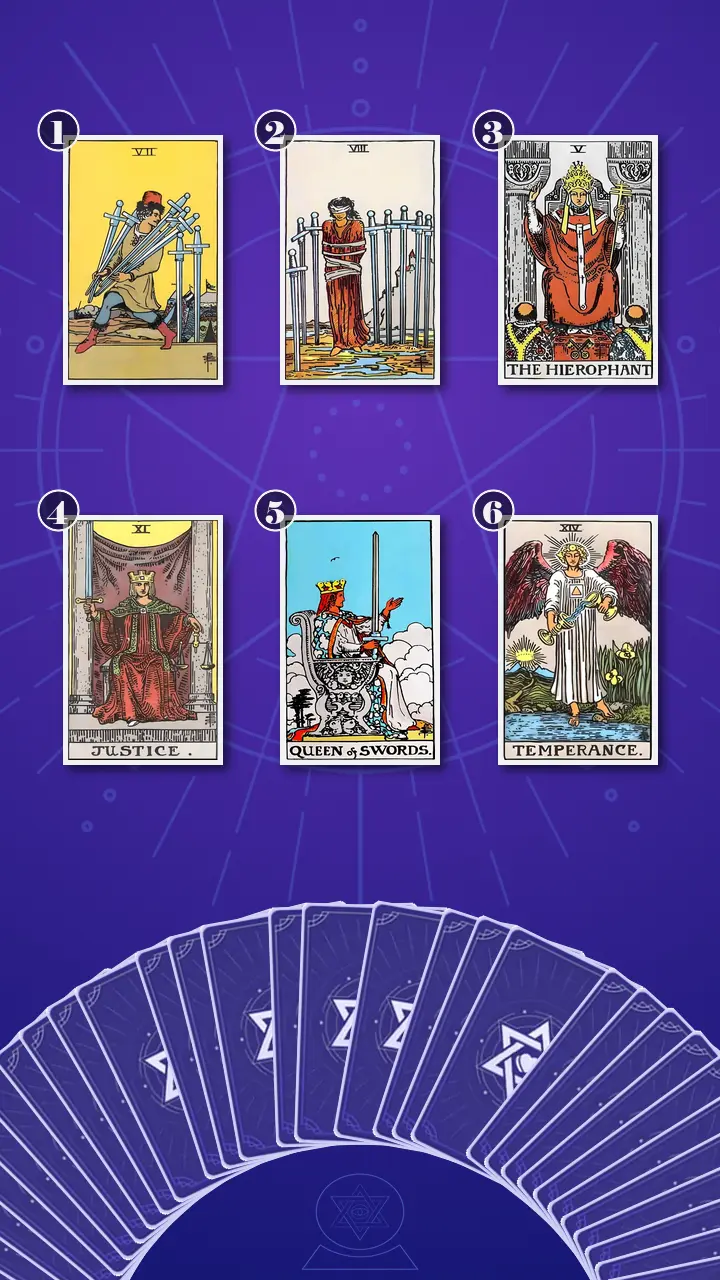
Reading the Map: Card Meanings in the Texting Moment
Position 1: Presenting pattern — the first 30 seconds after “Are you free?”
“Now turning over, is the card that represents your presenting pattern: the specific behavior you do in the moment you receive ‘Are you free?’,” I said.
Seven of Swords, upright.
“This is the card of the quick exit,” I told her, keeping my voice plain. “Not evil. Not malicious. Strategic.”
I used the translation that always lands with people who live in iMessage threads: You reply fast with “I’m busy” (or a half-truth), not because it’s the cleanest truth but because it’s the quickest exit. Then you keep your phone close, re-opening the thread to see if she’s typing, ready to add details to make the excuse believable.
“Your independence is being protected through stealth,” I said, “and the cost is self-trust. It’s like technical debt—your system runs today, but you pay interest later in follow-up questions and mental rehearsals.”
Energetically, Seven of Swords is Air in excess but pointed sideways—cleverness used to avoid contact. The mind is working overtime, but not in service of clarity. It’s in service of escape.
Taylor let out a small laugh that had a sharp edge to it—bitter, not amused. “That’s… so accurate it’s kind of rude,” she said, then immediately covered her mouth like she’d been impolite to the card.
I smiled gently. “It’s not rude. It’s just specific. And specificity is how we get out of loops.”
Position 2: Main blockage — the thought-trap that makes honesty feel unsafe
“Now turning over, is the card that represents your main blockage: the thought-trap or pressure that makes honesty feel unsafe in that texting moment,” I said.
Eight of Swords, upright.
“This one is the ‘no good options’ feeling,” I said, and I watched her shoulders rise a fraction before she even agreed with me—like her body was rehearsing the trap.
In modern life terms: You look at ‘Are you free?’ and instantly feel trapped between two extremes: say yes and lose your night, or say no and be ‘the worst.’ Your brain narrows reality into a binary, so lying starts to feel like the only door that opens.
I gave her the scene analogy the card always carries: “Your phone screen becomes a tiny courtroom where you’re both defendant and defense attorney.” Then I spoke the loop out loud, tight and fast, the way her nervous system ran it: “If I say no, she’ll think I don’t care, and then I’ll be selfish. If I say yes, I’ll resent it. If I lie, at least I get relief.”
That’s Air in blockage—thoughts stacking like swords, not cutting a path. “The card’s blindfold matters,” I said. “Because the message is asking a question. Your brain is acting like it’s issuing a verdict.”
Taylor went quiet. Her eyes stayed on the card, but her focus slipped past it like she was replaying a specific TTC ride home. Her breath paused, then restarted. Then—barely—her shoulders dropped. A soft, surprised “oh” escaped her like it didn’t ask permission.
“Yeah,” she whispered. “It really does feel like a verdict.”
Position 3: Root driver — the inherited rulebook underneath the guilt
“Now turning over, is the card that represents your root driver: the internalized rule, loyalty script, or fear underneath the guilt response,” I said.
The Hierophant, upright.
“This is the family Terms & Conditions you never agreed to,” I said, and she flinched like I’d read something private off her lock screen.
In her life: Under the panic is an internal rulebook that sounds like: ‘Good daughters show up. Good daughters don’t disappoint. Good daughters explain.’ Even though you’re 27 and independent, the old authority voice still treats your availability like a moral duty.
Energetically, The Hierophant is structure in excess—rules that once kept belonging predictable, now squeezing adult reality. “This is why the little buzz of the phone feels like someone raising a hand in blessing,” I told her. “Like you’re waiting for permission to be unavailable.”
Taylor’s eyes went glossy, but she didn’t cry. She pressed her tongue to the back of her teeth, then exhaled through her nose—an almost-cry turned into a controlled breath. “I hate that it still works on me,” she said. “Like I’m… still waiting to be graded.”
“I don’t hear failure in that,” I replied. “I hear conditioning. And conditioning can be updated.”
As someone who’s spent ten years guiding people under a planetarium dome in Tokyo, I’ve watched a thousand faces tilt up at the stars and feel small—and then relieved—because the sky has rules. Not moral rules. Motion rules. You can’t argue with an orbit, but you can learn it. Family systems can be similar: they have gravity. The question isn’t whether gravity exists. It’s whether you’re allowed to choose your distance.
When Justice Spoke: The Calendar Screenshot Pivot
Position 4: Catalyst — the principle that interrupts the loop without escalating conflict
I let the room get a little quieter before I flipped the next card. Even the HVAC hum felt like it leaned back. “We’re turning over the catalyst now,” I said. “This is the lever.”
“Now turning over, is the card that represents your catalyst: the principle or insight that can interrupt the lie-guilt loop without escalating conflict,” I said.
Justice, upright.
I pointed at the scales and the sword. “This is precision plus fairness,” I said. “Not harshness. Not punishment.”
In her actual texting moment: You pause long enough to consult reality—your calendar, your energy, your actual plans—then you answer like your time counts. Not with an excuse, not with a negotiation: ‘I’m not free tonight.’ You let that be the whole message.
Justice is Air in balance—words aligned with facts. “A clean ‘not free’ is not a character statement,” I said. “It’s a calendar statement.”
Then I brought in my own lens—the one I use when family gravity starts masquerading as moral law. “In my work, I use what I call Galactic Gravity Analysis,” I told her. “Think of your mom’s needs and expectations like a planet’s pull. Gravity isn’t ‘bad.’ It’s just force. But if you orbit too close, you burn up. If you orbit too far, you lose connection. Justice is you choosing an orbit that doesn’t require stealth. You don’t have to fight gravity. You adjust distance with one truthful sentence.”
Her jaw tightened as if to protest—and here came the setup, exactly as her body lived it: she sees “Are you free?” on her lock screen, and her thumbs start writing an excuse before she’s even decided what she wants—like her body is trying to outrun the guilt.
Stop negotiating with guilt and start answering with integrity—let the scales of Justice weigh your real capacity, then let the sword deliver a simple truth.
There was a pause after I said it, the kind that feels like the air is holding a sentence up for you to look at from all sides.
Taylor’s reaction came in a chain—three small steps that told me the card had landed where it needed to. First, she froze: breath caught, fingers hovering over the edge of her mug like she’d just seen a typing bubble appear. Then her eyes unfocused, not blank—replaying. You could almost see the Sunday night coffee table and the warm phone screen. Finally, her shoulders sank, and a long exhale left her chest like she’d been carrying a backpack she forgot she put on.
“But if I do that,” she said, and the words came out with a flash of irritation she didn’t expect, “doesn’t it mean I’ve been doing it wrong this whole time? Like I’ve been… manipulating the situation?”
I didn’t rush to reassure her. I kept my tone steady—warm, but not slippery. “It means you’ve been surviving a rulebook,” I said. “Seven of Swords is a coping skill you learned because Eight of Swords convinced you honesty was unsafe. Justice isn’t here to shame you. It’s here to make your life cheaper—less mental interest, less patching, less improvising.”
I asked her softly, “Now, with this new lens, can you think of one moment last week when a single clean sentence would have changed how your body felt—even if you still felt discomfort?”
Taylor swallowed. Her throat worked like she was unclipping something. “Tuesday on the TTC,” she said. “I wrote this whole thing about meetings. But the truth was… I wanted one quiet night. I could’ve just said, ‘Not tonight.’”
That was the pivot in real time: from guilt-driven bracing and excuse-making to integrity-based boundaries with steadier self-trust. Not perfection. Not a personality makeover. A new job description for her words.
The Queen’s Template: Boundaries Without Cruelty
Position 5: Actionable next step — the communication move to practice this week
“Now turning over, is the card that represents your actionable next step: a realistic boundary-and-communication move you can practice this week,” I said.
Queen of Swords, upright.
“This is the card of fewer words, not sharper vibes,” I said. “It’s clarity without punishment.”
In her phone-native reality: You adopt a texting style that’s kind and minimal. You send a short boundary and, only if you truly want to, a real alternative: ‘Not free today. I can do a quick call Saturday afternoon.’ Then you stop yourself from writing a paragraph to prove you’re still a good person.
Queen of Swords is Air in strength—direct, respectful, not defensive. “Over-explaining is just people-pleasing in paragraph form,” I added, because I could see her brain already trying to draft the five-paragraph version.
I gave her a tiny scene to anchor it: elbows on the kitchen counter between meetings, Slack stacking, iced coffee melting. “You type one calm line. You reread once. Then you hit send and put the phone face down. Not as punishment—just so you stop refreshing the thread like you’re monitoring a patient.”
Taylor nodded slowly. Her shoulders didn’t rise this time. Her mouth pulled into a small, reluctant smile—like she was realizing the template sounded like an adult she actually wanted to be.
Temperance Weeks: A Sustainable Rhythm With Your Mom
Position 6: Integration — what it feels like when the new pattern settles over time
“Now turning over, is the card that represents your integration: what a healthier, more sustainable relational dynamic feels like when practiced consistently,” I said.
Temperance, upright.
“This is the middle path,” I said. “Not total availability. Not total shutdown.”
In lived experience: Instead of swinging between over-giving and disappearing, you build a steadier rhythm: one clear no when you’re not free, one genuine yes when you actually want to, and one alternative that doesn’t drain you. Your nervous system learns that honesty doesn’t automatically equal catastrophe.
Temperance is regulation and pacing. It’s the angel pouring between cups—the exact opposite of the adrenaline spike that turns a text into a crisis. “You’re learning to blend autonomy and care,” I told her. “Like mixing two things that used to feel mutually exclusive.”
The One-Page “Justice Text” Plan: Actionable Advice for People-Pleasing Boundaries
I leaned back and traced the story the grid had told us, left to right like a storyboard. “Here’s why this keeps happening,” I said. “Seven of Swords is your fast escape—an excuse that buys immediate relief. Eight of Swords squeezes your perception into two bad doors, so the escape feels necessary. The Hierophant is the hidden engine: the ‘good daughter’ Terms & Conditions that treat availability like morality. Justice interrupts it with evidence—your real capacity—and one clean sentence. The Queen gives you reusable wording. Temperance turns it into a livable rhythm.”
“The blind spot,” I added, “is that you’ve been treating ‘not free’ like a statement about your heart. Like it proves you’re unloving. But it’s not. It’s a statement about your schedule and your nervous system. The transformation direction is simple but not easy: shift from managing your mom’s feelings with a story to managing your own boundaries with a clear, truthful sentence.”
Then I gave her the smallest next steps—low drama, high repeatability. Not a family summit. Not a perfectly worded manifesto. Just reps.
- Send one “Justice sentence” this weekThe next time you’re not available, text: “I’m not free tonight.” (One sentence. No reason. No backstory.)It may feel “mean” for 30 seconds. Treat that as a nervous-system alarm, not a moral verdict. If you want to lower the difficulty, practice the sentence in Notes first.
- Use the Calendar Evidence MethodBefore you reply, open your calendar for 10 seconds (or take a quick screenshot). Answer from reality—what your time and energy can actually hold—rather than imagined judgment.Tell yourself: “Not free is a fact.” You’re not building a case; you’re stating capacity.
- Phone-face-down 10-minute resetAfter you hit send, place your phone face down for 10 minutes. No refreshing the thread, no monitoring the typing bubble, no drafting follow-up defenses.If anxiety spikes, do a 60-second check: jaw, throat, stomach. Name what’s tight without fixing it. Then come back only when you can breathe.
As a bonus—if she wanted a conflict de-escalation tool, not just a boundary—this is where I sometimes borrow from my Solar Eclipse Mediation approach: (1) state reality (“Not free tonight.”), (2) name care without bargaining (“I love you.” / “I hear you.”), (3) offer a specific alternative only if it’s genuine (“I can do Saturday afternoon.”). Like an eclipse, it’s not about erasing the relationship; it’s about changing what’s in shadow and what’s visible—without panic.

A Week Later: The Quiet Proof
A week later, Taylor messaged me a screenshot—not of her mom’s reply, but of her text. Three words, no explanation: “Not free tonight.” Under it, a small note: “My jaw clenched, but I didn’t add a paragraph. I put my phone down. I ate my takeout while it was still hot.”
It wasn’t a Hollywood ending. It was better: a real rep. A tiny proof that her autonomy didn’t need stealth, and her belonging didn’t have to be purchased with a story.
When that “Are you free?” text hits and your throat tightens, it’s not just about tonight—it’s the old fear that a simple ‘no’ could make you look unloving, even when you’re just tired and human.
If you didn’t have to earn your belonging with a story, what’s the smallest truthful sentence you’d be willing to send next time—just to see how it feels in your body?
Every reading at AceTarot is a journey to connect with inner wisdom and empower your next step. The stories shared here are psychological mirrors, not private records—crafted to reflect universal emotional loops and help you find your own clarity. Learn more about our Journey to Clarity.