Deposit Due Tonight—And the Two-Sentence Text That Ended the Spiral

Finding Clarity in the “Deposit Due Tonight” Ping
You’re the friend who opens five hotel tabs, reads every cancellation policy, and still can’t hit “Confirm” because the real fear isn’t the price—it’s being seen as high-maintenance.
Jordan (name changed for privacy) appeared on my screen from their Toronto kitchen, hoodie on, hair still damp like they’d showered to reset their nervous system and it didn’t fully work. A kettle clicked off behind them. The overhead light was off, but the phone glow lit their face in that late-evening way that makes everything feel a little more urgent than it is.
They tilted their phone toward the webcam. In the group chat: “Deposit due tonight—who’s sharing with who?”
“I keep bouncing between Booking.com and this,” they said, thumb hovering like the screen might bite. “I don’t want to make it weird, but I also don’t want to hate my life in a cramped room.”
I watched their breath catch—small, high in the chest—like their body was bracing for impact, not for a vacation deposit. Pressure can look like a tight chest and keyed-up energy, but it feels like trying to breathe through a scarf that keeps tightening every time your phone buzzes.
The contradiction was already fully alive in the room with us: wanting to save money and keep things easy versus fearing you’ll lose privacy, comfort, and emotional safety if sharing goes sideways. And the deadline turned it into a pressure cooker.
“We’re not here to force a ‘perfect’ answer,” I said gently. “We’re here to make it clean. A decision you can respect, and a message you can actually send. Let’s try to draw a map through the fog.”

Choosing the Compass: The Pros & Cons Tarot Spread
I asked Jordan to put one hand on their chest for a moment—not as a mystical ritual, just a nervous-system check-in. “Notice what happens in your body when you imagine hitting ‘Pay deposit’ for each option,” I said. “No judging. Data.”
Then I shuffled slowly at my desk. Behind me, my perfume organ—rows of small bottles and blotter strips—sat like a quiet reminder of my other life. In perfumery, you don’t get clarity by thinking harder. You get it by testing, comparing, and naming what’s actually there.
“Today I’m using a classic decision layout called the Pros & Cons spread,” I told them, and also, in my head, the reader who might be searching Pros and Cons tarot spread for a decision with two options at 1 a.m.
This spread works especially well for a time-sensitive choice like “Trip deposit due—share a room with them or book solo?” because it doesn’t pretend we’re predicting the trip. It does something more useful: it clarifies the tradeoffs—money, privacy, social ease—and it forces an integration card at the end. In other words: not vibes-only. Terms and reality.
“Card 1 shows what’s making this feel urgent and mentally sticky right now,” I said. “Then we’ll look at what you truly gain—and what gets harder—if you share. Same for booking solo. And the final card is the guidance that ties it all together: the fairest way to decide and communicate before anyone hits ‘Pay now.’”
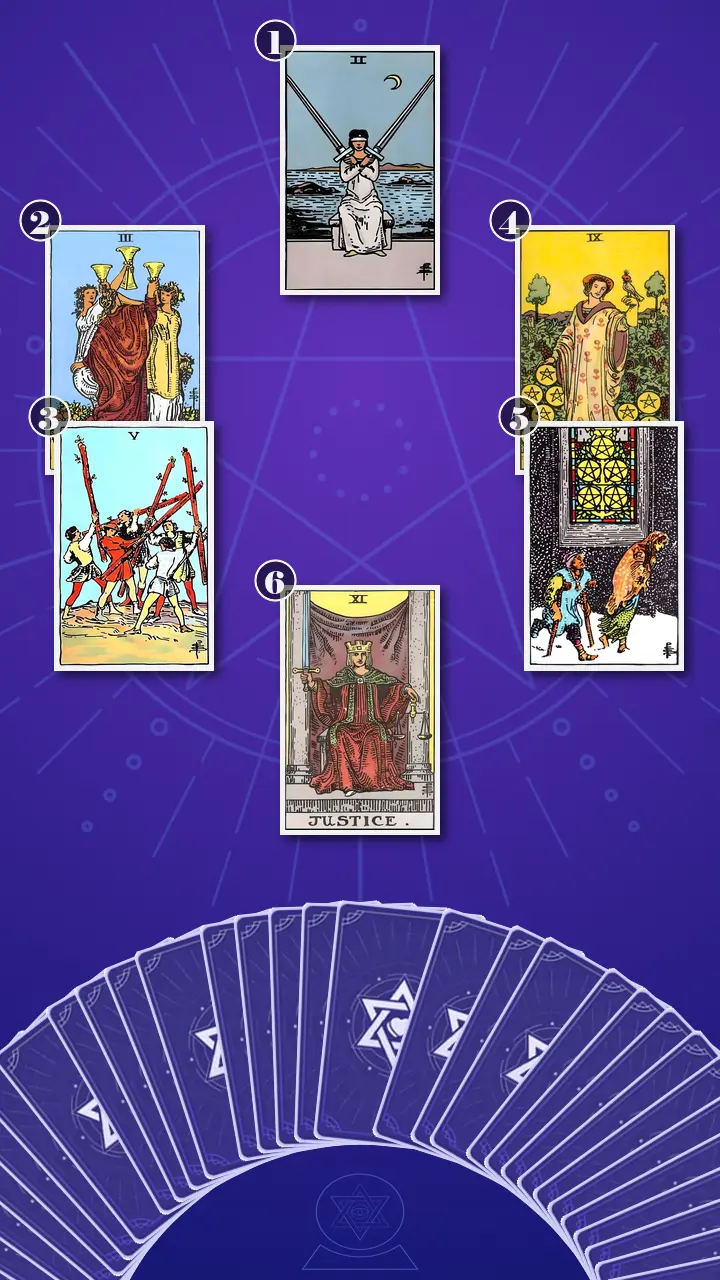
Reading the Map: Card Meanings in Context
Position 1: The Immediate Decision Pressure
“Now flipped, is the card representing the immediate decision pressure—what’s making this feel urgent and mentally sticky right now,” I said.
Two of Swords, upright.
“This is the night the deposit is due and you’re in ‘maybe mode’: five hotel tabs, one group chat thread, and a brain that keeps simulating worst-case roommate scenarios,” I said, using the exact life-translation because it was already Jordan’s lived reality. “You’re not missing information—you’re avoiding the moment where you state a preference and risk being seen as ‘difficult,’ so the indecision becomes the main source of stress.”
I pointed to the blindfold in the classic imagery. “This card isn’t about not knowing. It’s about not wanting to look directly at the tradeoff. The crossed swords are your internal tug-of-war: budget versus emotional safety. And the still water behind the figure—that’s the calm you’re trying to preserve. But staying undecided doesn’t preserve calm. Under a deadline, it manufactures pressure.”
I heard Jordan exhale through their nose—a short, almost laugh. Then, unexpectedly, they actually laughed. Not happy. More like a wince with sound.
“That’s… so accurate it’s kind of rude,” they said. “I literally have a Notion trip planner template I made at 1 a.m. instead of just deciding.”
“Yeah,” I said, slightly wry, not shaming. “Your brain is acting like an overheating browser: twelve tabs open so you don’t have to choose. And your chest is paying the electricity bill.”
I let the moment land, then named it plainly: “This isn’t a room decision. It’s a clarity decision. Because right now, you’re trying to avoid awkwardness for one conversation… by risking awkwardness for the whole trip.”
Jordan’s shoulders dropped a fraction, like their body recognized the pattern once it was spoken out loud.
Position 2: Upside of Sharing a Room
“Now flipped, is the card representing the upside of sharing a room—what you genuinely gain if you share,” I said.
Three of Cups, upright.
“This is the version of the trip you actually want,” I told them. “Laughing after a long day out, debriefing over snacks, feeling included and in it together. Sharing a room can genuinely make the trip feel more connected and easier—but only if the room doesn’t quietly become a stress container.”
I watched Jordan’s face soften—eyes less sharp, jaw unclenching. The card had shifted the energy from pure analysis to memory and warmth. It reminded us why anyone agrees to share a room in the first place: belonging, ease, shared excitement.
“Here’s the pivot,” I added. “Celebration needs a container. If the connection matters, we protect it with a few clear agreements—so the vibe doesn’t turn brittle.”
Jordan nodded once, slow. “I do want the ‘in it together’ feeling,” they admitted. “I just don’t want it to turn into… weird silence.”
Position 3: Downside of Sharing a Room
“Now flipped, is the card representing the downside of sharing a room—what becomes harder if you share,” I said.
Five of Wands, upright.
“Sharing means your routines will collide in a small space,” I said. “Different sleep times, lights, bathroom timing, calls, noise tolerance, even how long someone takes to get ready. None of it has to be a fight—but if nobody names the predictable friction points, it starts to feel personal and the room becomes where resentment quietly accumulates.”
The imagery always makes me think of a group project with no roles assigned. Everyone tries to be ‘easy,’ and then it becomes chaos anyway. Or like five different calendar notifications going off at the same time in one tiny room.
Jordan made a face—half grimace, half recognition. “The White Lotus vibe,” they said, dry. “Like tiny habits suddenly feel… loud.”
“Exactly,” I said. “Not malicious. Just messy. And the antidote is boring, not magical: one neutral logistics sentence that turns preferences into something manageable.”
I offered an example, simple enough to text: “What time are we doing lights-out?”
Jordan’s eyes flicked down, like they could already see the message they were afraid to send. And I could feel the deeper question underneath: What if the thing you’re calling ‘being chill’ is actually you shrinking your needs so nobody has to deal with them?
Position 4: Upside of Booking Solo
“Now flipped, is the card representing the upside of booking solo—what you protect or create if you book your own room,” I said.
Nine of Pentacles, upright.
“A solo room is buying yourself a controlled pocket of quiet,” I said. “You can close the door, sleep, decompress, and come back to the group actually present instead of depleted. It’s not about rejecting anyone—it’s about investing in the version of you who can enjoy the trip without negotiating every tiny need.”
I saw Jordan swallow, and their eyes went glassy for a second—not tears, more like recognition. Burnout does that: you can look fine, and one sentence about rest makes you feel exposed.
“Privacy isn’t a betrayal. It’s a resource,” I said, and I meant it as permission, not persuasion. “Nine of Pentacles is ‘Do Not Disturb’ mode as an emotional boundary, not just a phone setting.”
Jordan let out a longer breath. “If I had my own room… I would relax immediately,” they said. “And then I’d actually want to be around everyone.”
Position 5: Downside of Booking Solo
“Now flipped, is the card representing the downside of booking solo—what you risk or pay if you book alone,” I said.
Five of Pentacles, upright.
“You see the solo price and immediately feel the emotional sting of being ‘outside’—like booking your own room equals opting out of belonging,” I said. “The practical truth is: it costs more. The emotional story is: you’ll be judged or left out. This card asks you to separate the money facts from the mind-reading spiral so guilt doesn’t drive the decision.”
In my mind, it was a split-screen: on one side, their banking app total; on the other, an imagined court of friends deciding whether they were ‘dramatic.’ The card’s lit window is the clue: warmth and connection exist even if your door is different.
Jordan’s mouth tightened. “I do that,” they said quietly. “I look at the number and suddenly it’s not math. It’s like… a vote on whether I deserve to be included.”
“That’s the Outsider Story talking,” I said. “And it’s powerful because it sounds like logic. But it’s not. It’s fear dressed up as budgeting.”
Jordan stared at the table, then back at me. There was a tiny flash of irritation in their eyes—at themselves, at the pattern, at the whole situation. And then, softer: “So either way, I’m not eliminating discomfort—I’m choosing the kind I can live with.”
“Yes,” I said. “Exactly.”
When Justice Took Off the Blindfold
Position 6: Integration Guidance
I slowed my hands before turning the final card. “This is the integrating guidance,” I said. “The clearest, fairest way to decide and communicate so you can enjoy the trip regardless of the choice.”
It felt quieter in my office. Even the street noise outside my window softened, like the city was giving us a beat to listen.
Justice, upright.
“You stop hinting and put clear terms on the table,” I said. “What you’re choosing, why—in one line—what you’re willing to do to keep it fair, and a simple yes/no question so the deposit gets paid. This is choosing ‘clean and explicit’ over ‘vague and vibe-based,’ because clarity protects both the friendship and your nervous system.”
And this is where my perfumer’s brain always clicks in. Justice is the lab scale. It’s the part of you that stops waving a bottle around hoping the formula will balance itself, and starts weighing. In my work, I call this a kind of Relationship Vitality Assessment: not “Do we like each other?” but “Can this connection stay healthy under real-world conditions—shared air, shared space, shared habits?”
“Sharing a room is like putting two strong fragrance notes in a small bottle,” I told Jordan. “In open air, both can be lovely. In a confined space, everything gets amplified. Justice doesn’t ask you to pretend you won’t have needs. It asks: what ratios and rules keep the blend wearable?”
Jordan’s eyebrows lifted. “So… terms are the ratio,” they said.
“Exactly. Terms, not vibes.”
The Aha Setup
I could see it on their face: they were right back at that group chat line, five hotel tabs open, chest tight—trying to find an option that wouldn’t make anyone feel anything awkward.
“Here’s what I want you to hear,” I said, voice gentle but steady. “First—clarity isn’t drama. Clarity is what keeps the trip from turning into a quiet boundary war.”
The Aha Delivery
Stop trying to be ‘the easy one’ and start being the clear one—like Justice, you don’t guess what’s fair, you weigh it and state it.
I let a short silence sit in the air, the way I let a top note evaporate before judging a perfume’s heart.
The Aha Reinforcement
Jordan’s reaction came in layers—fast and honest.
First, a small freeze: their breath paused, and their hands stopped moving like someone hit “Hold” on their whole body.
Then the cognitive seep: their gaze went unfocused for a second, like they were replaying every time they’d typed “I’m flexible!” while their chest screamed the opposite.
Then the emotional release—quiet, but real: their shoulders lowered, and a shaky exhale left them like they’d been bracing for a verdict and realized it was just a choice.
And then—an unexpected flare of resistance. Their voice sharpened. “But if I do that,” they said, “won’t they think I’m being dramatic? Like… if I’m clear, I’m the problem.”
“That’s the old contract talking,” I said, kindly. “The one that says belonging requires you to be low-needs. Justice renegotiates that contract. It doesn’t demand you win. It demands you be honest about the tradeoff you’re choosing.”
I guided them into something tangible, exactly as practical as it sounds. “Open Notes,” I said. “Sixty seconds. Two bullets.”
“One: What I need to sleep/reset. Two: What I can compromise on. Keep it short. No case file.”
I watched Jordan type. Their fingers were a little shaky at first. Then steadier. Like a nervous system recognizing structure.
“Now,” I continued, “one clean message. Two sentences. No apology tour.”
Jordan looked up. “Like… ‘Heads up: I’m leaning toward booking my own room so I can sleep/recharge. I’m totally in for all the group stuff—just want the room plan locked in before the deposit.’”
“Yes,” I said. “Short message. Clear terms. Then hit pay.”
I leaned forward slightly. “And I want to ask you something—because this is where the shift happens. With this new lens, think back to last week: was there a moment when you felt that chest-tightening spike and started rehearsing? If you’d been ‘the clear one’ in that moment, what would have felt different?”
Jordan’s eyes softened again. “I would’ve slept,” they said, half-laughing at the simplicity. “I stayed up ‘researching’ until midnight. And then I was wrecked at work the next day.”
“That,” I said, “is your body asking for Justice. Not perfection. Just clean terms.”
This was the emotional transformation in real time: not from uncertainty to certainty, but from pressure-soaked overthinking to grounded clarity—one honest sentence at a time.
The One-Message Plan for a Group Trip Decision
I pulled the whole spread together into a single story so Jordan could feel the logic, not just hear it.
“Two of Swords shows you stuck in ‘maybe’ mode because you’re trying to prevent anyone’s discomfort,” I said. “Three of Cups reminds you that the point of sharing is connection. Five of Wands says: connection without structure turns into friction. Nine of Pentacles says: solitude can be a support tool, not a rejection. Five of Pentacles says: the cost isn’t just money—it’s the story you tell yourself about belonging. And Justice ties it all together: you choose based on explicit terms and communicate plainly, because clarity protects both the friendship and your nervous system.”
The cognitive blind spot was clear now: Jordan had been treating clarity like drama—like naming needs would “ruin the vibe”—when in reality, vagueness was the thing threatening the vibe.
“Your transformation direction is simple,” I said. “Move from trying to pick the option that prevents anyone’s discomfort to choosing the option that matches your actual needs—and naming the tradeoffs clearly and early.”
Then I gave them next steps that were small enough to do tonight.
- Send the Two-Sentence Justice TextOpen the group chat and send: “Heads up: I’m leaning toward booking my own room so I can sleep/recharge. I’m totally in for all the group stuff—just want the room plan locked in before the deposit.”Set a 7-minute timer before you type. When the guilt spike hits, don’t turn it into a paragraph. Save draft, stand up, take 5 slow breaths, then send it exactly as-is when the timer ends.
- Do a 60-Second Tradeoff Score (No New Tabs)Make a note titled “Room decision.” Score share vs solo on: cost, sleep, privacy, vibe (0–2 each). Pick the highest total and write one sentence naming the tradeoff you’re accepting (e.g., “I’m paying more for quiet so I can actually enjoy the days”).If you catch yourself opening a fourth listing, close everything and do the score immediately. More information won’t solve a belonging fear; it only delays the moment you name what you want.
- Book on a Calendar LockRight after you send the message, block 15 minutes tonight to finalize the booking. Label the alarm: “Deposit: choose + pay.” Then book within 20 minutes of scoring.If your nervous system spikes, pause and breathe—but don’t renegotiate with yourself. The relief comes from the plan becoming explicit.
Before we ended, I offered one optional tool from my world—not to make it fancy, but to make it easier. “If you have a scent you associate with calm—clean laundry, a soft vanilla, a simple cedar—put a little on your wrist before you hit send,” I said. “It’s first-impression management, but the first impression is for your nervous system: ‘I can be clear and still be safe.’”

A Week Later: The Quiet Proof
A week later, Jordan sent me a message that made me smile at my desk.
“Sent the two-sentence text,” they wrote. “Booked solo. I thought the chat would get weird. It didn’t. Someone literally replied ‘same, I need quiet too.’ Why did I make this a whole personality test?”
In the follow-up they told me the truth was both lighter and a little bittersweet: they’d booked the room alone, then sat at a café for an hour with a latte they barely drank—relieved, a little shaky, proud, and still faintly afraid of being ‘too much.’ But this time, the fear wasn’t driving.
That’s what I mean by a Journey to Clarity. Not an outcome guaranteed. A nervous system calmed by clean terms. A friendship protected by honesty. A decision chosen on purpose instead of under pressure.
And if tonight you’re feeling that same deposit-deadline panic—like you have to choose between being “easy to be around” and being safe in your own space—remember this: your body is usually the first to tell you when guessing has become its own kind of stress.
If you let yourself choose the option that fits your real nervous-system needs (even if it costs something—money or mild awkwardness), what’s the simplest sentence you’d be willing to send tonight?