The Read Receipt I Couldn't Answer—And the Two-Sentence Reset Text

The Read Receipt That Felt Like a Courtroom
“You’re an early-career city worker who can answer Slack in 30 seconds, but a single ‘Hey, are you okay?’ from Mom after 10 p.m. hits like a task you’re not staffed for—and the read receipt makes it worse.”
I said it gently, not as a punchline, but as a mirror.
Jordan (name changed for privacy) sat on the other side of my screen in her tiny Toronto bedroom, winter-dark pressed up against the window like a palm. The only light on her face was that phone-glow blue, the kind that makes everyone look a little guilty even when they’ve done nothing wrong. Her phone lay face-down on the duvet like it was overheating. Every few seconds, her fingers twitched toward it anyway.
“It’s… stupid,” she said, voice low. “I leave Mom on read. Then she calls my sibling. And it turns into—like—this family-wide alarm. I just want a reset. Not another apology loop.”
I watched her swallow hard. Tight throat. Tight chest. That restless urge to fix it, paired with no idea what would count as “fixed.”
“It’s not stupid,” I told her. “A read receipt isn’t a moral score. And tonight, we’re not here to judge you for being tired. We’re here to find clarity—so you can keep your warmth and your space without this worry-guilt loop owning your nervous system.”

Choosing the Compass: A Relationship Spread for Finding Clarity
I asked her to take one slow breath with me—not as a mystical ritual, just a clean transition from panic-brain to observing-brain. While she breathed, I shuffled my deck on my desk in my little home studio. The microphones were off, but I still felt the familiar quiet of “on air” energy: when you don’t fill the silence with noise, you can actually hear what’s happening underneath.
“Today, we’ll use something called the Relationship Spread,” I said, laying six cards into a simple two-column grid. “It’s a 6-card spread that maps an interaction loop—your pattern, her pattern, what happens between you, what still supports the connection, the main friction point, and then practical advice.”
For anyone reading along: I chose this spread because this situation isn’t about predicting whether your mom will ‘change’ or whether you’re ‘wrong.’ It’s about understanding a dynamic that repeats: read receipt → worry escalation → guilt. A relationship spread is the smallest structure that still captures both perspectives and gives you actionable next steps.
“We’ll read it like three conversational beats,” I told Jordan. “Top row is the present tension. Middle row is the relationship itself—what binds, what supports. Bottom row is the practical jam and the grounded repair.”
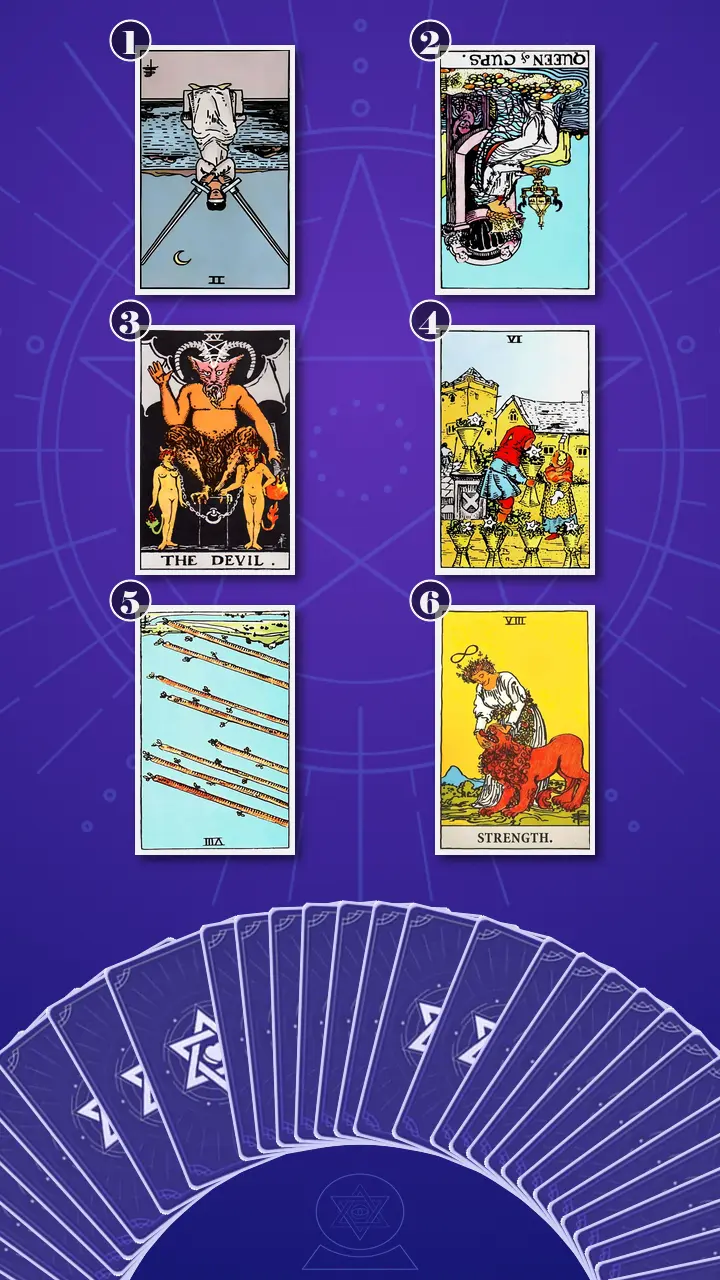
Reading the Grid: Six Cards, One Worry-Guilt Loop
Position 1 — Your Presenting Pattern: Two of Swords (reversed)
“Now the card we’re turning over is the one that represents the presenting behavior pattern—what you do in real time the moment your mom texts and the guilt spike hits.”
Two of Swords, reversed.
“This is the exact 10:47 p.m. moment,” I said. “You open your mom’s text, the read receipt flips on, and you immediately freeze. You tell yourself you’ll respond when you can sound caring and calm, but you can’t pick a simple line—so you lock your phone, draft in Notes, delete, and wait… which makes the whole situation louder later.”
I could practically hear the inner dialogue like two tracks playing at once—like a duet that never resolves.
“One voice is The Caretaker,” I said. “Say it perfectly. Make it warm. Don’t trigger follow-up. The other is The Exhausted Adult: I can’t do a whole emotional shift right now. And because those two can’t agree, you protect yourself by not choosing. Silence becomes a shield.”
That’s the energy here: blocked and over-controlled, then spilling into avoidance. Not a lack of love—just a nervous system trying to stay safe.
Jordan let out a small, bitter laugh—one sharp exhale that sounded like it had been waiting all week for somewhere to land. “Yup,” she said. “That’s me. It’s accurate in an annoying way.”
“It can feel cruelly accurate,” I agreed. “But it’s also good news. If the pattern is specific, the fix can be specific.”
Position 2 — Mom’s Stance: Queen of Cups (reversed)
“Now we turn over the card that represents your mom’s likely emotional stance and communication energy in this loop—without judging intent.”
Queen of Cups, reversed.
“On her side,” I said, “silence reads like danger. She doesn’t necessarily mean to pressure you—she’s trying to soothe her own anxiety—so she double-texts, then calls, then calls your sibling to confirm you’re okay. The channel becomes emotional, not logistical.”
Reversed, this Queen’s care is flooded. It’s not that she doesn’t love you—she loves you so much that uncertainty feels unbearable.
I leaned back a little, and my own instincts as a music therapist kicked in. “In sound terms,” I told Jordan, “this is like when a track has too much reverb—everything becomes a swirl. The message isn’t just ‘Are you okay?’ anymore. It becomes: Prove you’re okay. Prove you care. Prove you’re not slipping away.”
Jordan’s eyes softened in that complicated way—recognition mixed with a tiny sting. “She’s always been like that,” she said. “Even when I was a kid. If I was quiet, she’d assume something was wrong.”
Position 3 — The Loop Between You: The Devil (upright)
“Now the card we’re turning over is the repeating relationship dynamic—the loop that keeps the worry escalation and guilt repair cycle running.”
The Devil.
I didn’t rush this one. The Devil can make people brace, but in communication readings, I often find it’s the most compassionate truth-teller in the deck.
“This is the moment where love gets confused with obligation,” I said. “A late reply doesn’t feel like timing—it feels like a character test. When your mom escalates, it feels like proof you’ve failed, so you try to ‘repay the debt’ with extra emotional labor—apology essays, reassurance loops—which keeps the chain in place.”
I used the metaphor I see all the time with modern families: “It’s like your texts come with invisible terms & conditions. A family SLA you never agreed to. Somewhere in the fine print it says: Respond fast = good daughter. Delay = bad daughter.”
Then I mirrored her internal monologue, short and clipped, the way it sounds when guilt is holding the mic.
“I should’ve… I can’t… now it’s worse… I have to fix it… I have to fix it…”
Jordan went still. Then her shoulders dropped a millimeter. A quiet exhale slipped out of her like she’d been holding it since the TTC ride home. “This is exactly the guilt-contract I’m in,” she said, almost to herself.
“Yes,” I said. “And notice something important on this card: the chains are loose. This pattern is powerful, but it’s negotiable. We’re not breaking love. We’re renegotiating the contract.”
Position 4 — What Still Supports You: Six of Cups (upright)
“Now we turn over the card that represents what supports the relationship—what’s still healthy and real here.”
Six of Cups.
“Under the stress,” I said, “there’s still genuine affection. A reset can start with something small and human: a quick photo from your day, a short voice note, a tiny ‘thinking of you.’ It reminds both of you the relationship isn’t just crisis-management—it’s connection.”
Jordan’s face changed—less guarded. “My mom actually loves when I send pictures of random stuff,” she admitted. “Like a latte. Or the streetcar.”
“That’s exactly Six of Cups energy,” I said. “Warmth that’s cheap. Not costly.”
This is where my own toolkit slipped in naturally. “I’m going to use what I call a Memory Vinyl move,” I told her. “It’s not about digging up heavy family stories. It’s tiny. You send one warm touchpoint, and you attach it to something shared—like a song request.”
“A song request?” she asked, surprised.
“Yeah,” I said. “You text: ‘Saw this and thought of you. What’s one song you’re obsessed with this week?’ It turns connection into something light. Then you still hold your boundary with scheduling. Warmth plus structure.”
Position 5 — The Practical Jam: Eight of Wands (reversed)
“Now we’re turning over the card that represents the main challenge or blockage—the specific friction that turns a delayed reply into a bigger family alarm.”
Eight of Wands, reversed.
“The biggest practical issue is the gap,” I said. “You read the message, don’t respond, and the silence becomes a vacuum filled with stories: you assume you’re guilty, she assumes something’s wrong. Then your sibling gets pulled in, and suddenly you’re replying to an emergency that didn’t need to exist.”
I spoke it as a pacing montage—because this card is about momentum, and reversed, it’s about momentum that starts and stops like buffering video.
“6:12 p.m. TTC ride home. You read it. You think, after dinner. 9:40 p.m., two missed calls. Then the sibling text: ‘Mom called—are you okay?’ And now it’s not one conversation. It’s an escalation timeline.”
“Clarity now beats an essay later,” I said. “This isn’t a character flaw. It’s an operational issue. The gap is the trigger.”
Jordan nodded fast, like she’d been waiting for someone to frame it that way. “That’s the exact timeline,” she said. “It’s like… the longer I wait, the more expensive the reply becomes.”
When Strength Lowered the Volume
Position 6 — Advice / Best Way Forward: Strength (upright)
“Now,” I said, and I let the room go quieter, “we’re turning over the card that represents the most grounded way to reset the pattern—the tone and micro-action that rebuilds safety without overexplaining.”
Strength, upright.
“The reset is you choosing a calm, repeatable boundary—and sticking to it kindly,” I said. “Not an essay, not a fight. One steady ‘status + when’ message, sent with your shoulders down. You’re not trying to control her feelings; you’re building trust through a rhythm you can maintain.”
And then I anchored the moment in the real scene we both knew too well—the setup she’d described before she even booked with me.
It’s 10:47 p.m. You tap your mom’s text, the read receipt flips on, and your stomach drops. You start drafting the “perfect” reply in Notes—warm but not too warm—then you lock your phone like it’s a hot stove.
I looked at Jordan and softened my voice, the way I do when I’m about to say something I want someone to actually keep.
Stop trying to earn peace through perfect replies, and start building safety through gentle Strength—steady contact, clear limits, and a calm hand on the ‘lion’ of guilt.
I let that sentence sit in the air. No extra commentary. Just room for it to land.
Her reaction came in a chain—three small beats I’ve learned to watch for, because they’re what “finding clarity” looks like in a human body.
First: a freeze. Her breath caught; her fingers hovered like she was about to type something invisible. Second: the eyes unfocused for a second, like she was replaying last week’s thread—the read receipt, the Notes draft, the sibling text. Third: a release. Her shoulders dropped in a way that made the hoodie fabric shift, and she let out a sound that wasn’t quite a laugh and wasn’t quite a sob.
“But if I’m not… perfectly reassuring,” she said, and there was a flash of anger under it—at the whole system, at herself, at the idea of rules she never consented to—“won’t she just think I don’t care?”
I nodded. “That fear makes total sense. And here’s what Strength is teaching: warmth isn’t the same thing as availability. You can keep the warmth. We’re changing the availability contract.”
Then I used my signature diagnostic lens—something I call Generational Echo. “Let me ask you one question,” I said. “When you picture your mom worrying, does it feel… familiar? Like it’s not only about you, but something she learned from her own house?”
Jordan blinked. “Yeah,” she admitted. “My grandma was… intense. Like, if you didn’t call, she assumed the worst.”
“That’s the echo,” I said. “Three generations of ‘silence means danger.’ The card isn’t blaming you or your mom. It’s saying: you can be the one who changes the rhythm. Not by explaining forever. By being steady.”
I slid into practical reinforcement, the way I do on my radio show when I’m trying to turn insight into something someone can do on a Tuesday night.
“We’re going to do a 10-minute Bridge Text Rehearsal—no sending required,” I said. “Open Notes and write three versions of a two-line script: (1) status, (2) when you’ll reconnect. Example: ‘Saw this—I’m okay. I’m wiped from work; I’ll call tomorrow after 6.’ Then read them out loud once. If your chest tightens or you feel panicky, pause and stop—your job is practice, not pushing through.”
“Now,” I added, “use this new lens and think back to last week. Was there a moment when this could’ve changed how you felt?”
Jordan stared at the card, then nodded slowly. “When my sibling texted me,” she said. “If I’d just sent the two sentences earlier, it wouldn’t have become a thing.”
“Exactly,” I said. “This is the shift from being stuck in guilt-spike paralysis to grounded, compassionate self-leadership. Not perfect. Just steadier.”
The Two-Sentence Reset: Actionable Advice You Can Actually Use
I gathered the whole story the cards had told, because this is where tarot is at its most useful—when it becomes a map, not a vibe.
“Here’s the narrative,” I said. “You freeze after reading (Two of Swords reversed) because you’re trying to protect yourself from emotional scope creep. Your mom’s worry floods the channel (Queen of Cups reversed), and the relationship dynamic turns timing into a moral test (The Devil). But there’s real love and softness underneath (Six of Cups), and the problem is made worse by the silence-gap—by the story-vacuum (Eight of Wands reversed). Strength is your antidote: calm, repeatable, loving boundaries—rhythm over perfection.”
“Your cognitive blind spot,” I added, “is that you’ve been treating this like a tone problem—how do I sound caring enough?—when it’s mainly a rhythm problem—how do I remove the vacuum without handing over my entire evening?”
Then I gave her next steps, small enough to start even when her battery was low.
- Save a “Bridge Text” snippetTonight, create one saved text titled Bridge Text: “Saw this—I’m okay. I’m wiped tonight. I’ll call you tomorrow after 6.” Use it once this week when you feel the freeze.If it feels cold, remember: you’re not refusing care—you’re scheduling it. Copy/paste is allowed. You’re allowed to stop after two sentences.
- Choose one daily check-in window (and say it once)Pick a realistic window (e.g., 7–8 p.m.) and tell your mom one time: “I’m usually offline after work, but I check in around 7.”If she pushes for more in the moment, repeat the same line once—no new explanations. Strength is consistency, not debating.
- Add one “cheap warmth” touchpointOnce this week, send a quick photo (streetcar, first snow, coffee) with “Thought you’d like this.” If you want, add one Memory Vinyl question: “What song is stuck in your head today?”Keep it under 15 seconds of effort so it doesn’t turn into a late-night processing session. Warmth should be cheap, not costly.
Before we ended, I offered her one more strategy from my own practice—because her biggest problem wasn’t love. It was being on-call.
“Try a Soundproof Barrier for the hour after work,” I said. “Not emotionally. Literally. Put on noise-cancelling headphones or low, steady background sound while you decompress—brown noise, a calm playlist, anything consistent. Your brain needs a ‘shift change’ so family messages don’t feel like another Slack ticket.”

A Week Later: The Quiet Proof
Five days later, I got a message from Jordan. No essay. Just a screenshot.
It was her two-sentence text: “Saw this—I’m okay. I’m wiped tonight. I’ll call you tomorrow after 6.”
Under it, her mom had replied: “Okay. Love you. Talk tomorrow.”
Jordan added one line: “I still felt the guilt flare, but it didn’t hijack my whole night.”
It wasn’t a Hollywood resolution. She didn’t suddenly love texting, and her mom didn’t instantly become chill forever. But the proof was real: she’d chosen a rhythm she could keep.
When you want a normal amount of space but your body treats a late reply like proof you’re unloving, every read receipt starts feeling like a courtroom instead of a conversation.
If you didn’t have to earn peace with a perfect explanation, what would a two-sentence “status + when” text sound like in your own voice?
Every reading at AceTarot is a journey to connect with inner wisdom and empower your next step. The stories shared here are psychological mirrors, not private records—crafted to reflect universal emotional loops and help you find your own clarity. Learn more about our Journey to Clarity.