From Shame-Freeze to Speaking Up: A Group Chat Inclusion Journey

The Line That Makes Your Throat Close
You hear “we assumed you were busy,” you force a laugh, and your throat tightens—then you spend the entire commute doing group-chat forensics like it’s a second job.
Maya (name changed for privacy) slipped into the chair by my front window, the one that always catches the first slice of London daylight. Outside, the pavement was slick from a recent drizzle; inside, my espresso machine exhaled its steady hiss like a small, loyal radiator. She kept her headphones looped around her fingers like a safety cord.
“It’s stupid,” she said, the word coming out fast, as if she could outrun it. “Someone said, ‘Oh—yeah, we made plans without you.’ And I did the thing. I smiled. ‘No worries.’ I even laughed, like… properly. But my body went—”
She pressed her fingertips lightly to the base of her throat. Her swallow looked careful, like there was a stone lodged behind her ribs. “It’s like a drawstring pulled tight. Then I’m on the Jubilee line, and my phone is warm from opening and closing WhatsApp, and I’m scrolling like I’m trying to solve a crime. But it’s not a crime. It’s just… plans.”
I watched her eyes flick down and away as if a neon sign somewhere in the café said too much. Shame isn’t loud; it’s often a quiet, numb-heavy stillness that makes your mouth forget how to form a normal sentence. In Maya, it looked like a perfectly polite face holding back a storm.
“So the question you’re bringing,” I said gently, “isn’t really ‘how do I get invited.’ It’s: When I hear ‘we made plans without you’—what old story makes me freeze? Because you want belonging and closeness… and at the same time you’re terrified of being unwanted and replaceable. So you vanish.”
She let out a breath that sounded like it had been trapped behind her teeth. “Exactly. I know it’s not a big deal, but my body acts like it is.”
“Then our goal today,” I told her, “is clarity. Not the kind that pretends it didn’t hurt. The kind that helps you stay in the room—inside yourself, and inside the relationship—without shrinking.”

The Horseshoe on the Café Table
I slid a glass of water toward her—something simple for the nervous system, something to hold—and brought out my well-worn deck. In my café, tarot isn’t a theatrical ritual. It’s a focusing tool, like turning down background noise so you can finally hear your own thoughts.
“Take one slow breath,” I said. “Not a performance. Just a reset.”
As she exhaled, I shuffled with the soft, familiar clap of cardstock. Twenty years of coffee has taught me this: most people don’t need more intensity; they need the right dose. A steady pour. A grounded pace.
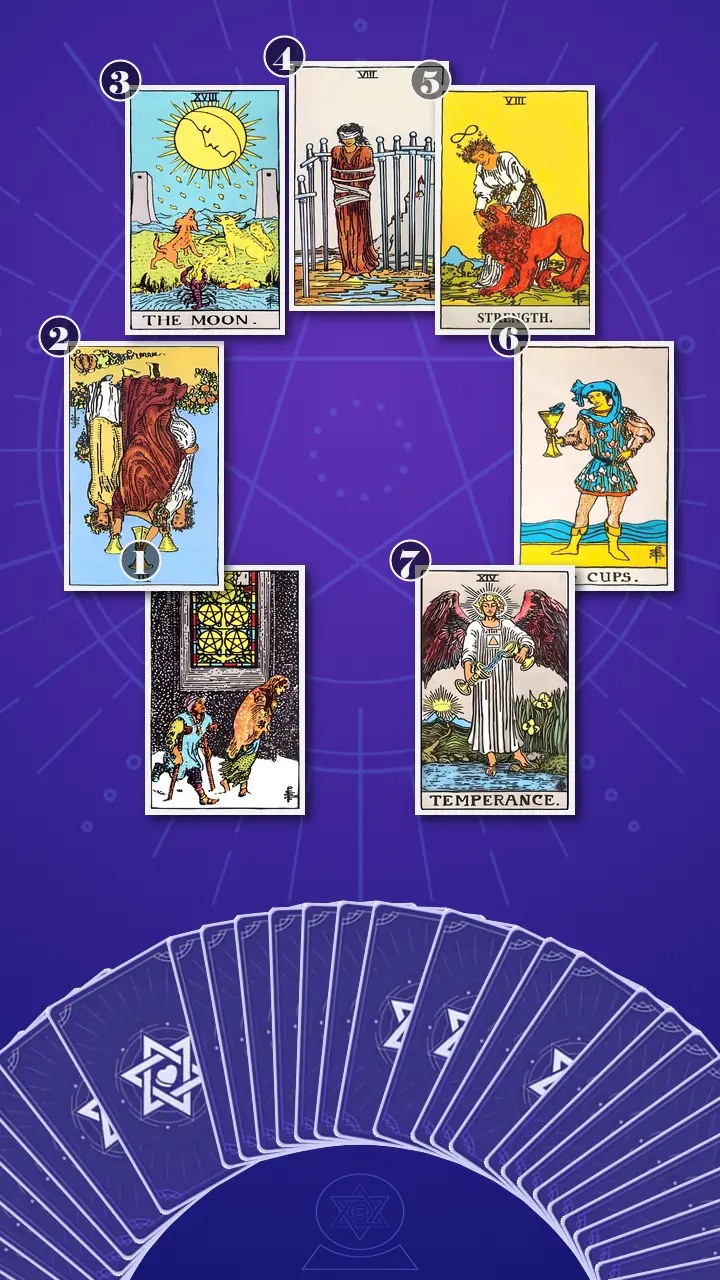
“Today we’ll use a spread called the Horseshoe · Context Edition,” I explained. “It’s seven cards laid in an arc—like a path you can walk. I use it a lot for friendship anxiety, social exclusion triggers, and that specific ‘freeze response’ people get in group chats.”
For you reading this: the reason the Horseshoe works so well here is that it separates the pieces your mind tends to mash into one painful blob. It gives distinct places for: the old belonging template (where this reaction was learned), the present trigger (what actually happened), the hidden story (what your brain adds in the gaps), the obstacle (the freeze), and then practical advice and integration. In other words, it answers the search-intent question behind the question: “We made plans without you”—how do I respond without spiraling?
“The card here,” I said, tapping the left side of the arc, “will show the old template that gets reactivated. The top card is the choke point—the mechanism that turns hurt into paralysis. And this one,” I touched the right side, “is the antidote: how you stay kind to yourself while you ask for clarity.”
Maya nodded, eyes on my hands. “Okay. I can do seven.”
Fog, Closed Circles, and the Freeze
I laid the cards in a horseshoe arc, open end facing upward—an invitation back into the circle rather than a verdict from outside it.
Position 1: The old belonging template
“Now flipped over,” I said, “is the card that represents the old belonging template—what earlier experience is being reactivated.”
Five of Pentacles, upright.
The stained-glass window in the card glowed like warm light behind glass. Two figures moved through snow, close enough to touch, but convinced the warmth wasn’t for them.
“Here’s the modern translation,” I told her. “The old story shows up like this: you’re walking past a lit-up pub window on a rainy night, seeing silhouettes laughing inside, and your brain decides, ‘they wouldn’t want me there anyway.’ It’s not about today’s plan—it’s your body remembering the feeling of being outside the circle and making that the default truth.”
In tarot terms, this isn’t predicting your friends will exclude you. It’s showing the origin file your nervous system opens when it hears a certain sentence.
Maya gave a short laugh—half recognition, half something bitter. “That’s… rude,” she said quietly. “Like, it’s accurate. But it’s rude.”
“It can feel cruel to see it laid out,” I said, keeping my voice warm. “But it’s not shaming you. It’s naming the template. Because once you can name it, you can stop treating it like the present.”
Position 2: The present trigger
“Now we look at the present trigger—what’s happening now that lights the fuse,” I said.
Three of Cups, reversed.
“This is that closed-circle feeling,” I said. “In real life it looks like: the present trigger is a tiny sentence with massive impact—‘We made plans without you.’ You see a tagged carousel the next day and suddenly the word ‘we’ feels like a membership you don’t have.”
I let it land, then added the gut-punch line the card always carries when it shows up like this: “The party happened, and your name wasn’t in the ‘we.’”
Maya’s nostrils flared slightly—anger trying to surface, then getting swallowed. “It’s not even that I needed to go,” she said. “It’s… feeling forgettable.”
“And the contradiction is real,” I said. “You want closeness. And you’re scared that needing it makes you replaceable.”
“Also,” she added, quieter, “I’m a product manager. I literally run meetings. But this—this turns me into someone who can’t type one normal sentence.”
“That’s because your work brain is built for roadmaps,” I said. “This reaction is built for attachment.”
Position 3: The hidden story
“Now flipped over,” I said, “is the card that represents the hidden story—your unconscious assumptions when information is incomplete.”
The Moon, upright.
Even before I spoke, I saw Maya’s expression shift the way it does when someone recognizes their own mind in a mirror they didn’t ask for.
“The Moon is the fog machine,” I said. “The path between the towers—your brain walking forward in uncertainty, trying to create certainty from shadows because ‘not knowing’ feels unsafe.”
I framed it like a weather report, because that’s what The Moon is: a forecast of visibility, not a declaration of truth. “Fog rolls in,” I said. “Shapes look like facts.”
Then I drew an invisible line down the table with my finger. “Two columns,” I told her. “Column one: what was said. Column two: what your brain adds.”
“What was said: ‘We made plans without you.’ ‘We assumed you were busy.’”
“What the brain adds: ‘They don’t like me.’ ‘I’m not inner circle.’ ‘If I ask, I’ll look needy.’ ‘If I care, it’s embarrassing.’”
I held her gaze. “Ambiguity is not evidence. It’s just empty space your brain rushes to fill.”
She made a soft “oh no” sound—tiny, but honest. Then her shoulders dropped a millimeter, the kind of micro-release that says: Okay. Maybe I’m not crazy. Maybe I’m in fog.
Position 4: The freeze mechanism
“Now we reach the top of the arc,” I said. “This card represents the freeze mechanism—the internal block that turns hurt into paralysis and silence.”
Eight of Swords, upright.
“This is the exact loop,” I said, and I mirrored it without dramatizing it: “Unlock phone → hover over chat → type six words → delete → lock phone → repeat.”
I looked at her hands. Without realizing it, she’d tightened her grip around her headphones again.
“And the inner monologue scaffold is brutal,” I said, naming it plainly so it couldn’t hide. “If I ask, I’ll look needy. If I don’t, I look unbothered. If I’m unbothered, I’m safer.”
“You don’t freeze because you’re weak—you freeze because you learned silence looks safer than need.”
Maya’s exhale was long, like someone finally turning off a loud extractor fan. She nodded once, slow. “Stuck,” she said. “But… technically not trapped.”
“Exactly,” I replied. “The bindings in this card are loose. The cage is made of perception. The obstacle isn’t the group itself. It’s the belief that asking for clarity will equal humiliation.”
When Strength Spoke: Gentle Courage, Not Performative Chill
When I turned the next card, the café felt quieter—not because the city outside had changed, but because Maya’s attention gathered into one point. Even the espresso machine seemed to pause between breaths.
Position 5: The antidote
“Now flipped over,” I said, “is the card that represents the antidote—the inner stance that helps you keep your self-worth while you stay in relationship.”
Strength, upright.
I didn’t call it confidence. I never do, not in moments like this. “Strength here is steadiness,” I said. “A calm hand on the lion. Soft control. Not forcing feelings away—guiding them into one deliberate move.”
“And in real life,” I continued, “it looks like this: instead of acting unbothered, you pause, feel the sting, and choose a clean sentence that honors you. Not a rant, not a test, not a performance—just steady self-respect.”
Stop treating silence as safety and choose gentle courage instead, like the calm hand that guides the lion rather than running from it.
I let the sentence hang for a beat, the way you let espresso settle before you judge the taste.
Setup (what you’re caught in): I watched Maya’s eyes flicker the way they do on the Tube when your phone is warm from being opened and closed, and you keep rereading one line like it’s a verdict—while you practice looking totally fine. That’s where she lived: one sentence turning into a whole internal movie, then a courtroom, then a sentence passed on herself.
Her first reaction wasn’t relief. It was resistance. “But if I do that,” she said, voice sharpening for a second, “doesn’t it mean I’ve been doing it wrong? Like… I’ve been disappearing for years.”
I nodded. “That anger makes sense,” I said. “It’s grief wearing a sharper coat. But notice what Strength is saying: you weren’t ‘wrong.’ You were surviving with the tools you had. Now you’re updating the tool.”
And then her body did a three-step reaction chain I’ve seen a hundred times behind café tables and tarot decks—tiny, but unmistakable.
First: a freeze. Her breath paused, and her fingers stopped moving mid-fidget, as if her nervous system wanted to check the room for danger.
Second: a cognitive seep. Her gaze went unfocused for a second, like she was replaying a memory—the first time she learned that wanting in could be used against her.
Third: an emotional release. Her shoulders sank. Not dramatically—just enough that her posture stopped trying to be invisible. Her eyes shone, the smallest bit of wet at the lower lash line, and she whispered, “I can be honest without making it a big scene.”
“Yes,” I said softly. “That’s Strength.”
Then I brought in the tool that’s mine—my café-born way of making the advice practical.
“In my world,” I told her, “we talk about extraction time. If you pull espresso too long, it turns bitter. Too short, it’s sour. Social moments have extraction time too. When you feel excluded, your instinct is to either over-extract—scroll, analyze, draft a ten-paragraph message—or under-extract—say nothing and disappear.”
“Strength is finding your optimal extraction time,” I said, using my signature lens: Social Espresso Extraction. “Long enough to be real. Short enough to stay clean.”
I slid my phone toward her, screen face down, like a boundary. “Two minutes,” I said. “Not two hours. Two minutes.”
“Here’s your practical anchor—the 2-Minute Strength Script. Do it once, then stop. We’re not feeding the spiral.”
“Set a 2-minute timer. Put one hand on your chest or throat—where the freeze lives. Take three slower breaths,” I said, demonstrating with my own hand at my collarbone.
“Open Notes and write only two lines:
• Fact: ‘They said: “we made plans without you.”’
• Request: ‘Next time, please loop me in—I’d love to come.’
Then pick one tiny next step: send it to one person, or schedule it for tomorrow. No rewriting marathon.”
She swallowed again, but this time it looked possible. “And if I can’t send it?”
“Then you don’t,” I said, without judgment. “Boundary: if sending feels too raw today, you’re allowed to not send. The win is building a clean sentence that honors you—without turning it into a courtroom argument.”
I watched her nod. Strength had done its job: not a personality transplant, just a new posture. This was the shift—from shame-driven freeze toward grounded self-advocacy.
Position 6: The relational doorway
“Now flipped over,” I said, “is the card that represents the relational doorway—the communication move available in your environment.”
Page of Cups, upright.
“This isn’t a CEO memo,” I said, because she’d already told me she’d rather die than sound dramatic. “The Page of Cups is a tender messenger. Warm. Simple. Human.”
I translated it into the exact modern scenario: “You text one person: ‘I felt a bit left out—can you loop me in next time?’ Then you stop. No paragraph. No self-deprecation. You let their response give you real information instead of guessing in silence.”
Maya’s face did what it always does when someone realizes the door has been there the whole time: relief mixed with skepticism. “Wait,” she said. “I can say it simply? And then… stop?”
“Yes,” I said. “One clean sentence beats an hour of draft-and-delete.”
And because my café has always been a place where people get back into conversation gently, I offered a tiny ice-breaker from my own toolkit—my 3-Second Latte Art approach. “If it feels too exposed to reference the plan directly,” I said, “you can lead with warmth instead of analysis. Three seconds. Something like: ‘Want to grab coffee this week? I miss you.’ It’s an invitation, not a prosecution.”
Position 7: Integration
“Now flipped over,” I said, “is the card that represents integration—what it looks like to update the old story and respond from reality, not reflex.”
Temperance, upright.
“Temperance is the middle path,” I said. “It’s the opposite of swinging between two extremes: ghosting but make it polite… or overperforming friendliness to prove you’re fine.”
I tapped the image of water pouring between cups. “This is emotional mixing. A regulated flow. Belonging built on reality feels quieter than belonging built on guessing.”
“So the outcome isn’t ‘you never feel hurt,’” I added. “It’s: you feel the sting, you don’t surrender your self-worth to it, and you choose a measured repair instead of disappearing for days.”
The Clean Sentence Method: Next Steps for When Friends Made Plans Without You
I gathered the arc into a single story, the way you’d describe a day by its real turning points instead of every minute you refreshed your phone.
“Here’s what your spread says,” I told Maya. “An old template—Five of Pentacles—gets activated the moment the present trigger hits—Three of Cups reversed. Then The Moon fills the gaps with worst-case headlines, and Eight of Swords makes silence feel like the only safe move. The turning point is Strength: steadiness in your body plus one clean request. Page of Cups is how you deliver it—simple, warm, not over-explained. Temperance is what happens when you practice this often enough that your social life stops feeling brittle.”
“Your cognitive blind spot,” I said, carefully, “is believing that disappearing is neutral. It isn’t. It feels like protection in the short term, but it quietly teaches your brain, ‘See? I don’t belong.’ The transformation direction is exactly what you came for: shifting from mind-reading and self-erasure to naming the impact and making one clear request.”
Then I gave her the smallest possible next steps—because advice that’s too big is just another reason to freeze.
- Save One Clean SentenceIn Notes, write and pin: “I would’ve loved to be included—please loop me in next time.” Keep it as your default response for when the sting hits.If your brain says “cringe / needy,” label it “old story flaring,” not a fact. Don’t edit the sentence into coldness.
- One-Person-First RepairPick the safest person in the group and send: “Hey, I saw the plan happened—would love to be included next time.” Not the whole WhatsApp chat.Boundary: one message, one follow-up max. No essays. No receipts. Let the reply be information.
- 60-Second Body Reset, Then SendBefore you hit send: feet on the floor, exhale longer than inhale, one hand on chest/throat for 3 breaths—then paste the sentence and send without rereading ten times.After sending, do one grounding task for 10 minutes (walk, dishes, stretch) to stop reply-monitoring and spiralscrolling.
“If you want an extra layer,” I added, “use my Social Thermometer strategy. Not every friend gets the same ‘temperature’ of truth. Some people can handle a hot, direct check-in. Some need it warm and simple. The Page of Cups is warm. Start there.”
Maya gave a small, almost embarrassed smile. “Warm and simple sounds… doable.”

A Week Later: Belonging Built on Reality
A week later, I got a message from Maya. Just one line, which felt like proof in itself.
“I sent it to one person,” she wrote. “The clean sentence. No smiley. No apology. She said she genuinely thought I was slammed and asked if I wanted to come to brunch this weekend.”
Then: “Also—I didn’t check Stories after. I went to Tesco and bought stupidly expensive pasta and let myself be normal.”
I could picture it: a small, bright act of self-respect with a bittersweet edge—steady, but still tender. Clarity doesn’t erase vulnerability; it just stops vulnerability from running the whole show.
That’s the real journey tarot offers when it’s used well. Not fortune-telling. Not mind-reading. A map from reflex to choice—from shame-driven freeze and silence-as-safety to grounded self-advocacy and reality-based belonging.
When you hear “we made plans without you,” your throat tightens and your mind sprints ahead—not because you’re dramatic, but because part of you still equates ‘not included’ with ‘not wanted.’
If you didn’t have to prove you’re “low-maintenance,” what’s one clean sentence you’d want to say the next time it stings—just to ask for clarity, not permission?