The Night My Paragraph Vanished in Google Docs and I Hit Send Anyway
Finding Clarity in the 8:49 p.m. Version-History Spiral
If you keep reopening Google Docs version history like it’s going to tell you how to speak up without being labeled “hard to work with,” you’re not alone in visibility-and-fairness anxiety.
Jordan (name changed for privacy) sat across from me at my little Italian café, shoulders squared like they were trying to look calm on purpose. Outside, Toronto was doing its usual evening thing—streetcar bells, wet tires on pavement, that faint metallic hush that comes after rain. Inside, the espresso machine hissed and clicked like it was impatient with everyone’s overthinking.
“It’s stupid,” they said, and their jaw flexed once, hard. “My edit got deleted in the shared doc. And I keep… spiraling. I keep rewriting a Slack message, but I can’t send it without sounding petty.”
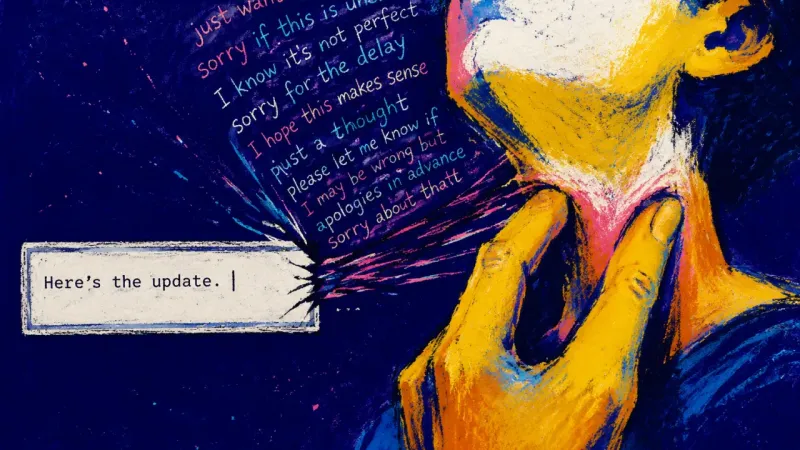
They described Tuesday night at their kitchen counter: cold mug of tea, Slack open on one monitor, Google Docs version history glowing on the other. Clicking the timeline again—again—watching their paragraph vanish like it never existed. Fingers hovering over Send. Throat tightening. Jaw clenching. The words getting stuck behind their teeth like a too-big bite of toast.
“If I speak up,” Jordan said, staring at the tabletop like it was a document they could edit, “I’m difficult. If I don’t, I’m basically telling myself my work doesn’t matter.”
What they called “stupid” wasn’t stupid at all. It was that specific, body-level unease—like trying to swallow while someone’s gently pressing two fingers against your throat—frustration on the surface, fear of being judged underneath.
I nodded and kept my voice steady. “You’re not overreacting—you’re reacting to a workflow that made your contribution invisible. Let’s try something simple today: we’ll use tarot like a map. Not to predict your coworker’s personality, but to find one clean step you can actually take—one that protects your work and your professional relationships.”

Choosing the Compass: The Five-Card Problem-Solving Cross
I asked Jordan to take one slow breath in through the nose, out through the mouth—longer exhale than inhale. Not as a ritual with dramatic vibes, just as a nervous-system gear shift. Then I shuffled while they held the question in their mind: My edit got deleted in the shared doc—how do I speak up, one step?
“Today,” I said, “we’ll use the Five-Card Problem-Solving Cross.”
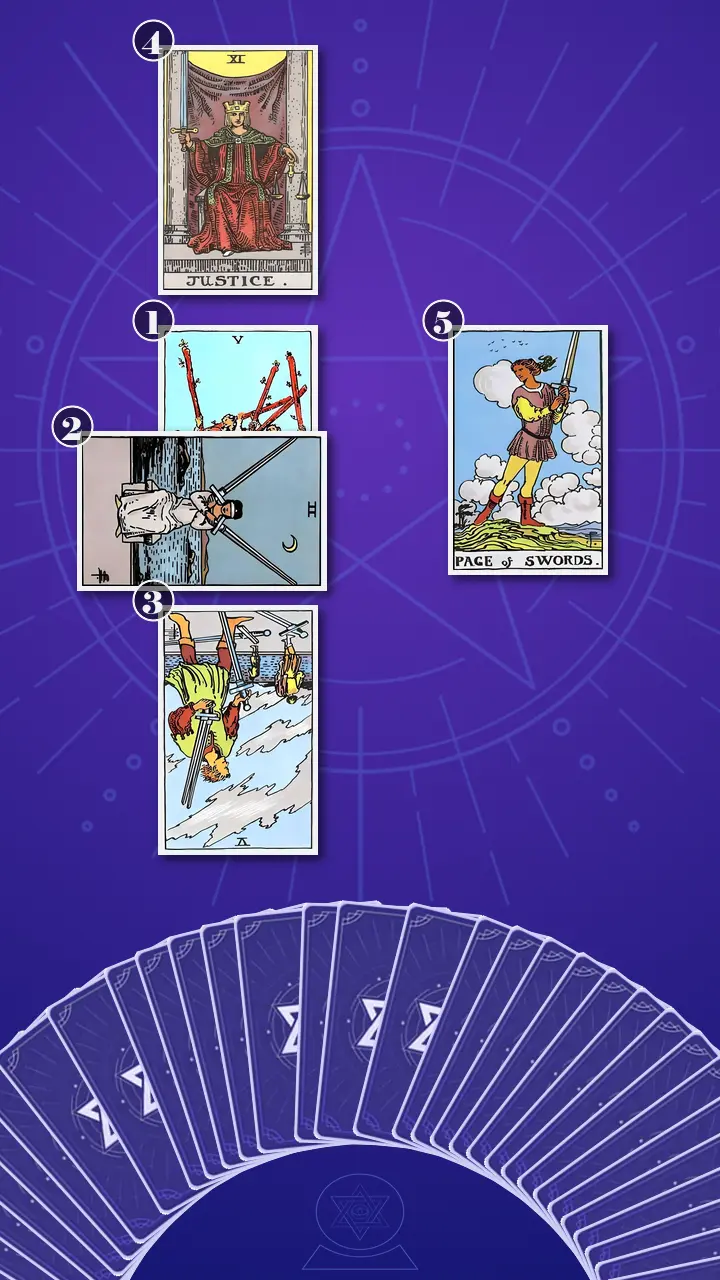
For readers who like to know how tarot works in a real-world context: a cross layout is ideal here because this is a simple, high-stakes interaction. One external event (a deleted edit) meets one internal blocker (the freeze before speaking up). This spread moves from what’s happening on the surface, to the obstacle inside you, to the deeper root pattern, then offers a principle for clarity—and finally one actionable next step. It’s built for moments like this when you’re asking, “Okay, but what do I do?”
I pointed lightly at the spots on the table. “Card one will show the immediate situation as it’s showing up in the shared space. Card two is the main obstacle inside you—what makes speaking up hard in practice. Card four is the key advice—the supportive reframe. And card five is the one step you can take in the next 24–48 hours.”
Jordan’s hands were wrapped around their cup like they were borrowing warmth until they could borrow courage.
Reading the Map: When a Doc Turns Into a Live-Edit Mosh Pit
Position 1: The immediate situation in the shared space
“Now flipped open,” I said, “is the card representing the immediate situation as it’s showing up right now.”
Five of Wands, upright.
This card always makes me think of a kitchen during a dinner rush—hands everywhere, everyone meaning well, nobody moving in the same rhythm. I looked at Jordan. “In modern life, this is: you open the shared Google Doc and it looks like a mini-riot of good intentions. Comments stacked, sections rewritten, someone ‘cleaning up’ while someone else is still drafting.”
“Yes,” Jordan said too fast, a laugh that sounded like it had a bitter edge. “That’s exactly it. Like… a doc mosh pit.”
“Your paragraph didn’t get deleted because you’re irrelevant,” I continued. “Your work got lost in a process optimized for speed and control, not coordination.”
The energy here is excess: too much activity, too many hands, not enough shared agreement about what ‘done’ means. That external heat is real. And it’s why this feels high-stakes: it’s not just the paragraph—it’s the unspoken rule that whoever edits last gets to define reality.
Jordan’s shoulders crept up a millimeter, like their body was bracing for the next ping.
Position 2: The main obstacle inside you
“Now flipped open,” I said, “is the card representing the main obstacle inside you—what makes speaking up feel hard in practice.”
Two of Swords, upright.
I didn’t rush this one. “Slack is open. The message box is open. You’re frozen like the cursor is judging you. You keep trying to write the ‘perfect’ tone—friendly, non-accusatory, not needy—until the safest option feels like doing nothing.”
Jordan’s eyes narrowed, not at me, but at the memory. Their thumb traced the rim of their cup like it was a touchpad.
I gave them the micro-scene I could see without being there: “You type, ‘Hey team—quick question…’ then backspace. You add, ‘Sorry if I missed something…’ then delete that too. And your brain runs the whole meeting in advance—who will roll their eyes, who will take it personally—until you close the laptop like it’s safer to disappear than to be ‘a lot.’”
Jordan exhaled through their nose. “That’s… kind of brutal.” They looked up for the first time and half-smiled. “Accurate. But brutal.”
“That’s the Two of Swords,” I said gently. “The obstacle isn’t lack of words. It’s the belief that words will cost you belonging.”
Energetically, this is blockage. Not silence as peace—silence as a shield that also blocks your own voice. Like muting yourself in a Zoom call to avoid noise… and forgetting you also muted your influence.
Position 3: The deeper root pattern underneath
“Now flipped open,” I said, “is the card representing the deeper root pattern—the learned fear underneath the reaction.”
Five of Swords, reversed.
“Under the surface,” I told them, “this isn’t just about one edit. It’s about conflict hangover: you’ve learned that small questions can turn into weird power games, so you’d rather opt out. But opting out doesn’t give you peace—it gives you a private resentment file you keep reopening.”
Jordan’s mouth tightened, then relaxed. That tiny change—like a clenched jaw realizing it’s been clenching—was the whole story.
This reversed card can show a desire to resolve things cleanly, but without feeling safe enough to enter the arena. The energy here is deficiency: a lack of trust that conflict can be handled without someone needing to “win.” And it explains why you over-polish your tone: you’re trying to pre-pay the social cost of speaking.
“You don’t have to accuse anyone to advocate for yourself,” I added, watching that land.
When Justice Spoke: Holding the Scales Without Turning It Into a Trial
Position 4: The most supportive reframe to lead with
I felt the room quiet down—not literally, the milk steamer was still doing its little dragon-breath thing—but the attention in the space sharpened. “We’re turning over the core card of your reading,” I said. “The principle that makes this fair and clean.”
Justice, upright.
Jordan leaned forward, then stopped, like their body wasn’t sure whether to approach clarity or flinch away from it.
“Justice,” I said, “is you stopping the performance of being ‘easy to work with’ and starting to act like a calm steward of accuracy.”
And because I’m a café owner before I’m anything else, my mind went straight to extraction. “In espresso, over-extraction happens when you keep pushing water through the grounds trying to get more—more flavor, more certainty—and what you get is bitterness. Your message drafts are the same. You keep over-extracting, trying to pull a perfect tone out of one situation. But the longer you push, the harsher it tastes in your mouth.”
That’s my Stress Flavor Profile: when your words start tasting burnt, it’s often not because you’re wrong—it’s because you’ve been brewing fear for too long.
Jordan’s eyes flicked down to the card again. Their shoulders were still raised, but their hands loosened around the cup.
Then I delivered the line I wanted them to hold onto—like a barista holds the scale steady instead of guessing by vibes.
Not “maybe I’m overreacting,” but “let’s look at what changed and why”—hold the version history like Justice holds her scales.
For a second, Jordan went still in a three-part chain I’ve seen a hundred times:
First, a physiological freeze—their breath paused, and their fingers hovered above the cup as if they forgot what they were holding.
Second, the cognition seeped in—their gaze softened, unfocused, like a memory replayed at 0.5 speed: Slack drafts, version history, the phrase “quick question” used like a shield.
Third, emotion moved—their shoulders dropped a fraction, and they let out a shaky little breath that sounded like relief and grief had decided to share a room.
Then came the unexpected reaction. Jordan’s brow furrowed, and their voice sharpened for one sentence. “But if I do that,” they said, “doesn’t it mean I’ve been doing it wrong? Like… all this time?”
I didn’t correct them. I honored the anger. “It means you’ve been doing what you had to do to stay safe. Justice isn’t here to shame you. It’s here to upgrade your strategy. The upgrade isn’t ‘be nicer’ or ‘be tougher’—it’s ‘be factual and fair.’”
“This isn’t a vibe conversation,” I added, tapping the table lightly beside the card. “It’s a clarity conversation.”
I watched Jordan’s jaw unclench—one of those almost invisible releases that changes your whole voice. “Now,” I asked, “with this new frame, can you think of a moment last week when you were about to ask and then didn’t? Where a single factual sentence could’ve protected you from spiraling?”
Jordan blinked, then nodded once. “Tuesday. I had the message in the box for… twenty minutes. I kept adding apologies.”
“That’s the shift,” I said. “From tight-throat conflict avoidance and mind-reading to calm, evidence-based self-advocacy with a clean request.”
Position 5: The one step in the next 24–48 hours
“Now flipped open,” I said, “is the card representing one step you can take in the next 24–48 hours—a concrete communication move you can actually do.”
Page of Swords, upright.
“This is courage as a clean question,” I told them. “One step, right now: you send the short message you’ve been circling—curious, direct, and specific. Then you pause and let the conversation be a conversation.”
The Page’s energy is balance: alert without aggression. It’s the buzzy wind-before-send feeling, but with a spine.
Jordan swallowed and touched their throat once, like checking whether it was still locked. “I hate how physical it is,” they murmured.
“Me too,” I said. “But it’s useful data. Think of it like a Caffeine Energy Scan: your body is reacting before your brain gives you the story. Tight throat means ‘this matters.’ It doesn’t mean ‘don’t speak.’”
And because I’ve watched a thousand cups cool on a thousand tables, I added my practical favorite: “We’ll also do a Cup Temperature Scan. If your energy is dropping fast—like your drink goes cold in five minutes—that’s your sign to keep the message simple. No dissertations. No over-extraction.”
From Insight to Action: The Justice Script You Can Actually Send
I leaned back and looked at the spread as a full story: external chaos in the doc (Five of Wands), internal freeze to protect belonging (Two of Swords), an old conflict hangover that assumes any pushback means you were wrong to ask (Five of Swords reversed). Then Justice steps in—not as a judge of people, but as a judge of process. The Page of Swords makes it real with one brave, concise question.
The cognitive blind spot here is subtle: you’ve been treating your message like a personality test—Will they like me after this?—instead of treating it like a collaboration tool—Can we align on what changed? The transformation direction is clear: shift from mind-reading and self-silencing to a neutral, evidence-based request tied to shared goals like accuracy, clarity, and workflow.
Here are your next steps—small enough to do, structured enough to stop the spiral:
- The “Once Only” Evidence CheckOpen Google Docs version history one time. Copy the exact section/header name where your text was removed (e.g., “Section 3: Risks & Dependencies”). Then close version history.If you feel tempted to keep scrolling the timeline, tell yourself: “Version history is for evidence, not emotional self-harm.”
- Fact–Question–Request (DM-First)Send a DM to the doc owner or closest collaborator: “Hey—noticed my paragraph under [Section/Header] was removed in the latest version. Was that intentional? If not, I can restore it; if yes, what direction are you aiming for so I can align?”Expect the urge to add disclaimers. If you see “sorry/just/quick question,” delete it once. Lower the bar: DM-first is allowed.
- The 6-Minute Draft-and-Send TimerSet a timer for 6 minutes. Draft the message one time only—three parts: (1) what changed, (2) was it intentional, (3) what’s next. When the timer ends, send.Right before you hit Send, do one slow exhale longer than your inhale. Then: “Fact. Question. Request. Then stop typing.”
If your body is too activated to send in the moment, your boundary is the pace, not the silence. You can step away, do a quick reset, and come back—but you don’t have to keep rewriting to earn the right to ask.

A Week Later: Ownership, Not Certainty
Six days later, between the morning rush and the lunchtime lull, I got a message from Jordan.
“Sent it as a DM,” they wrote. “Two lines. No apologies. They said it wasn’t intentional and restored it. Also… I didn’t refresh the thread twenty times. I walked around the block like you said.”
I pictured it easily: them standing outside in damp Toronto air, phone in pocket, shoulders still a little tense—but not folded inward. Clear but still human. Clear but not invincible.
Clear but vulnerable: they told me they slept through the night for the first time in a week, yet the next morning their first thought was still, “What if they think I’m difficult?”—and then they actually smiled, because now they had a script, not a spiral.
That’s the real Journey to Clarity. Not a life overhaul. A clean request, sent once, with self-respect intact.
When your work disappears in a shared doc, it can feel like your throat locks up between two fears: being seen as “too much” if you speak, and being quietly erased if you don’t.
If you let yourself send one message that’s more factual than friendly—just this once—what’s the simplest question you’d be willing to ask?
Every reading at AceTarot is designed to connect you with your inner wisdom and empower your next step.
Learn more about our Journey to Clarity.