The Chair-Scrape Moment That Stung—And the Text I Finally Sent

The Chair Scrape That Hit Like a Verdict
You’re 27, juggling a marketing job and a nonstop group chat, and one chair scrape at dinner sent you into a full Seat-Switch Spiral.
Taylor (name changed for privacy) came into my café a little after lunch, when the espresso machine is finally quiet enough to hear yourself think. Outside, Toronto was doing that grey, in-between-season thing—wind pushing receipts and leaves along the sidewalk like they owed it money. Taylor wrapped both hands around a cappuccino they hadn’t really tasted yet, shoulders pulled in as if they could make themselves smaller by sheer will.
“At dinner,” they said, eyes fixed on the crema, “my friend group… switched seats away from me. Like, casually. Chairs scraping, people standing mid-convo, and suddenly I’m at the edge. No one said anything. I didn’t say anything. And then I went home and—” They made a small, sharp laugh that didn’t reach their face. “I basically replayed it like security footage.”
I watched their throat tighten on the last word, the way their jaw set like it was holding back a whole argument they didn’t feel allowed to have. Hurt like that is specific: it lands in the body first. It’s the stomach-drop, tight-chest, hot-face combo that says outside before you’ve even decided what it means—like you missed a step on a stair that wasn’t there.
“You want clear belonging and respect,” I said gently, “but asking for clarity feels like volunteering to be labeled ‘needy.’ And if you don’t ask… you’re stuck with ambiguity punishing you all night.”
Taylor’s gaze flicked up, quick. “Yeah. Exactly. I don’t want to make it weird, but it already feels weird.”
“Okay,” I said, sliding a napkin toward them like a small flag of truce. “Let’s make a map for the weird. Today is a Journey to Clarity—not to force an outcome, but to get you out of mind-reading and back into self-respect.”

Choosing the Compass: A Relationship Spread for Friendship Tension
I didn’t light candles or do anything theatrical. In my world, the ritual is about switching gears—like taking the first slow breath before you pull an espresso shot. “Put both feet on the floor,” I told Taylor. “One inhale. One exhale. Just let your nervous system know we’re not in that dinner moment anymore.”
Then I shuffled, slow and even, the way my hands know how to do after twenty years of making coffee: steady pressure, no rush, no panic. “We’re going to use a five-card layout called the Relationship Spread,” I said.
For readers: I chose this spread because the question isn’t prediction—it’s interpretation and boundaries. Taylor doesn’t need a cosmic verdict about whether the group is ‘good’ or ‘bad.’ They need a clean container to separate what happened, what it triggered internally, what context might be in play, what next step restores agency, and what boundary keeps them from chasing belonging at the cost of dignity.
In this spread, the center card is the observable moment—the camera-footage version. The left card shows the internal story and sensitivity that wakes up when things get ambiguous. The right card shows the group dynamic you can consider without
It’s a cross shape for a reason: it mirrors that feeling of being nudged to the edge… and then re-centering yourself with one move upward (action) and one move downward (grounding self-respect).
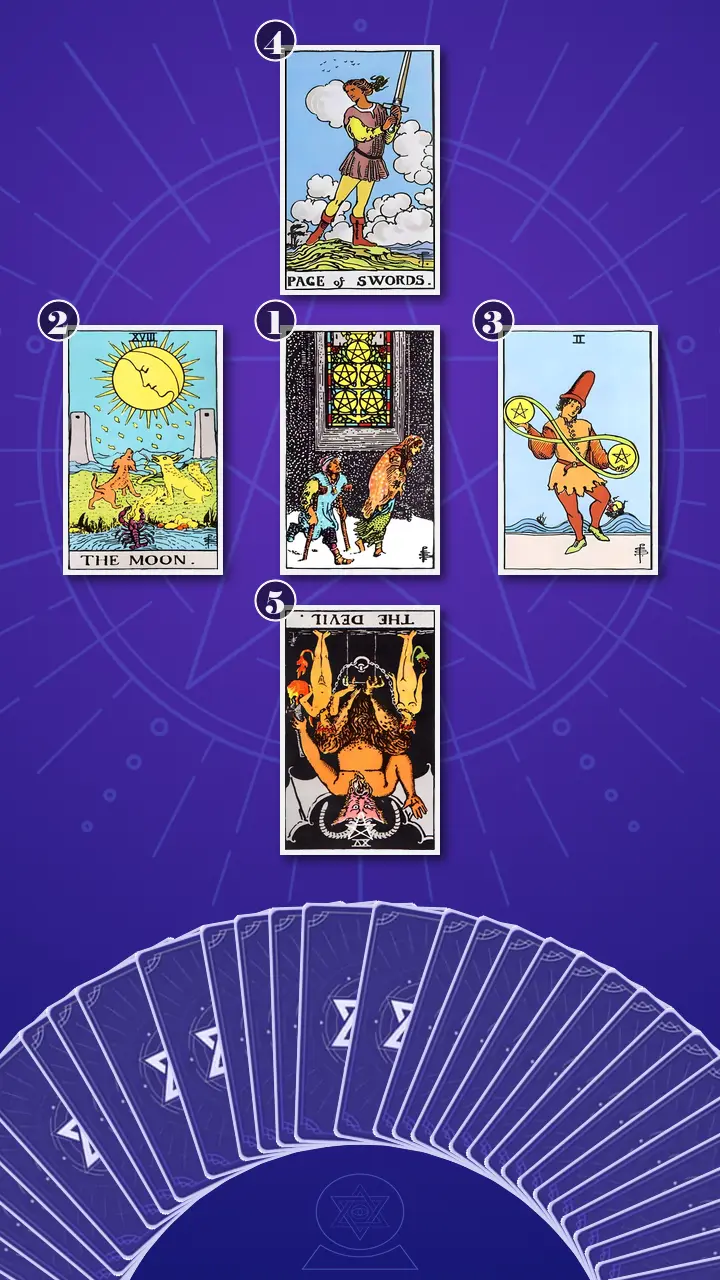
Reading the Map: Card Meanings in Context
Position 1: The Observable Moment (the “camera footage” version)
“Now flipping over is the card that represents the observable moment and its immediate relational impact—the camera footage version of what happened at the table,” I said.
Five of Pentacles, upright.
In the picture, two figures move through snow while a stained-glass window glows warm nearby. I pointed at the contrast. “This card doesn’t need an argument to hurt. It’s that specific sting of being in the same room but feeling locked out of the warmth—like you’re watching closeness through glass.”
And in Taylor’s life, the modern translation is painfully exact: you’re at dinner and nothing officially ‘happens’—no insult, no blow-up—but bodies angle inward, chairs scrape, and you end up on the edge of the conversation.
“Energy-wise,” I continued, “this is Earth—belonging feeling like something physical you can lose. The pain here is real. Nothing dramatic happened—yet your body clocked ‘outside’ instantly.”
Taylor let out that bitter little laugh again, softer this time. “Saying it like that feels… too accurate. Even kind of brutal.”
“Brutal doesn’t mean wrong,” I said. “It means your nervous system noticed something important. The key is: we name what you observed and what you needed without
Position 2: Your Internal Story (what fear writes in the gap)
“Now flipping over is the card that represents your internal story, sensitivity, and what you’re projecting or fearing in the absence of clarity,” I said.
The Moon, upright.
Even before I spoke, I could feel Taylor’s attention sharpen—like when you hear your name across a room. The Moon is fog, projection, and the mind filling in blanks when data is missing. It’s the part of you that treats uncertainty like danger.
“This is the seat switch turning into a whole storyline,” I told them. “Later that night, you replay chair movements and micro-expressions like they’re clues. Your brain buys the worst story at full price because it feels safer than not knowing.”
I let it land, then gave it a modern frame Taylor would recognize. “It’s like doomscrolling Instagram Stories after dinner like it’s evidence—zooming in on who sat next to whom, replaying clips, checking who’s tagged—trying to squeeze motive out of pixels that can’t actually show you intent.”
Energy-wise, this is Water swelling. Not because you’re “too sensitive,” but because old alarms rise fast when belonging has felt conditional before.
Taylor went still in a three-beat sequence: first their breath paused (like the body bracing), then their eyes unfocused for a second (like a memory replay), then their shoulders dropped a fraction with a quiet, resigned exhale. “Okay,” they said, almost to themselves. “Yeah. I do this. I literally did that this morning.”
“Good,” I said, warm but precise. “Not good that it hurts. Good that we can name the mechanism. Don’t turn a gap in information into a life sentence about your worth.”
Position 3: The Group Dynamic (context without mind-reading)
“Now flipping over is the card that represents the group’s likely dynamic or context you can consider without mind-reading any one person’s motives,” I said.
Two of Pentacles, upright.
The figure on the card juggles two coins in an infinity loop while ships bounce on choppy water. “This is social juggling,” I said. “Multiple conversations, multiple histories, multiple energy levels—people trying to balance it all in real time.”
In modern life terms: the seating change could be less ‘statement’ and more messy balancing—two friends catching up, someone trying to mediate energy, a reshuffle so different mini-convos can happen.
“This doesn’t erase your hurt,” I told Taylor. “It just introduces a possibility that’s not about you being exiled. The energy here is balanced adaptation, not a coordinated rejection.”
Taylor’s fingers, which had been gripping the cup, loosened slightly. “So it might’ve been… chaotic, not pointed.”
“Exactly,” I said. “And we don’t decide which story is true by replaying the night on the TTC in our heads. We decide by gathering one piece of real information.”
When the Page Raised a Sword in the Wind
I turned the deck once more, and the café felt suddenly quieter—like the espresso machine itself was listening.
Position 4 (Key Card): Your Most Empowering Next Step
“Now flipping over is the card that represents your most empowering next step: a concrete communication or behavior that restores agency and self-trust,” I said.
Page of Swords, upright.
The Page stands into the wind, sword raised—not aggressive, just steady. “This is clarity-through-questions,” I said. “Curiosity with backbone. One calm check-in instead of twelve drafts and a three-hour spiral.”
And this is where my café brain and my tarot brain speak the same language. “In coffee, there’s an extraction window,” I told Taylor. “Too short and it’s sour—too long and it’s bitter. Social Espresso Extraction works the same way: there’s an optimal time to ask for clarity. Not at 1:13 a.m. with your phone on low brightness, fingers hovering over Messages like it’s a detonator. More like: before 7 p.m., when your body is steadier and you can keep it low-drama.”
Taylor gave a tiny nod, the kind that says yeah, that’s painfully true.
Setup (what you’re stuck in): Taylor had been trapped between two awful options—ask and risk looking “needy,” or don’t ask and let uncertainty fill every quiet space. The dinner chairs moved for ten seconds; the meaning-making ran for hours.
Delivery (the sentence that cuts through the fog):
Not mind-reading in the dark—raise one clear question like the Page’s sword and let truth, not fear, decide your next move.
I let the words sit there. The steam from Taylor’s cappuccino curled up and vanished, like it didn’t want to be pinned down either.
Reinforcement: Taylor reacted in layers. First, their face went very still, eyes widening just a touch as if the sentence had found a direct line to their chest. Then their fingers—tight around the cup all session—unhooked one by one, palm flattening against the saucer. Finally, a small exhale came out of them, shaky but relieved, like their body had been holding a posture for hours and was suddenly allowed to stop.
“But if I ask,” Taylor said, and here came the flash of resistance, a quick flare of anger at the unfairness of it, “doesn’t that basically admit I care more than they do?”
“It admits you care about clarity,” I said, steady. “Those aren’t the same thing. And caring doesn’t make you needy. It makes you human. The Page doesn’t apologize for wanting reality.”
I leaned in slightly—not to pressure, to anchor. “Let’s do the contrast your brain keeps avoiding. The 17-paragraph text you draft at 1:13 a.m. versus one clean line.”
I watched Taylor’s eyes dart left, like they were seeing the Notes app in their head: the over-explaining, the self-deprecating jokes, the ‘lol sorry if this is dumb.’ Then their gaze returned to the table, more forward-facing.
“What if I just ask like it’s normal to want clarity?” they said quietly.
“That,” I said, “is the move from ambiguous social rejection spirals and self-silencing to reality-based clarity and self-respecting communication. That’s you stepping from The Moon’s fog into Air—data, not drama.”
I asked the question I always ask at this point: “Now, with this new lens—can you remember a moment last week when your mind started writing the script early? A moment when this sentence could’ve changed how your body felt?”
Taylor swallowed. “On the TTC,” they admitted. “Line 1, heading north. I was replaying the chair-scrapes, refreshing the group chat, like… if I stared hard enough at reaction emojis I’d get a verdict.”
“That’s the exact moment,” I said softly, “where one clear question beats twelve perfect drafts.”
Position 5: Integration & Boundaries (the pattern to release)
“Now flipping over is the card that represents integration and boundaries: what pattern to release so you don’t chase belonging at the cost of yourself,” I said.
The Devil, reversed.
This card is about attachment and compulsion—chains that feel permanent until you notice they’re removable. Reversed, it’s the unhooking.
“This,” I told Taylor, “is the urge to treat belonging like a subscription you keep renewing by being ‘low-maintenance.’ You pay with self-respect: you shrink at the table, laugh it off, speed-yes the next invite so you don’t get forgotten.”
Energy-wise, it’s the release of a block—stepping out of approval-seeking as a default survival strategy. “Belonging you have to earn by shrinking isn’t safety—it’s a deal that costs too much,” I said.
Taylor’s mouth tightened in a brave, slightly defiant line. Not dramatic. Grounded. “So… even if they say something dismissive, that’s information too.”
“Exactly,” I said. “We’re not using tarot to accuse anyone. We’re using it to restore your access to choice.”
From Fog to Next Steps: Clarity Isn’t Drama. It’s Data.
I pulled the whole story together the way I’d explain a coffee blend to a regular: what’s dominant, what’s subtle, and what changes the finish.
“Here’s the narrative,” I said. “The Five of Pentacles shows the real sting—your body felt outside the warm window at that table. The Moon shows the mechanism that turned a small cue into a full verdict: fear writing the script when you don’t have data. The Two of Pentacles reminds us group dynamics can be messy balancing, not a coordinated exile. The Page of Swords is the bridge—one respectful question that turns ‘vibes’ into information. And The Devil reversed is your long-term lesson: stop bargaining with your dignity to keep access.”
“Your cognitive blind spot,” I continued, “is treating silence as a strategy when it actually becomes self-punishment. You stay quiet to look chill, but then you force yourself to live with not-knowing—which is the exact fuel for the spiral.”
“The transformation direction is simple and not easy,” I said. “Move from mind-reading and self-silencing to one direct, low-drama question—then make a boundary-based choice about how much access this group gets to you.”
I slid a fresh napkin over and wrote a few steps down, crisp and doable.
- Do the “Camera Footage” Reset (2 minutes)Open Notes and write three observable facts only from the dinner (e.g., “X stood up,” “chairs moved,” “I ended up at the end”). Then add one line: “The story my brain tells is ___.” Label it as a story, not a fact.If your chest tightens while writing, stop after three facts. Then do one physical reset (drink water or wash your hands) to tell your nervous system you’re back in the present.
- Send One Low-Drama Check-In (before 7 p.m.)Pick the most grounded person in the group and send one sentence: “Hey—quick check-in. I noticed the seat shift last night and it landed a little weird for me. Was something up?”Use my Social Espresso Extraction rule: don’t ask at midnight mid-spiral. Ask in the clean window when you can stay calm and specific. One person, one sentence, no apology tour.
- Use the Social Thermometer to Read the ReplyWhen they respond, notice the “temperature”: Do they answer with warmth and clarity, or do they go lukewarm (minimize, mock, dodge)? Treat it as data about emotional safety and access settings—not as a verdict on your worth.If you feel the urge to over-explain after they reply, pause. Repeat: “Name what happened. Name how it landed. Then choose what you do with the answer.”
“And one boundary experiment for The Devil reversed,” I added, because Taylor’s eyes had that familiar ‘I’m going to overcompensate’ flicker. “Next time the group chat pings with a plan, wait 30 minutes once before replying. Not to play games—to break the compulsion loop that says you have to secure your spot by performing.”

A Week Later: Ownership, Not Certainty
A week later, between the lunch rush and the late-afternoon lull, my phone buzzed behind the counter. Taylor’s message was short—no twelve drafts, no careful self-erasure.
“I sent it,” they wrote. “Before 7. One sentence. They said it wasn’t about me—two people were trying to catch up and didn’t realize. They apologized. I still felt kind of tender, but… I slept.”
Clear but vulnerable: they slept a full night, and the next morning the first thought was still, what if I misread it?—only this time, they noticed the thought, breathed, and didn’t build a whole courtroom around it.
That’s what I love about tarot when it’s done like real life: not as fate, but as a tool for finding clarity. We didn’t erase awkwardness. We gave it a shape, a question, and a next move—so Taylor’s dignity didn’t have to be the price of staying connected.
When a room rearranges without you, it can feel like your body gets voted off the table before anyone says a word—so you stay quiet to look chill, and the silence punishes you louder all night.
If you trusted yourself enough to trade one tiny moment of awkwardness for real information, what’s the simplest, calmest question you’d be willing to ask this week?