Stuck in Read-Receipt Anxiety—And How to Let Your Message Stand

The 11:58 p.m. WhatsApp Trial
You hit send on an honest text and immediately start treating WhatsApp timestamps like evidence—classic read receipt anxiety.
When Alex (name changed for privacy) sat down across from me, they didn’t look “dramatic” or “too much.” They looked like someone whose evening had been hijacked by a tiny blue screen.
They described 11:58 PM in their London flatshare bedroom: rain tapping the window, the radiator clicking like a metronome for dread, the duvet pulled up to their chest. The only light was their phone glow. Their thumb did the same loop—unlock, open WhatsApp, stare at “last seen,” lock, unlock—like repeating the action could change the outcome.
“I hate that one text can hijack my whole evening,” they said, voice tight with that specific edge you get when you’re embarrassed and wired at the same time. “I’m not asking for a lot, but I’m terrified it’ll look like too much. Silence feels like an answer even when I know it isn’t.”
I watched them rub their sternum, as if they could press the tightness down into something manageable. Their breathing was shallow, their stomach doing that restless, caffeinated buzz you get when your body is ready to sprint but your life is… waiting.
It felt like this: a paper airplane has already left your hand, but you’re sprinting after it anyway—trying to force where it lands.
“We’re not here to judge the text,” I told them gently. “We’re here to map what happens after you hit send—so you can get your evening back. Let’s use tarot the way I use scent in my work: not as magic, but as a tool for pattern recognition and finding clarity.”

Choosing the Compass: The Four-Layer Insight Ladder
I invited Alex to take one slow breath with a hand on their ribs—not to “calm down” on command, but to give their nervous system a reference point. Then I shuffled while they held the question in mind: After I send a vulnerable text, what drives my overthinking spiral?
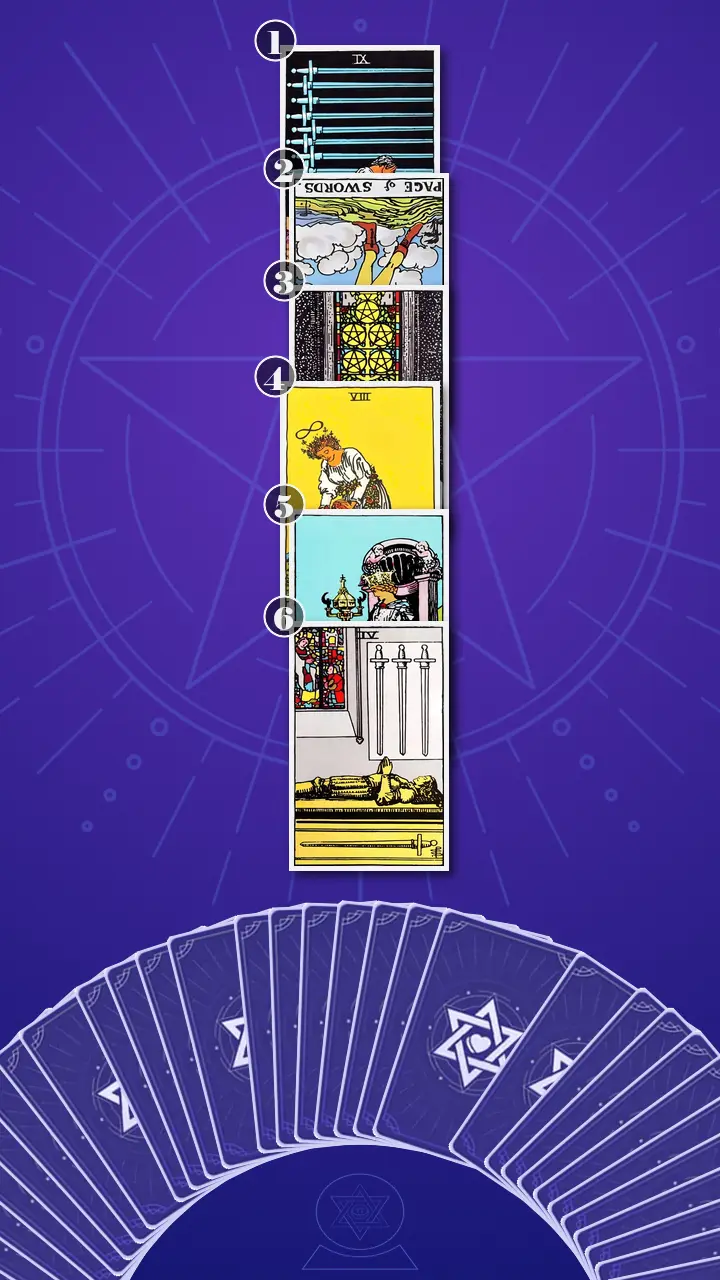
“Today I’m using a spread I call the Four-Layer Insight Ladder · Context Edition,” I said. “It’s a 6-card tarot spread for that post-text overthinking spiral—because the spiral usually isn’t caused by the message itself. It’s caused by what the waiting period symbolizes.”
For anyone reading this who’s ever Googled ‘Why do I spiral after sending a vulnerable text?’ at 1 a.m.: this spread works because it moves in a clean sequence—symptom to pattern to root fear, then back up into a lever, a resource, and a practical next step. It’s how tarot works best in real life: it organizes the mess into something you can actually respond to.
“Card 1 will show the visible spiral—what you do right after you hit send,” I explained. “Card 3 gets underneath it, to the fear the silence is poking. And card 4 is our hinge: the turning point that changes the whole pattern.”
Reading the Ladder Down: From Symptom to Root
Position 1 — The visible spiral: what you do right after sending
“Now turning over,” I said, “is the card that represents the visible spiral: what you do right after sending the vulnerable text and how it affects your body and attention.”
Nine of Swords, upright.
It was almost too on-the-nose: a figure sitting up in bed, hands to their face, swords hanging overhead like thoughts you can’t click out of.
“This is 12:14 AM in bed in your London flatshare,” I said, using the scene exactly as it lives in modern life. “Cold blue phone glow. Tight chest. Restless stomach. Leg bouncing under the duvet. You reread your message like it’s a legal document—then replay their possible reactions like trailers: annoyed, amused, indifferent, gone.”
I held the card between us. “The energy here is Air in excess—not ‘thinking’ as a helpful tool, but thinking as an attack. Uncertainty turns into self-punishment. It’s not waiting. It’s interrogation.”
Alex let out a small laugh that had no humor in it. “That’s… brutal,” they said, like it hurt to be perceived that accurately.
I watched a three-step reaction pass through them: first a freeze—their breath paused mid-chest; then recognition—their gaze unfocused, like they were replaying last night’s loop; then release—a tiny exhale through the nose, shoulders dropping a millimeter.
“Brutal, yes,” I said. “But also precise. Precision is how we get leverage.”
Position 2 — The mental hook: the thought pattern that grabs you
“Now turning over,” I said, “is the card that represents the mental hook: the thought pattern that grabs you and turns uncertainty into a problem to solve.”
Page of Swords, reversed.
In the Page, the sword is raised, the sky windy—curiosity and quick analysis. Reversed, that watchfulness becomes surveillance.
“Here’s the split-screen,” I told Alex. “On one side: your thumb hovering over the chat while Netflix autoplay runs like background noise you can’t actually hear. On the other side: your brain running courtroom-style arguments about punctuation and timing.”
And I named the loop the way it actually happens: unlock phone → open thread → stare at ‘last active’ → lock phone. Repeat. Tight chest, buzzing stomach. Repeat. Draft three follow-ups—one over-explaining, one joking it off, one going icy. Delete them all. Repeat.
“This is Air in blockage,” I said. “Your mind is trying to be helpful by collecting micro-data so it can predict safety. But reversed, it turns into suspicion—like you’re investigating a case about your own worth.”
Alex swallowed. “I literally zoom in on their punctuation,” they admitted. “Like it’s going to confess something.”
I nodded. “Checking again won’t give you certainty. It just rents your nervous system out by the minute.”
Their jaw unclenched—then clenched again, like their body didn’t fully believe it was allowed to stop.
Position 3 — The core fear underneath: what the silence might “prove”
“Now turning over,” I said, “is the card that represents the core fear underneath the overthinking: what the silence or response might ‘prove’ about you.”
Five of Pentacles, upright.
The stained-glass window glowed in the card—warmth, community, shelter—while two figures limped in the cold, unable to access it.
“This is the belonging alarm,” I said, keeping my voice calm and specific. “The silence doesn’t just feel uncomfortable—it feels like being quietly deprioritized. Like you stepped out into the cold and everyone else stayed inside.”
I translated the window into modern warmth: notifications, invitations, being chosen, that sense that you’re safely held in someone’s attention. “Even if you have friends who love you, in this moment you can’t feel the warmth. You can only feel ‘outside.’”
Alex stared at the card and then at their hands. “I’m not sad,” they said slowly, almost surprised by their own words. “I’m… unpicked.”
“Yes,” I said, and let the pause be respectful, not dramatic. “And here’s the reframe I want you to hold.”
A vulnerable text isn’t a test you pass—it’s an offer you make.
Their eyes softened, just slightly. The shame in their expression shifted into something closer to grief—less sharp, more honest.
When Strength Spoke: Holding Your Center in the Pause
Position 4 — The turning point: the inner capacity that changes the pattern
I let the room go quieter before we turned the next card. The rain was steady now, and somewhere in the flat a kettle clicked off—small, domestic proof that life continues even when a reply hasn’t arrived.
“Now turning over,” I said, “is the card that represents the turning point: the inner capacity that helps you stay with vulnerability without trying to control outcomes.”
Strength, upright.
Setup lived right there between us: it’s 11:26 PM in a shared flat in London. Hallway light leaks under the door. Your phone is warm from being in your hand. You reread the same two lines like they’re going to change if you stare hard enough. Your body is begging you to do something to end the uncertainty.
Stop wrestling the outcome and start holding your center—like Strength, you lead with gentle steadiness instead of chasing certainty.
I didn’t rush past the sentence. I let it sit in the air like a base note—slow to bloom, impossible to fake.
Alex’s reaction came in layers. First: their fingers went still, hovering above their phone as if they’d forgotten what it was for. Second: their eyes went glossy, not with tears yet, but with pressure—like the body recognizing an exit after too long in a cramped stairwell. Third: a long, trembling exhale that seemed to come from deeper than their lungs.
“But if I don’t manage it…” they started, and then stopped. Their mouth tightened. A flash of anger crossed their face—sharp, honest. “Doesn’t that mean I’ve been doing it wrong? Like I’ve been… embarrassing myself?”
I kept my tone steady, the way I do when someone’s nervous system expects judgment. “It means you’ve been trying to stay safe with the tools you had,” I said. “Strength doesn’t shame the lion for being a lion. It doesn’t pretend the urge isn’t real. It leads it.”
This is where my perfumer brain always flashes in: people think perfume is about forcing an impression. It isn’t. Over-spraying never creates intimacy; it creates distance. The best scent doesn’t chase. It holds—a calm structure that lets someone come closer on their own terms.
“Your overthinking spiral is a kind of over-spraying,” I told Alex, and I saw them actually smile at the metaphor. “It’s your nervous system trying to control how you’re perceived in real time. Strength is choosing a steadier fixative: self-trust in the pause.”
Then I gave them the practice in the simplest, most usable form—my version of an Emotional Repair Pathway: phase one is regulation, not resolution.
“Try a ‘Strength Pause’ once this week,” I said. “Right after you send something vulnerable, set a 20-minute timer and put your phone out of reach—another room if possible. In a note, write: (1) one fact, (2) one story, (3) one self-respecting action that doesn’t require their reply. If this spikes your anxiety, you can shorten it to 5 minutes—this is practice, not punishment.”
I leaned in slightly. “Now, with that lens—when was the last time you tried to ‘fix’ the pause? Like, last week. Can you picture a moment where holding your center would’ve changed what you did next?”
Alex blinked, then nodded once. “Tuesday. On the Overground. I drafted the ‘No worries if you’re busy!’ text like… five times.” They looked down, and when they looked back up, their voice was quieter. “I could’ve just… let it stand. Let my message be my message.”
“Exactly,” I said. “This is the shift from anxious anticipation and outcome-control to calm self-trust and self-respecting vulnerability. Not instantly. Not perfectly. But directionally.”
Position 5 — Your emotional resource: the supportive inner stance you can access
“Now turning over,” I said, “is the card that represents your emotional resource: what supportive inner stance or relational skill you can access right now.”
Queen of Cups, upright.
“This is the part of you that can feel deeply without making every feeling an emergency,” I said. “The closed cup matters: emotions are honored, but not dumped out to force reassurance.”
I used the modern translation because it matched Alex exactly: “Instead of screenshotting the thread to three friends, you become the friend you keep trying to outsource to. You say: ‘Of course I’m spun up. I took a risk.’”
Alex’s shoulders lowered again, as if someone had finally given their heart permission to take up normal space.
“I always ask for analysis,” they admitted. “But I want comfort.”
“That’s Queen of Cups wisdom,” I said. “Comfort is not the same as decoding.”
Position 6 — A grounded next step: what to do during the waiting period
“Now turning over,” I said, “is the card that represents a grounded next step: a specific way to respond to the waiting period that builds self-trust this week.”
Four of Swords, upright.
The card felt like a deep exhale: a resting figure, swords present but contained—thoughts exist, but they’re not being weaponized.
“We’re going back to the same setting as the Nine of Swords,” I said, “but we’re re-staging it.”
“Right after you hit send, you create a mini ‘rest container’: Do Not Disturb on, phone charging across the room, and a 20-minute timer. You make tea, rinse a few dishes, or step outside for a quick lap around the block—anything that tells your body, ‘We’re safe enough to pause.’”
The rain outside sounded softer now, or maybe Alex’s attention had stopped clawing at it for meaning. They nodded, slow and practical. “Okay,” they said. “I can do 20 minutes. That’s not impossible.”
The Rest Container Rule: Actionable Advice for the “Seen-But-No-Reply” Spiral
I stitched the ladder into one story for Alex, the way I’d blend a fragrance so the notes finally make sense together.
“Here’s what I see,” I said. “The moment you hit send, your mind spikes into Nine of Swords—rumination so loud it steals your sleep. Then Page of Swords reversed kicks in: you try to get control by monitoring, drafting, collecting micro-data. Underneath, Five of Pentacles is the engine: the silence threatens to ‘prove’ you don’t belong. Strength is the hinge—gentle courage that leads your impulse instead of obeying it. Queen of Cups is your inner ally. Four of Swords is the boundary that turns waiting from punishment into a protected pause.”
The cognitive blind spot was clear: Alex was treating uncertainty like a technical problem—something they could optimize with the perfect wording—when it was actually an attachment alarm demanding proof of belonging.
“The transformation direction is simple, but not easy,” I said. “You’re shifting from trying to control their response to practicing self-trust in the pause after you speak. You don’t need a perfect follow-up. You need a steadier pause.”
Then I gave them concrete next steps—small, choice-based, and doable in a London flatshare with thin walls and a phone that feels magnetized to your palm.
- The Strength Pause timerRight after you send a vulnerable text, set a 5–20 minute timer and put your phone on charge across the room (or in the kitchen if you can). No follow-up drafts until the timer ends.If 20 minutes feels impossible, do 5. This is nervous system practice, not a personality makeover.
- The “Facts vs Stories” check (two lines only)Open a note titled Facts vs Stories. Write exactly one fact (“No reply yet.”) and one story (“They’re losing interest.”). Stop there—no third line, no debate.If you catch yourself adding paragraphs, that’s your cue to step away, not to refine the narrative.
- A self-respecting action (plus a tiny space-clear)Do one action that doesn’t require their reply: make tea, shower, a 7-minute block-walk, or tidy one surface. While you do it, open a window for 30 seconds or change the sensory scene (fresh air, a different room, even washing your hands with a scent you like) to signal “new moment.”This is my heartbreak-recovery space-clearing technique in mini form: you’re not erasing feeling—you’re interrupting the loop with a clean reset.

A Week Later: Ownership, Not Certainty
A week after our session, Alex sent me a message that made me trust the work even more: “Did the Strength Pause. Put my phone in the kitchen. I hated the first two minutes. Then I made tea and—no joke—I stopped shaking.”
They added, “They replied eventually. It was fine. But the weird part is… I slept. I still woke up and thought, ‘What if I’m wrong?’—but I didn’t grab my phone. I just… lay there. And I was okay.”
That’s the Journey to Clarity I care about: not a guaranteed response, but a steadier center. A vulnerable text as an offer—not a trial. A pause you can survive without interrogating your worth.
We’ve all had that moment where your phone goes quiet, your chest tightens, and it suddenly feels like your honesty is on trial—like their response is going to decide whether you belong.
If you didn’t have to control how they receive you, what’s one tiny way you’d want to take care of yourself in the hour after you hit send?