From WhatsApp Spiral to Clean Questions: Practicing Calm Directness

Finding Clarity in the 11:38 p.m. WhatsApp Glow
If a single “K” can flip your whole evening into a Notes-app spiral, welcome to comparison-free, vibe-preserving conflict avoidance—aka the modern texting mind-reading loop.
Maya (name changed for privacy) slid into the chair by the window of my café, hoodie still damp from the London drizzle. She was 29, a junior product manager, the kind of person who can be crisp in a stand-up meeting and somehow turn into a poet of apologies in a dating text.
She didn’t even need to show me her phone for me to see it: 11:38 p.m. on a Tuesday in a Hackney flat, sofa cushions swallowing you whole, the blue WhatsApp glow bleaching your face. The lamp hums. The kettle clicks off. Your tea has gone cold enough to taste like metal. Notes is open with three drafts of the same message. Your jaw is locked like it’s keeping a secret.
“I hate that a single letter can ruin my whole evening,” she said, voice tight at the back of her throat. “I want to call it out and ask for clarity. But I keep editing myself into silence so I won’t seem… demanding.”
Her anxiety wasn’t an abstract feeling—it sat in her body like she’d swallowed a stone that pressed up into her chest, while her thumb kept twitching toward the screen, trying to fix uncertainty by checking it again.
I nodded, gentle but direct. “You want clarity and self-respect. You fear being seen as ‘too much’ and getting dropped. Let’s not judge that—let’s map it. Tonight, we’re doing a Journey to Clarity, not a trial.”

Choosing the Compass: The Four-Layer Insight Ladder Spread
I asked Maya to take one slow breath in, one slow breath out—nothing mystical, just a clean transition from spiraling to observing. While I shuffled, the café did what it always does: espresso machine hissing softly, rain tapping the awning, the comfort of ordinary life holding the edges of something tender.
“We’re going to use a spread called the Four-Layer Insight Ladder · Context Edition,” I told her. “It’s designed for moments exactly like this—conflict avoidance in texting after a dismissive one-letter reply.”
And for you reading: I like this ladder because it keeps agency in the querent’s hands. It moves from behavior → trigger → root fear → shadow → integration → action. It doesn’t pretend to predict what the other person ‘really meant.’ Instead, it shows why the loop starts, why it sticks, and what a grounded next step looks like.
I previewed the three rungs that matter most tonight: the first card would show the observable habit right after the “K.” The fifth would reveal the balancing medicine—the middle path between silence and a fight. And the sixth would give a next-message script—a practical move, not a personality overhaul.
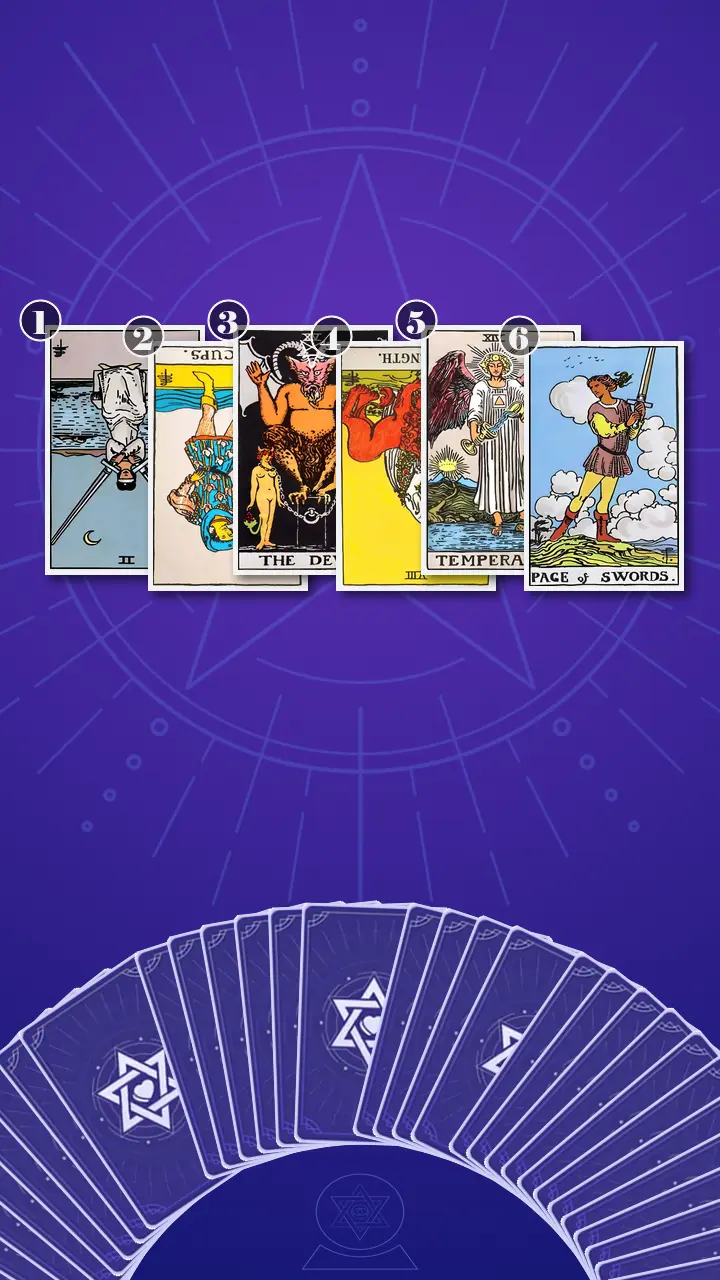
Reading the Ladder: From Blindfold to Breath
Position 1 — The Habit You Do on Your Phone: Two of Swords (reversed)
“Now we open the card that represents the observable conflict-avoidance habit that shows up right after the ‘K’ text.”
Two of Swords, reversed.
I pointed to the blindfold and the crossed blades held tight to the chest. “In modern life, this is you seeing ‘K’ and then locking your screen, unlocking it, reopening the chat, jumping to Notes, drafting multiple versions that all try to sound ‘least annoying.’ You keep the conversation technically alive—a safe emoji, a soft ‘no worries’—while avoiding the one thing you actually want: a direct read on what’s going on.”
Reversed, the energy isn’t calm neutrality. It’s a blockage—Air stuck in the throat. Communication held back like breath you don’t want anyone to hear. I mirrored it back exactly: the app-close/app-open loop; the jaw clench; the internal subtitles—If I say it plainly, I’m ‘too much.’ If I say nothing, I’ll resent them tomorrow.
Maya gave a small laugh that had a bitter edge. “That’s… so accurate it’s kind of rude.” Her shoulders dropped a millimeter, like the body appreciates being named without being shamed.
Position 2 — The Trigger: Page of Cups (reversed)
“Now we open the card that represents what the ‘K’ text triggers in you emotionally and cognitively.”
Page of Cups, reversed.
“See the cup, and the fish popping up like an unexpected fact?” I said. “This is the moment you sent something normal—maybe a plan, a check-in, a tiny vulnerable line—and the ‘K’ makes you feel instantly exposed. You start shrinking your tone. You add ‘haha’ or ‘no stress!’ because you’re trying to protect yourself from the possibility that you cared more than they did.”
In reversed form, this Page is a deficiency of emotional safety. Not because you’re wrong for wanting warmth—but because the system inside you starts negotiating your needs down before anyone has even answered.
I softened my voice. “I wasn’t asking for a poem—I was just hoping for warmth.”
Maya’s eyes went briefly glossy; she looked down at her hands. A quiet, almost embarrassed “yeah” slipped out, like admitting tenderness costs her something.
Position 3 — The Root Hook: The Devil (upright)
“Now we open the card that represents the deeper attachment or fear keeping the pattern in place.”
The Devil, upright.
“The chains are loose,” I said, tapping the image lightly. “That’s important. This isn’t fate. It’s habit.”
Then I used the metaphor that always lands cleanly: “This card feels like an autopay subscription to approval. Every time a reply goes cold, you renew the subscription with politeness—softening your ask, checking read receipts, waiting for them to rescue you from ambiguity—because cancellation feels like it could cost you belonging.”
Upright Devil energy is an excess of control-by-pleasing: treating their tone like a verdict on your worth. If they’re warm, you’re safe. If they’re curt, you’re at risk. So the keyboard becomes a place where you perform for safety instead of asking for reality.
Maya’s stomach visibly tightened—she pressed her lips together, then let out a slow breath through her nose. “God. I do act like I’m trying to earn my way back into ‘good standing.’”
Position 4 — The Shadow You Swallow: Strength (reversed)
“Now we open the card that represents the shadow you avoid expressing—the courage, boundary, or truth you swallow to keep peace.”
Strength, reversed.
I held the card between us. “Strength isn’t aggression. It’s steadiness. Reversed, it’s the fear that you won’t stay regulated if there’s pushback.”
And I gave her the split-screen: “You type, ‘That felt dismissive—what did you mean?’ Your body reacts like it’s danger—tight chest, clenched jaw. You swallow it; your tongue presses to your teeth. Then you replace truth with performance: a meme, a topic change, or silence dressed up as ‘being chill.’”
This is a deficiency of self-trust—not self-esteem as a slogan, but the specific trust that you can handle a tense reply without collapsing or exploding.
Maya took a sharp inhale. Her fingers curled, then unclenched on her cup. “I don’t trust myself to stay calm if they come back defensive,” she admitted. “So I try to prevent the whole situation by being… small.”
When Temperance Spoke: Two Cups, One Truth
Position 5 — The Integration: Temperance (upright)
I let the room go quieter on purpose before turning the next card. Even the espresso machine seemed to pause between hisses, like the café was listening with us.
“Now we open the card that represents the key integration that turns conflict into a workable conversation—the regulated middle path.”
Temperance, upright.
Temperance is the angel with one foot on land, one in water, pouring steadily between two cups. In real life: it’s not silence versus a fight. It’s a third option—honesty with calm.
Here’s where my café brain always kicks in. I’ve pulled thousands of espresso shots. When someone is exhausted, they keep the shot running too long—over-extraction. The result isn’t “more coffee.” It’s bitterness. In texting, you can over-extract too: you pull thirty interpretations out of one letter until the whole thing tastes harsh. Temperance is the exact opposite: balanced extraction. Enough truth to be real. Enough regulation to keep it drinkable.
Setup: Maya was right back on the sofa with her phone lighting up her face, rereading the thread like it’s evidence. Notes open, three drafts, jaw tight, thumb hovering—an entire evening decided by one letter she’s pretending she’s fine with.
Stop diluting your needs into silence; blend honesty and calm like Temperance pouring between two cups.
It landed, and her reaction came in a chain. First, a freeze—she stopped breathing for a beat, eyes fixed on the card like it had said her name. Then the thought pushed through, sharp and defensive: “But if I do that,” she said, voice rising, “doesn’t it mean I’ve been doing it wrong? Like… I’ve been the problem?”
I didn’t rush to soothe. I stayed steady. “It means you’ve been trying to stay safe with the tools you had. Temperance isn’t a verdict. It’s a skill.”
Her face changed again: the anger softened into something raw; her mouth opened slightly; her eyes reddened at the rims. Her shoulders lowered like she’d put down a heavy bag she forgot she was carrying. She exhaled—long, shaky, then cleaner. “So I don’t need the perfect reply,” she whispered. “I need a balanced one.”
I nodded. “Exactly. Set a 6-minute timer. Draft exactly two sentences—your ‘two cups’: (1) one neutral observation: ‘When I got “K,” I wasn’t sure how to read it.’ (2) one clean question: ‘Are you annoyed, or just busy?’ No apology. No emoji buffer. If your throat spikes, do three slow exhales. You can still choose not to send—this is practice, not a contract.”
Then I asked, softly but clearly: “Now, with this new lens—can you think of one moment last week when this would’ve changed the whole night?”
Maya stared past me for a second, like she was replaying footage. “Friday,” she said. “I typed the direct question, deleted it, and sent ‘lol fair’ instead. I spent two hours checking read receipts.”
“This,” I told her, “is the shift from phone-checking anxiety and self-editing into silence to regulated honesty and boundary-led curiosity.”
The Page of Swords Send Button
Position 6 — The Concrete Next Step: Page of Swords (upright)
“Now we open the card that represents a concrete next step you can do in the next message—one clean move that breaks the loop.”
Page of Swords, upright.
Wind-tossed hair, wide eyes, sword held cleanly up: this isn’t an attack. It’s a reality test. A question that replaces guessing with information.
I gave her the exact Page of Swords message script: “Hey—when you replied ‘K’ I wasn’t sure how to read that. Are you annoyed or just busy?”
Then I added the reframe I’ve watched change people’s posture in real time: “A clean ask is not a fight. It’s a request for reality.”
Maya’s thumb mimed the motion of pressing send. She inhaled, paused, then let the breath out slowly like she was proving to herself she could survive a moment of discomfort.
From Overthinking to Actionable Advice: The Two Cups Text
I leaned back and stitched the ladder together for her: after the “K,” the Two of Swords reversed shows the freeze-and-edit habit—neutral on the outside, clenched on the inside. Page of Cups reversed shows the tender drop—sincerity flipping into self-consciousness. The Devil shows the hook—belonging-by-performance steering the keyboard. Strength reversed shows the avoided skill—trusting you can stay steady if there’s pushback. Temperance is the integration—regulated honesty. Page of Swords is the behavior—one clean question, data over guessing.
The blind spot is subtle but huge: believing you can earn safety through perfect tone. That’s why you keep drafting and deleting. The transformation direction is simpler: clarity over perfect tone—one respectful ask, then letting the response give you information.
Before we wrote her next steps, I used one of my café tools. I placed her cappuccino down and watched it for a moment. “This is my Cup Temperature Scan,” I said. “If your cup cools fast, your system is already leaking energy. Texting from that place turns everything into emergency.” She gave a small, surprised smile—because it was absurdly true.
Then I offered her practical next steps she could actually do in the next 48 hours:
- Two Drafts MaxWhen you get a dry reply, allow yourself only two drafts in Notes. Draft 1 is whatever your anxious brain wants. Draft 2 is the cleaned version. After that, send or pause.Expect the urge to add “sorry if…”—that’s the old safety strategy. Two drafts max. After that, you’re not editing a text—you’re editing yourself.
- The Two Cups Text (Observation + Question)Set a 6-minute timer and write exactly two sentences: (1) “When I got ‘K,’ I wasn’t sure how to read it.” (2) “Are you annoyed, or just busy?”No apology padding. If it feels harsh, read it out loud once—if it sounds like something you’d say to a colleague, it’s probably fine.
- 5-Minute Coffee Meditation (Riposo Reset)Before you send, put your phone face down. Grind coffee or open a jar of grounds, inhale the aroma, and do three slow exhales. Unclench your jaw, drop your shoulders, then type the shortest honest version.This is riposo—an Italian pause. You’re not delaying to avoid conflict; you’re regulating so you can be clear.

A Week Later: Ownership, Not Certainty
A week later, Maya messaged me—not a paragraph, just a screenshot and one line: “I sent the Two Cups Text. My stomach flipped, but I did it.” The reply she got back was… normal. Not perfect, not magical. But real. She didn’t celebrate with fireworks—she sat alone in a café after work, drinking something hot on purpose, and let herself feel proud without needing anyone to co-sign it.
This is what finding clarity can look like: not certainty about their intentions, but ownership of your voice. You’re allowed to prefer clarity over vibes.
When one letter makes your throat tighten and your brain start auditioning ‘the least annoying version’ of you, it’s not drama—it’s the exact moment you’re choosing between belonging-by-performance and self-respect-by-clarity.
If you didn’t have to earn warmth tonight, what’s the smallest, cleanest question you’d feel okay sending—just to get real information?