From Shame-Spiral Texting to Mutual Fit: Answering 'What Are You Looking For?'

The TTC Spotlight Text: A Self-Worth Spiral in One Question
You’re a 20-something/early-30s city person with a hybrid job, and the second a dating app match asks “What are you looking for?”, your stomach drops like you’ve just been put on the spot in a meeting—instant Sunday Scaries, but make it romance.
Taylor (name changed for privacy) sat across from me with their phone face-down on the little table between us, as if it might buzz and expose them at any moment. They’re 29, a marketing specialist in Toronto, the kind of person who can ship a deck, track performance, and hit a deadline—then completely freeze over one sentence in a chat thread.
They described Tuesday, 8:47 PM on Line 1 southbound: fluorescent lights buzzing overhead, winter coats brushing shoulders, the screen glow too bright against the window’s black reflection. Their phone had gone warm from being open so long. A simple message—“So… what are you looking for?”—and suddenly their throat tightened like a drawstring. Stomach dropped. Face went hot. Thumb hovered. Then: Notes app. Draft. Delete. Draft. Change one word, change it back. Lock the phone like closing a laptop in a meeting when you realize you’ve been caught off-guard.
“The second I have to define it,” Taylor said, voice low, “I feel like I’m failing a test.”
I didn’t call it anxiety. I didn’t call it insecurity. I called it what it felt like in their body: like trying to speak while standing on thin ice—every syllable a crack that might prove you don’t belong on the surface at all.
“That makes so much sense,” I told them. “If your nervous system thinks this is an evaluation, it will try to protect you with perfection. Today, let’s do something different. Let’s make a map through the fog—so you can find clarity without turning your worth into a negotiation.”

Choosing the Compass: The Four-Layer Insight Ladder
I invited Taylor to take one slow inhale, then a longer exhale—nothing mystical, just a signal to the body that we were stepping out of the chat thread and into a wider view. I shuffled slowly, listening the way I listen to weather: not for drama, but for patterns.
“Today,” I said, “we’ll use a spread I designed for moments exactly like this: the Four-Layer Insight Ladder · Context Edition.”
For anyone reading who’s ever googled how tarot works because you don’t want vague predictions—you want something usable—this is why I like this spread for a self-worth spiral after a dating-intentions question. It’s not about forecasting whether this person will text back. It’s about decoding what happens inside you when the question lands, so you can change the next step.
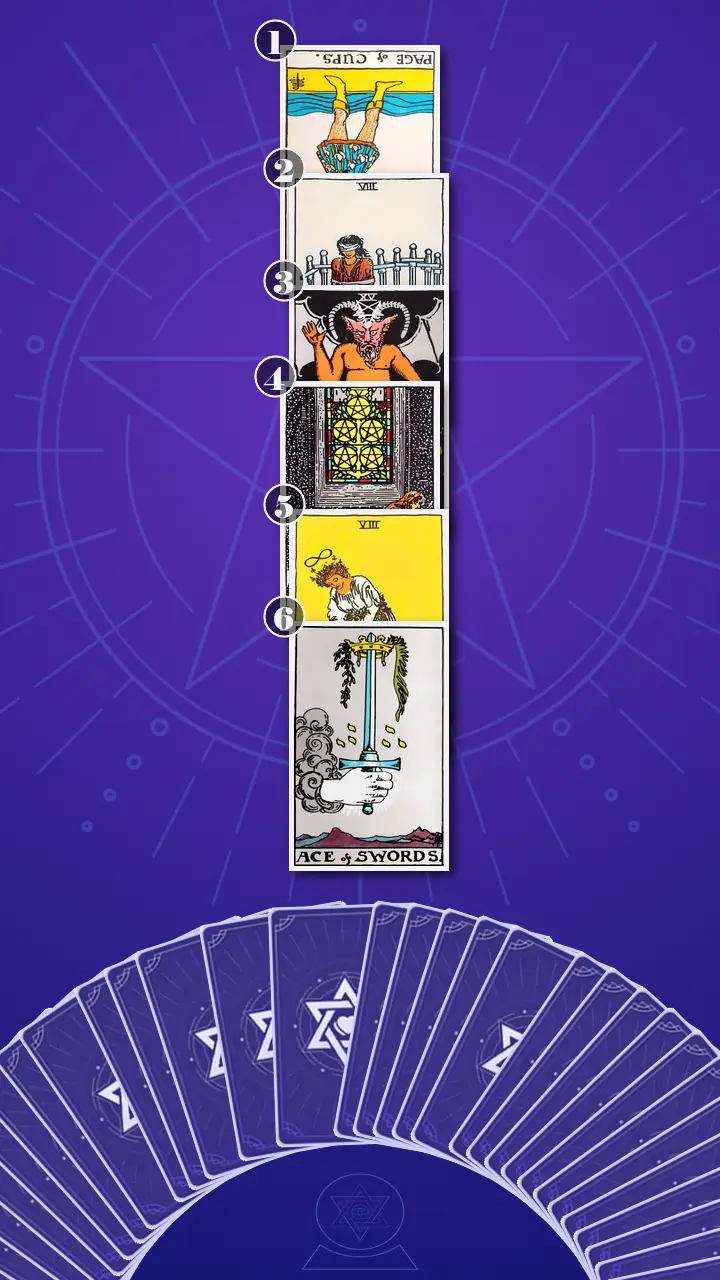
The ladder is linear—six cards read straight down like walking down a stairwell from noise to clarity. Card 1 shows the first ten seconds (the trigger). Card 2 shows the visible spiral behavior (editing, delaying). Cards 3 and 4 name the deeper drivers (attachment, belonging wound). Card 5 is the turning point. Card 6 is your one-week action—low-drama, repeatable, practical.
Reading Down the Stairwell: From Trigger to Root
Position 1 — The first 10 seconds: The immediate trigger response
“Now turning over,” I said, “is the card that represents the immediate trigger response—what the question activates in your emotional system in the first 10 seconds.”
The Page of Cups, reversed.
I showed Taylor the image: the Page holding a cup, the surprise fish rising up—something alive where you expected something simple. “This,” I said, “is the moment a normal question becomes suddenly… loaded.”
In modern life, it looks like this: You see “What are you looking for?” and your nervous system treats it like you’ve been cornered into defining yourself on the spot. You start trying to sound perfectly balanced—chill but serious, confident but not ‘too much’—and you lose access to your real voice.
“They asked X,” I said gently, keeping my voice plain. “Your brain heard Y. So you did Z.”
“They asked: What are you looking for? Your brain heard: Prove you deserve to be here. So you did: Notes app. Editing. Tone control. Not connection.”
Reversed, the Page’s water-energy is blocked—too tender to flow outward. It turns inward into self-consciousness. That’s not a character flaw. That’s a protective reflex.
Taylor let out a quick laugh that sounded like it had bumped into a bruise. “That’s… so accurate it’s kind of mean.” Their fingers pinched the edge of their sleeve, then released. Throat tight, even as they smiled.
Position 2 — The default loop: The observable spiral pattern
“Now turning over,” I said, “is the card that represents the observable spiral pattern—the concrete behaviors you default to once triggered.”
The Eight of Swords, upright.
“This is the Notes app as a prison cell,” I told them. “Not because you’re trapped. Because the trap is built out of assumptions.”
The modern-life translation is almost painfully specific: Your draft becomes a maze: you keep rewriting to prevent misinterpretation, but the rewriting is what freezes you. You can’t hit send until you’ve predicted every possible reaction.
The Eight of Swords is Air-energy in excess and blockage at the same time—thoughts multiplying, breath getting shallow, options narrowing. The blindfold isn’t punishment; it’s tunnel vision. The ropes are loose, but when you’re bracing for judgment, “loose” still feels like “locked.”
I watched Taylor’s shoulders creep up toward their ears as if they were cold. “If I just tweak this one word,” they murmured, almost embarrassed, “then I’ll be safe.”
“Your nervous system wants certainty,” I said. “Your life needs honesty.”
Taylor nodded, slow and heavy, the way you nod when you recognize a pattern and can’t unsee it.
Position 3 — The hidden bargain: The attachment you’re trying to secure
“Now turning over,” I said, “is the card that represents the hidden attachment—what you believe you must secure to feel okay in dating conversations.”
The Devil, upright.
Toronto winter had pressed itself against the window in a dull gray sheet, and for a moment the card’s chains felt like they belonged to the season: the way the city can make you hunch, rush, grip your phone like it’s the only warm thing you’ve got.
The Devil’s modern translation is blunt: Under the draft is a deal you didn’t agree to out loud: “If I say this perfectly, I’ll be chosen.” You check response times, read tone into punctuation, and treat compatibility as a verdict on your desirability.
This is attachment-as-safety. It’s the compulsion to optimize—like refreshing a feed for the one update that will finally let you unclench. You’re not chasing love. You’re chasing a guarantee.
I spoke the sentence I knew Taylor needed to hear, clean as a snapped twig: “A perfect line can’t buy belonging.”
Their reaction came in a split-screen, just like the card wanted. First: they glanced down at their phone, like they could see the “seen” status floating there even with the screen dark. Second: their eyes unfocused, like they were replaying every time a typing bubble vanished and their chest read it like a stock price drop. Third: a sharp little breath—“Oh.” Not a sigh. A realization.
“It’s not actually about the wording,” Taylor said, quieter now. “It’s about… what it means if they don’t like the answer.”
Position 4 — The wound underneath: The fear you’re protecting
“Now turning over,” I said, “is the card that represents the core fear under the attachment—the belonging wound that makes the stakes feel life-or-death.”
The Five of Pentacles, upright.
On the card, two figures move through snow past a warm stained-glass window. “This is the cold-street feeling,” I said. “The part of you that assumes everyone else has a warm room called ‘secure love’—and you’re outside trying to earn the password.”
In modern life, it’s exactly this: After you stall, you see couples content—moving-in updates, engagement posts—and it hits like a cold draft through your ribs. You start to feel like you’re outside looking in.
Earth-energy here shows up as scarcity: there isn’t enough love, enough time, enough chances, enough ‘right answers.’ When shame takes the wheel, you don’t just fear rejection—you fear exile.
Taylor’s jaw worked once, like they were swallowing a sentence they didn’t want to say. Their eyes reddened, but they didn’t cry. They just went very still, and I could feel how practiced they were at keeping themselves upright.
“If they walk,” they said, “it proves I’m not someone people choose.”
“That’s the wound talking,” I said softly. “Not the truth.”
When Strength Put Its Hand on the Lion
Position 5 — The unlock: The key inner shift
I let a beat of silence settle. The room felt quieter, as if even the radiator had decided to listen.
“Now turning over,” I said, “is the card that represents the key inner shift—the quality that unlocks the pattern and changes how you relate to the question.”
Strength, upright.
Here’s the setup as it lives in real time: you’re on the TTC home, phone warm in your hand, re-opening the same chat thread. A clean question—“What are you looking for?”—hits like a spotlight. You open Notes, start drafting, and suddenly your chest tightens like you’re defending a thesis on your own worth.
Stop trying to ‘say it right’ to earn safety—hold your desire with gentle strength, like calming the lion, and let clarity be a mutual filter instead of a self-worth test.
When I said it, Taylor’s body answered before their mind did—three small movements, like a season changing by a degree. First, a freeze: their breath paused and their hands stopped fidgeting, fingers suspended above the table. Then the thought landed: their gaze drifted past me, unfocused, as if replaying the last time they wrote “just to clarify…” and felt their stomach drop the moment it sent. Then the release: a slow exhale, shoulders lowering a fraction, jaw unclenching like they’d been grinding their teeth through half their dating life.
“But if I don’t perfect it,” they said, and there was a flash of irritation—at themselves, at the whole system, at the idea that something so human could feel so scored—“then I’m just… exposed.”
“Yes,” I said, steady. “Exposed in the way a real person is exposed. Not in the way a product pitch is exposed.”
This is where my own work—what I call Relationship Pattern Recognition—matters. I don’t look for a ‘good’ or ‘bad’ dater. I look for recurring scripts. And Taylor’s script was clear: interview mode. A question arrives, and their whole system switches to performance: craft, calibrate, anticipate, prevent. Strength is the interrupt. It says: you can be nervous and still be honest. You can feel the lion—tight chest, hot face—and still keep your hands gentle.
“This,” I told them, “is a move from shame-driven performance and mind-reading to grounded self-respect and mutual clarity. It’s not about becoming unbothered. It’s about staying on your own side.”
I leaned in slightly. “Now, with this new lens—can you remember a moment last week when you were about to rewrite the message again? A moment when ‘gentle strength’ could’ve been one honest sentence instead?”
Taylor’s eyes flicked down, then back up. “Thursday,” they said. “I had it written. I just… couldn’t send.”
“That’s the lion,” I said. “Not a verdict.”
The Ace of Swords: A Two-Line Exit From the Loop
Position 6 — The one-week action: Practical integration
“Now turning over,” I said, “is the card that represents the one-week action—how to answer differently in a concrete, low-drama way.”
The Ace of Swords, upright.
This card is the antidote to the three-paragraph “just to clarify” message. The modern-life scenario is simple and almost shocking in its normalness: You use a script you trust and keep it short enough that it can’t spiral: “I’m looking for something intentional, and I’m open to taking it one step at a time. What about you?”
Ace of Swords is Air-energy returned to balance: clean, direct, self-respecting. Not sharp like a weapon—sharp like a clear title on a calendar invite. Not a 12-paragraph agenda. Just: “Here’s what this is.”
Taylor made a small sound—half relief, half disbelief. “I want to screenshot that,” they said, almost laughing again, but this time without the bruise. “Like… I can do two lines.”
“You’re not answering a test,” I reminded them. “You’re starting a two-way clarity check.”
From Insight to Action: The Worth-Not-On-The-Table Reply
I gathered the six cards into one story, the way you’d gather scattered groceries into one bag. The Page of Cups reversed showed the first sting—where a curious question gets misread as evaluation. The Eight of Swords showed the coping loop—drafting, rewriting, delaying until the connection cools. The Devil named the bargain underneath: “If I say it perfectly, I’ll be chosen.” The Five of Pentacles revealed the fuel—fear of being outside, left out, walking alone. Then Strength arrived as the turning point: staying with yourself while you speak. And the Ace of Swords turned that inner steadiness into one clean sentence.
The cognitive blind spot here is sneaky: you think the problem is not knowing what you want, when the deeper problem is believing you must define it perfectly to deserve belonging. The transformation direction is clear: from performing the “right” answer to offering one honest sentence—and asking what they want back.
Here are your next steps—small enough to start, concrete enough to work, and designed for anyone who’s ever thought, How do I stop overthinking my dating app replies?
- Build a “Two-Line Intent” Notes template (10 minutes)Create a Note titled Two-Line Intent with three versions: (A) “intentional relationship,” (B) “open-to-exploring with consistency,” (C) “not sure yet, but I do want kindness/effort.” Keep each version to 25 words max, and end each with one question back (e.g., “What are you looking for?”).Expect the thought “this is too blunt.” If that hits, just write the drafts and save them—still counts. You don’t owe a stranger your relational autobiography.
- Do the 20-second body check + 3 slow exhalesBefore you reply, pause and ask: “Where do I feel this question—throat, stomach, face?” Name it once (“tight throat”), then take 3 slow exhales before typing. This is Strength in real life: calm hands on the lion.If it spikes too high, use “pause without punishment”: step away without ghosting yourself. Come back later the same day with the same two-line template.
- Send within 15 minutes, then do the “No Re-Open for 30” ruleNext time you’re asked “What are you looking for?”, pick one template, personalize one word, and send within 15 minutes. Then put your phone face-down and do not reopen the chat for 30 minutes.If you feel pulled to check, redirect your hands: refill water, wash one dish, step onto the balcony for 3 minutes. Your worth is not a live scoreboard.
If you want one extra layer—optional, not required—I sometimes suggest a gentle scheduling trick from my own practice: choose a time when your body is resourced for “important talks.” In my family we’ve long used moon cycles as reminders (new moon for intentions, full moon for clarity), but you can translate that into modern terms: don’t have the conversation at your emotional midnight. Choose a moment when you can actually breathe.

A Week Later: The Quiet Proof
Eight days later, Taylor messaged me. “I did it,” they wrote. “Two lines. Sent in under 10 minutes. Phone face-down. I walked to get groceries like a normal person.”
The bittersweet part was there too, honest and human: they said they slept through the night for the first time in a while—then woke up and their first thought was still, What if I said it wrong? Only this time, they noticed the thought, exhaled, and didn’t reopen the chat like it was a courtroom.
That’s what I call a Journey to Clarity: not certainty, not control—just a steadier self-respect you can feel in your jaw, your breath, your thumbs hovering over the keyboard. The question didn’t disappear. The self-worth spiral loosened.
When someone asks a normal question and your throat tightens like you’re about to be graded, it’s not that you don’t know what you want—it’s that you’re trying to protect yourself from the feeling of not being chosen.
If you didn’t have to earn safety with the perfect wording, what would your one honest sentence be—and what would you be curious to ask them back?