From 1 a.m. Doomscrolling Urgency to Off-Duty Rest: A 7-Night Reset

The 1:03 a.m. Blue Glow
You plug in your phone, promise yourself “five minutes,” and then you’re reopening the same two headlines and rereading the same comments with a tight chest.
Alex (name changed for privacy) said it like a confession, but her voice had that flat, over-it edge I’ve heard from a hundred high-achieving, sleep-deprived New Yorkers. Twenty-eight. Fast-paced office. The kind of person who can run a meeting and handle a rent increase—then get absolutely body-slammed by bedtime anxiety the second the apartment goes quiet.
She described a very specific slice of time: 1:03 a.m. on a Wednesday in a Brooklyn walk-up. She’s on her side under a thin duvet. The room is lit blue by her phone. The radiator clicks like it’s counting down. The screen feels warm against her fingers. She refreshes the same two apps, rereads the same comments, and her chest tightens like she’s bracing—yet her eyes are heavy and gritty. “I want relief before sleep,” she told me, “but stopping feels like choosing to be unprepared.”
As she spoke, I watched her throat work around the words, like she was swallowing urgency. Her shoulders were slightly raised, as if she’d been doing that all week without noticing. Anxiety, yes—but not as a concept. Anxiety as a lived texture: like trying to fall asleep under a 24/7 breaking-news ticker scrolling across the ceiling, daring you to read fast enough to prevent danger.
“We’re not going to shame this,” I said, gentle and steady. “We’re going to understand it. Let’s make a map of the loop, and then we’ll find one small way out—something your body can actually follow at 1 a.m. This is a journey to clarity, not a discipline contest.”

Choosing the Compass: A Tarot Spread for Anxiety Loops
I asked Alex to take one slow breath—nothing mystical, just a clean moment of arriving. I shuffled while she held the question in her mind: What anxiety loop am I feeding when I doomscroll at 1 a.m., and what’s my next step?
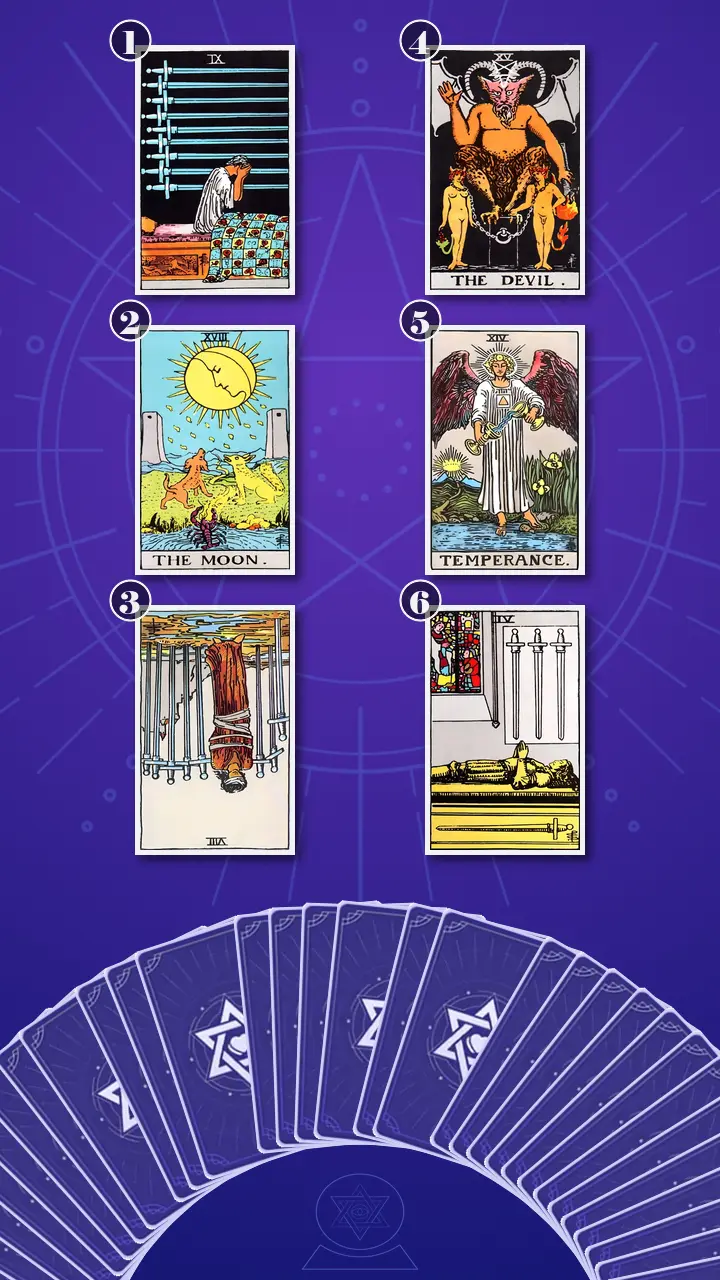
“Today,” I said, “I’m going to use my own spread: the Transformation Path Grid (6) · Context Edition.”
For you, reading along: a six-position transformation grid is the smallest structure that can hold this issue as a loop—symptom → trigger → belief → fear—while still giving us a grounded interruption and actionable advice. Late-night doomscrolling isn’t one decision. It’s a self-reinforcing mechanism. This spread separates what’s happening on the surface from what’s fueling it underneath, and then turns the insight into a one-week experiment you can actually try.
I traced the layout with my finger in the air: a vertical ladder of six cards, two columns of three. “We’ll read down the left column first—what you’re inside of at 1 a.m. Then we move to the right column—what’s underneath, and the way out.”
“The first card shows the 1 a.m. symptom,” I added. “The fourth goes deeper into the root fear. And the fifth is the medicine—the key transformation that breaks the cycle without requiring perfect certainty.”
Reading the Map: How Tarot Works in Context
When I read, I’m listening to symbols—but I’m also listening to the body. My family called it a kind of weather sense: the way a shift in wind shows up before a storm. I call it Body Signal Interpretation. The chest, the jaw, the throat—these are often more honest than the story we tell ourselves at 1 a.m.
Position 1 — The 1 a.m. Symptom: What’s Observable
“Now I’m turning over the card that represents The 1 a.m. symptom: the most observable doomscrolling behavior and its immediate mental/emotional tone.”
Nine of Swords, upright.
It’s 1 a.m. and you’re in bed, but your brain is acting like you’re on night watch. You keep refreshing headlines and reopening the same two stories, scanning comments like they contain the one sentence that will let your body unclench. The more you consume, the more ‘urgent’ your thoughts feel—like each new post is another sword hanging above your pillow.
In energy terms, this is Air in excess: thoughts racing so fast they start to feel like reality. The mind is doing incident response at 1 a.m. with no on-call rotation. The body is exhausted, but the mental vigilance refuses to clock out.
I leaned in a little. “This isn’t curiosity. This is your nervous system trying to buy safety with information.”
Alex let out a small laugh that wasn’t funny. It had a bitter edge, like she’d been caught red-handed by someone kind. “That’s… yeah,” she said. “It’s accurate in a way that’s almost rude.” Her fingers tightened around her coffee cup, then loosened, like her hands were practicing letting go before her mind could agree.
“Two beds,” I said softly, offering her a picture. “There’s the bed you’re in now—the phone glow, the headlines hovering above you. And there’s a second bed you haven’t built yet: one where your mind isn’t in charge of the room.”
Position 2 — The Trigger: What Flips the Switch
“Now I’m turning over the card that represents The immediate trigger that flips the switch into scrolling (nighttime context, sensations, cues, or uncertainty).”
The Moon, upright.
The trigger isn’t the article—it’s the moment the apartment goes quiet and your nervous system interprets quiet as danger. In that foggy, late-night state, every vague headline feels like a clue you have to decode. You scroll to ‘light the path,’ but the path gets creepier the longer you stare at it.
This is Water without a container: feelings and uncertainty swelling in the dark, distorting perception. Like trying to navigate your apartment with a flickering flashlight—everything looks like a threat when the light jumps. The Moon isn’t “bad.” It’s honest about night: it blurs edges.
“Before your thumb moves,” I asked, “can you name the weather? One word. Foggy. Keyed-up. Lonely. Edgy.”
Alex stared at the Moon card for a beat, then nodded once, slow. Her gaze drifted a little unfocused, as if replaying Tuesday night at 12:54 a.m.—the AC clicking on, the street noise dipping, her brain whispering, What if something’s happening and I’m the last to know?
Position 3 — The Belief-Rule: The Script That Keeps It Running
“Now I’m turning over the card that represents The belief that keeps the loop running: the thought-rule that makes scrolling feel necessary.”
Eight of Swords, reversed.
The belief-rule is: “I can’t stop until I know enough.” You feel trapped, but it’s a trap made of thoughts and pressure. Reversed, it looks like you almost know you have a choice—yet you keep picking the phone back up automatically, then arguing with yourself about whether you’re allowed to stop. You’re not fully bound; you’re half-blindfolded by the story that ‘staying informed’ equals being safe.
Energetically, this is a blockage rather than a lack: the door is open, but your mind keeps acting like it’s locked. That’s why all-or-nothing fixes backfire—deleting every app at midnight, reinstalling by noon. Your nervous system hears punishment, not support.
“You don’t need to delete your entire online life to sleep—you need a dose that your body can tolerate,” I said, letting the sentence land like a hand on a shoulder rather than a rule.
Alex exhaled through her nose, sharp at first, then softer. “I do the ‘Ignore for 15 minutes’ thing,” she admitted. “Over and over. And part of me is like, why am I negotiating with an iPhone?”
“Because the negotiation isn’t with the iPhone,” I said. “It’s with the fear.”
Position 4 — The Root Fear: The Bind Under the Habit
“Now I’m turning over the card that represents The deeper fear underneath the behavior, touching safety/control/worth, that the loop is trying to manage.”
The Devil, upright.
Underneath the habit is a bind: you’re using compulsive checking to manage fear—fear of missing something important, fear that being ‘out of the loop’ equals being unsafe or incompetent. The phone becomes a chain you touch for reassurance. The scary part is how it masquerades as responsibility: “I’m just staying on top of things,” even while it steals your sleep and makes you more reactive tomorrow.
This is Earth in excess: sticky gravity. A habit loop that feels heavier than intention. The Devil doesn’t show “evil.” It shows attachment—what you keep renewing even when you didn’t mean to subscribe.
I kept my tone clean—no moralizing. “You’re not failing at self-control—you’re negotiating with fear at the worst possible hour.”
Then I gave the Devil an inner monologue, because that’s how this card tells the truth:
If I stop, then I’ll miss the one thing I should have known.
If something goes wrong and I wasn’t paying attention, it’ll be my fault.
I just need one more update so my brain can relax.
Alex winced—an honest, involuntary reaction—then went very still. Her breathing paused for half a second. Her eyes flicked down to the card, then away, like she’d been looking at herself too directly.
“The Devil is also a cue,” I added, and this was important. “The compulsion is the seam where change becomes possible. It’s that micro-moment: your hand hovering over the phone, the urge peaking, your throat tightening—and you choosing a ten-second pause. Not ‘be strong.’ Just: make the loop visible.”
Outside my window, the city sound thinned for a moment—one of those rare midnight gaps between sirens—like New York itself was taking a breath. I noticed Alex’s shoulders drop a fraction, as if her body heard the permission before her mind did.
When Temperance Spoke: Regulation Over Certainty
I could feel the reading gathering itself. Sometimes a key card arrives the way weather changes: not dramatic, just unmistakable. “We’re turning over the core of this spread now,” I told her. “The medicine.”
“Now I’m turning over the card that represents The key transformation: the inner posture that interrupts the loop without requiring perfect certainty.”
Temperance, upright.
Your way out isn’t an extreme (delete everything / scroll forever). It’s a measured blend: a clear cutoff plus a transition that calms your body. Think of it as dosing your attention—one steady stream into another—so you can go from ‘activated internet brain’ to ‘human body ready for sleep.’ Temperance looks like designing a nightly sequence your nervous system trusts.
In my practice, Temperance is where I use Elemental Balance on purpose: you’ve had too much Air (thoughts), then too much Water (night fog), then Earth in a bind (habit). Temperance is Fire and Water working together—warmth and flow—so your system can come back into range. It’s not about “winning” against the internet. It’s about teaching your body what safe-enough feels like.
It’s 1:03 a.m., the room is dark except for your screen, and you’re telling yourself you’ll stop after the next post—while your chest is tight and your eyes are heavy.
You don’t need a perfect headline to feel safe; you need to blend your nervous system back into balance—like Temperance pouring one steady stream into another until your body believes it’s okay to rest.
For a second, Alex’s whole face went still, like she’d been interrupted mid-sprint. Then a three-part wave moved through her—so subtle you’d miss it if you weren’t watching for body truth.
First: a tiny freeze. Her breath caught high in her chest, and her fingers stopped fidgeting as if someone had pressed pause. Second: cognition seeping in. Her eyes softened and went slightly out of focus, like she was replaying every 1 a.m. scroll and seeing the mechanism rather than the content. Third: release. Her shoulders dropped, not dramatically, but in a way that made her look younger; her jaw unclenched; she let out a long exhale that sounded like, “Oh.”
“But if I stop,” she said, and there was a flash of anger in it—unexpected, honest—“doesn’t that mean I was… wrong? Like I made it all worse?”
I shook my head once. “No. It means you were trying to protect yourself with the tools that were available at 1 a.m. Temperance isn’t a verdict. It’s a new option.”
“A boundary is the off-switch. A soothing action is the landing,” I added, simple as a recipe.
Then I asked her the question that turns insight into lived change: “Now, with this new lens—regulation over certainty—think back to last week. Was there a moment at night when this would have made you feel different, even by five percent?”
Alex blinked fast, eyes a little wet. “Sunday,” she said. “I was listening to The Daily and then I went straight into TikTok ‘news explainers’ and comments. I kept thinking I had to… I don’t know, earn sleep by being informed.” She swallowed. “If I had just put my phone away and done something to calm down, maybe I could’ve stopped sooner.”
That’s the shift right there—the emotional transformation from chaotic high-alert scanning and guilt-driven checking to steadier calm, deliberate rest, and self-trust around “enough.” Not perfection. A direction.
Position 6 — The Next Step: The One-Week Practice
“Now I’m turning over the card that represents The next step: a concrete, doable practice for the next 7 days that supports sleep and self-trust.”
Four of Swords, upright.
The next step is a protected rest window: your bedroom becomes a small sanctuary where you’re allowed to be unavailable. Not forever—just for the sleep container. The practical version: phone out of the room, Do Not Disturb on a schedule, and one short wind-down ritual so your mind learns there’s a safe ‘off-duty’ mode.
This card is Air in balance: not the screaming wind of rumination, but the quiet after. A sword laid down horizontally. Action paused on purpose.
Alex nodded—practical, almost relieved. “Sanctuary rule,” she repeated, like it was something she could actually do without turning it into a personality referendum. “Not… ‘be a different person.’ Just… change the room.”
The Boundary + Bridge Protocol: Actionable Next Steps for the Next 7 Nights
I gathered the six cards into one clear story—because this is where tarot stops being aesthetic and starts being useful.
Nine of Swords showed the surface: your mind standing guard at 1 a.m., treating headlines like threats that must be processed before sleep is allowed. The Moon revealed the trigger: nighttime quiet and ambiguity feel like danger, and your nervous system reaches for the phone as a flickering flashlight. Eight of Swords reversed named the script: “I can’t stop until I know enough,” even though the bindings are loose and the door is open. The Devil exposed the root: compulsion-as-safety, the belief that being on watch equals being competent and protected. Temperance offered the medicine: moderation and nervous-system regulation instead of chasing certainty. Four of Swords made it real: build a sanctuary where your mind is officially off-duty.
The cognitive blind spot I named for Alex was this: she was trying to solve a body alarm with more information. But the transformation direction is different: from “more information will make me safe tonight” to “a clear boundary plus one grounding action is what makes me safe enough to rest.”
Then I offered a one-week experiment—tiny on purpose, because 1 a.m. is not the hour for grand reinventions. I call it a Boundary + Bridge Protocol: the boundary is the off-switch; the bridge is the landing.
- Sanctuary Rule Sleep WindowFor the next 7 nights, charge your phone outside the bedroom (even if it’s just the hallway). Set iOS Focus / Do Not Disturb from 12:30 a.m. to 7:30 a.m., with exceptions only for true emergency contacts.Expect your brain to protest: “But what if I miss something?” That protest is the point—you’re practicing tolerating the discomfort. If this feels too big, start with one night, not seven.
- The Tomorrow Check-In NoteBefore you get into bed, write one line in Notes: “In the morning I’ll check headlines at 9:15 for 10 minutes.” Then you’re done for the night—no comment sections, no “just one more.”This gives your anxious mind a receipt. If you slip and scroll anyway, don’t punish yourself—just return to the note and treat it as data.
- Two-Cup Wind-Down (Boundary, Then Bridge)When the urge spikes, do this in order: (1) Boundary: phone out of reach. (2) Bridge: 3 minutes of slow exhale breathing or my Shower Water-Flow Meditation—stand under warm water for 2 minutes and imagine the day’s “breaking news ticker” rinsing off your shoulders and jaw.If your chest feels tight, put one hand there for 10 seconds before you do anything else. That’s Body Signal Interpretation in real time: you’re telling your system, “I hear you.” If 3 minutes is too much, do 60 seconds.
“If you keep checking,” I told Alex, with gentle accountability, “you’re telling your brain the world is only safe when you’re on watch. Four of Swords is you choosing off-duty on purpose.”

A Week Later: The Quiet Proof
Five days later, Alex texted me at 10:12 a.m. (the timing itself felt like a small miracle). “Did the hallway charger,” she wrote. “First night was brutal for like ten minutes. Then I did the shower thing. Slept.”
She added, “Not perfect. I still wanted to check. But having the note—‘9:15 for 10 minutes’—made my brain chill out faster. Like it believed me.”
Here’s the bittersweet truth, in her words: she slept through the night, but in the morning her first thought was still, What if I missed something? Then she said she caught herself and actually laughed. Not because it was gone—but because it no longer had the steering wheel.
That’s what I love about this kind of tarot work. It doesn’t demand certainty. It offers a path from on-watch to off-duty: from compulsive checking and decision fatigue to steadier calm, deliberate rest, and self-trust around “enough.” And when you need a tool to map a repeating pattern, the Transformation Path Grid (6) · Context Edition is one of my favorite ways to make the mechanism visible without making you the villain of the story.
When it’s 1 a.m. and your eyes are burning but your thumb still wants to refresh, it’s not because you love the feed—it’s because some part of you is terrified that letting go means being unsafe or unprepared.
If you didn’t need one more update to earn rest tonight, what would your ‘boundary + bridge’ look like—just for the next 10 minutes?