A Late-Night Screenshot Thread, and the One-Sentence Boundary

Finding Clarity in the 11:46 p.m. Screen Glow
If you’re the friend who replies “omg” to gossip screenshots just so you don’t seem cold—and then you feel gross about it five minutes later, you’re not alone.
Jordan (name changed for privacy) appeared on my screen from Toronto, the kind of late-night lighting that turns a bedroom into a small, blue cave. They were in bed—lamp off—phone screen reflecting in their glasses like a tiny second moon. Outside their window, everything looked winter-muted and still, but their body wasn’t. I could see it in the tight line of their jaw and the way their shoulders kept creeping up, like bracing for impact.
“It’s like I’m being handed drama and expected to hold it,” they said. “My friend keeps sending me gossip screenshots. Like… receipts. And I don’t want to be mean, but I also don’t want to be part of this.”
I watched their thumb hover near the bottom edge of the phone, the reflex you get when a notification has trained your nervous system. The unease wasn’t loud. It was polite. It was the feeling of swallowing a complaint so often your throat starts to feel like a hallway with all the doors shut.
“Okay,” I said, keeping my voice soft and level. “We’re not here to judge your friend or the gossip. We’re here to get you out of the role of unpaid emotional admin. Let’s make this a Journey to Clarity—something you can actually do the next time the screenshot hits.”

Choosing the Compass: The Five-Card Cross · Context Edition
Before I read, I always give people one small, non-mystical reset: a breath that belongs to them, not to their phone. “Inhale for four,” I told Jordan. “And when you exhale, imagine you’re letting go of the pressure to react fast.”
On my side of the call, I was sitting in a quiet back office of the Tokyo planetarium after the last show. The dome was dark, the star projector cooling down with a faint mechanical tick—like a clock that measures a different kind of time. I shuffled slowly, not as a ritual for the cards, but as a transition for the mind: a way to stop sprinting and start seeing.
“For this,” I said, “I’m using a spread called the Five-Card Cross · Context Edition.”
To you, the reader: this spread works beautifully for friendship boundaries and group chat drama because it’s not trying to predict whether your friend will ‘take it well.’ It maps a pattern you can change. The positions move in a simple diagnostic chain—current dynamic → what blocks you → the deeper driver → a clear intervention → how things integrate once you hold the line. It’s practical, and it keeps the reading from turning into an endless analysis of everyone’s motives.
“Card 1 will show what’s happening right now—the screenshot loop itself,” I said to Jordan. “Card 2 shows what blocks you from setting the boundary. Card 3 goes underneath, into what makes this feel risky. Card 4 is your clean boundary—tone and wording energy. And Card 5 shows what the connection can feel like afterward, if you actually hold it.”
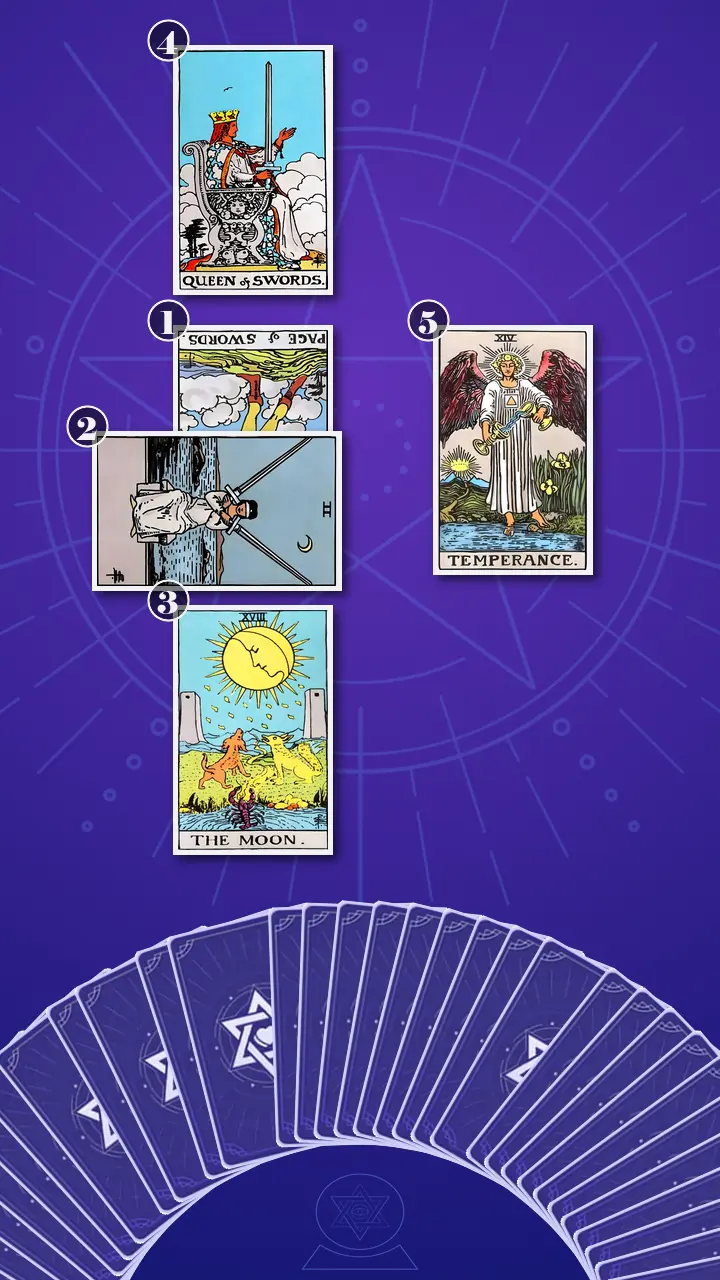
Reading the Map: The Loop That Feels Like ‘Being Nice’
Position 1 — The current dynamic you’re living in
“Now flipping over is the card that represents what is happening right now in the friendship dynamic,” I said. “The Page of Swords, reversed.”
In modern life, this card shows up like this: Jordan gets a screenshot mid-day and treats it like breaking news—opens instantly, zooms in, fires off a quick “NO WAY,” and asks for context. It looks friendly, but it quietly trains the friend that Jordan is available for gossip delivery on demand.
I nodded at the screen. “This is that jittery, vigilant energy. The Page upright can be curious in a clean way—learning, asking, staying sharp. Reversed, it becomes agitation. The sword is still up, but it’s not defending truth; it’s chasing stimulation.”
“Like… I feel my brain go into analysis mode,” Jordan said, and their shoulders rose an inch as if the sentence itself had weight.
“Exactly,” I said. “And here’s the uncomfortable reframe that isn’t blame: your politeness can read like consent. Every ‘omg’ is like a tiny engagement signal. It’s an algorithm. It rewards the feed.”
Jordan gave a small laugh that had more tiredness than humor. “Saying it like that is… accurate, and kind of brutal.”
“Brutal is pretending you’re fine when your body’s already voting ‘no,’” I replied. “This card says the issue isn’t one screenshot. It’s the whole rumor pipeline.”
Position 2 — What blocks you from setting the boundary
“Now we’re looking at what blocks you from setting the boundary,” I said. “Two of Swords, upright.”
In modern life, this card plays like: Jordan keeps the thread open, keeps replying with safe filler, and keeps telling themselves they’ll set a boundary “later.” It’s a stalemate: they don’t want to participate, but they also won’t choose the discomfort of saying no—so they end up doing both.
“This is conflict-avoidance as a full-body posture,” I explained. “The blindfold isn’t ignorance—it’s protection. It’s ‘if I don’t look directly at the choice, I don’t have to feel the sharp part of it.’”
I leaned in a little. “Tell me what happens in the first 60 seconds after a screenshot arrives. What are you trying to prevent by responding fast?”
Jordan’s eyes dropped away from the camera, like they were watching a replay. Their thumb hovered in mid-air, then twitched, then stopped—an almost-perfect physical impression of the Two of Swords.
“I type ‘lol’ sometimes,” they admitted. “Then delete it. Then I’ll do ‘no way’ because it’s… safe.” Their jaw tightened as they spoke. “I’m trying to prevent them thinking I’m judging them. Or that I’m not supportive. Or that I’m boring.”
“That’s the crossing pressure,” I said. “Connection versus belonging panic. Peacekeeping versus self-respect. The Two of Swords blocks you because it convinces you there’s no clean option—so you hover. And hovering feels neutral, but it isn’t. It keeps the channel open.”
The Moon’s Fog Over the Group Chat
Position 3 — The deeper root that keeps the pattern alive
“Now flipping is the card under everything—the deeper root that keeps the pattern going,” I said. “The Moon, upright.”
In modern life, it looks like: Jordan starts imagining what the screenshot ‘means’ for the friend group—who’s loyal, who’s fake, who might be screenshotting them too. Nothing is confirmed, but the vibe feels dangerous, so Jordan stays polite and hyper-aware instead of direct.
“The Moon is social fog,” I said. “It’s when the facts are simple—‘a friend sent me a screenshot’—but your mind starts doing what I call fog math.”
Jordan frowned. “Fog math?”
“Yeah,” I said. “You take partial information and your brain fills in the missing numbers with worst-case outcomes. Who screenshotted who. Who will think you’re disloyal. Whether you’re next on someone’s screenshot list. Under Moon energy, your mind can write the rest of the thread like doomscroll fanfic.”
Jordan went still for a moment, then nodded slowly. Their shoulders lowered a fraction—like naming it made it less monstrous.
“So the root isn’t that you don’t have the right words,” I continued. “The root is that the social terrain feels unclear, so you treat directness like a risk. Screenshots feel ‘safer’ than a real conversation, but they actually make everything fuzzier.”
“I hate that I do that,” Jordan said.
“I’m not hearing something to hate,” I told them. “I’m hearing a nervous system trying to keep belonging.”
When the Queen of Swords Spoke
Position 4 — The most skillful boundary to set
I paused before turning the next card. The planetarium behind me gave a soft settling sound—metal cooling, the kind of quiet you only notice when you stop talking. “We’re flipping the most important card in this reading,” I said. “The one that tells you what to actually say.”
“Now showing is the card that represents the most skillful boundary to set—tone, wording energy, and the mindset you need to hold it,” I said. “Queen of Swords, upright.”
In modern life, it’s this: Jordan sends one calm, specific message that doesn’t argue about the gossip: “I care about you, but I don’t want to receive screenshots about other people—can we talk about what you’re feeling instead?” Then, the next time a screenshot arrives, Jordan repeats the same line without re-litigating it.
Setup (the moment you’re stuck in): I could almost see Jordan at lunch—opening the thread “just to clear it,” shoulders up, jaw tight, doing emotional admin with one thumb while their actual work tab sits untouched. In that moment, the fear isn’t the screenshot. It’s the imagined verdict: What will this cost me socially if I don’t play along?
Stop keeping the peace by staying blindfolded; lift one clean sentence like the Queen’s sword and let it do the work.
I let the sentence hang. The call went quiet enough that I could hear Jordan’s breath change.
Reinforcement (what shifts in your body and mind): Jordan’s first reaction wasn’t relief. It was resistance. Their eyebrows pulled together, and their mouth tightened like they’d bitten something too sour. “But if I say that,” they said, voice sharper for a second, “won’t they just think I’m being… judgmental? Like I’m acting better than them?”
I watched the reaction chain move through them in layers: (1) a brief freeze—inhale stuck high in the chest; (2) the eyes unfocused, like they were watching a future argument play out; (3) then a long, involuntary exhale that softened their shoulders, even while their face still looked uncertain.
“That fear makes sense,” I said. “And the Queen of Swords doesn’t ask you to be cold. She asks you to be precise. It’s the difference between ‘You’re messy’ and ‘I’m not available for this channel.’”
This is where my research brain always lights up. In my work, I call it Cosmic Redshift Communication: when two people start drifting, the first sign isn’t always a fight. It’s a change in the signal. Direct sharing gets replaced by forwarded content, screenshots, commentary about third parties—connection at a distance. The “redshift” here is that the friendship is moving away from intimacy and toward stimulation.
“Your boundary isn’t a rejection,” I told Jordan. “It’s a course correction. It’s you saying: ‘I want closeness, not just content.’ Support isn’t the same as participation. And clarity is not cruelty.”
I added the contrast I wanted them to feel in their bones. “Imagine unsubscribing from a noisy Slack channel called ‘Hot Takes.’ You’re not quitting the job. You’re just changing a setting so you can actually do your work—and keep your sanity.”
Jordan blinked fast, like the image hit somewhere tender. “So… I don’t need to write a whole paragraph.”
“One clean sentence can do more than ten paragraphs of explaining,” I said gently. “Now, with this new lens, think back to last week—was there a moment when a screenshot hit and you could’ve felt different if you’d had this sentence ready?”
Jordan looked off to the side. “Tuesday. Office kitchen. Fluorescent buzzing. My lunch went cold. I replied fast because it felt like… a pop quiz.”
“Exactly,” I said. “And next time, you’re allowed to decline the test.”
Temperance and the Hot Takes → Healthy Takes Shift
Position 5 — What it can feel like after you hold the boundary
“Now we turn over the final card,” I said. “This represents how it can feel and function after you hold the boundary.”
Temperance, upright.
In modern life: After the boundary becomes normal, the friendship feels less like a rumor feed and more like actual support—voice notes about real stress, plans that don’t revolve around commentary, and fewer late-night pings that leave Jordan tense.
“Temperance is not ‘no connection,’” I explained. “It’s regulated connection. Turning the volume down instead of smashing the speaker. Filtering your inbox so you still get important messages, just not spam.”
Jordan’s expression shifted into something like relief mixed with skepticism. “So it doesn’t have to be all-or-nothing.”
“Right,” I said. “This card says the goal isn’t to become the ‘no gossip ever’ person overnight. It’s to stop being the automatic container for it. If it needs a fast reaction to feel like friendship, it might be running on adrenaline—not trust.”
The One-Clean-Sentence Boundary, Saved Like a Star Chart
I took a breath and stitched the whole story together for Jordan—because integration is where tarot becomes usable.
“Here’s the pattern,” I said. “Page of Swords reversed shows the screenshot economy: gossip-as-stimulation, treated like urgent intel. Two of Swords shows the block: draft-delete paralysis and staying ‘neutral’ to avoid tension. The Moon is the root: fog math—assuming setting a boundary means losing belonging. The Queen of Swords is the intervention: one clean, humane sentence that changes the channel. Temperance is the outcome: support that doesn’t cost you your nervous system.”
“Your cognitive blind spot,” I added, “is thinking that being a good friend means engaging with the content. But the shift is this: support means caring about your friend while refusing to participate in the screenshot economy. That’s the difference between warmth and absorbency.”
Jordan nodded, then hesitated. “But I can’t always do this perfectly. Sometimes I’m in meetings. Sometimes I’m tired. Sometimes I just… open it.”
“Good,” I said, matter-of-fact. “Perfection isn’t the job. Repeatability is. Let’s make it easy.”
- Save the ‘Screenshot Boundary’ in NotesOpen Apple Notes (or Notion) and write one copy‑paste line: “I care about you, but I don’t want to get screenshots about other people. If you want to talk about how you’re feeling, I’m here.” Keep it as your default reply so you’re not improvising while activated.Draft three versions in 2 minutes, then stop. The goal is calm and true—not perfect.
- Insert a 10‑minute delay before you open anythingNext time a screenshot arrives, don’t open it right away. Put your phone down and wait 10 minutes. If that feels impossible, start with 2 minutes—just enough to interrupt the “respond fast” reflex.Send your boundary during the day when you can; late-night screen glow makes everything feel more dramatic than it is.
- Run a one-breath ‘Facts vs Assumptions’ checkBefore you reply, name 1 fact (“They sent me screenshots”) and 1 assumption (“They’ll think I’m disloyal if I say no”). Then redirect to feelings, not receipts: “I’m not the right person for screenshots, but I’m here—what’s coming up for you?”Warmth belongs in tone, not in participation. If they push back, repeat the same line once and change the subject.
Then I offered one of my own tools—the one I use with people who live inside group chats the way others live inside neighborhoods.
“If you want to make this sustainable,” I said, “use my Social Star Map strategy for one week. It’s not astrology homework; it’s attention budgeting. Pick two social ‘zones’ in your calendar: (1) Real Connection—a 15-minute voice note or call with this friend where the rule is ‘no screenshots, just what’s actually happening with you.’ (2) Noise—times you don’t open receipt threads at all. Your relationships get lighter when your attention has a map.”

A Week Later: Quieter Pings, Louder Self-Respect
A week later, Jordan messaged me a screenshot—ironically, but this time it was of their own Notes app. At the top: “Screenshot Boundary.” Under it: three versions of the sentence, each getting shorter and calmer.
“I used it,” they wrote. “My heart was pounding. But the thread didn’t explode. They just said ‘fair’ and then sent a voice note about their actual work stress. I feel… weirdly proud.”
In my mind, I saw the Temperance horizon: not a grand finale, just a steadier rhythm. Clarity that doesn’t require you to harden—just to choose what you can hold.
When you’re scared a boundary will cost you belonging, even a single screenshot can feel like a pop quiz you have to pass by reacting fast—while your body is already telling you you don’t want to hold this.
If you let “support” mean caring about your friend—but not participating in the screenshot economy—what would your one clean sentence be?