The Two-Sentence Boundary Text I Drafted After a Group Chat Pile-On

The Notification That Lands Like a Punchline
You ‘laugh it off’ in the moment, then spend the next hour rereading the thread and drafting replies you never send—classic rumination with a group chat twist.
Taylor (name changed for privacy) said that to me like it was a confession she’d repeated so many times it had started to sound normal. We were on a late Zoom call—Toronto dusk on her side, Tokyo night on mine. Behind me, the planetarium’s hallway lights were dimmed, and I could still hear the soft ventilation hum that always reminds me of distant ocean waves.
She described 8:12 PM on a Monday on the Line 1 subway heading north: harsh fluorescent light, the phone warm in her palm, her thumb scrolling too fast while she checked who reacted. Then her name—used as the punchline—again. Her throat tightened like a drawstring, her cheeks went hot, and she hit the laugh reaction on autopilot because she didn’t want to be “dramatic.”
“I can take a joke,” she said, staring past her camera. “But why is it always me.”
I watched her swallow. It wasn’t just embarrassment; it was that contracted, shrinking feeling people get when they’re trying to stay in the room while their dignity quietly gets traded for comfort.
Her actual question was practical: “Group chat jokes at my expense—what boundary do I set?” But the engine underneath it was sharper: wanting to stay included in the group chat vs fearing that setting a boundary will make you look “too sensitive” and get you pushed out.
Humiliation has a specific texture in the body. In her, it looked like a tight throat and hot cheeks paired with a frozen smile—like holding a laugh in your mouth while your chest tries to pull you backward.
“Okay,” I told her, steady and simple. “Let’s not make this about winning the vibe. Let’s make a map. Our whole journey tonight is about finding clarity—so you can open that chat without bracing for impact, and trust yourself to protect your dignity.”

Choosing the Compass: The Transformation Path Grid (6) Spread
I asked her to take one slow breath before we touched the cards—nothing mystical, just a clean transition. A way of telling the nervous system: we’re not in the thread anymore; we’re observing it.
“I’m going to use a spread I built for situations exactly like this,” I said, aligning six cards into a neat 2×3 rectangle on my desk. “It’s called the Transformation Path Grid (6) · Context Edition.”
To you reading this: I chose it because this isn’t about predicting whether a friend group will suddenly become perfect. It’s about identifying the repeating pattern, naming the root fear, and choosing a boundary that is specific and enforceable. Six positions keep the logic tight: surface dynamic → blockage → root driver → boundary principle → delivery → integration. It answers, very directly, “what boundary do I set?” without turning it into a feelings trial.
I told Taylor what to expect: “The top row will show what’s happening, what keeps it going, and what it’s really hitting. The bottom row is the plan: the boundary principle, how to say it, and how to protect your peace afterward.”
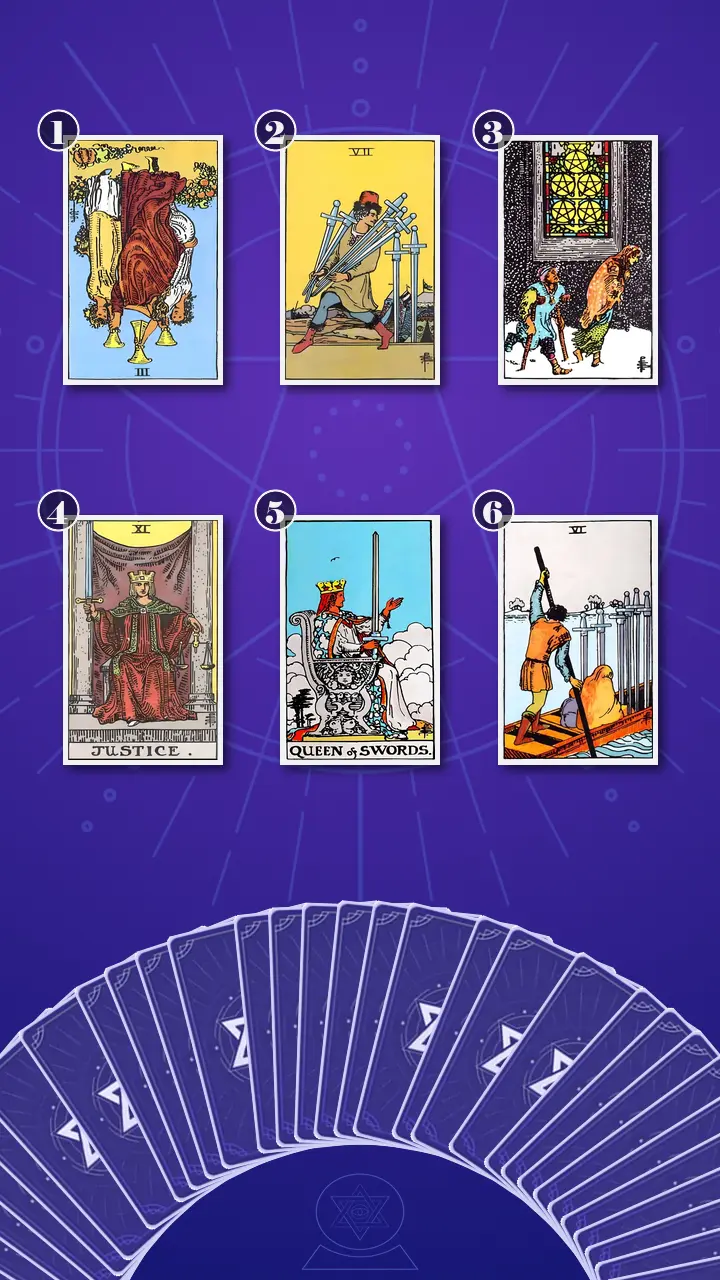
Reading the Thread Like a Star Chart
I’ve guided thousands of people under a planetarium dome. When you watch the night sky long enough, you learn a comforting truth: patterns repeat—until something changes the rules of motion. Friend groups are like that, too. Not fate. Physics. Reinforcement.
Position 1: The Party Where the Entertainment Is You
“Now we’re turning over the card that represents what’s happening on the surface: the observable group-chat dynamic and your in-the-moment response.”
Three of Cups, reversed.
I didn’t need to dramatize it; this card is already a scene. “This is like a Wednesday night in Toronto where the group chat is popping off like a mini after-party—GIFs, quick replies, stacked laugh reactions. Then someone drops a ‘joke’ using your name as the punchline. You laugh-react in under five seconds because you can feel the social momentum and you don’t want to be the person who makes it weird. Ten minutes later, you’re rereading the thread, counting reactions, realizing the laughter isn’t with you—it’s on you.”
The reversal is an energy imbalance: belonging energy turned sour—not absent, just distorted. In upright form, Three of Cups is mutual celebration. Reversed, it can become cliquey bonding where the group’s closeness is built by making someone else the object.
Taylor let out a small laugh that didn’t match her eyes. “That’s…,” she started, then stopped. Her mouth twitched like she wanted to joke her way out. Her shoulders lifted toward her ears. Then she winced—recognition landing with a sting. “That’s too accurate. Like, almost rude.”
“It’s not rude,” I said gently. “It’s data. And it’s important data.”
Position 2: The “Just Kidding” Escape Hatch
“Now we’re turning over the card that represents what’s blocking change right now: the social pattern or communication style that keeps the jokes going.”
Seven of Swords, upright.
“The jokes keep happening because everything is said sideways,” I told her. “A meme that ‘accidentally’ reads like a dig. A cutting line followed immediately by ‘relax, it’s a joke.’ Then a quick pivot—new topic, new GIF—so the impact becomes your problem for noticing.”
Seven of Swords is the energy of indirectness: not enough accountability, too much plausible deniability. It’s a blockage because you can’t repair what no one will name. It also trains you to argue about intent instead of impact.
I leaned in. “And here’s the logic check I always use with this card: If it’s ‘just a joke,’ it should be easy to stop. If someone can’t stop, it was never ‘just’ anything.”
Taylor blinked slowly, like her brain was rewinding the last three months of screenshots. “Oh,” she said. Not agreement—clarity. The kind that makes you realize you weren’t failing at communication; you were trying to negotiate with a loophole.
In my mind, I saw a quick planetarium flashback: school kids pointing at Saturn’s rings, asking why they don’t fall. “Because motion has rules,” I’d said. In friend groups, “just kidding” is often the rule that lets people throw a stone and keep their hands clean.
Position 3: The Cold Street Outside the Warm Window
“Now we’re turning over the card that represents the deeper root: the need, fear, or vulnerability the situation is poking.”
Five of Pentacles, upright.
I softened my voice. “Under the humiliation is a very practical fear: plans get made in that thread. You can picture the next Friday night happening without you—not because you were ‘uninvited,’ but because you became ‘too much’ and people quietly stop tagging you.”
This card’s energy is the sensation of exclusion: not a dramatic breakup, but a slow cold. The Pentacles suit makes it physical—your nervous system equates belonging with safety, like warmth in a Toronto condo lobby while you’re standing outside in winter.
Taylor’s gaze dropped. She held her breath for a beat, then exhaled through her nose—smaller, quieter. Her fingers, which had been gripping a mug, loosened.
“I hate how much that scares me,” she admitted.
“It makes sense,” I said. “And it explains why you’ve been paying the fee. But—this matters—Belonging shouldn’t cost you your dignity. That’s not sensitivity. That’s a healthy standard.”
Position 4: The Fair Line You Can Hold
“Now we’re turning over the card that represents the boundary principle to set: what is fair, clear, and self-respecting for you.”
The moment before I flipped it, the room went a little still—like that quiet pause right before a meteor streaks across the dome and everyone collectively inhales.
Justice, upright.
Justice is not a plea. It’s not a vibe check. It’s a standard: what’s allowed, what’s not, and what happens next. The energy here is balance and accountability—scales and sword. Calm, not cruel.
And this is where my research brain always reaches for my signature lens—what I call Cosmic Redshift Communication. In astrophysics, redshift is how we detect something moving away: the light stretches, the signal changes, and distance reveals itself early if you know what to measure. In friendships, repeated “jokes” at one person’s expense are often an early redshift—humor that stretches into disrespect. If you ignore the signal, you don’t preserve closeness; you just normalize distance.
Setup: I could feel Taylor right on the edge of her old loop: “If I say it wrong, I’ll ruin everything. If I say nothing, I’ll keep shrinking.” It was 9:18 PM in her story—couch, half-watching Netflix, notification hitting like a small electric shock—thumb hovering over the laugh reaction, trying to buy safety with performance.
Not “keep the peace by swallowing it”; choose a fair line and hold it—like Justice’s scales and sword.
Reinforcement: Her body did the three-step tell I’ve learned to watch for on both star charts and human faces. First: a freeze—her eyes widened a fraction, breath catching like she’d been tapped on the sternum. Second: the cognitive shift—her gaze went unfocused for a second, like she was replaying a specific screenshot in her head with new captions. Third: the release—her shoulders dropped, and a shaky little exhale came out like, “Oh….”
Then the unexpected reaction hit. Her brow tightened. “But if I do that,” she said, voice sharper with anger than she’d allowed herself all night, “doesn’t it mean I basically trained them to do it? Like I taught them I’m fine with it?”
I nodded. “I hear the sting in that. And no—you didn’t ‘cause’ their behavior. But your laugh-react did function like a permission slip. Justice isn’t about punishing yourself for that. It’s about updating the Terms of Service.”
I asked her, exactly as I always do with Justice: “Open your Notes app. Set a 10-minute timer. Write a two-line draft: (1) what needs to stop, (2) what you’ll do if it happens again. If your body spikes—hot cheeks, tight throat—you can stop early. This is practice, not a courtroom.”
Then I invited the real integration question: “Now, with this new lens—fair line, fair follow-through—think back to last week. Was there a moment where this would have changed how you felt, even by five percent?”
She nodded slowly. “Tuesday. They made a joke about my dating life. I did the whole ‘haha yeah I’m a mess’ thing. If I’d had a line ready… I wouldn’t have hated myself afterward.”
That was the pivot I wanted: from humiliation-driven vibe-management to calm self-respect with clear accountability. Not perfection. Just a different center of gravity.
Position 5: The Queen’s Two Sentences
“Now we’re turning over the card that represents how to deliver it: the tone and communication style that makes the boundary land without over-explaining.”
Queen of Swords, upright.
I smiled a little, because this card always feels like clean air. “This is the message that sounds almost boring,” I told her. “A two-sentence Slack-style note. No jokes. No essay. No performance.”
And I said the line I could tell she needed to hear: Stop negotiating in emojis what you need to say in plain words.
The Queen’s energy is precision—neither excess softness nor excess aggression. Not pleading. Not attacking. Just adult clarity: “Hey—jokes about me in here aren’t funny to me. Please stop. If it happens again, I’m going to mute the chat.”
Taylor’s face did something subtle but huge: her jaw unclenched. “I don’t want an apology speech,” she said. “I just want it to stop.”
“Exactly,” I replied. “And Queen of Swords doesn’t ask for a speech. She states a standard.”
Position 6: Steering Toward Calmer Water
“Now we’re turning over the card that represents integration: how to protect your peace after you set the boundary.”
Six of Swords, upright.
“After you set the boundary,” I said, “you don’t sit there refreshing the thread and analyzing every reaction. You protect your attention. Mute. Step back for a day. Shift energy to one-on-one plans with the people who treat you well.”
Six of Swords is a transition card—calmer water, not instant happiness. Its energy is movement with self-protection: you carry lessons forward without forcing yourself to heal in public.
And the phrase that belongs here: You don’t have to leave dramatically to step back clearly.
Taylor nodded, relief mixing with something like grief. “I always thought muting was petty,” she said.
“It’s navigation,” I corrected gently. “In my world, we don’t shame a telescope for narrowing focus. We call it precision.”
The Two-Sentence Rule: Actionable Advice for a Boundary You’ll Actually Use
When I linked the six cards together, the story was painfully coherent: a group chat that runs on pile-on laughter (Three of Cups reversed), protected by the “just kidding” escape hatch (Seven of Swords), hooked into a real fear of being iced out (Five of Pentacles). The way out isn’t becoming funnier or more chill. It’s Justice: a fair rule, stated plainly, backed by follow-through—delivered with the Queen’s clean voice—and then steering your attention toward calmer water (Six of Swords).
The cognitive blind spot was also clear: Taylor was treating her boundary like a performance review she had to ace—perfect tone, perfect timing, perfect amount of “chill”—so no one could accuse her of being “too sensitive.” That perfectionism kept her stuck. The transformation direction was the opposite: shift from “I need to keep the vibe pleasant” to “I can be clear and fair, and I will enforce what I need to feel respected.”
I said it out loud, because it matters: A boundary isn’t a speech. It’s a rule you can actually follow.
- Write the Two-Sentence Draft (Notes App Version)Tonight, open your Notes app and draft (don’t send yet) a two-sentence boundary text: (1) name the off-limits category (dating life, appearance, work competence—pick one), (2) name your follow-through (e.g., “If it happens again, I’ll mute this chat for 24 hours.”).Set a 10-minute timer. If you start writing a five-paragraph explanation, stop and cut it down. Clarity beats courtroom.
- Send It in a Neutral Window (Not Mid Pile-On)Choose a calm time (late morning or early evening) and send the boundary as a standard, not a reaction. If someone replies with “relax, it’s a joke,” respond once with a short repeat: “I’m serious—please don’t joke about that.”Read it out loud before sending. If it sounds like you’re apologizing for having a limit, remove one softener word.
- Follow Through Without Drama (Mute-As-Navigation)Decide your follow-through in advance (like muting for 24 hours) and put a calendar reminder for when you’ll unmute—so you’re not stuck monitoring reactions. Then, shift connection from “group performance” to one-on-one: invite one person to coffee outside the thread.Use my “Social Star Map” strategy: pick one or two people as your weekly “inner planets” (steady, close contact) and let the group chat become an “outer planet” (lower access) until it earns trust again.

A Week Later: The Quiet Proof
A few days later, Taylor messaged me: “I sent it. Two sentences. No jokes.” She told me she muted the chat for one workday right after. She didn’t do a dramatic exit. She just went to a coffee shop alone after work, sat by the window, and let her shoulders drop while the city moved around her.
“It was awkward,” she admitted. “But I didn’t spiral. I didn’t rewrite it ten times. I feel… steadier.”
That’s the real Journey to Clarity: not controlling other people’s reactions, but trusting your own standards enough to protect your dignity—and your nervous system—without turning your needs into a performance.
When your name pops up as the punchline and your throat tightens while you type “LOL,” it can feel like belonging has a hidden fee: letting your dignity be negotiable so you don’t get quietly pushed out.
If you didn’t have to keep the vibe pleasant to keep your seat at the table, what one simple line would you want your people to respect—so you could open the chat without bracing for impact?
Every reading at AceTarot is a Journey to connect with inner wisdom and empower next step.
Learn more about our Journey to Clarity.