From Post-Hang “Can We Process?” Texts to Calm Boundaries Without Becoming Cold

Finding Clarity in the 11:06 p.m. Buzz
You get home from a “chill” hangout and immediately see: “Hey, can we process something from tonight?”—and your shoulders tense like you just got assigned another shift.
Jordan (name changed for privacy) showed up on my screen from a small Toronto apartment kitchen, the kind where the fridge hum becomes its own soundtrack after midnight. They were microwaving leftovers, dish soap faintly in the air, and the only real light was the harsh phone-glow bouncing off their cheekbones. Their jaw looked like it had been clenched for hours.
“I’m supportive,” they said, voice careful in that way people get when they’re trying not to sound like the villain in their own story. “But I’m not a therapist. And after we hang out, it’s like… I literally just got home, and suddenly I’m back on the clock.”
I watched their shoulders lift when they said back on the clock, like their body had memorized the moment the text arrives. Pressure sat on them the way a too-heavy backpack does on a crowded TTC commute—straps biting, neck stiff—except the backpack was invisible, and the person who packed it wasn’t them.
“Okay,” I said gently. “You’re not dramatic for feeling this. Support isn’t supposed to feel like unpaid overtime. Let’s try to give this pattern a map—something you can actually use the next time your phone buzzes.”

Choosing the Compass: The Transformation Path Grid (6) · Context Edition
I’m Laila Hoshino. By day, I’m a tour guide at a Tokyo planetarium—ten years of explaining why the sky looks stable even though everything is moving. By night, I read tarot with the same principle in mind: patterns feel personal, but they often run on repeatable mechanics.
I asked Jordan to take one slow breath—not as a ritual for luck, but as a hard reset for the nervous system. While they exhaled, I shuffled. The sound of cards sliding is small, but it creates a pause long enough for a choice to become visible.
For this question—post-hang “can we process?”… how do I quit being the therapist-friend without losing the friendship?—I chose a spread I use when someone needs actionable advice, not a twelve-card dissertation: the Transformation Path Grid (6) · Context Edition.
If you’ve ever Googled “how to stop being the therapist friend without losing the friendship,” you already know the trap: this isn’t about predicting whether the friendship will “work.” It’s about interrupting a repeating emotional-labor loop and rebuilding reciprocity. This grid keeps the logic tight: symptom → blockage → root contract, then pivot → next script → new normal. It’s basically “how tarot works” when you need card meanings in context—fast, grounded, and usable within a week.
I told Jordan what we’d track: the surface symptom (what it looks like on their phone), the internal friction that stops the boundary mid-text, the hidden agreement they never meant to sign, the pivot mindset, a two-sentence move for next time, and what healthier exchange looks like once the dust settles.
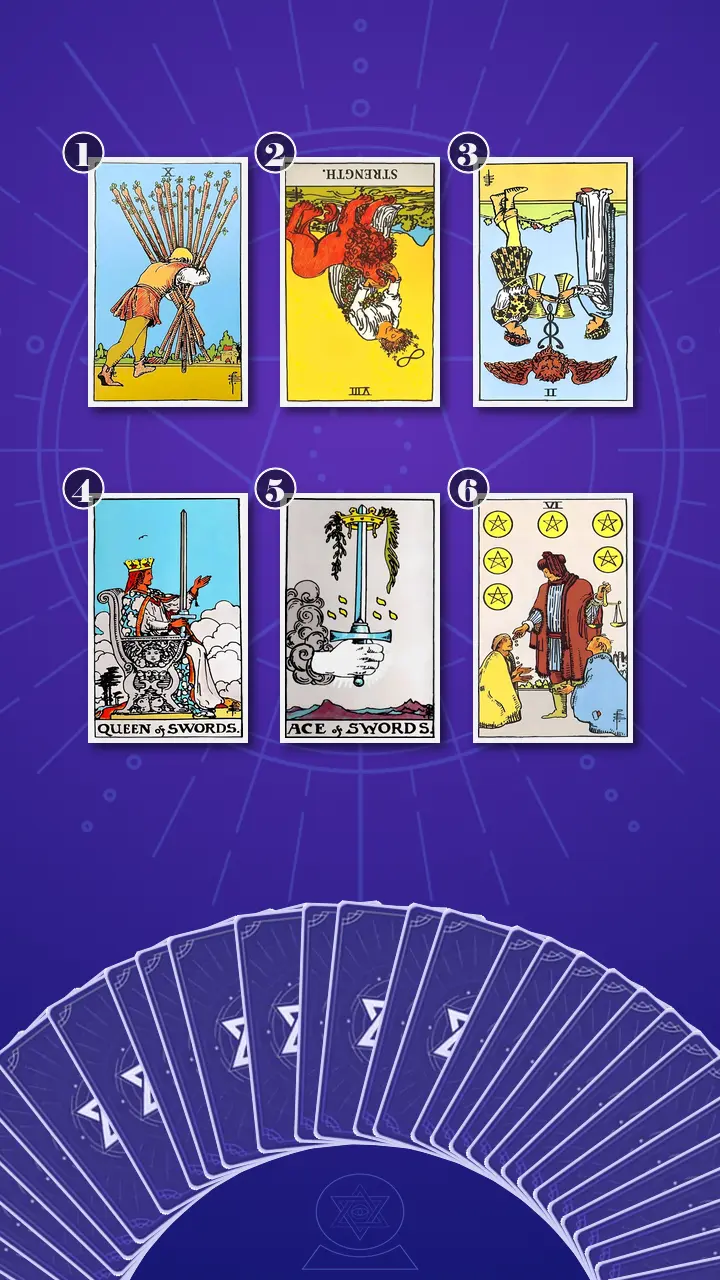
Reading the Map: The Upstairs Room Where It Gets Stuffy
Position 1: The Surface Symptom
“Now flipped over,” I said, “is the card that represents the surface symptom: what the ‘can we process?’ dynamic looks like in real life.”
Ten of Wands, upright.
In modern life, this is painfully specific: it’s 10:43 p.m., you’ve kicked off your shoes, you’re opening Uber Eats, and your phone buzzes—“Hey, can we process something from tonight?” You think you’ll reply quickly. Instead you send a long, careful paragraph, then another, then a voice note—like the hangout didn’t end, it just changed formats into unpaid emotional overtime.
The Ten of Wands isn’t “you’re bad at boundaries.” It’s Fire energy in excess: over-functioning, carrying, doing. The figure on the card is bent forward under a bundle that blocks their view—exactly how your own night disappears the second the “processing” thread begins.
Jordan let out a small laugh that had no humor in it. “That’s… so accurate it’s kind of rude.” Their hand went to their jaw like they’d only just noticed they were clenching.
Position 2: The Primary Blockage
“Now flipped over,” I said, “is the card representing the primary blockage: the immediate inner friction that stops you from saying ‘no’ in the moment.”
Strength, reversed.
This is the stomach-drop card. The moment you see “can we process?”, your brain flips into de-escalation mode. Draft a boundary—delete it—draft again—soften it until it’s basically an invitation back into the therapist chair.
Strength reversed is inner steadiness in deficiency. Not a lack of compassion—too much compassion leaking out without a container. You’re trying to prevent them from feeling anything sharp, even if it costs you an hour of your evening and a tight jaw the next morning.
I described the montage out loud: the blinking cursor, the unsent sentence that starts with “I can’t tonight,” the second paragraph forming like a safety net. The internal group-chat voice that says, I can’t be the reason they feel bad.
Jordan’s eyes unfocused for a second, like they were watching their own thumbs do it in real time. Then they nodded once—slow, resigned.
Position 3: The Underlying Root
“Now flipped over,” I said, “is the card that represents the underlying root: the relational agreement you never consciously signed.”
Two of Cups, reversed.
Here’s the hard truth that often brings relief: this isn’t a morality test about being “a good friend.” It’s a reciprocity issue. Two of Cups is supposed to be symmetry—two cups at equal height, equal exchange. Reversed, the flow tilts.
In Jordan’s life, it looks like this: they start telling a story about their week, and within two minutes it becomes a prompt for the other person’s feelings recap. The vibe they thought they were having—casual hang, memes, maybe a late-night snack—quietly switches into a format where the friendship only feels “close” if Jordan performs emotional expertise.
Two of Cups reversed is Water energy distorted: intimacy without mutuality. And because Jordan values mental-health language (TikTok “holding space,” “processing,” “emotional safety”), it’s easy to confuse imbalance with depth—until the resentment shows up on the ride home like an alarm you can’t snooze.
“If ‘processing’ is the only format,” I said, “it stops being connection and starts being a job.”
Jordan swallowed, eyes flicking down. “I hate that I want it to be lighter,” they admitted. “Like… maybe I’m not emotionally evolved enough.”
“Or,” I offered, “maybe you’re evolved enough to notice the exchange is off.”
When the Queen of Swords Lifted Her Blade
Position 4: The Key Transformation
I held my breath for a beat before turning the next card. The grid always has a pivot point—like standing under the planetarium dome right before the lights go down. The room doesn’t change. Your perception does.
“Now flipped over,” I said, “is the card representing the key transformation: the boundary mindset you need to embody so you can exit the therapist role without becoming cold or cruel.”
Queen of Swords, upright.
In real life, this is you choosing clear over nice. Reading the message, taking one slow breath, and replying with adult-to-adult clarity: what you can offer, what you can’t, and what you’d prefer instead. Not a TED Talk. Not a therapy disclaimer.
And this is where my research brain always slides in. In celestial mechanics, a binary star system can become tidally locked—one body ends up always facing the other, stuck in a single orientation. The system still looks “close,” but it’s not flexible. It can’t breathe.
Jordan’s friendship had that tidal-lock feel: no matter what the hangout was supposed to be, they kept rotating into the same face of the relationship—emotional containment—because their fear of disappointing the other person pulled like gravity.
That was the setup Jordan was living in: keys on the counter, shoes half-off, phone lighting up the room—realizing the night isn’t over, because “can we process?” means they’re about to start another shift.
Stop performing emotional triage by default—pick up the Queen of Swords’ clear blade and name the boundary that protects both your time and your sincerity.
The words landed, and I watched the reaction chain move through Jordan in three small beats: first, a freeze—breath held, eyes wider, like their nervous system had to verify it was allowed to hear that. Then a tiny cognitive shift—their gaze slid off the screen toward the kitchen window, as if replaying past nights, past threads, past voice notes. Then the release: their shoulders dropped a fraction, and the hand at their jaw loosened like they’d set something down without realizing it was heavy.
“But if I do that,” they said, and there was a flash of anger in it that surprised even them, “won’t they think I’m cold?”
“You’re allowed to be kind and still be unavailable,” I said, calm and direct. “The Queen of Swords isn’t cruelty. She’s accuracy. Over-explaining is how you accidentally re-enroll yourself. Clarity is what stops the tidal lock.”
I let a pause hang long enough for the idea to settle. “Now—using this new lens—can you think of one moment last week when that text came in, and this boundary would’ve changed how your body felt? Even by five percent?”
Jordan’s eyes got shiny, not in a dramatic way—more like the first sting when you walk from cold air into heat. “Tuesday,” they whispered. “I could’ve eaten. I could’ve gone to bed. I didn’t have to…” They trailed off, and their mouth tightened again with the responsibility of what it means to choose differently.
“That’s the shift,” I said. “From pressure and pre-editing to steadier self-trust. Not all at once. Just one clean pivot.”
The One-Point Reply That Ends the Shift
Position 5: The Actionable Next Step
“Now flipped over,” I said, “is the card representing the actionable next step: the simplest, most direct thing to say or do next time—doable within a week.”
Ace of Swords, upright.
This card is the difference between a boundary and an essay. The single sword is one clean point. In context: you send one short message that resets the format before the thread turns into an hour. Something like: “I care about you, and I’m not available to process tonight. If you want to talk, I can do a quick 10-minute check-in tomorrow, or we can keep it light.”
The Ace of Swords is Air energy in balance: clean language, clean edges. It’s also the “stop button” your conversation flow has been missing.
Jordan flinched a little. “But I can’t wait,” they said. “If I don’t reply fast, they’ll spiral. And then I’ll feel worse.”
“That’s Strength reversed talking,” I replied. “It thinks your speed equals your care. We’re going to test a different equation: your clarity equals your care. And your capacity is real, even if someone feels disappointed for a minute.”
Position 6: The Integration
“Now flipped over,” I said, “is the card representing integration: what a healthier friendship exchange looks like after you set the boundary.”
Six of Pentacles, upright.
This is where the weight redistributes. The scales on the card are a reminder: the friendship doesn’t need more empathy. It needs measurement and structure—time boxes, mutual check-ins, and an equal right to say “not tonight.”
Six of Pentacles is Earth energy in balance: practical, measurable give-and-take. After the Queen and Ace clear the air, this card asks you to build a new normal your nervous system can trust—so your body stops bracing at every notification.
From Insight to Action: A Boundary You Can Repeat This Week
I leaned back and stitched the whole grid into one story for Jordan:
The pattern starts with emotional labor creep (Ten of Wands): the hangout ends, but the “aftercare” shift begins. The blocker is that your steadiness drops the second you anticipate hurt (Strength reversed), so you soften and soothe to avoid conflict. Underneath, the friendship has slid into an unspoken contract where “closeness” equals you regulating (Two of Cups reversed). The way out isn’t more soothing—it’s clean language (Queen/Ace of Swords) that makes room for measured reciprocity (Six of Pentacles).
Your cognitive blind spot, I told them, is believing: if I don’t help them process, I’m a bad friend. The transformation direction is smaller and more humane: shifting from “I have to hold the whole emotional process” to “I can name my capacity and offer friendship within boundaries.”
Then I gave them next steps—designed for the real moment, when it’s late, you’re tired, and your nervous system wants to over-explain.
- Save the script before you need itOpen Apple Notes (or Notion) and write a two-sentence reply titled “Processing Boundary.” Keep it copy/paste-ready: “I care about you, and I’m not available to process tonight. If it’s important, I can do a 10-minute check-in tomorrow—or we can keep it light.”If you feel tempted to “make it nicer,” write the extra paragraph in Notes—not in the chat.
- Use the 90-second pause ruleNext time the “can we process?” text hits, wait 90 seconds: both feet on the floor, one slow exhale, shoulders down. Then send the saved script as-is.If guilt spikes, label it—“this is the discomfort I used to manage”—and hit send anyway. One message. One point. No apology tour.
- Make support measurable, not unlimitedIf you choose to engage, offer a time-box: “I can do 10 minutes—do you want advice or just listening?” Set a visible timer. When it ends, pivot: “Okay, I’m tapped out on processing—want to watch an episode / send memes / talk trip plans?”Start with 5 minutes if 10 feels too big. The goal is repeatability, not perfect tone.
“This isn’t you becoming less caring,” I said. “It’s you becoming legible. A boundary that protects your time also protects your sincerity.”

A Week Later: The Quiet Proof
Six days later, I got a message from Jordan. No long explanation—just a screenshot.
The friend had texted: “Hey, can we process something from tonight?”
Jordan’s reply was two sentences. Clean. Kind. Finite. Then, beneath the screenshot, they wrote: “I put the phone face down and ate my leftovers while they were still hot. My shoulders were up for like a full minute. Then… they dropped.”
That’s the kind of proof I trust: not a magically fixed friendship, but a reclaimed evening. Clarity, in motion.
When a “can we process?” text lands, it can feel like your body is bracing to prove you’re caring—while a quieter part of you is begging not to disappear into another open-ended emotional shift.
If you let yourself be both kind and unavailable this week, what’s the smallest sentence you’d be willing to repeat—just once—so your evenings belong to you again?