Auto-Yes to Moving Requests—and the Pause That Made It a Choice

The TTC Ping That Ate Your Weekend
You text “Sure!” to a friend’s last-minute moving request before you even check your calendar—then spend the next hour rearranging your weekend and feeling weirdly judged by every “ride-or-die” friendship post you scroll past.
Jordan (name changed for privacy) said it like a confession, but their laugh didn’t have any air in it. They were 28, based in Toronto, and the kind of person who could juggle a hybrid marketing job, a Notion to-do list, and a friend group that plans everything in DMs—until one tiny text turned their whole body into an alarm system.
They described the exact moment: 8:52 p.m. on the TTC Line 1, heading home. The car smelled faintly like wet jackets and hand sanitizer. Their phone was warm from doom-scrolling when the group chat lit up: “Can you help me move this weekend?” Their stomach dropped like an elevator missing a floor. Their shoulders climbed. Their thumb opened Google Calendar like it was a life raft.
“I said yes,” Jordan told me, eyes flicking to the side as if the words were embarrassing, “and now I’m mad at myself for saying yes.”
The guilt wasn’t abstract. It sat in their chest like a tight strap, the kind you only notice once it’s already cutting off your breath. The pressure had that buzzing-restless quality—like their nervous system was an “always-on notifications” setting that couldn’t find the off switch.
I kept my voice soft, steady. “We’re not here to make you a different kind of friend,” I said. “We’re here to figure out why this feels like a loyalty test, and how to respond in a way you can respect tomorrow. Let’s draw a map through the fog—something that actually gives you clarity and next steps.”

Choosing the Compass: The Four-Layer Insight Ladder
I asked Jordan to take one slow breath in through the nose, out through the mouth—not as a ritual, just as a gear shift. Then I shuffled until the pace of my hands matched the pace of the room: quieter, less reactive.
“For this,” I told them, “I want to use a spread I call the Four-Layer Insight Ladder · Context Edition.”
Here’s why it works—especially if you’ve been googling things like why do I feel guilty saying no to friends or how to set boundaries without over explaining and nothing sticks. This isn’t a single yes/no decision. It’s a repeating reflex with a past-based engine. So instead of predicting the future, this spread climbs through layers: observable behavior → the inner pressure that locks it in → the past script → the core belief → a boundary experiment → integration (so it’s sustainable).
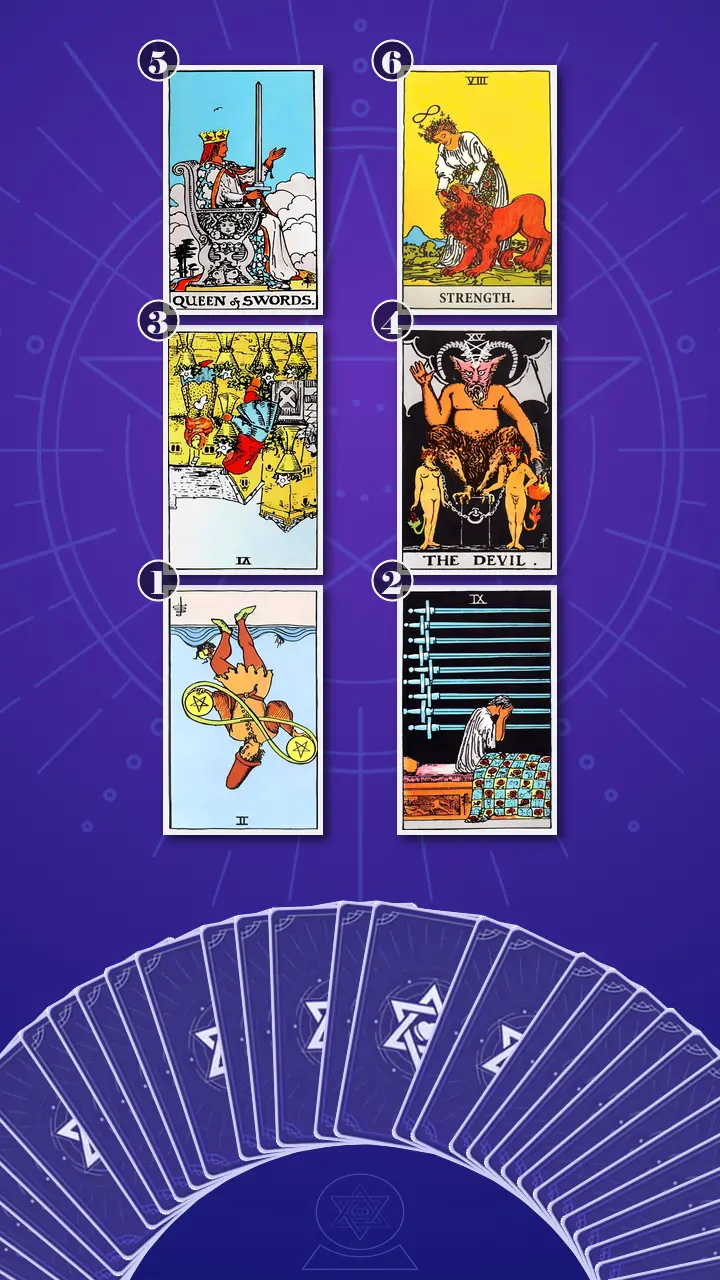
I pointed to the “ladder” layout. “Card one shows what you do in the first sixty seconds—the auto-yes. Card four is the knot: the belief that makes boundaries feel dangerous. And the top rung—card six—shows what it looks like when your body can actually hold a limit without collapsing into compliance.”
Reading the Ladder: From Calendar Chaos to Old Scripts
Position 1 — The Auto-Yes in the First 60 Seconds
“Now flipping over,” I said, “is the card that represents the immediate trigger behavior: what you do in the moment you’re asked.”
Two of Pentacles, reversed.
I tapped the image lightly. “This is the calendar-Tetris card. A friend drops a last-minute moving request, and you instantly open your calendar app—work deadlines, errands, the one recovery window you were counting on—while telling yourself you’ll ‘make it work somehow.’ Reversed, it’s committing before you’ve checked what you’re sacrificing, because juggling feels safer than choosing.”
Energetically, reversed Two of Pentacles is a blockage: not a lack of capability, but an overload that pretends it’s fine. The infinity loop around the coins is the tell—your mind toggles between your life and everyone else’s needs like you’ve got two mental tabs permanently running.
I added one line I’ve learned people need to hear early, before they shame themselves for wanting time: “A pause is not a rejection. It’s a capacity check.”
Jordan let out a small, bitter laugh. “That’s… brutal,” they said. “Because I literally don’t even think. I just… send it.” Their fingers mimed typing, quick and automatic, then they rubbed their palm as if it still held the phone’s heat.
Position 2 — The Pressure That Locks It In
“Now flipping over,” I said, “is the card that represents the felt experience that locks the pattern in—what your mind and body do right after the request.”
Nine of Swords, upright.
“This is the after-hours mental trial,” I said. “It’s late, you’re in bed, and your brain is still in the text thread. You replay your wording, worry about tone, imagine disappointment, and quietly put yourself on trial for being ‘selfish’—even if you already said yes. The request isn’t what’s keeping you up; it’s the fear-story about what boundaries could cause.”
In terms of energy, this is excess Air—too much thinking, too much forecasting. I’ve seen this pattern in finance and in friendships: when uncertainty spikes, the mind starts trying to ‘hedge’ with more data. But in relationships, there’s no perfect spreadsheet that guarantees nobody feels disappointed.
Jordan’s jaw tightened as they nodded. Their foot bounced once, twice, like their body wanted to run while their face tried to look composed.
“Guilt is loud,” I said, careful not to dismiss it. “That doesn’t make it true.”
Position 3 — Past Fuel: The Role You Learned to Play
“Now flipping over,” I said, “is the card that represents past fuel—earlier conditioning that this request activates.”
Six of Cups, reversed.
“This favor doesn’t just feel like a favor,” I told them. “It feels like proving you’re safe to keep. Six of Cups reversed is the old script activating: being easy, helpful, and low-maintenance was how you stayed liked—or stayed out of trouble. So adult friendship requests hit the same old button: ‘Be good. Be useful. Don’t disappoint.’”
Reversed, the energy is a misplaced loyalty. Not loyalty to your friend—loyalty to an outdated survival role. And it explains why a simple boundary text starts to feel like breaking a rule you never consciously agreed to.
Jordan went quiet. Their shoulders dropped a fraction, not from relief—more like something heavy finally got named.
Position 4 — The Core Bind: “I Have To”
“Now flipping over,” I said, “is the card that represents the core bind—the belief that makes boundaries feel dangerous.”
The Devil, upright.
I didn’t lean into drama. I never do with this card, because people-pleasing already comes with enough shame.
“You tell yourself, ‘I can’t say no,’ and it feels true—like there’s a social price tag you can’t afford,” I said. “The Devil is that bind where approval equals safety, so compliance feels like protection. Your self-worth gets quietly chained to being needed, and a simple boundary turns into a fear of distance, rejection, or losing your place in the group.”
In my head, I flashed to my old Wall Street life—risk limits, hard lines, contracts where the language wasn’t emotional, just clear. Fairness wasn’t a vibe; it was a structure. Jordan never got that structure around their time and energy. They were negotiating belonging with their weekends.
I mirrored the card’s loose chains with something painfully modern: “It’s like the unread message sitting on your lock screen like a tiny collar. Not heavy enough to kill you. Heavy enough to steer you.”
And I asked, “Finish this fast, no polishing: ‘If I say no, it means I am ____.’”
Jordan swallowed. “Selfish,” they said, like they hated the word. Then, softer: “Replaceable.”
That was the real engine. Not the move. Not the box. Belonging.
Position 5 — The Boundary Experiment: Clean Words, No Essay
“Now flipping over,” I said, “is the card that represents the boundary experiment—what you can practice in a real conversation this week.”
Queen of Swords, upright.
“This is the medicine,” I said. “You write one clear message that doesn’t audition for approval: ‘I can’t do Saturday, but I can do 1–3 on Sunday,’ or ‘I can’t help this weekend.’ Then you stop. No paragraphs. No life story. Queen of Swords is you separating compassion from compliance—being respectful without being negotiable.”
I described the moment like a screenshot because that’s how it shows up in real life: the glow of the phone screen, the cursor blinking, the three-paragraph apology draft you keep trying to perfect.
“You’re going to feel the urge to add ‘sorry sorry’ or explain your entire week,” I warned. “That urge is just the old system trying to keep you safe.”
Jordan exhaled—an actual, audible release. “A one-sentence text sounds… impossible,” they said, then smirked. “But also kind of hot.”
When Strength Held the Lion of Guilt
Position 6 — Integration: The New Normal You’re Building
Before I turned the final card, the room got very still. Even the city noise outside my window felt like it backed up a step, like it was listening too.
“Now flipping over,” I said, “is the card that represents integration—the inner capacity you’re building so boundaries become sustainable rather than reactive.”
Strength, upright.
“This is what it looks like when guilt spikes and you don’t immediately obey it,” I said. “Strength isn’t force. It’s meeting the ‘lion’ of guilt with steadiness and breath. Hand on chest, slow exhale, shoulders down. You choose the response you can live with tomorrow—yes, no, or limited help—and you let the friendship hold a normal amount of disappointment.”
Jordan’s face had that familiar trapped look—the one that says, Okay, but if I don’t fix it right now, something bad happens. They were still caught in the moment from the TTC: the ping, the stomach drop, the thumb typing “Of course!” before Saturday even existed.
Not “prove you’re a good friend by carrying the whole load,” but “practice calm courage—like Strength—by holding the lion of guilt gently and choosing a sustainable yes or no.”
Jordan froze—breath caught, hand hovering above their own phone like they were back on the train. Their eyes unfocused for a second, as if a memory buffered on-screen. Then their shoulders lowered in a slow, almost reluctant release. A flush climbed their neck, and their mouth opened like they were going to argue… but instead they whispered, “Oh.”
The reaction came in three beats: first the body (a tight inhale, knee going still), then the mind (their gaze drifting to the side, replaying a dozen moments they’d called “being nice”), then the emotion (a shaky exhale that sounded like grief and relief sharing the same lungs).
I let the silence do its job. Then I asked, gently but directly, “Now, with this new lens—can you remember a moment last week when guilt rushed in, and this idea could’ve changed what you did? Just one moment. Even a small one.”
Jordan blinked fast. “Yesterday,” they said. “A friend asked if I could review their resume ‘real quick.’ I had dinner plans. I said yes anyway, then stared at the doc and hated myself.” They pressed their palm to their chest without being prompted, like their body finally understood the assignment. “It wasn’t that I wanted to help. It was that I thought I had to. Like… my place in the group depended on it.”
“Exactly,” I said. “This is the shift—from guilt-driven automatic yeses and quiet resentment to regulated self-trust and kind, sustainable boundaries. Not because you care less. Because you’re finally choosing.”
The On-Call Friend Reset: Actionable Next Steps That Don’t Feel Like a Personality Transplant
I pulled the whole ladder together for them in plain language. “Here’s the story your cards told,” I said. “When a request hits, you juggle first (Two of Pentacles reversed). Then your brain runs a reaction simulation and puts you on trial (Nine of Swords). Under it is an old role—helpful equals good equals belonging (Six of Cups reversed). The deepest knot is the belief that a boundary means you’re selfish or replaceable (The Devil). The turning point is clean language (Queen of Swords). And the new normal is learning to ride the guilt wave without letting it steer (Strength).”
The blind spot was sharp: Jordan kept trying to solve a belonging fear with logistics and perfect wording. That’s why the calendar checks and apology drafts never delivered peace.
“The transformation direction,” I said, “is pause-and-choose. Not automatic agreement. Not dramatic confrontation. Just a deliberate pause, a capacity check, and one clean sentence.”
I also offered something from my old professional toolkit—because sometimes people need a framework that feels concrete. “On Wall Street, we’d never take a position without knowing our downside and our alternative. In friendships, that’s not cold—it’s healthy. I call it Negotiation Alchemy: you pair a human signal (‘I care’) with a clear BATNA—your best alternative to a negotiated agreement—which, here, is your time, rest, and self-respect. If you don’t know your BATNA, guilt will negotiate for you.”
Then I gave Jordan a structure they could actually use the next time someone asked, ‘Can you help me move?’
- The 10-minute reply pauseWhen the next favor text lands, don’t answer in the same minute. Set a 10-minute timer. In your Notes app, write: “My capacity this weekend is: ____.” Then reply with either a clear yes, a clear no, or a limited counteroffer.If pausing feels “dramatic,” remember: a pause is not a no—it’s capacity-checking. If 10 minutes feels too long socially, do 5. It still counts.
- One clean sentence (Queen of Swords script)Send one clean limit text: “I can’t do Saturday.” or “I can do 1–3 PM, not the full day.” or “I can’t lift furniture, but I can bring coffee and help pack one room.” Stop after the sentence.Expect the urge to justify to spike after you hit send. That discomfort is practice, not proof you were wrong. Put your phone face-down for 2 minutes and do something physical (fill your water bottle, stand at the window).
- The Cocktail Party Algorithm (3-phase boundary template)Use this three-part text format: (1) Warmth: “Thanks for thinking of me.” (2) Limit: “I can’t help Saturday.” (3) Option: “I can do one hour Sunday” or “I’m cheering you on—hope it goes smoothly.”If they push back, repeat the limit without expanding. You don’t need to disclose your whole schedule to make your boundary valid.

A Week Later: The Quiet Proof
Six days later, Jordan messaged me a screenshot—not of a perfect friendship moment, just a real one. Their friend had asked, last-minute again. Jordan’s reply was one clean sentence: “I can’t do Saturday, but I can do 1–3 on Sunday.” Under it, a second message from the friend: “Totally! That helps a lot.”
Jordan added, “I felt shaky after I sent it. Like I wanted to write a whole TED Talk apology. I didn’t. I took a shower and went for a walk. I still feel… weirdly proud.”
It wasn’t fireworks. It was quieter than that: a firm choice, followed by a few minutes of loneliness in the pause, followed by the first real evidence that mutual connection can survive a normal amount of disappointment.
That’s the Journey to Clarity I trust most—the kind that turns “I have to” into “I’m choosing,” without making you hard or shut down.
When a simple “no” makes your stomach drop, it’s not because you’re selfish—it’s because some part of you learned that belonging had to be earned in real time, one exhausted yes at a time.
If you let yourself pause for just ten minutes next time, what would a “kind but chosen” answer sound like in your own words?