12:07 AM, the 'What Are We?' Text, and a Way Out of Limbo

Finding Clarity in the “What Are We?” Text Bubble
If you’ve drafted a reply to “what are we?” in Notes more times than you’ve actually replied, welcome to situationship limbo.
Taylor (name changed for privacy) came into my café in Toronto with that look I’ve learned to recognize over twenty years of morning espresso and late-afternoon confessions: the eyes are on the table, but the mind is still lit up by a screen.
She described it like a time-stamped loop: 12:07 AM in her condo living room, the laptop glow and a streetlight bleeding through the blinds. Netflix on low volume, not really watched. Her phone warm in her hand from being reopened too many times. iMessage thread, then Notes app, then back—thumb hovering over Send like it’s a wire she might cut wrong. Her jaw felt locked, her chest tight, and the thought kept landing like a cold coin: One wrong sentence could ruin this.
“He asked, ‘what are we?’” she said, almost like she was quoting a subpoena. “And I want exclusivity. I want to know what lane we’re in. But I’m terrified if I say that out loud, I’ll trigger the breakup that’s been waiting in the wings.”
The anxiety wasn’t abstract—it was physical, like trying to breathe through a scarf you didn’t choose, while your hand keeps reaching for your phone on autopilot just to feel in control for two seconds.
I nodded and slid her a small glass of water—something to anchor the body before we ask the mind to stop sprinting. “We’re not here to predict your life,” I told her gently. “We’re here to get you out of the fog. Let’s make a map—something you can actually use to find clarity, even if the answer isn’t the one you hoped for.”

Choosing the Compass: The Decision Cross Tarot Spread
I lit nothing dramatic—just the usual warm café lamps and the steady hiss of the espresso machine behind the counter. Tarot, for me, works best when it feels like real life: you breathe, you focus, you tell the truth. So I asked Taylor to take three slow breaths and hold one simple question in her mind: Exclusive—or end this situationship?
While I shuffled, I explained what I was doing in plain language: not summoning anything, just using a structured mirror. “Today we’ll use the Decision Cross,” I said. “It’s designed for a clean fork in the road—two paths, plus the emotional fog that makes the choice feel high-stakes, and one grounding next step so you don’t leave here with ‘interesting insights’ and no plan.”
For anyone reading along: the Decision Cross is simple on purpose. Card 1 shows the current dynamic (why you’re stuck). Card 2 is Path A (what exclusivity looks like when it’s mutual). Card 3 is Path B (what you reclaim if you walk away). Card 4 names the blind spot—the projection, fear, or assumption that keeps you in limbo. Card 5 is the practical move you can take this week to create clarity and self-respect, regardless of what they choose.
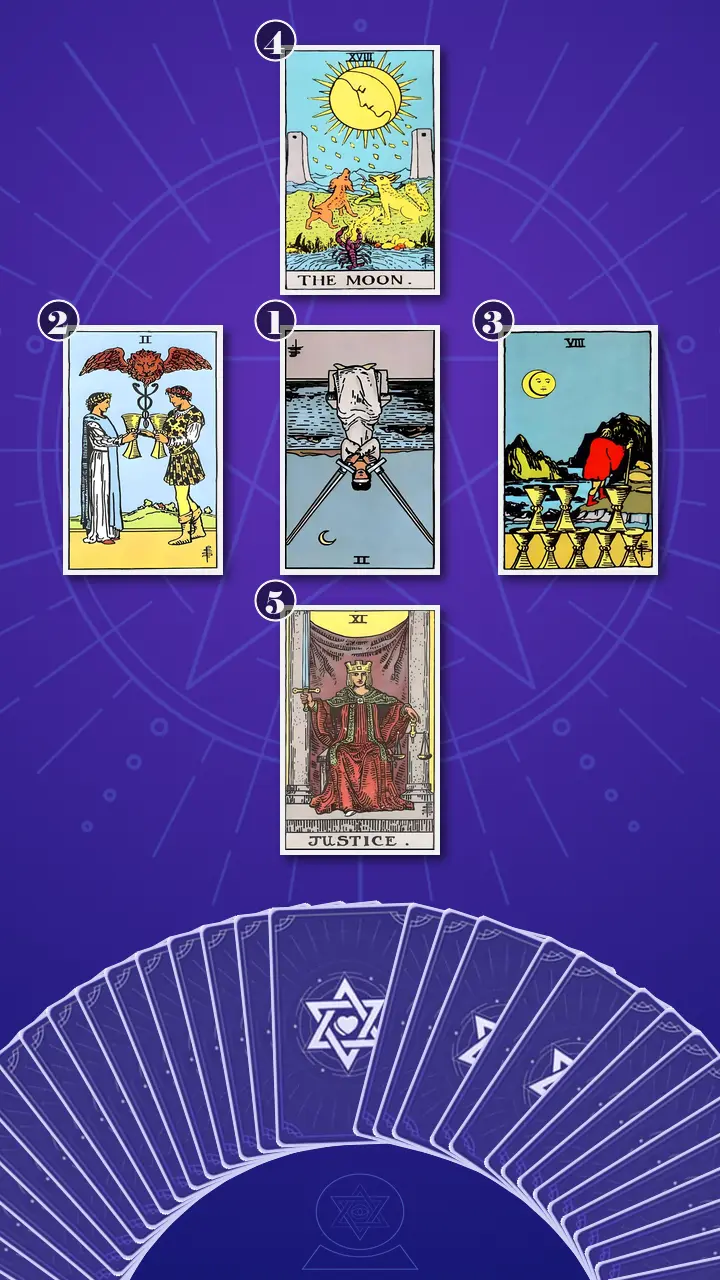
Reading the Map: Mixed Signals, Mutuality, and the Moment You Stop Vibe-Managing
Position 1 — The present situationship dynamic (where you get stuck)
“Now we turn over the card for the present situationship dynamic and the specific way you’re getting stuck after the ‘what are we?’ question.”
Two of Swords, reversed.
I pointed to the blindfold and the crossed blades. “This is the energy of having seventeen drafts and no send—decision fatigue disguised as being ‘careful.’ It’s 12:30 AM, you reopen the same thread, type-delete-retype three breezy versions, chest tight, jaw clenched, telling yourself you’re just being thoughtful… but really you’re avoiding the one clean conversation that forces a yes or a no.”
In terms of energy, reversed Two of Swords is a blockage that’s leaking. You’re trying to keep your heart protected by staying neutral, but the pressure of indecision keeps spilling into your body—tight chest, restless hands, that constant “if I say this, then they’ll think that” forecasting.
Taylor gave me an unexpected little laugh—sharp at the edge, like it surprised her. “That’s… so accurate it’s kind of mean,” she said, but her eyes didn’t leave the card.
“I know,” I said, soft but firm. “And here’s the thing: You don’t need a perfect text. You need a clean question.”
She swallowed, then nodded once—small, precise. The kind of nod that says, Okay. You saw me.
Position 4 — The blind spot (the fog that distorts the decision)
“Now we turn over the card for the blind spot: assumptions, fears, or projections that distort the decision and keep you in limbo.”
The Moon, upright.
I let the silence stretch just a beat, the way you let coffee grounds settle before you judge what’s actually in the cup. “The Moon is the doom-scroll of your own situationship,” I told her. “A slow reply becomes a whole storyline. One minute it’s ‘they’re pulling away,’ the next it’s ‘they’re just busy.’ You read into Story views, timing, punctuation—because without a container, your mind fills dead air like an algorithm that can’t stand an empty feed.”
Energetically, The Moon is excess imagination plus insufficient data. It’s not that you’re dramatic. It’s that ambiguity is loud. It keeps your nervous system bracing—like you’re riding the TTC at 8:41 AM, wedged between winter coats, refreshing messages you already know won’t be there, shoulders inching up toward your ears.
I watched Taylor’s hand tighten around her cup, then loosen. Her eyes went unfocused for a second, like she was replaying the same message thread in her head. That was the pattern clicking into place: Two of Swords reversed says “I’ll stay neutral so I can’t be hurt,” and The Moon says “and then you’ll suffer in the fog anyway.”
“So what’s one story you keep treating as fact?” I asked her. “About him, or about you?”
Her voice dropped. “That if I ask for exclusivity, I’ll look needy. And then he’ll leave.”
Position 2 — Path A (what mutual exclusivity requires, when it’s real)
“Now we turn over the card for Path A: what choosing exclusivity would require emotionally and relationally—and what it looks like when it’s mutual.”
Two of Cups, upright.
“This,” I said, tapping the image lightly, “is the calm version of exclusivity. Not you auditioning. Not you performing ‘low-maintenance.’ Two people exchanging cups like adults: mutual consent, spoken terms, steady eye contact.”
I translated it into her city life. “It looks like meeting after work—maybe a walk through Trinity Bellwoods, or grabbing coffee on Queen West—and having a conversation that’s almost boring in the best way. You define what ‘exclusive’ means in practice: dating apps, seeing other people, communication expectations, what plans look like. And you leave steadier because the agreement is mutual, spoken, and real.”
In energy terms, the Two of Cups is balance. Mutual is calm. Ambiguous is loud.
Taylor’s face softened—relief, but also a kind of practical focus. “Like… I don’t even need a label right away,” she said slowly. “I need the terms.”
“Exactly,” I said. “A relationship is a container. If you don’t define it, you end up trying to live inside a vibe.”
Position 3 — Path B (what ending it helps you reclaim)
“Now we turn over the card for Path B: what ending the situationship supports you in reclaiming, and what you may be walking toward by leaving.”
Eight of Cups, upright.
“This isn’t a dramatic breakup card,” I said immediately, because I could feel her flinch before she even admitted it. “It’s the quiet exit. You stop organizing your week around someone who won’t define you. You don’t send a paragraph that reads like a closing argument. You just step back: fewer late-night hangs, no more ‘are you up?’ plans, more room for friendships, sleep, and a life that doesn’t revolve around one reply.”
Energetically, Eight of Cups is self-respect through departure—not punishment, not villainizing. It’s choosing not to accept a slow emotional leak as your normal.
Taylor’s expression did a small, bittersweet shift: first a nod, then her lips pressed together, then a long exhale through her nose. “A ‘no’ is painful,” she said, almost to herself. “But a maybe that lasts months is… corrosive.”
“Yes,” I said. “That’s the truth your body has been trying to say while your brain keeps rewriting the text.”
Position 5 — The best next step (grounding guidance for clarity this week)
I held the last card a moment longer than usual. The café felt quieter—not silent, just… focused. Even the espresso machine sounded farther away, like the room had decided this part mattered.
“Now we turn over the card for the best next step you can take this week to create clarity and self-respect, regardless of their response.”
Justice, upright.
“This is your exit from the fog,” I told her. “Justice is standards and clean language. It’s cause-and-effect. It’s the Terms of Service—maybe not romantic, but it tells you what you’re consenting to.”
And this is where my café brain always joins my tarot brain. I use what I call Relationship Stage Diagnosis: espresso, latte, americano. “Taylor,” I said, “right now you’ve been drinking this connection like an americano—diluted on purpose. You keep adding water so you don’t look like you ‘need’ it. But your nervous system is begging for espresso: concentrated truth. One shot. One sentence.”
This is the shift—from tense situationship uncertainty and vibe-managing to grounded clarity and self-trust through direct standards. Not by decoding mixed signals. By choosing clarity over comfort.
She started to speak, then stopped—like she could feel the old habit of over-explaining rev up.
So I slowed down and gave her the setup I knew she lived in.
It’s late, your phone is warm in your hand, and you’re toggling between the chat thread and your Notes draft—trying to sound “chill,” while your chest is tight because you actually want a clear yes.
Stop negotiating in the dark; choose a clear question and a clear standard, like Justice’s sword and scales.
The words landed, and I watched the whole three-step reaction chain unfold in her body.
First: a brief freeze. Her breath caught at the top of her chest; her fingers stilled on the cup, like she’d been caught mid-scroll.
Second: the cognitive shift. Her eyes went slightly unfocused, not dissociating—more like she was replaying that “what are we?” moment and seeing it with new lighting. Not a verdict. A compatibility check.
Third: release. A slow exhale. Her shoulders dropped half an inch, as if she’d been wearing a heavy coat indoors. Then, unexpectedly, her face tightened again for a second—new vulnerability, the dizzy moment after you set something down and realize you were using it to keep yourself braced. “But if I ask that,” she whispered, “and he says no… it means I misread everything.”
“It might mean you misread him,” I said, “not yourself. Wanting exclusivity isn’t a mistake. It’s a preference. Justice isn’t here to shame you—it’s here to stop you from putting your belonging on trial every time a text bubble appears.”
I leaned in, voice practical. “Now, with this lens—clear question, clear standard—look back at last week. Was there a moment where you almost asked, and then you softened it? Where this would’ve changed how you felt?”
Taylor blinked fast, then nodded. “Tuesday. I typed it. I added ‘lol’ and deleted it. Then I just sent a meme.”
“That’s your data,” I said. “Not your shame. Your data.”
The One-Week “Clarity Over Vibe” Plan
I gathered the cards into a neat stack the way I tamp espresso: firm, clean, no extra fuss. “Here’s what the spread is saying as one story,” I told her. “You’re stuck (Two of Swords reversed) because you’re protecting yourself with ambiguity. The fog (The Moon) makes you treat timing and tone like evidence, so you keep running A/B tests on vibes instead of collecting actual data. Two of Cups says exclusivity is possible only if it’s mutual and spoken. Eight of Cups says if it can’t be mutual, leaving is not dramatic—it’s deliberate. Justice brings it home: clarity is created by one direct question, one timeline, and one standard you’ll honor.”
“Your blind spot,” I added, “is believing that being direct equals being ‘too much.’ That belief keeps you performing chill so you can’t be rejected—while you slowly reject yourself. The transformation direction is the opposite: direct, time-bound clarity paired with follow-through.”
I gave her actionable advice—small, specific, and doable even with a tight chest and shaky hands.
- The One-Sentence AskWrite one clean line and keep it under 12 words: “I’m looking for exclusivity—are you?” Send it as-is (no paragraph, no softening add-ons).If you feel the urge to add a whole explanation, pause and reread the one sentence only. Direct doesn’t mean harsh; it means clear.
- The Time-Bound ContainerAdd one timeline: “Can we talk about this by Thursday?” If texting spikes your anxiety, ask for a 10-minute call instead.Treat it like logistics, not a performance. You’re not asking to be picked on the spot—you’re checking fit.
- The 5-Minute Facts vs Stories FilterBefore you send anything, set a timer for 5 minutes and list: (1) facts only (what was said/done, plans made), then (2) stories (what you think it means). Choose one standard from the facts (ex: “I need planned dates, not only late-night hangouts”).Stop when the timer ends. Your brain will want to ‘solve’ the story side—bring it back to the fact list.
And because I’m a café owner, I couldn’t help adding one more grounding image—my Cup Bottom Divination twist, not as fortune-telling but as a ritual of reality. “When you finish your coffee,” I said, “look at what settles at the bottom. The grounds don’t lie, but they also don’t scream. Let your emotions sediment. Then act from what’s left when the swirl stops.”

A Week Later: The Quiet Proof
Six days later, Taylor texted me a photo from her Notes app. The title was simple: Facts vs Stories. Under it, one line was highlighted: “Plans are always last-minute.” Below that, the message she’d sent—twelve words, no apology. And then her follow-up: “We talked by Thursday.”
She didn’t tell me it was magically easy. She told me something better: “I slept through the night. I woke up and my first thought was still ‘what if I ruined it?’—but then I laughed a little, because at least I wasn’t negotiating in the dark anymore.”
That’s the real Journey to Clarity I watch unfold again and again across my little tables: not certainty, but ownership. Not vibe-managing, but self-trust strong enough to ask a clean question and honor the answer.
When you want to be chosen but you’re terrified that asking for clarity will prove you weren’t, your body turns one text bubble into a full-blown verdict on your belonging.
So if you let clarity over vibe be your standard for one week, what’s the smallest direct question you’d be willing to ask—and what would it feel like to trust your own follow-through?