Hovering Over "Post" for Their View—From Auditioning to Presence

Finding Clarity in the 11:48 p.m. Scroll
You’re a 20-something city professional who can run a whole marketing campaign at work… but one Instagram Story for one person turns you into a late-night overthinker with Sunday-Scaries energy on a Tuesday.
That was the first thing Taylor (name changed for privacy) said when she dropped into the chair across from me—half laughing, half wincing like she’d just admitted to googling her own symptoms.
“It’s literally embarrassing,” she added, rubbing her thumb over the edge of her phone case. “I hate that I care this much about who watched.”
As she spoke, I could see the whole scene without her even trying: 11:48 p.m. in a Toronto condo living room, the only light coming from a phone screen and the blue glow of a paused show. The fridge hum suddenly sounds loud. The phone feels warm in your palm because it’s been in your hand for an hour. You record a Story, delete it, record again. And then your thumb hovers over Post the way someone hovers over a slot machine lever—pulling for a hit of reassurance.
Taylor’s question landed clean and sharp: “Before I post a story for them… what’s my self-worth chasing?”
She didn’t mean the general “why do I want attention.” She meant this specific loop—re-recording, caption tweaking, checking if they’re online, then watching the viewers list like it’s a stock ticker. In plain language, it’s validation-driven posting: using a Story as a covert bid for worth, attention, or reassurance from a specific person.
And I could feel the contradiction inside her like two browser tabs fighting for audio: she wanted to post freely and express herself… and she feared their silence would land in her body like proof she wasn’t worth noticing.
I leaned forward slightly, keeping my voice gentle and matter-of-fact. “We’re not here to bully you into ‘not caring.’ We’re here to get you back to choice. Let’s map what’s happening in those two minutes before you post—so you can find clarity without turning your nervous system into a scoreboard.”

Choosing the Compass: The Transformation Path Grid (6) Tarot Spread
I’m Juniper Wilde, and I read Tarot the way I make art: symbol first, shame never. I asked Taylor to take one slow breath—not as a mystical ritual, just a clean handoff from spiral-brain to observing-brain—then to hold the question in her mind while I shuffled.
“Today,” I said, “we’ll use a spread called Transformation Path Grid (6) · Context Edition.”
For you reading this: this is a six-card tarot spread designed for inner conflict, not prediction. It’s especially useful for social media anxiety and validation seeking because it separates the layers: the behavior you can see (re-recording), the pressure you feel (approval), the deeper driver (attachment), and then the specific shift and next steps that give you agency back.
We lay the cards in a 2-column by 3-row grid—like a phone screen split into inner vs outer pressure. Top row: Present and Block. Middle row: Root and Catalyst. Bottom row: Action and Integration. We read left-to-right across each row, then drop down—like scrolling through a feed that becomes progressively more honest.
“This way,” I told her, “we can answer your real question: not ‘should you post,’ but ‘what bargain are you making with your self-worth right before you do.’”
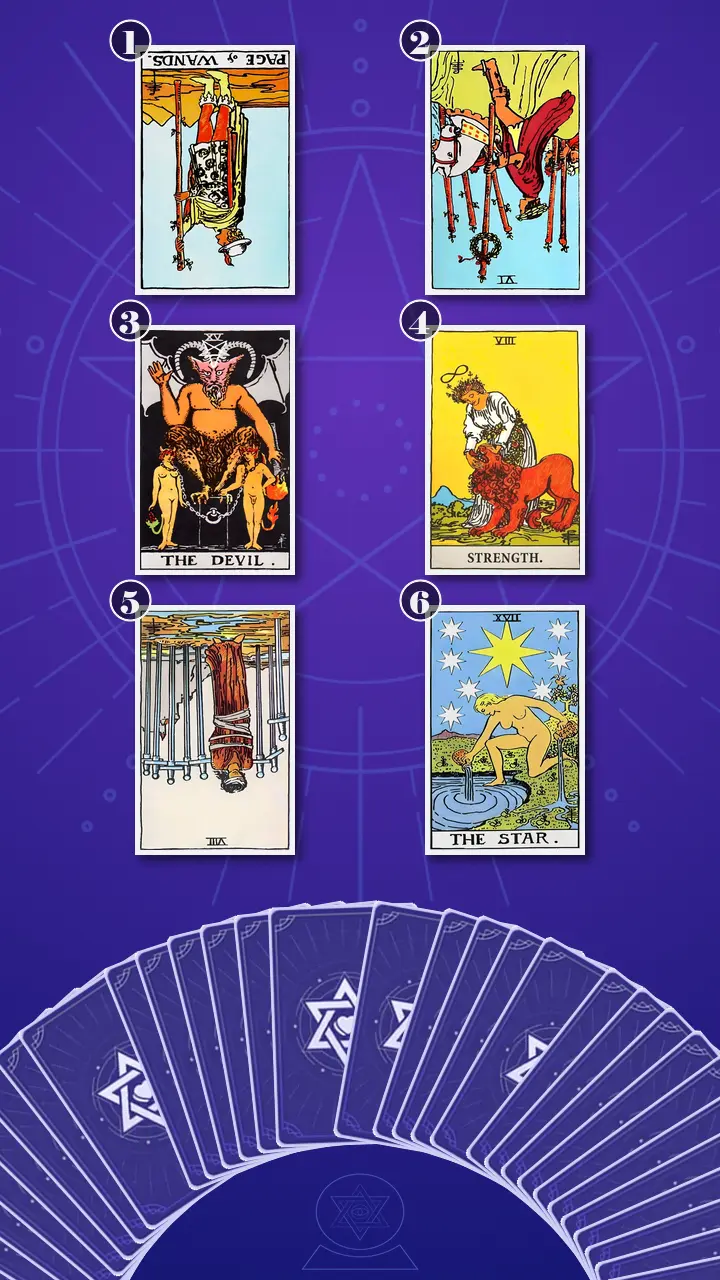
The Loop, the Scoreboard, the Chain
Position 1 (Present): The moment before posting
“Now flipping over,” I said, “is the card that represents Present: the observable ‘moment before posting’ behavior and the emotional tone driving it.”
Page of Wands, reversed.
Immediately I felt that jittery fire energy—enthusiasm trying to be spontaneous, but getting stuck in self-consciousness. “This is the exact card of ‘I want to put something out there’—and reversed, it turns into ‘I can’t land the vibe.’”
And it matched her modern-life reality almost too perfectly: You’re on your couch at 11:48 p.m. filming an 8-second Story that is totally fine—then you delete it, re-film it, and re-film it again because you’re trying to land the exact tone that says “effortless, unbothered, desirable.” You’re not asking “Do I like this?” you’re asking “Will they read this as cool?”
I framed it as an energy dynamic: “This is Fire in blockage. Your spark is real. Your desire to share is real. But it’s being forced through a filter called how will this be perceived, so it can’t move cleanly.”
Then I used the split-screen language I’ve learned people recognize instantly.
“On the left side of the screen,” I said, “is ‘casual cool girl’ caption drafts: lol, anyway, not me doing this, soft launch energy. On the right side is your body telling the truth: tight throat, fluttery chest, restless hands hovering over the screen.”
I tapped the Page’s wand on the card—held like a prop. “This wand is the Story. But in this moment, it’s not a wand. It’s a costume. You’re not asking, ‘What do I want to express?’ You’re auditioning.”
Taylor didn’t do the polite nod people do when they’re being read. She let out a short, bitter laugh—like a cough that decided to become honesty.
“Okay,” she said. “That’s… too accurate. Like, borderline rude.”
I smiled, not smug—more like relieved. “Good. If we can name it, we can change it.”
Position 2 (Block): Why the Story feels high-stakes
“Now,” I said, “we’re opening the card for Block: what makes the post feel high-stakes, especially around being seen by them.”
Six of Wands, reversed.
“In its upright form,” I explained, “this is applause. It’s being seen. It’s recognition.” I turned the card slightly so she could see the laurel wreath. “Reversed, it’s that specific ache of recognition feeling delayed, inconsistent, or never quite enough.”
Its modern translation landed like a notification you didn’t want but couldn’t ignore: You’re timing your Story like a mini launch: waiting for them to be online, tweaking the caption like bait, then watching the viewers list like it’s a scoreboard. When their name doesn’t show up, it doesn’t feel neutral—it feels like being quietly un-crowned in public.
“This is the algorithm-brain leaking into self-worth,” I said—because she’d told me she works marketing. “Your nervous system is acting like your Story is an A/B test and the conversion is their attention.”
Then I gave her the practical reframe the Six of Wands reversed always begs for: “Make one internal metric the grade. Let everything else be extra credit.”
Taylor’s eyes flicked down to her hands as if she’d just realized she’d been holding her phone like it was fragile. She exhaled—not dramatic, just a tiny release.
“It’s literally a performance review,” she murmured. “But I’m the employee and also the manager and also the unpaid intern.”
“Exactly,” I said. “And the worst part is the rubric changes based on their mood.”
Position 3 (Root): What your self-worth is actually chasing
“Now we open the card that represents Root: what your self-worth is actually chasing underneath the urge to post for them.”
The Devil, upright.
The room got quieter in that way it does when the truth shows up without asking permission. Outside, a car hissed past on wet pavement; inside, even the fridge hum felt like it was listening.
“I want to be careful here,” I said, because people hear this card and instantly jump to self-judgment. “The Devil isn’t ‘you’re bad.’ The Devil is ‘this loop is powerful.’”
And the card’s modern-life scenario was painfully specific: You already know checking the viewers list will spike your anxiety, but your fingers open it anyway because it feels like the only way to get a ‘clear answer’ about where you stand. The app becomes a chain: you trade your peace for the chance of one tiny hit of reassurance.
“Notification badges, ‘seen’ receipts, the green dot, the viewers list—these are the new chains,” I said. “They’re lightweight, always within reach, and weirdly powerful.”
I pointed at the card’s detail most people miss: the chains are loose. “Here’s the thing: the chains feel locked. But they’re not. This compulsion is strong, not inevitable.”
“So what’s your self-worth chasing?” I asked softly. “Safety? Desirability? Belonging? Certainty about where you stand?”
Taylor’s eyes stopped doing that scanning thing—like she was tracking invisible data points. Her shoulders dropped a fraction, like her body got tired of carrying the act. She stared at the card and whispered, almost annoyed at herself, “I hate that this is true.”
I nodded. “Because the Story is acting like a permission slip. But your nervous system is treating it like a parole hearing: ‘Will I be approved to feel okay tonight?’”
For a second, I had a flash of my own: a gallery opening years ago in Brooklyn, my first one where strangers actually came. I’d made a whole room of work—and still, I kept scanning the crowd for one critic’s face like their presence would decide if the art was real. The Devil does that. It makes one gaze feel like oxygen.
“You’re not checking for information,” I said, “you’re checking for permission to relax.”
When Strength Put a Hand on the Lion
Position 4 (Catalyst): The inner shift that changes everything
“We’re turning over the card for Catalyst: the inner shift that changes the meaning of posting from ‘proof’ to ‘expression’,” I said. “This is the hinge.”
Strength, upright.
The imagery is deceptively simple: a calm woman, a lion, a gentle hand, an infinity symbol above her head like a quiet, steady halo. “This,” I told Taylor, “is not ‘stop wanting.’ This is ‘wanting, without handing over the steering wheel.’”
And I watched her in that moment—because Tarot isn’t just symbols; it’s the body’s response to being named. Taylor’s jaw had been set since the Page of Wands. Now it softened, almost involuntarily, like her face didn’t have to keep proving she was chill.
Setup (the moment before the sentence): It was easy to see where she’d been living—caught in that 11:48 p.m. loop where every re-take is a negotiation with potential rejection, and hovering over Post feels like waiting for permission to exist.
Delivery (the sentence that changes the angle):
Stop trying to tame their attention with a perfect post, and practice taming your own impulse with a gentle hand on the lion.
I let it hang there. No rush to explain it away. Just room for it to echo.
If your Story needs their reaction to feel real, it’s not expression anymore—it’s a referendum. Self-worth doesn’t need to be proved through their attention; it needs to be protected through your own self-respect.
Reinforcement (the body learns it first): Taylor’s breathing did a three-part shift I’ve come to recognize as the beginning of actual change. First, a tiny freeze—like her lungs paused at the top of an inhale. Second, her eyes unfocused for a beat, as if her brain replayed last week’s exact viewers-list spiral in fast-forward. Third, a slow exhale that came from her chest, not her throat. Her shoulders lowered, then she blinked hard, and when she spoke her voice had that slight tremor of relief mixed with “oh, this means I have to be the one to protect me.”
“But if I do that,” she said, and I heard the resistance underneath, “doesn’t it mean I’ve been… doing it wrong?”
“No,” I said immediately. “It means you’ve been doing it human. Strength isn’t a punishment. It’s dignity with your hand still shaking a little.”
Then I guided her through the exact 10-minute micro-ritual I recommend when someone’s thumb is hovering over Post like it’s a lever that could save the night:
10-minute micro-ritual (no pressure, stop anytime):
1) Open Notes and write: “I want their reaction to prove that ______.” (one blunt sentence, no editing).
2) Put one hand on your chest and take 3 slow breaths.
3) Choose ONE self-respecting action that meets the need without them (pick one): text a friend “Can you hype me for 30 seconds?”, change into comfy clothes + water, or queue one song that makes you feel like yourself.
4) Only then decide: post / don’t post. Either choice counts.
Boundary: For the next 10 minutes, keep Instagram closed. If you feel your hand drifting to the app, set the phone face-down and name the urge out loud: “I’m chasing a hit.”
Here’s where I used one of my own tools—because this is where the reading becomes personal, not generic. “Taylor,” I said, “what’s in your Spotify On Repeat right now?”
She made a face. “Don’t judge me.”
“Never,” I said. “Playlist Psychology isn’t about taste. It’s about signal.”
When she told me the top track—a moody, cinematic ‘main character’ song she played on loop while waiting for replies—I nodded. “Your nervous system is already self-soothing. The problem is you’re self-soothing while still holding the chain.”
I asked her the question I always ask after Strength shows up: “Now, with this new lens—wanting connection without giving it the steering wheel—think back. In the last week, was there a moment when you checked the viewers list to calm down, and this would have felt different?”
Taylor’s eyes went watery, not from sadness exactly—more like the relief of being caught in the act of self-abandonment and offered another option. “Last Thursday,” she said. “I posted, then I checked, then I checked again. I didn’t even want to. I just… couldn’t not.”
“That’s Strength’s territory,” I told her. “Not forcing yourself to stop caring. Choosing to care and protect yourself.”
And I named the transformation in plain terms: “This is the pivot from validation-driven posting and mood-by-viewer-count anxiety to portable self-worth—self-worth you carry into the app, instead of waiting for the app to hand back.”
The Doorway Out of the Viewer List
Position 5 (Action): A concrete interruption that proves you’re not trapped
“Now we turn over the card for Action: a concrete, near-term way to interrupt the loop and reclaim agency,” I said.
Eight of Swords, reversed.
“This is the card of ‘I’m trapped,’” I explained, “but reversed, it’s the first moment you realize the cage is partly imagined. Not because you magically feel confident—because you test one small freedom.”
The modern-life scenario was exactly the experiment: You post (or decide not to), then you physically interrupt the spiral: timer on, Instagram closed, phone face-down. The urge to check still shows up, but you treat it as a sensation—not a command. You realize the ‘cage’ weakens the moment you stop feeding it with more checking.
Taylor’s immediate reaction was practical, not poetic—which I respected. “I can’t do two hours,” she said. “I’ll go insane. Also I have my phone for work. Slack, emails, all of it.”
That was the real-life obstacle. So I stayed in coach mode. “Great,” I said. “We’re not doing a morality play. We’re running an experiment.”
“Start with 20 minutes,” I offered. “The point isn’t forcing yourself not to care; it’s proving you can tolerate not knowing. You don’t think your way out of the bind; you move one inch and notice the fear doesn’t get to decide.”
I watched her hands, and I saw the tiniest shift: from restless hovering to a firmer hold, like she could feel the table under her palms again.
Position 6 (Integration): What aligned visibility feels like afterward
“Last card,” I said. “This represents Integration: what aligned self-worth and healthier visibility looks and feels like afterward.”
The Star, upright.
The Star is unarmored sincerity—visibility without bargaining. Water poured evenly: some for the world, some for yourself. “This is ‘fresh air internet,’” I told her, “posting like opening a window, not like stepping onto a stage.”
And the modern-life scenario felt like a nervous system exhale: You post something simple—maybe a streetcar window, a small win, a quiet moment—and then you go back to your life without monitoring the outcome. It feels like fresh air: you’re visible, but you’re not performing. Your worth stays with you, not in the viewer count.
I shifted the pacing on purpose—like cutting from hot, fast edits to a clean wide shot. “I want you to picture it,” I said. “You post. Then you immediately do something grounded. Dishwasher hum. Nighttime skincare. Balcony air. Not as a flex. As a return.”
Taylor’s face softened into something like recognition. “That sounds… so normal,” she said, like normal was suddenly aspirational in the best way.
From Insight to Action: The Portable Worth Protocol
I pulled the whole spread into one story, because that’s where Tarot becomes practical. “Here’s what I see,” I said. “Your fire wants to express (Page of Wands), but it gets distorted into performance because the post has become a win-condition (Six of Wands reversed). Underneath, there’s a chain: you’re outsourcing your peace to one person’s attention (The Devil). Strength is the bridge—calm courage, hand on heart, choosing dignity without pretending you don’t care. Then Eight of Swords reversed gives you the exit: one small behavior interruption that proves you’re not trapped. And The Star is what it feels like afterward: visibility as fresh air, not a referendum.”
“Your cognitive blind spot,” I added gently, “is thinking the problem is the right Story. It’s not. The problem is the worth-test you’re running.”
“And the transformation direction is simple, even if it’s not easy: before you post, name what you want their reaction to prove. Then protect your worth through self-respect—so posting becomes expression, not a verdict.”
Then I gave her next steps—small, specific, and built for real life:
- One Honest Sentence Check (60 seconds)Open Notes and write, exactly once: “I want their reaction to prove that ______.” Then add one more line: “Even if they never see it, I’d still be glad this Story exists because ______.”If your brain says “cringe,” that’s just the Devil card trying to keep the chain invisible. Don’t polish the sentence—blunt is the point.
- Hand-on-Chest Pause Ritual (30 seconds)Right before you hit Post, put one hand on your chest and take 3 slow breaths. Silently set one intention: “Expression, not grading.”If hand-on-chest feels awkward, press both feet into the floor and breathe slower than usual. Gentle mastery beats white-knuckling.
- No-Check Window Experiment (20–120 minutes)If you post, set a timer and keep Instagram closed until it rings (start with 20 minutes; work up to 120). Put your phone face-down, or in another room if you can. If you don’t post, run the same timer anyway—your worth still gets practice.When the urge hits, say out loud: “I’m chasing a hit.” Then do one grounding task: shower, wash a few dishes, prep tomorrow’s coffee, or step to the window and drink water.
Before she left, I used my “Gallery Communication” logic—the one I usually use for relationships, but it works strangely well for social media. “Imagine your Story is a small piece in a gallery,” I told her. “You don’t stand in the corner counting who stared at it and for how long. You hang it. You let it exist. And you go back to being a person with a life.”

A Week Later: The Quiet Proof
A week later, Taylor texted me a screenshot—not of her viewers list, but of her Notes app. One sentence, no editing: “I want their reaction to prove I’m not forgettable.” Under it: “Even if they never see it, I’m glad this exists because it’s actually me.”
Her message was short: “Did the 20-minute timer. It sucked for like… four minutes. Then I washed dishes and felt weirdly okay. Also I posted a streetcar-window Story with no caption. Fresh air internet, I guess.”
It wasn’t a fairytale ending. She didn’t become immune to wanting. She became someone who could want—and still choose herself. That’s the Journey to Clarity I trust: not certainty, but ownership.
When you’re hovering over “Post,” it’s not really the Story that feels risky—it’s the possibility that their silence will land in your body like proof you were never worth noticing.
If you let your next post be expression—not a test—what’s one tiny, self-respecting thing you’d want to do for yourself first, even before anyone sees it?