From Being the Default Target to Fair Play: One Calm Sentence

Finding Clarity When You’re the Default Target at Game Night
Jordan (name changed for privacy) didn’t come in saying, “My friends are mean.” They came in saying, “I don’t mind losing—I mind being the default target.”
It was the kind of sentence that lands in the body before it lands in the brain. The tight jaw. The shallow, careful breathing that tries to look like a laugh. The little spike of heat in the cheeks when someone says, “It’s not that deep,” and the room moves on like you’re the only one who felt it.
They described a weekly game night in Toronto that used to be their social anchor—something to break up a busy hybrid work week, something that made the city feel less lonely. But around round three, the vibe kept shifting. Not always dramatically. Sometimes it was a look between two friends. Sometimes it was a quick alliance formed “as a joke.” Sometimes it was someone saying, “Okay, everyone target Jordan,” and the table laughing like it was tradition.
“I can’t tell if it’s banter or disrespect,” they told me. “And I’m scared if I say something I’ll become the vibe killer.”
What I heard underneath was the core contradiction: wanting to belong and relax with friends vs fearing that speaking up will make you look ‘too sensitive’ and cost you your place in the group. That fear isn’t abstract. It shows up as a whole internal operating system: scanning, tracking, replaying. Like reading a group chat the next morning as if it’s evidence—because if you can prove it, maybe you’re allowed to feel it.
Jordan’s humiliation didn’t look like tears. It looked like a forced smile that felt like holding a paper cup full of hot coffee with no sleeve—your hand burning, your face staying polite.
“Let’s not treat this like a personality flaw,” I said gently. “We’re going to treat it like a pattern. And today, we’re going to do what tarot does best: we’re going to draw a map through the fog—toward clarity, toward a next step you can actually take.”

Choosing the Compass: The Five-Card Cross Tarot Spread for Friend Group Dynamics
I asked Jordan to take one slow breath—nothing mystical, just a nervous system handoff: from reacting to observing. While I shuffled, I invited them to hold the exact question in mind: “Game night: why do they always team up on me—what’s my next step?”
For something like this—friendship conflict, subtle exclusion, “is it banter or disrespect,” and the spiral afterward—I like a Five-Card Cross. It’s small enough to feel practical, but it still separates the situation into the pieces that actually matter: what’s happening on the surface, what’s reinforcing it in the group atmosphere, what your blind spot is, what your next constructive move is, and what the likely direction becomes if you take that move.
That matters because this isn’t about predicting who “wins” socially. It’s about getting out of decision fatigue—out of the endless mental replay—and into one grounded experiment. The cross shape also mirrors the felt experience: you feel “crossed” at the table… and then you need a vertical axis (inner truth) and a horizontal axis (social pressure) to find your center again.
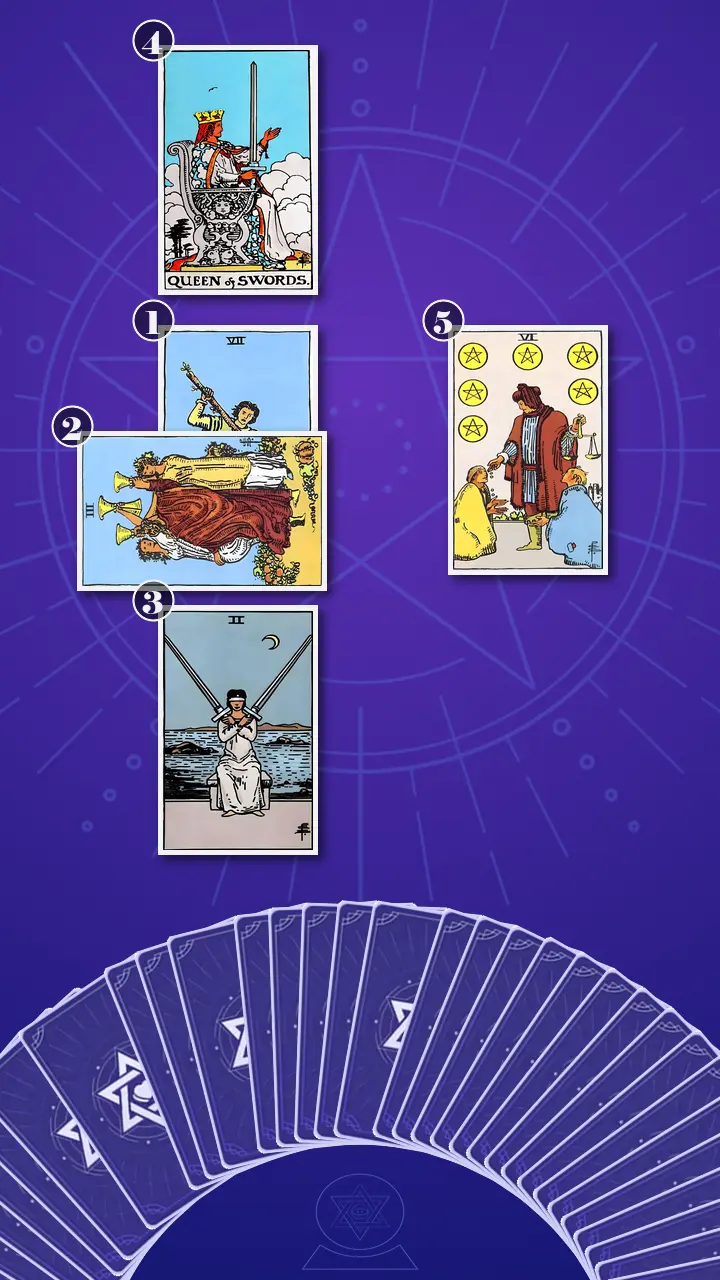
“We’ll read it like this,” I said, laying the cards down. “Card one is the surface snapshot—your most observable game-night reaction. Card two is what’s actively reinforcing the pile-on dynamic. Card three is your blind spot—what you’re not naming that keeps the cycle stable. Card four is advice: the next step that preserves self-respect without mind-reading. Card five is what you can build if you take that step—fairer norms, or a clean decision about access.”
Reading the Map: From ‘Everyone vs Me’ to Something You Can Name
Position 1 — Surface snapshot of the game-night dynamic and your most observable reaction
“Now flipped over,” I told Jordan, “is the card representing the surface snapshot of the game-night dynamic and your most observable in-the-moment reaction.”
Seven of Wands, upright.
I didn’t even have to stretch for the real-life translation. “This is the exact moment you described,” I said. “You sit down telling yourself it’ll be fun, but within the first few rounds you’re bracing. The second someone says, ‘We have to stop Jordan,’ your body spikes—jaw tight, breath short—and you start defending every play like you’re in a debate, not a living room.”
In energy terms, the Seven of Wands upright is excess fire: not passion, but pressure. Adrenaline. The feeling of being put on higher ground against your will—like the table decided you’re the one who has to justify yourself. It’s dignity turning into defense because your nervous system reads, I’m under attack.
Jordan let out a small laugh that wasn’t amusement so much as recognition with a bruise under it. “Yeah,” they said. “That’s… kind of brutal.”
“I know,” I said. “And I want you to notice something: the card isn’t judging you for defending yourself. It’s naming the role you’ve been assigned. You’re being pushed into ‘fairness attorney’ mode when you actually came for friendship.”
As a Jungian psychologist, I can’t help but see the archetype here: the group unconsciously casts someone as the sparring partner so everyone else can bond. The card is saying: you’re not imagining the pressure. But it’s also asking: are you protecting your score… or your right to be respected in the room?
Position 2 — What’s actively reinforcing the “everyone vs me” pattern in the group atmosphere
“Now we flip the card representing what’s actively reinforcing the ‘everyone vs me’ pattern in the group atmosphere,” I said.
Three of Cups, reversed.
This is the one that often makes people sit back, because it’s so socially specific. “Reversed,” I explained, “the Three of Cups is celebration that turns into a closed circle. It’s not just strategy—it’s social glue. You notice the same two or three people sync up fast, share a look, and get louder when you’re the one getting hit. The teaming-up feels like an inside joke you weren’t in on, and suddenly you’re playing two games at once: the board game and the ‘am I actually included?’ game.”
Energy-wise, this is blocked water: connection that can’t circulate fairly. The attention in the room behaves like an algorithm—like the unspoken mod rule of a group chat: the fastest way to get laughs is to dunk on one person, so the algorithm keeps rewarding it.
I watched Jordan’s face as I said that. Their eyes unfocused for half a second, like they were replaying a specific moment: two people locking eyes, a private laugh, the room volume rising right when their piece got hit.
“It’s like… I’m supposed to laugh,” they said quietly, “but I’m not having fun.”
“Exactly,” I said, matching their pace. “That two-track line? That’s the heart of this card: I’m supposed to laugh vs I’m not having fun. Belonging vs being used as entertainment.”
They nodded once—slow, almost relieved. The confusion loosened a notch. Not because it felt good, but because it felt real.
Position 3 — Your blind spot in the cycle: what you’re not naming that keeps the pattern stable
“Now we flip the card representing your blind spot in the cycle—what you’re not naming, deciding, or acknowledging that keeps the pattern stable,” I said.
Two of Swords, upright.
“This is the Notes-app draft,” I told them. “In the moment, you keep your face calm and your voice light. Afterward, you can’t stop replaying it. You draft a message—polite, careful, totally reasonable—then delete it because you’re afraid that naming it will make you the problem.”
In energy terms, the Two of Swords is blockage: air held in the chest. It’s silence as self-protection. And the cost shows up later—like muting notifications instead of leaving the group chat. Temporary relief, same dynamic waiting when you return.
I said it the way I’d say it to someone sitting beside me on a train: “Silence isn’t ‘chill’ here. It’s a strategy. And it’s expensive.”
Jordan’s reaction came in a chain—three small steps I’ve learned to watch for.
First: a physical freeze. Their breath paused; their fingertips stopped moving on the edge of their sleeve.
Second: cognitive seep. Their eyes slid to the side like they were reading the same sentence on a screen: Hey, can I ask about something from last night?
Third: emotional release, but tiny. Not tears—just a long exhale through their nose, like their body finally admitted, yeah… that’s me.
“Because if I say it,” they murmured, “I’ll sound dramatic. If I don’t say it, I’m basically teaching them it’s fine.”
“That’s the crossroads,” I said. “And it’s why it feels like there’s no safe way to be taken seriously. The card isn’t calling you wrong. It’s showing you the stalemate.”
When the Queen of Swords Cut Through the Noise
Position 4 — The most constructive next step that preserves self-respect and tests the dynamic
I let the room get a little quieter before turning the next card. Outside my studio window, Toronto traffic made that soft, distant hush—like the city itself was holding its breath with us.
“We’re flipping the card representing the most constructive next step you can take that preserves self-respect and tests the relationship dynamic without mind-reading,” I said. “This is the key.”
Queen of Swords, upright.
“This is you, but in a different mode,” I told Jordan. “Instead of arguing rules mid-game, you choose one calm line and say it early: ‘I’m down to play, but I’m not into everyone-vs-me.’ You don’t over-explain. You offer one alternative—rotate teams, free-for-all, switch games—and you let the room show you whether it can handle basic respect.”
The Queen of Swords is balanced air: clarity without cruelty. Boundaries without drama. The sword is upright, but she’s not swinging it around. She’s not performing. She’s stating.
And this is where I brought in one of my most practical tools—something I learned long before I became “the tarot person,” back when I trained staff on international cruises. On a ship, social friction escalates fast because you can’t escape the room. People would come to me with the same question Jordan was asking, just in different clothes: How do I keep my place in the group without swallowing disrespect?
“I want to use what I call Social Role Switching,” I said. “It’s not ‘being fake.’ It’s choosing the right mode for the moment. At game night, you’ve been snapping between two modes: defensive lawyer (Seven of Wands) and silent peacekeeper (Two of Swords). The Queen is a third mode: Assertive Mode. Calm. Slow speech. One sentence. No receipts.”
Jordan swallowed. Their shoulders lifted, then dropped like they were trying to make space in their chest. “But if I’m assertive,” they said, “won’t I sound… intense?”
That question is the setup, and I honored it.
Setup (the moment you recognize yourself): You know that moment when the table gets loud, someone says “it’s just a joke,” and you feel your jaw lock while you start explaining rules like it’s a courtroom—then you replay it all the next morning over coffee, drafting a text you never send.
I looked at them and slowed my own voice down, the way you do when you want someone’s nervous system to believe you.
Not “I’ll just take it and hope it changes,” but “I’ll raise the sword of clarity once,” and let that clean line redefine the game.
There was a beat of silence after that—clean, almost echoing.
Reinforcement (what it looks like in a body): Jordan’s face did something subtle first: their brows lifted like the sentence had surprised them. Then their eyes went glassy for a second—not crying, just wet with the shock of being seen. Their jaw unclenched in a way you could actually see, like they’d been holding a bite down all night and finally realized it wasn’t food.
Then came the three-step reaction chain again, but stronger: (1) a brief freeze—hands still, breath caught; (2) the mind rewinding—like a highlight reel of game nights and unsent drafts; (3) a release—shoulders dropping an inch, a shaky laugh that was half relief, half grief for how long they’d been proving instead of stating.
“But… if I say it,” they said, a little sharper now, “doesn’t that mean I was wrong to just take it before?”
“No,” I said, steady. “It means you were doing what you had to do to keep access to belonging. And now you’re choosing a different kind of belonging—one that includes you.”
I leaned in and made it practical. “Let’s do a 10-minute one-line boundary practice—because the goal is not to write a TED Talk. The goal is to get one sentence into your mouth so it’s not the first time you say it when you’re activated.”
“Open Notes,” I said. “Write one line you could say at the table: ‘I’m down for competition, but I’m not doing everyone-vs-me tonight.’ Then write one concrete alternative: ‘Can we rotate partners each round?’ or ‘Free-for-all, no alliances.’ Then read it out loud once—quietly—like you’re testing the tone.”
I paused and added the part people always need permission for: “If your body spikes—jaw clenches, face gets hot—you’re not required to justify, debate, or keep talking. You can repeat the boundary once and stop. You can say, ‘I’m not debating it—I’m just letting you know what I’m up for.’”
This is the shift from the starting state to the desired state in real time: from humiliation-driven hypervigilance and rule-lawyering to calm, self-respecting boundary-setting. Not certainty. Not control. Just a clean line.
“Now,” I asked them, “with this new lens—can you think of a moment last week when this could’ve changed how you felt?”
Jordan stared at the edge of the table for a second. “When they said, ‘we HAVE to stop Jordan,’” they said. “I joked back. But I felt my face go hot. If I’d said it then—early—I think I would’ve stayed in my body instead of… leaving it.”
“If your body braces,” I said softly, “your ‘chill’ is already gone—honesty is just catching up.”
Position 5 — How the situation can evolve if you take the next step
“Now we flip the card representing how the situation can evolve if you take that next step—healthier norms and your sense of agency,” I said.
Six of Pentacles, upright.
I pointed to the scales in the image. “This card is the antidote to mind-reading. It says: make fairness visible.”
In modern life terms: “The next game night doesn’t rely on everyone reading each other’s minds. There’s a simple structure—rotating partners, random teams, a quick pre-game ‘teams or free-for-all?’ check. And then you watch: who’s generous with fairness? Who acts like fairness ruins their fun?”
Energy-wise, it’s earth: practical reciprocity. The vibe becomes a structure. And I used one of my favorite anchor phrases because it’s true in friendships as much as it’s true in workplaces:
Fairness isn’t a vibe. It’s a structure.
Jordan’s face changed on that line. Less heat. More steadiness. Like they could finally stop collecting evidence and start designing a better game night—one lightweight process tweak instead of a courtroom argument.
The One-Page Plan: Stop Proving, Start Stating
I pulled the reading together as a single story, so Jordan could feel the logic under their emotions.
“Here’s the arc,” I said. “On the surface, you’re in Seven of Wands: you brace, you defend, you try to earn respect in real time. The challenge is Three of Cups reversed: the group bonds through a closed-circle dynamic, and you become the easiest target for laughs. Underneath, Two of Swords keeps it stable: you don’t name it because you fear losing your place, so the pattern never gets updated. The Queen of Swords is the pivot: one clean line, said once, early. And the Six of Pentacles is what comes next: visible agreements—fair play by design—so you’re not begging for basic respect.”
“The blind spot,” I continued, “is believing you need court-level proof to speak. That’s the trap: you stay in ‘proving mode’ because it feels safer than being direct. The transformation direction is exactly the opposite: name the pattern plainly and propose one specific boundary or structure change. That’s how you find clarity without mind-reading.”
Then Jordan hit me with a real obstacle—practical, immediate, and honest. “Okay,” they said, “but I can’t do some big confrontation. And I barely have time. I’m fried after work. I don’t have 45 minutes to script my feelings.”
“Good,” I said, almost relieved. “We’re not doing a big confrontation. We’re doing a small, ship-tested protocol.”
On cruise ships, I used what I call Maritime Social Protocol: you don’t debate the weather; you adjust the sails. In a crowded social space, you keep it brief, respectful, and structural. And you keep a ready-to-use script for when someone tries to pull you into chaos.
Here are Jordan’s next steps—low-drama, actionable advice you can start within 48 hours:
- The “Teams or Free-for-All?” Check-In TextBefore the next game night, text the host (or your closest friend in the group): “Quick check—are we doing teams or free-for-all tonight? I’m down to play, just not into ‘everyone vs me’ dynamics.”Keep it to one sentence + one request. If you feel the urge to explain, you’re slipping back into proving mode—pause and send the short version.
- The One-Line Boundary at the Table (Say It Early)When you arrive—before round three, before you’re activated—make eye contact, slow your speech, and say: “I’m competitive, but I don’t enjoy being the default target.” Then stop talking.Use the “one-repeat rule”: you’re allowed to state it twice, not ten times. If someone pushes back, repeat once: “I’m not debating it—I’m just letting you know what I’m up for.”
- Fair-Play by Design (One Structural Tweak)Offer one concrete alternative: “Can we rotate partners each round?” or “Let’s keep it free-for-all—no alliances.” If they want a game that rewards dogpiling, suggest a swap (co-op, party game, or hidden-role game).Offer two options so it feels collaborative, not controlling. Then observe-the-response: who adapts easily, and who gets weird about basic fairness?
I added one more tool from my own toolbox—because Jordan’s fear wasn’t just about words. It was about identity. “When you walk in,” I told them, “choose your mode on purpose. Supportive Mode is for comforting a friend. Assertive Mode is for boundaries. Game night needs Assertive Mode—not because you’re cold, but because you’re protecting your fun and your dignity.”
And I said the line I wanted them to remember when their brain tried to build a case file: Stop proving. Start stating.

A Week Later: The Quiet Proof
Six days later, Jordan sent me a message that was almost annoyingly short—exactly what we’d practiced.
“I texted the host,” they wrote. “Teams or free-for-all. I said I’m down to play, just not into everyone-vs-me. My hands were shaking but I sent it.”
They told me the response was… mixed. One friend replied immediately with, “Oh damn, fair. Free-for-all.” Another tried to joke it off with “lol are we that mean?”—and Jordan, for the first time, didn’t pile on their own discomfort with a paragraph.
“I just said, ‘Yeah, it stops being fun for me,’” Jordan wrote. “And then I stopped talking.”
The bittersweet part came later: they still felt a flicker of fear walking in. They still had that morning-after impulse to check the chat. But this time, they didn’t feel like a passenger in their own friendships.
Clear but a little vulnerable: they slept through the night for the first time in weeks, but when they woke up, their first thought was still “What if I made it weird?”—only this time, they exhaled, and the thought didn’t own the whole day.
This is what I mean by a Journey to Clarity. Not a magical outcome. A measurable shift: from bracing and shrinking to choosing your words once, choosing your structure, and letting reality respond.
When you’re trying so hard to be “chill” that your jaw is clenched the whole night, the real humiliation isn’t losing the game—it’s watching yourself shrink just to keep your seat at the table.
If you let yourself say one clean sentence next time—no jokes, no over-explaining—what would you want your boundary to protect: your fun, your dignity, or your time?