From Spreadsheet Spirals to Fair Agreements: A Move-In Readiness Arc

The CN Tower Glow and the “Move-in Math” Tab
If your version of “thinking about it” is opening Notes titled “Move-in math,” then somehow ending the night having decided nothing… you’re not indecisive, you’re protecting yourself from vulnerability.
Jordan showed up to my studio on a grey Toronto evening with that particular kind of composure you learn in tech: the calm face, the busy eyes. She’s thirty, a UX designer, the sort of person who can facilitate a critique meeting like it’s choreography—then go completely wordless when the topic turns into her own life.
She told me about Sunday at 10:41 p.m.: the CN Tower faint through the condo window like a dim status light. Laptop open to a budgeting tab. Phone open to a furniture mood board. The room smelled like takeout and screen heat. “I get keyed-up,” she said, pressing her thumb into the side of her mug like she could squeeze a decision out of ceramic. “Not excited. More like I can’t unclench.”
Her partner had asked to move in. A concrete next step. The kind of relationship milestone that looks sweet on Instagram and feels like a trapdoor in your chest when it’s yours.
“I love them,” she said, then immediately—like a reflex—“I just don’t know if I’m ready for the whole lifestyle shift.”
Under that sentence, I could hear the real contradiction: wanting to deepen commitment and share a home vs fearing loss of independence and feeling trapped. Jordan’s mind had tried to solve the fear the way she solves everything—by engineering certainty. Rent splits. Commute math. Furniture lists. Polling friends. Scrolling r/relationships at midnight. Anything except the conversation that would actually change the day-to-day reality: boundaries, timelines, what living together would mean when the honeymoon glow fades and the dishwasher is full.
She touched her chest, just once, almost as if checking a bruise. “When we even say the words ‘move in,’ my chest goes tight. Like my lungs get smaller.”
Ambivalence can feel like standing in a doorway with your hand on the doorknob, waiting for a magical “ready” feeling that never arrives—while your body quietly rehearses worst-case scenarios like it’s running a trailer for a movie that hasn’t been filmed.
I leaned forward, keeping my voice steady. “We’re not here to force you into a yes or a no,” I said. “We’re here to figure out what you would need to feel ready—grounded, self-trusting ready. Let’s try to draw a map through this fog, and see what the next honest step actually is.”

Choosing the Compass: A Celtic Cross for Relationship Readiness
I asked Jordan to put her phone face down—not as a dramatic ritual, but as a small act of nervous-system honesty. Then I invited one slow breath in, one slow breath out, while I shuffled. The sound of cards sliding against each other has always reminded me of turning pages in an archive: not mystical, just focused. A way of saying, we’re looking at the evidence now.
“Today we’ll use a spread called the Celtic Cross · Context Edition,” I told her.
For readers who wonder how tarot works in a moment like this: I don’t use it as fortune-telling. I use it as a structured mirror. The classic Celtic Cross is ideal for a relationship milestone because it separates surface indecision from the deeper driver underneath, and it shows how you, your partner, and the shared environment interact.
This Context Edition keeps it grounded: position 6 isn’t a predictive “near future,” but an immediately available next phase you can actually test. And position 10 isn’t a fixed “outcome,” but an integration-based readiness key—what you can practice so the decision becomes lighter and clearer.
I pointed to the layout. “The first card will name your current stuck point. The crossing card shows the immediate challenge that’s making this feel heavier than it needs to be. The root card goes underneath—what’s driving this under the surface. And at the top, we’ll look for the readiness key: what helps you move forward with fairness and self-respect.”
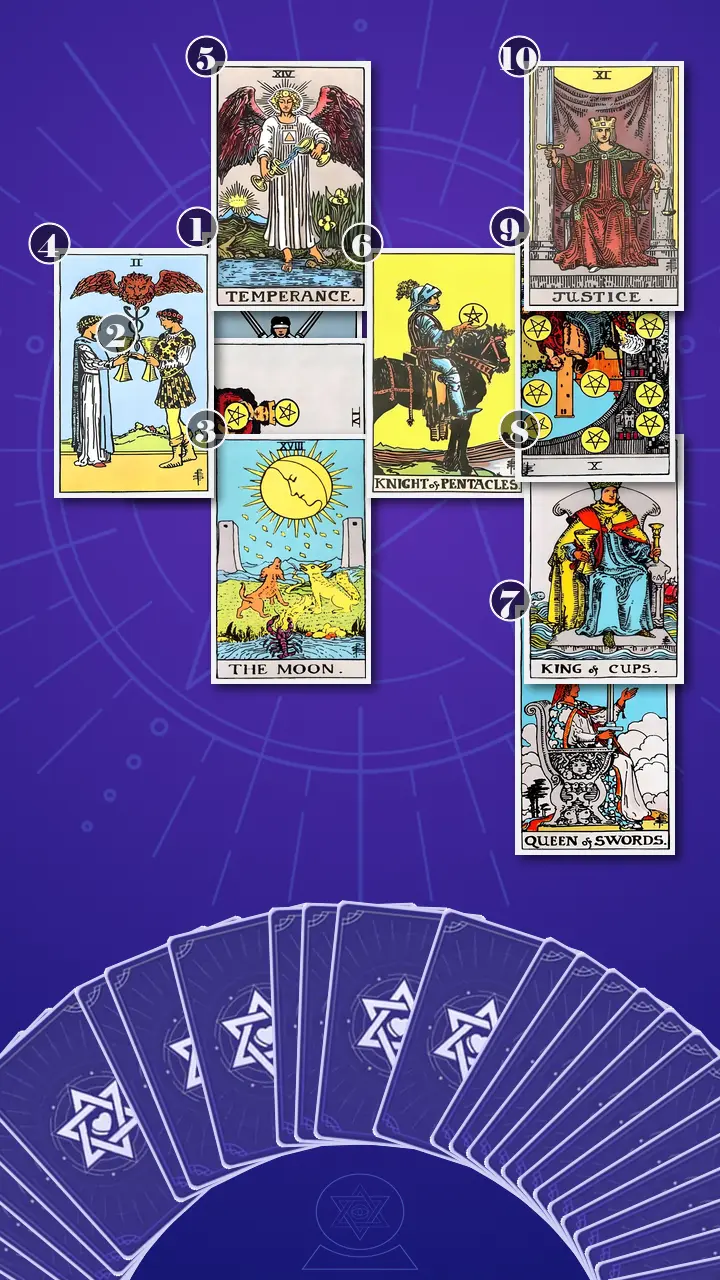
Reading the Map: Card Meanings in Context
Position 1 — Current stuck point: how readiness is showing up right now
“Now we turn over the card that represents your current stuck point,” I said, and placed it at the center. “Two of Swords, upright.”
I watched Jordan’s eyes flick to the blindfold on the figure, the crossed swords held close to the chest, the still water behind. Before I said anything, her leg started bouncing under the table—small, fast, like a phone on vibrate.
“This is you answering the move-in question by staying neutral,” I said, using the language of her life because it matters. “You keep saying ‘maybe soon’ while you hide behind logistics. Your phone is full of drafts—half-written texts asking for a boundary, then deleted and replaced with ‘Can we talk about rent split?’ You look composed, but your body is tense like you’re bracing for impact.”
The Two of Swords isn’t a lack of intelligence. It’s an Air energy in blockage: thinking used defensively. The blindfold is the deal you’ve made with yourself—I’ll decide when I feel certain. The crossed swords are the cost—protecting yourself from having to name what you need.
Jordan let out a short laugh that didn’t reach her eyes. “That is… so accurate it’s kind of rude,” she said, and then her mouth tightened like she regretted even admitting that.
I nodded. “You’re not being dramatic. You’re being human. And—this matters—You’re not indecisive—you’re trying to engineer certainty so you don’t have to risk regret.”
She went still for a beat, fingers hovering above her water glass, like her body had briefly paused to see if it was safe to be seen.
Position 2 — Immediate challenge: what’s blocking readiness
“Now we turn over the card that represents your immediate challenge,” I said, sliding the next card across it. “Four of Pentacles, upright.”
“The blocker isn’t the relationship,” I said. “It’s the fear of losing what’s ‘yours’: your solo routines, your space, your savings cushion, your ability to opt out. You start negotiating the apartment like it’s a defensive perimeter—separate shelves, separate money, strict rules, and a subtle insistence that nothing can touch your independence.”
Earth energy here is in excess: gripping for stability. The figure clutches the coin to the chest—safety through control—and it works, briefly. Then it isolates you inside the grip.
I used the split-screen that I’ve seen in so many clients—especially the high-functioning ones. “On the outside it’s: ‘Let’s look at utilities.’ On the inside it’s your body braced, asking a different question: What do I get to keep that is mine?”
Jordan’s shoulders rose a fraction, then dropped. “Yeah,” she said quietly. “I’m gripping because I’m scared.”
Position 3 — Root driver: what’s operating under the surface
“Now we turn over the card that represents the root driver,” I said, placing it below. “The Moon, upright.”
The Moon always changes the light in the room. Even in a downtown office with clean white walls, it puts a kind of shadow on the edges of the conversation.
“Underneath everything is fog,” I told her. “You can’t tell whether the hesitation is a real boundary or a fear story, so your mind fills in blanks with worst-case scenes—breakup logistics, lease traps, loss of self. You treat those imagined outcomes like evidence and then stall even harder.”
Here, Water is not calm; it’s a projector. The Moon is uncertainty and projection—treating imagined futures like confirmed facts. It’s trying to solve a foggy problem with more brightness—more research—instead of better landmarks: better questions, better agreements.
I called back to her late-night Googling without shaming it. “This is the 11:05 p.m. screen glow: searching ‘Ontario lease break penalty’ with your heart thudding, planning an exit route from an apartment you haven’t agreed to share.”
Then I offered a simple archaeological question—because my work has always been about separating layers. “What do you know, and what are you guessing?”
Jordan’s eyes unfocused for a second, like she was replaying her own thoughts. Then she exhaled. “I’m acting like my fears are guaranteed outcomes.”
Position 4 — What led here: the recent relational context
“Now we turn over the card that represents what led here,” I said, placing it to the left. “Two of Cups, upright.”
“This didn’t come from pressure,” I said. “It came from genuine closeness. There’s a history of reciprocity. You’ve been meeting each other halfway, so the move-in request is more like an invitation than a demand.”
The energy here is balanced: connection without coercion. It matters, because it reframes the whole story. If the foundation is mutual, then boundaries aren’t rejections—they’re part of the partnership.
Jordan’s face softened for the first time. “They really aren’t trying to corner me,” she said. “I just… I turn it into that in my head.”
Position 5 — Conscious aim: what “being ready” is supposed to achieve
“Now we turn over the card that represents your conscious aim,” I said, placing it above. “Temperance, upright.”
“What you actually want isn’t a dramatic commitment moment,” I told her. “It’s a balanced blend: a shared home that still contains you. Think less ‘merge into one person’ and more ‘design a third system’ where alone time, routines, and shared rituals all have a place.”
Temperance is balance in motion. Not a vibe. Not a magical feeling. A constant pour between two cups.
In my mind, I flashed to a trench I supervised years ago—an ancient threshold stone worn down by thousands of feet. People didn’t cross it because they felt perfectly ready. They crossed because the threshold was built to hold them. That’s what Temperance suggests: the structure makes the crossing survivable.
Jordan nodded, almost reluctantly, like the idea was both relieving and annoying. “I need a plan, not a vibe,” she said, repeating what she’d told herself in her Notes app a hundred times.
“Exactly,” I replied. “And this next card will help us make that real.”
Position 6 — Near-term next phase: what’s immediately available to explore
“Now we turn over the card that represents your near-term next phase,” I said, placing it to the right. “Knight of Pentacles, upright.”
“The next phase available is slow, structured progress,” I said. “A timeline, a budget method, a chores baseline, and a check-in date. Not endless research—one concrete topic at a time, fully discussed. It’s the difference between avoiding and moving deliberately.”
Earth energy here is in balance: steady follow-through. The knight doesn’t sprint. He doesn’t freeze. He shows up.
I saw Jordan’s mouth twitch into the hint of a smile—she recognized the language. “Like… a prototype,” she said.
“Like a prototype,” I agreed. “Readiness isn’t a vibe. It’s a set of terms you can live with.”
Position 7 — Your role: how your self-image and communication shape readiness
“Now we turn over the card that represents your role,” I said, beginning the staff. “Queen of Swords, upright.”
“Your readiness tool is clean honesty,” I told her. “You’re allowed to say the terms out loud without apologizing: ‘I want this, and I need X.’ ‘If we do this, I need two nights of solo time.’ ‘If conflict happens, here’s how I want us to repair.’ You don’t have to be harsh—you just have to be clear.”
I shifted into crisp, practical examples—because this is where courage gets concrete. “Compare these,” I said. “Version A: ‘Sorry, I’m being difficult, but maybe I need space?’ Version B: ‘I’m open to moving in, and I need two weeknights that are solo by default.’”
Jordan’s eyes widened a touch. “I could actually say it like that,” she said, and it sounded like she’d just discovered a door in a hallway she thought was solid wall.
“You can,” I said. “And you can be loving and still be specific.”
Position 8 — Relational field: how the other person and environment impact safety
“Now we turn over the card that represents the relational field,” I said. “King of Cups, upright.”
“The relational environment can handle truth,” I said. “Your partner—or the dynamic between you—has the capacity to stay steady while you talk about hard stuff. That matters, because you don’t have to manage their emotions by staying vague. You can ask for what you need and let them meet you there.”
Water here is in balance: a container, not a flood. The sea is choppy in the card, but the king stays calm. That’s the promise: you can have big feelings and still have a safe conversation.
Jordan’s shoulders dropped again, this time more fully. “They’re actually pretty good at that,” she admitted. “I just… assume they won’t be.”
Position 9 — Hope and fear: what you want, and what you fear it will cost
“Now we turn over the card that represents your hope and fear,” I said. “Ten of Pentacles, reversed.”
“When you hear ‘move in,’ your brain jumps to ‘permanent life structure’ and starts rehearsing escape routes,” I said. “Who keeps what. How to break a lease. How fast you could recover financially. The fear isn’t love—it’s entanglement without safeguards, and the feeling that undoing would be messy and shameful.”
In reversed form, this Earth energy is in blockage: stability feels like a trap rather than a home.
I pointed at the archway imagery in the card, that sense of a whole domestic ecosystem. “This is the part of you that translates ‘next chapter’ into ‘forever, right now.’”
Jordan’s eyes got bright—not tears, exactly, more like pressure behind the eyes. “Yes,” she said. “It’s not the love. It’s the structure.”
“And here’s the reframe I want you to hold,” I said gently, making sure it landed as permission, not pressure: A shared home doesn’t have to be a lifetime sentence—it can be a well-designed next chapter.
When Justice Held the Scales
I let the room settle. Even the street noise outside felt like it backed off for a second, as if the city itself was giving us a clean beat.
“Now we turn over the card that represents integration,” I said. “This is the most empowering readiness key to practice now—the kind of agreement that would help you feel solid.”
I turned the final card.
Justice, upright.
Jordan stared at the scales and the sword. Then she swallowed, once. Her hand went to her chest again, automatic.
“Justice is not a demand that you ‘be sure,’” I said. “It’s an invitation to be fair—to both of you. It says readiness looks like a fair, explicit agreement you can respect. Picture you and your partner at the table with a shared doc: money terms, chores baseline, alone time, guest rules, conflict repair, and a review date. Your body relaxes because the decision stops being a foggy leap and becomes a values-aligned plan you can revisit.”
As an archaeologist, I’ve spent years studying covenants—ancient agreements scratched into stone or inked onto papyrus. People often imagine the past as more romantic, but history is blunt: the relationships that lasted weren’t powered by perfect feelings. They were held by workable terms. That’s my lens—what I call Emotional Historiography: understanding love through time. When a commitment step arrives, we don’t ask, “Do I feel 100% fearless?” We ask, “What structure would make this sustainable for the people we actually are?”
The Aha Moment (and the Part Your Body Has Been Trying to Say)
Setup. It’s 11 p.m., you’re in bed with your phone glowing, comparing lease clauses and couch prices—while the real question (space, autonomy, repair) stays untouched, like a tab you won’t open because it might change everything.
Delivery.
Stop waiting for a perfect feeling; start creating a fair agreement you can stand on—like Justice’s scales that balance both of you.
There was a quiet after I said it, the kind you get in a lecture hall when something finally clicks—not because it’s new information, but because it’s the sentence that names what everyone’s been avoiding.
Reinforcement. Jordan’s breathing paused—just a fraction. Her fingers curled against the edge of her chair as if bracing for impact. Then her gaze went slightly unfocused, like she was watching herself in her condo at 10:41 p.m., the CN Tower dim through the glass, the spreadsheet open like a shield. Finally, her shoulders sank on an exhale that sounded almost surprised, a small release from the ribs.
“But that means…” she began, and her voice sharpened into a brief, honest flare of anger. “That means I’ve been making this harder. Like… I’ve been acting like it’s dangerous.”
I didn’t rush to soothe it away. “That reaction makes sense,” I said. “Your mind has been trying to protect you. Justice isn’t here to shame you; it’s here to give you an adult alternative to the panic: explicit terms.”
I set a pen between us, like an offered tool. “Set a 10-minute timer. Write three ‘Justice sentences’ you could say verbatim: (1) ‘I’m open to moving in.’ (2) ‘I need ___ to feel like myself at home.’ (3) ‘Let’s try an 8–12 week pilot and pick a check-in date.’ If you feel your body tighten, pause—hands off the keyboard, one slow breath—then choose whether to continue. You’re allowed to stop and come back later.”
Her eyes watered slightly now, not from sadness, but from the strange vulnerability of clarity. She blinked hard once, then looked back at the card. “I can do sentences,” she said, almost laughing at herself. “I can do terms.”
“Now,” I added, “use this new lens and think back: last week, was there a moment when a simple agreement would have made you feel different—before you opened another spreadsheet?”
Jordan closed her eyes briefly. “The elevator,” she said. “When they said it. I smiled and said ‘Totally,’ and my brain opened a spreadsheet. If I’d had one sentence—just one—it wouldn’t have turned into a whole… spiral.”
That’s the shift, right there: from pressure and contraction toward grounded, self-trusting readiness. Not certainty. Not a perfect feeling. A step into a structure you can stand on.
From Insight to Action: A Cohabitation Pilot You Can Actually Live With
I gathered the spread into a single story for her—because insight without integration is just another tab left open.
“Here’s what I see,” I said. “You started in Two of Swords: calm on the outside, holding your breath on the inside. The Four of Pentacles crossed it—control as protection—because your home is your recovery space and you fear losing it. Underneath, The Moon has been filling in blanks with worst-case projections, turning ‘move in’ into ‘I’ll be trapped and it will prove I can’t trust myself.’ But the Two of Cups reminds us this request grew from real mutuality, not coercion. Temperance shows what you’re aiming for: a balanced blend, not self-erasure. The Knight of Pentacles says the way through is deliberate structure. The Queen of Swords is your voice—clean sentences. The King of Cups says the relationship can hold the truth. And Ten of Pentacles reversed names the real fear: the structure, not the love. Justice is the answer: fair, explicit agreements.”
“Your cognitive blind spot,” I continued, “is that you’ve been trying to protect your independence with silence and logistics. But silence doesn’t protect it—it just leaves it undefined. The transformation direction is clear: shift from chasing emotional certainty to building practical and relational safety through explicit agreements, timelines, and check-ins.”
Jordan frowned slightly. “I’m going to want to do all of this at once,” she said. “And then I’ll get overwhelmed and do none of it.”
“That’s very Knight of Pentacles,” I said, matter-of-fact. “One topic. One doc. One date.”
Then I brought in my own strategy, the way I translate ancient practices into modern life. “In archaeology we find amphorae—storage jars—built to distribute weight evenly so they don’t crack. I call this Amphora Balance in relationships: if one person holds all the emotional risk and all the decision pressure, the container breaks. So we design the load-sharing on purpose.”
“And when conversations get complicated,” I added, “I use something I call Pictogram Dialogue: reducing conflict into a few simple symbols so you don’t drown in nuance. Think: a key for ‘alone time,’ a coin for ‘money,’ a broom for ‘chores,’ a heart for ‘repair.’ Simple doesn’t mean shallow—it means usable.”
- Draft the “Cohabitation Pilot” (Draft v0.1)In the next 20 minutes, open a Google Doc titled “Cohabitation Pilot — Draft v0.1”. Add headings only: Money, Chores, Alone Time, Guests, Conflict/Repair, Check-in Date. Under each heading, write 2–4 bullet points—messy is fine.If you feel yourself trying to make it perfect, stop at headings only. A draft is a bridge, not a verdict.
- Say one clean boundary sentence (Queen of Swords practice)Before the next conversation, pick one independence-protecting boundary and write it as one clean sentence. Example: “If we live together, I need two weeknights that are solo by default. We can still be affectionate, but I’m not available for plans those nights unless we both opt in.” Say it once, without over-explaining.Your brain will call this “too formal” or “unromantic.” Counter with: clarity is affection in a form your nervous system can trust.
- Hold a 45-minute “terms talk” (one topic only)Schedule one calendar invite this week labeled “Move-in Terms Talk”. Set a 45-minute timer. Choose ONE topic (e.g., Alone Time). End with: “What did we agree to, and what do we still need to decide?”If you can’t find 45 minutes, do a 20-minute version. Ending early on purpose proves you don’t have to solve it all in one sitting.
Finally, I offered her a way to think about commitment that doesn’t demand self-erasure. “This is Covenant Evolution,” I said. “Commitments aren’t one irreversible leap; historically, they evolve. A pilot period is not a lack of love. It’s an honest phase of building a home with consent.”

A Week Later: Ownership, Not Certainty
Six days later, Jordan texted me a screenshot: a Google Doc with the title line “Cohabitation Pilot — Draft v0.1” and a single comment bubble from her partner: “This is actually really helpful. Thank you.” She added: “We did the alone-time topic with a timer. I was shaky at first, but I said the sentence. My chest didn’t do the full panic thing.”
She told me she still woke up the next morning with the thought, What if I’m wrong?—but this time she didn’t open a lease-break calculator. She made coffee, looked at the doc, and thought, We have a check-in date. I can choose, and I can revisit. Clear, but still human. Steady, not perfect.
That’s the whole Journey to Clarity, as I see it: not forcing a feeling, but building a structure your nervous system can live inside—where love and independence don’t have to fight to the death.
And if you’re standing at your own threshold—if someone asks you to move in and it feels like your heart says “yes” while your body quietly panics—remember: you’re not afraid of love. You’re afraid of losing the ability to choose.
If you didn’t need a perfect ‘ready’ feeling, what’s one fair, specific agreement that would let you take the next step while still feeling like yourself?
Every reading at AceTarot is a Journey to connect with inner wisdom and empower next step.
Learn more about our Journey to Clarity.