Public Teasing in Standup—And How One Calm Sentence Draws the Line

The 8:56 AM Standup Spiral
Jordan (name changed for privacy) sat in a Toronto condo with the Slack huddle link open, their laptop fan humming under the kitchen light. In Notes, three versions of the same standup update were stacked like discarded drafts; every time they deleted a detail that felt 'teaseable', their shoulders climbed a little higher. If you’ve ever force-laughed in standup and then spent the next hour replaying the exact line while drafting a DM you never send, you already know the shape of public teasing at work.
Jordan told me, very quietly, 'I don’t want to be the vibe killer, but I also don’t want to be the punchline.' That was the whole knot: wanting a boundary in public while fearing the social fallout of being seen as difficult at work. The humiliation sat in their body like a browser tab draining battery in the background—hot face, tight jaw, and that heavy stomach-drop after the meeting ended.
I nodded and told them we were not here to win the room. We were here to read it. 'Let’s draw a map,' I said. 'Not to make the meeting perfect—just to make your next move clearer.'

Choosing the Relationship Spread
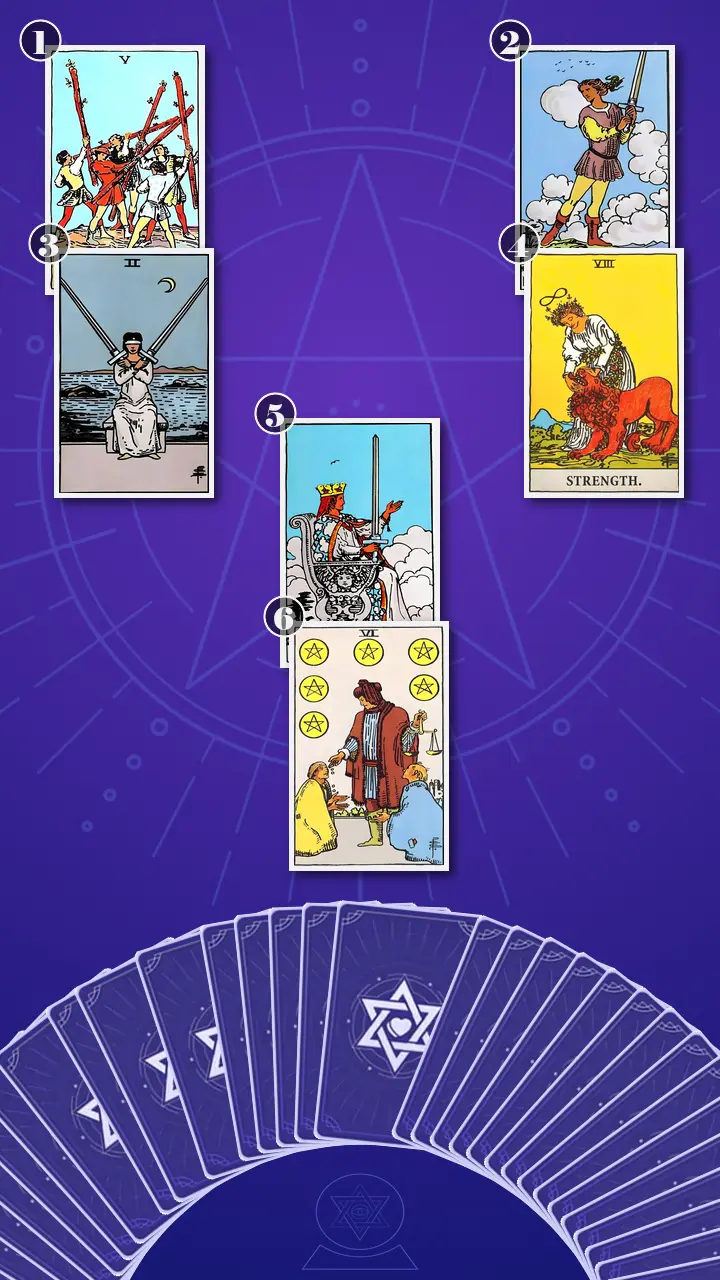
I asked Jordan to take one slow breath, drop their shoulders, and keep the day outside the conversation for a minute. As I shuffled, I explained why I was using the Relationship Spread tarot reading for workplace boundaries: this was not a vague future question, and it was not just about their personality. It was a live two-person dynamic inside a public work ritual, so I wanted a spread that could separate the surface friction, the teammate’s style, the freeze reflex, the deeper resource, the boundary line, and the follow-through. In plain language, tarot works best here when it gives structure before it gives actionable advice.
The top row would show the visible standup game. The middle would show what keeps the loop stuck and what steadiness is already available. The bottom row would turn that steadiness into a sentence, then into a norm. By the end, I wanted the room to feel less like a verdict and more like a system that could be changed.
Reading the Room, Card by Card
The Verbal Scrum Under Fluorescent Light
Now I turned over the first card, representing the surface dynamic: Five of Wands, upright. The image landed immediately. In your standup, the jokes are not floating in a vacuum; they are part of a low-level competition for airtime, where the funniest line gets boosted like a post in an attention algorithm and the quietest person gets edited out. The modern-life version looks like overlapping voices in Zoom, a half-second of lag, and somebody cracking a line while you are still unmuting. No clear leader. No clear rule. Just friction dressed up as banter.
Jordan gave a thin, knowing smile that never quite reached their eyes. 'That’s exactly it,' they said, and then let out a short laugh that carried more bitterness than amusement. The room, in card form, was not asking them to be tougher; it was asking them to notice that the meeting culture rewarded the jab.
Words as Sport
Now I turned over the second card, representing the other side: Page of Swords, upright. Here I saw the teammate’s posture clearly—quick, sharp, and always scanning for payoff. This is the person who drops a quip and immediately checks the Zoom grid or the faces around the table to see whether the room will laugh. It is less a verdict on Jordan than a habit of using words as sport, testing the wind to see where the line moves.
I watched Jordan’s expression shift. Their shoulders lowered a fraction, like a small internal argument had just ended. 'Oh,' they said. 'So they’re testing the room, not proving something about me.' That was the first clean reframe: data, not verdict.
The Muted Button
Now I turned over the third card, representing the connection and the coping reflex: Two of Swords, upright. This was the major blockage, and it showed up with almost embarrassing precision. In the moment, you go camera-face neutral. You laugh lightly, pivot to your update, and tell yourself you’ll deal with it later. Later becomes a Notes draft, an unsent Slack DM, and a loop of 'if I speak and it’s imperfect, I’m dramatic' versus 'if I don’t speak, I’m consenting.' That is the crossed-swords image in modern clothes: two unsent messages sitting in your drafts like blades crossed over your chest.
Jordan went very still. First the breath paused. Then their eyes lost focus for a beat, as if they were replaying the last roast in real time. Finally they gave a tiny, quiet nod. Not agreement—recognition. 'I hate that this is what I do,' they said, almost under their breath. But naming the freeze as self-protection, not weakness, was already loosening it.
The Stillness Before Strength
When I reached the fourth card, the room seemed to get quieter. This was the root, the deeper resource underneath the freeze: Strength, upright.
I used my Jazz Solo Planning lens here, because this card does not ask for a perfect speech. It asks for timing, breath, and one clean phrase played in the pocket. If the Page of Swords is the teammate treating the meeting like a verbal riff contest, Strength is the musician who stops chasing the noise and changes the room with a steadier pulse. In another life I might have compared it to a Godfather close-up—no shouting, just authority—but here the jazz image fit better: not louder, just truer.
A boundary in standup isn’t a clever comeback—it’s a calm, consistent sentence delivered from self-respect.
Jordan blinked. For a second their face went blank, then their mouth tightened as if the sentence had hit somewhere tender. I could see the reaction in three small waves: first the physical freeze, then a slow exhale through the nose, then the shoulders dropping a few millimetres as the nervous system realized it did not have to produce a performance. It was not pure relief; there was a little vertigo in it too, the strange feeling that if the perfect comeback was never the real task, then the whole old rulebook had to be thrown out. That is the step from humiliation-driven freeze and rumination to grounded self-respect and calm clarity. Now, use this new view to think back to last week and notice the moment it would have changed how the room felt.
The Clean Edge of the Queen
Now I turned over the fifth card, representing the boundary itself: Queen of Swords, upright. This was the sentence card. The modern-life translation was immediate: no extra padding, no nervous laugh, no TED Talk about why the joke hurt. Just one clean line that names the behavior and the limit, then returns to the work. A Queen of Swords boundary is a clean UI—no apology pop-up, no extra buttons, just the action.
The line I gave Jordan was simple: 'Please don’t make jokes about me in standup—keep it to the work.' I told them that if the teammate tried to turn it into banter, they could repeat the same words once, with the same calm tone, and then continue their update. One calm sentence. Same words. Every time.
Fairness, Not Feud
Now I turned over the sixth card, representing advice and the most constructive direction forward: Six of Pentacles, upright. This was the Earth at the end of the spread, the part that makes the change stick. The point was not to win the joke or stage a personal feud; it was to reset the meeting norms so the room stopped rewarding disrespect as if it were charm. The scales in the card felt like a meeting hygiene check: equal airtime, equal respect, clear updates, no one made into content.
I told Jordan that after the boundary, they had options. A short DM. A note to the standup lead. A simple request that the meeting stay on blockers and updates. Not because they owed anyone a lecture, but because the room needed a rule. Don’t win the joke—change the rule of the room.
The One-Calm-Sentence Protocol
When I stepped back from the cards, the story was almost painfully clean. Five of Wands showed the standup culture rewarding the laugh. Page of Swords showed the teammate using words as a test. Two of Swords showed Jordan’s freeze as self-protection that had turned into accidental permission. Strength showed the steadiness that already lived under the fear. Queen of Swords translated that steadiness into language. Six of Pentacles turned the language into a fairer norm.
The cognitive blind spot was not lack of courage. It was the habit of treating discomfort as something to privately process instead of a signal you could publicly name once. The key shift, the one the reading kept returning to, was this: move from 'keep it light so no one feels awkward' to 'name the specific behavior and the specific limit in one calm sentence, then redirect to the work.' That is where finding clarity starts to become actionable.
Here is what I had Jordan do next:
- Rehearse the line in NotesWrite your boundary sentence under your standup update, then read it out loud five times over the next three days. Keep it to one sentence, the same sentence each time.Think of it like Oscars Speech Training: you are not preparing a speech, you are learning how one clean line feels in your mouth when your face is hot.
- Use the Queen of Swords sentence liveThe next time the joke lands in standup, say: 'Please don’t make jokes about me in standup—keep it to the work.' Then continue your update immediately.If your body spikes with adrenaline, shorten your exhale and repeat the same words once. No explaining, no defending, no extra story.
- Reset the norm after the meetingIf it repeats, send a short DM to the teammate or a quick note to the standup lead: keep it about updates, blockers, and respect.Frame it as meeting hygiene, not a feud. If you need a paper trail, document dates and exact lines privately first.

A Quiet Proof of Change
Four days later, Jordan sent me a screenshot from standup: after a roast, they had said, 'Please don’t make jokes about me in standup—keep it to the work,' then kept going. They wrote that their hands were shaking, but the replay stopped sooner, and they slept without re-running the whole scene in their head.
That is what clarity looked like here: not perfection, not instant comfort, just the first evidence that their dignity was no longer up for negotiation. When everyone laughs and you smile anyway, it can feel like your dignity is negotiable—and you’re paying for the room’s comfort with a tight jaw and a stomach-drop later. If you trusted that one calm sentence was enough, what is the simplest line you’d want future you to say the next time the joke lands?