Stuck as an Emergency Contact—The Two-Sentence Text I Sent

Finding Clarity in the “Hope That’s Fine” Text
You’re a late-20s city professional who can handle a lot—until you get a “hope that’s fine” text saying you’re someone’s emergency contact, and suddenly you’re deep in Sunday Scaries-level overthinking.
Taylor came into my café on a wet Toronto evening with that particular kind of careful calm that never reaches the shoulders. Their coat was still dotted with melted snow, and when they wrapped both hands around a small cup like it was an anchor, I noticed the tell: jaw set so tight it looked like a decision had been clenched there.
“I don’t mind helping,” they said, staring at their phone like it might start vibrating out of spite. “But I hate being volunteered.”
They told me how it happened: a portal notification—Workday, benefits, one of those painfully official screens that makes friendships feel like paperwork—showed Emergency Contact: Taylor — confirmed. No heads-up. No ask. Just… assigned access.
And then the text landed after, casual as a shrug: “Hey, I put you down—hope that’s fine.”
Taylor’s thumb kept hovering over the message thread as if their phone was hot. They’d drafted a reply five different ways, each version softer than the last, each one trying to guarantee the other person wouldn’t feel even a flicker of disappointment. They didn’t send any of them.
What they felt wasn’t just stress—it was like living on an on-call rota they never signed up for. Tight jaw. Chest braced. A restless urge to check their phone “just in case,” as if the call could come any minute and prove they’d failed some invisible test of goodness.
“I want this to be clean,” they said, almost whispering the word like it could scare the drama away. “Not dramatic. But if I say it too bluntly, I’ll look like a terrible person.”
I nodded and set a demitasse down between us, the espresso aroma cutting through the rainy air like a warm line drawn on a map.
“You want to be kind and dependable,” I said, “and you also don’t want to get trapped in responsibility you never agreed to. That isn’t you being difficult. That’s your nervous system asking for consent and clarity. Let’s make a map through the fog—something practical, not mystical.”

Choosing the Compass: The Celtic Cross · Context Edition
In my café, the ritual is simple. Not candles and whispers—just a small pause that tells the brain, we’re switching modes now. I asked Taylor to take one slow breath, feel the chair under them, and hold the question in plain language: They put me as their emergency contact—how do I set a boundary?
While I shuffled, the espresso machine hissed in the background, steady and indifferent—like the world reminding us it keeps moving even when we freeze.
“Today we’ll use the Celtic Cross · Context Edition,” I said. “It’s the classic Celtic Cross, but I like it for boundary questions because it shows the whole chain: the moment you freeze, the deeper ‘should’ rule underneath, the ethical standard you actually believe in, and the next sentence that breaks the loop.”
If you’ve ever wondered how tarot works in real life: this is it. It’s not a verdict. It’s a structure for attention. The spread gives us positions—containers—so we’re not just swimming in feelings. It turns “I feel bad” into “this is where the guilt hooks in, and this is the clean next step.”
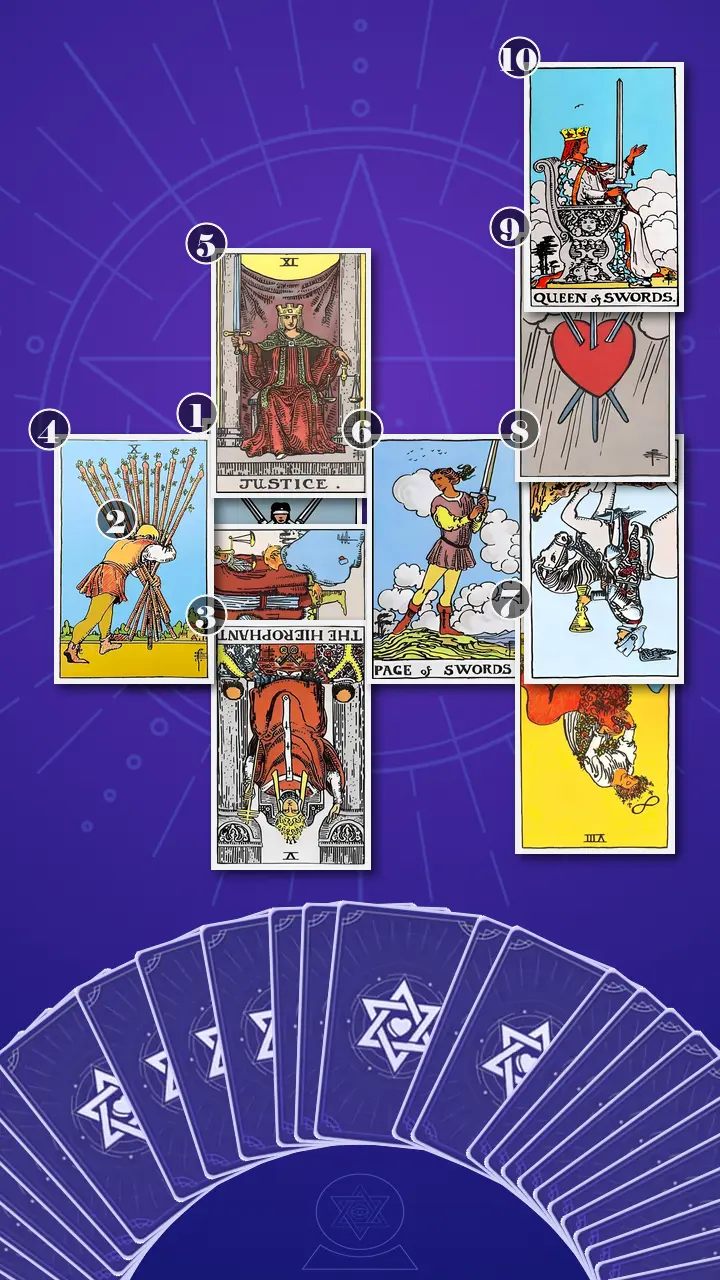
“The first card will show how the boundary-freeze is showing up in your body and behavior,” I told Taylor. “The crossing card shows what makes this feel unfair or sticky. And the card above—the conscious aim—is where we’ll find your definition of ‘fair’ that doesn’t depend on anyone else’s mood.”
Reading the Map: The Freeze and the Unfair Exchange
Position 1: The current boundary freeze
“Now we turn over the card that represents the current boundary freeze: how the situation is showing up in your behavior and nervous system right now,” I said.
Two of Swords, upright.
I tapped the blindfold on the figure. “This is the moment you keep describing—opening the notification, closing it, reopening it—like if you stare long enough the problem becomes less real.”
In modern life, this card looks like: you reread the portal notice, then swipe away, telling yourself you’ll deal with it later, while your body stays braced as if the call could come at any time.
Energy-wise, the Two of Swords is a blockage. Not a lack of intelligence—an overload of competing priorities. Peace vs. honesty. Kindness vs. consent. The crossed swords aren’t “no”; they’re “not yet.” But “not yet” still costs you. Your nervous system pays interest.
Taylor let out a small laugh that had no joy in it. “That’s… brutally accurate.” They shook their head once, like the card had said something out loud they’d been trying to keep quiet. “I keep thinking if I can just find the perfect wording, it won’t be a thing.”
“That’s the blindfold,” I said gently. “It’s not that you don’t know. It’s that looking directly feels like conflict.”
Position 2: The core challenge
“Now we turn over the card that represents the core challenge: where the exchange becomes unequal or consent gets blurred,” I said.
Six of Pentacles, reversed.
On the card, there are scales and coins being handed out. Reversed, the giving doesn’t feel clean—it feels assumed. In modern life, it looks like: Taylor senses that saying yes would make them the ‘responsible one’ by default, while the other person gets to feel cared for without actually checking in.
Energy-wise, this is imbalance. The support isn’t being requested and negotiated; it’s being assigned. And your irritation? That’s not you being petty. It’s data. It’s your internal fairness meter noticing the scales are off.
“This is not about kindness,” I told Taylor. “It’s about consent and reciprocity.”
They swallowed, eyes flicking to their phone like it might object. “But it’s also—” Their voice lowered. “It’s like if I say no, I’m… failing some friend test.”
“That belief is exactly why this gets sticky,” I said. “And we’re going to name it, not obey it.”
Position 3: The hidden driver
“Now we turn over the card that represents the hidden driver: the deeper ‘should’ rule or fear that keeps you from stating the boundary plainly,” I said.
The Hierophant, reversed.
I exhaled softly. “This is the invisible rulebook.”
In modern life, this card looks like: worrying friends will judge you for not being ‘the reliable one,’ as if there’s an invisible rating system for who deserves closeness.
Energy-wise, reversed Hierophant is a reframing invitation. It asks you to stop treating old social scripts as law. The deeper block isn’t actually the wording of your boundary—it’s the fear of breaking an unspoken contract: be available, be nice, be loyal at all costs, and you’ll stay safe in belonging.
“You’re not only deciding whether to send a text,” I said. “You’re deciding whether you still have to live by that rule.”
Taylor’s shoulders lifted an inch, then dropped. Like their body had been waiting for permission to admit it.
Position 4: The recent pattern
“Now we turn over the card that represents the recent pattern: where you’ve already been carrying too much, making this boundary feel loaded,” I said.
Ten of Wands, upright.
The image is almost physical: a person bent forward under a bundle they can barely see past. In modern life, it looks like: Taylor already has a full week, yet still feels compelled to be the person who picks up the call, fixes the problem, and absorbs the fallout.
Energy-wise, Ten of Wands is excess—too much responsibility, too much self-management, too much “I can handle it.” That’s why this emergency-contact label feels like a tipping point. It’s not “just a form.” It’s one more wand on arms that are already shaking.
Taylor’s mouth tightened again. “I keep telling myself I should be able to handle one small thing,” they said. “But it feels heavy.”
“Of course it does,” I said. “Because you’re not reacting to one small thing. You’re reacting to the pattern of being drafted.”
When Justice Spoke: Access, Not Affection
Position 5: Your conscious standard
I let the room get a little quieter before we turned the next card. The café’s background noise softened into something like weather—present, but not demanding attention.
“Now we turn over the card that represents your conscious standard: what ‘fair and respectful’ looks like when you define it for yourself,” I said. “This is the card that tells me what your spine already knows.”
Justice, upright.
In modern life, Justice looks like this: realizing you don’t need a dramatic breakup-style speech; you need a clear policy—roles like this require asking first.
“Here’s the cleanest modern translation,” I said, and I watched Taylor’s eyes track the scales. “Being listed as someone’s emergency contact is like being granted admin access in Google Drive without your permission. Your name equals access, not affection. And you’re allowed to revoke access.”
Justice energy is balance: clear roles, explicit agreement, cause and effect. It’s also the end of moral spirals. Justice doesn’t ask, “Are you nice?” It asks, “Is this fair, consent-based, and proportionate?”
And because I’m Sophia Rossi, café owner before tarot reader, my mind went—automatically—to espresso. I’ve pulled shots for twenty years. If you let a shot run too long, it over-extracts: bitter, sharp, punishing. Too short, and it’s thin, sour, unsatisfying. There’s an optimal extraction time. Not because you’re controlling—because you respect the bean, the process, and the person who has to drink it.
“This is what I call Social Espresso Extraction,” I told Taylor. “There’s an optimal extraction time for a boundary conversation, too. If you over-extract—too many apologies, too much explanation—you don’t make it kinder. You make it bitter and confusing. Justice is saying: pull the shot clean. Two lines. Stop on time.”
They blinked, like something clicked into place but their body hadn’t caught up yet.
And then the stuck moment rose right on cue—the familiar couch-after-work loop, the “typing bubble anxiety,” the jaw locking as they reread: Hey, I put you down—hope that’s fine. Taylor had been treating this like a moral trial, as if they needed to earn the right to say no with a courtroom-level closing argument.
Stop trying to be ‘nice enough’ to avoid discomfort; be clear enough to be fair, like Justice holding the scales and the sword at the same time.
The sentence landed between us like a set of keys dropped onto a table—small sound, big meaning.
Taylor’s reaction came in layers, not all at once. First: a brief physiological freeze—breath caught, eyes widening, thumb hovering over their phone as if it suddenly weighed more. Second: cognition seeping in—gaze unfocusing for a second, like they were replaying every draft they’d written, every extra “sorry” they’d added, every time they’d tried to manage the other person’s feelings from inside a Notes app. Third: the release—an exhale that seemed to come from the ribs, shoulders lowering in a slow surrender that wasn’t defeat, but relief.
“Wait,” they said, voice rougher now, more real. “Why does this feel like a moral test when it’s literally a consent question?”
“Exactly,” I said. “Consent isn’t a vibe—it’s a yes. Asking to be removed isn’t unkind; it’s you being responsible to your actual capacity.”
I leaned in just a little. “Now—use this new lens and look back at last week. Was there a moment where you felt the bracing start? The jaw, the chest, the impulse to check your phone? If Justice had been sitting on your shoulder then, what would you have told yourself in one sentence?”
Taylor stared at their screen, then whispered, almost surprised: “I would’ve said, ‘This role requires asking.’”
That was the shift—subtle, but foundational. From “I must protect their feelings” to “I can be respectful and still require consent for access to me.” From tense guilt to the first edge of clarity.
The Send Moment: Clean Air, Gentle Courage
Position 6: The next step energy
“Now we turn over the card that represents the next step energy: the most workable communication move to break the loop,” I said.
Page of Swords, upright.
In modern life, this card looks like: stopping the polishing, sending the clear message, trusting that clarity is kinder than vague reassurance.
Energy-wise, the Page is activation. Not perfect confidence—momentum. It’s the version of you whose thumb hovers over iMessage and presses send before your feelings arrive in the right outfit.
I made it concrete, because that’s what this card wants.
“Picture it,” I said. “You’re on your condo couch after work. Slack is finally quiet. You open the thread. Your thumb hovers. Your brain wants to write an apology essay. Page of Swords says: ask a clarifying question or make a clarifying statement—short and clean.”
I offered a borrowable line, the way I’d offer a regular their usual order.
“‘Hey—please remove me as your emergency contact. I’m not able to be in that role.’”
Taylor’s lips parted like they might argue—and then closed. Their shoulders dropped a fraction, like their body recognized the simplicity as safety.
Position 7: Your inner posture
“Now we turn over the card that represents your inner posture: where self-trust or courage wobbles when you imagine their reaction,” I said.
Strength, reversed.
In modern life, this card looks like: equating ‘setting a boundary’ with ‘starting a fight,’ then trying to prevent the fight by shrinking your own needs.
Energy-wise, this is deficiency—not of strength as toughness, but of strength as steadiness. Reversed Strength is where you mistake courage for being unbothered.
And this is where Taylor’s inner split-screen plays.
“Let me guess,” I said softly. “Left side of your mind writes: ‘Please remove me.’ Right side plays the fear trailer: ‘They’ll think I’m heartless. They’ll tell people I’m unreliable. They’ll get mad.’”
Taylor winced—small, immediate, like their body had been called out by name.
“Then your chest tightens,” I continued, “and that’s the pivot point. That’s where you start negotiating with yourself. You add apologies you don’t believe. You offer extra help you don’t want to give. You try to sound colder to feel safer—or softer to feel liked.”
They nodded once, slow. A quiet exhale followed, the exact kind that says: oh, that’s exactly where I fold.
“Strength here isn’t ‘no feelings,’” I said. “It’s gentle hands holding the line.”
Position 8: Their side of the dynamic
“Now we turn over the card that represents their side of the dynamic: the interpersonal pressure, expectations, or emotional style you’re responding to,” I said.
Knight of Cups, reversed.
In modern life, this card looks like: a message that’s sweet or needy enough to trigger guilt, even though the actual request is logistical: ‘Please choose someone appropriate and ask them.’
Energy-wise, reversed Knight of Cups is emotional fog—not necessarily malicious, but persuasive. The kind of energy that turns a practical boundary into a feelings referendum.
I used one of my other café frameworks without making it feel like a gimmick. “This is Milk Foam Layer Analysis,” I said. “On top: foam—sweetness, urgency, closeness language. Underneath: the espresso—what’s actually being asked.”
“The foam message sounds like,” I continued, and I kept it painfully realistic: “ ‘You’re basically my only person here 🥺.’ Or: ‘I just trust you the most.’”
Taylor’s eyes widened like they’d just been shown a screenshot of their life. “Yes. That exact vibe.”
“And foam isn’t evil,” I said. “But you can’t build consent on foam. Vague reassurance feeds the pattern. Clean logistics interrupts it.”
Position 9: The emotional stake
“Now we turn over the card that represents the emotional stake: what you most hope to protect and what you most fear will happen emotionally,” I said.
Three of Swords, upright.
In modern life, this card looks like: imagining them reading your boundary text and instantly deciding, ‘Wow, Taylor doesn’t care about me,’ even though you’re simply protecting consent and capacity.
Energy-wise, Three of Swords is honest pain. Not catastrophe—truth that stings. This is the card that admits: yes, a boundary can feel sharp. Especially if you learned that honesty equals rupture.
“This is the fear,” I said gently. “That one clear sentence will change the relationship permanently.”
Taylor’s face tightened, then softened. “I don’t want to hurt them,” they said. “And I don’t want them to… decide I’m not worth keeping around.”
“Of course,” I said. “And here’s the question Justice would ask: what’s the smaller harm—one honest ‘no’ now, or a slow build of resentment that poisons the connection later?”
Position 10: Integration direction
“Now we turn over the card that represents the integration direction: what boundary-setting looks like when you act aligned with your values,” I said. “Not a fixed outcome—your north star.”
Queen of Swords, upright.
In modern life, this card looks like: sending a short text, not over-apologizing, and trusting that an adult can be disappointed without you having to fix it.
Energy-wise, this is clean Air—clarity that doesn’t need cruelty. The Queen is what happens when the Two of Swords takes off the blindfold and makes eye contact with reality. One upright sword. One steady gaze. No bargaining.
“You can be respectful without being available,” I said. “And—this matters—you don’t have to stay in the conversation once you’ve made the request. You’re not customer support for your own consent.”
From Insight to Action: The Justice Text (Pulled Like a Clean Shot)
I slid the cards into a tidy line, the way I line up cups before the morning rush. “Here’s the story your spread told,” I said, making it coherent—not mystical.
“You froze because you didn’t want conflict (Two of Swords), but underneath that, something real was unfair: you were assigned responsibility without consent (Six of Pentacles reversed). The reason it hit so hard is you’ve been overloaded already (Ten of Wands), and you’ve been living by an old ‘should’ rule that says being dependable equals being endlessly accessible (Hierophant reversed). Justice is your conscious standard: explicit agreement, fair exchange. The Page says the medicine is a short message. Strength reversed is the wobble point—anticipating their reaction makes you negotiate your boundary away. The Queen of Swords is your integration: clean language, adult-to-adult.”
“Your cognitive blind spot,” I added, “is thinking you need the perfect wording to prevent feelings. That’s an impossible assignment. The transformation direction is: from protecting their feelings to requiring consent—respectfully, briefly, and without a closing argument.”
Then I gave Taylor what most people are actually searching for when they type how to tell someone to remove me as emergency contact: actionable advice and next steps.
- The 7-Minute Justice Text SprintOpen Notes. Write exactly two lines: (1) the boundary, (2) the action step. Then paste it into the thread and send. Template: “Hey—please remove me as your emergency contact. I’m not able to be in that role.”Your brain will demand a “good enough reason.” That’s the loop. Set a 7–10 minute timer and stop editing when it ends—don’t let the shot over-extract into bitterness.
- The Neutral Repeat Line (No Debate)If they respond emotionally or try to negotiate, copy/paste one calm line: “I hear you, and I still need you to update it. Thanks for understanding.”Think of it as your macro. You don’t need a new argument every time; repeating calmly is what makes the boundary real.
- The 60-Second Grounding Before SendRight before you hit send: feet on the floor, inhale for 4 counts, exhale for 6 counts, once or twice. Then send without rereading.Strength isn’t “no nerves.” It’s letting your hands shake a little while you still do the clean thing.
Taylor looked at the two-sentence template again, and I watched the tension shift—not vanish, but reorganize. Less “I’m in trouble,” more “I’m choosing.”

A Week Later: The Quiet Proof
Six days later, I got a message from Taylor while I was wiping down the counter after the lunch rush. It wasn’t a paragraph—just a screenshot.
Their sent text: “Hey—please remove me as your emergency contact. I’m not able to be in that role.”
The reply they received wasn’t perfect. It had a little guilt in it—some foam on top. But Taylor had used the neutral repeat line once, and then stopped typing.
“My chest did the spike thing,” their message read. “But after I sent it, it was like… my shoulders finally remembered they’re allowed to drop.”
Later, they told me something even smaller and more important: they slept through the night for the first time in a while. In the morning, their first thought was still, What if I sounded mean?—but this time, they exhaled and said, quietly, “Respectful and clear is enough.”
That’s what a real Journey to Clarity looks like in my world: not a dramatic transformation montage. Just a clean sentence that returns your life to consent.
And if you needed to hear this tonight, let it land: when you’re trying to be “the good person,” your body can end up living like you’re on call—jaw tight, chest braced—because you’re carrying a responsibility you never actually agreed to.
So if you let “respectful and clear” be enough—no extra explaining—what’s the smallest sentence you’d send to return this role to consent?