My Friend Covered Brunch, and I Felt in Debt—So I Tried One Sentence

Finding Clarity in the Brunch Beep
If your stomach drops the second the payment terminal shows the total—because you didn’t get to offer first and now it feels like a social imbalance in public—then you already understand the question before you even ask it.
Taylor (name changed for privacy) slid into the chair across from me with the kind of careful posture people have when they’re trying to look “totally fine.” We were at a small table by the front window of my café—steam ghosting the glass, the espresso machine hissing like it always does, that warm-bitter coffee smell that crawls into your hoodie and stays there.
They didn’t start with theory. They started with a scene.
“Sunday brunch near Ossington,” Taylor said, eyes flicking up like they could still see it. “Plates clinking. My friend just… tapped their card. The beep was so loud it felt like a gavel. And I smiled—like, too hard—while my brain went, I didn’t even get to offer first, so now I look like I expected it.”
Taylor’s fingers tightened around their phone even though the screen was off. “I know it’s just dinner or coffee,” they added, almost laughing at themself. “But my brain turns it into a contract. And then I’m opening Venmo before I even get home. Not because they asked—because I can’t relax until the account is balanced.”
I watched the way their shoulders sat slightly raised, like they were holding a bag you couldn’t see. That familiar, contracted energy I’ve seen in a hundred people who aren’t scared of money itself—just the meaning their nervous system assigns to it.
“That’s not you being ungrateful,” I said, keeping my voice simple. “That’s your body reacting as if kindness comes with terms and conditions. Today, let’s give that reaction a map. Not to judge it—just to find clarity and a next step that doesn’t require you to ‘fix it’ in ten seconds.”

Choosing the Compass: The Four-Layer Insight Ladder
I asked Taylor to take one slow breath—nothing mystical, just a clean transition from replaying the brunch moment to looking at it with a little distance. While I shuffled, I told them what I tell everyone: “The cards don’t make decisions for you. They help us name what’s already happening, especially the parts you’ve learned to do on autopilot.”
For this, I chose a spread I use when someone is stuck in a loop that feels small but steals a lot of peace: the Four-Layer Insight Ladder · Context Edition.
Here’s why it fits bill-splitting anxiety and that “why do I feel guilty when my friend pays for me” spiral: it doesn’t stay on the surface. It starts with the observable moment (the beep, the receipt, the Venmo thumb-hover), then climbs into the belief and the fear underneath, and finally climbs back out into a reframe and a one-week experiment. It’s practical—more like debugging than fortune-telling.
I laid out the cards in a single vertical line, like rungs you climb from reflex to clarity. I previewed the key rungs for Taylor—and for you, the reader:
“The first card shows your immediate reaction—what your body and behavior do right when someone says ‘I’ve got it.’ The third card is the shadow root—the fear that makes receiving feel dangerous. And the fourth card is the turning point: the reframe that restores agency without forcing you into panic repayment.”
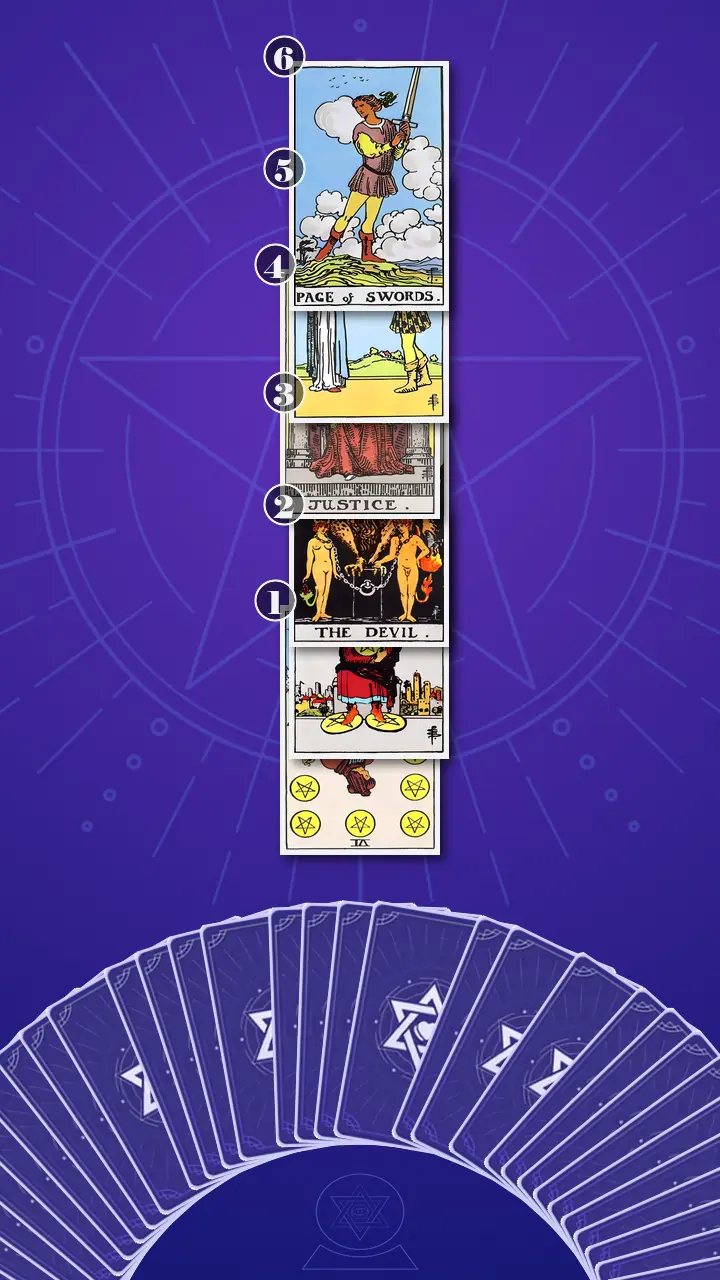
Reading the Ladder: From Ledger Mode to Relationship Mode
Position 1: The Observable Bill-Moment Reflex
“Now flipped,” I said, “is the card that represents the observable present-moment reaction when your friend offers to pay—the specific ‘owe’ feeling and what you do next.”
Six of Pentacles, reversed.
I angled the card so Taylor could see it clearly: the scales, the coins, the sense of someone up and someone down—then reversed, like the whole scene tilts into discomfort.
“This is the brunch moment,” I said. “Your friend reaches for the check first and says, ‘Don’t worry about it.’ Even if you can afford it, your nervous system reads it like a status shift. You’re smiling, but inside you’re scrambling: offer again, don’t argue, say something normal… or open Venmo under the table to erase the imbalance before it becomes ‘a thing.’”
In this reversed position, the energy isn’t generosity. It’s perceived power. The scales stop being a symbol of balance and turn into a public scoreboard: who is up, who is down, who looks like they expected it.
Taylor let out a quick breath that turned into a small, bitter laugh. “Okay,” they said. “That’s… too accurate. It’s like you were there. And it’s embarrassing because literally nobody else cares. Everyone keeps talking about the eggs.”
“Exactly,” I replied. “The table keeps being a table. But your nervous system hears that beep like it’s announcing a ranking.”
Position 2: The Belief That Turns Fairness Into Armor
“Now flipped,” I said, “is the card that represents the underlying belief about fairness, worth, and control that turns generosity into pressure.”
Four of Pentacles, upright.
“This is the grip,” I told them. “You walk home and you can’t even enjoy the afterglow of the hangout because your mind is holding the receipt total like a coin under your foot. You re-open the screenshot, re-calculate tax and tip, draft a message that proves you’re not taking—because leaving it open feels like leaving yourself exposed.”
The Four of Pentacles is control as safety. Upright, it can be budgeting and responsibility. But here it reads as armoring: ‘If I keep everything contained and balanced immediately, I can’t be judged.’
“Fairness matters to you,” I said, “but this card asks: when you say ‘fair,’ do you mean honesty and consent… or do you mean no vulnerability allowed?”
Taylor didn’t answer right away. Their eyes went slightly unfocused, like they were watching themself do it: the receipt photo → Venmo → the draft text that starts kind and ends like a mini legal brief. Their jaw tightened, then loosened.
“It’s… armored,” they admitted. “I call it being fair, but it’s like I’m trying to make sure there’s no opening for anything messy.”
I nodded. “Your nervous system wants the tab closed. Your values want the connection open.”
Position 3: The Shadow Root—What Receiving Feels Like It Could Cost
“Now flipped,” I said, “is the card that represents the root fear underneath the belief—what receiving feels like it could cost you socially or emotionally.”
The Devil, upright.
In my café, the grinder kicked on for a moment—loud, abrupt—then quiet again. The sudden noise made Taylor blink, like their body was already braced. It matched the card too well: that jolt of “something’s about to happen” energy.
“This is the part that surprises people,” I said gently. “A friend covers your coffee and suddenly your brain adds invisible terms: you must be extra available, extra grateful, extra easygoing. You feel bound—not by them, but by the story that receiving means losing autonomy or belonging unless you repay immediately.”
I pointed to the chains. “They’re loose. That’s the detail most people miss. It’s like your mind invents an invisible chain, but nobody actually locked it.”
Taylor’s stomach visibly dropped—one of those micro reactions you can see in the throat before the words come. Their hand went to their mug, not to drink, just to hold something warm.
“So let me ask it as a mirror,” I said. “If you accepted without paying back immediately—what do you think they’re entitled to now?”
Taylor swallowed. “Time,” they said. “Like… access. Like they get to be disappointed in me if I don’t respond fast enough. Or they get to ask favors and I can’t say no. It’s not even about the twenty bucks.”
I let that land for a beat, then said the line I wish every ledger-brained heart could hear:
“Kindness isn’t a hidden contract unless you sign one.”
Taylor’s eyes watered—not dramatic, just that sudden shine of being seen too clearly. “That’s the thing,” they whispered. “I sign it instantly. In my head.”
When Justice Spoke: The Chain-to-Handshake Reset
Position 4: The Key Reframe That Restores Agency
I touched the top card lightly before turning it. “We’re flipping the turning point,” I said. “This is the reframe that restores agency and equality without transactional urgency.”
The room felt quieter for a second—not because anything changed, but because Taylor’s attention sharpened, the way it does when you know you’re about to hear something you can’t un-hear.
Justice, upright.
“This,” I told them, “is the difference between panic repayment and values-based reciprocity. Justice says real fairness is clarity, consent, and proportionality—not rushing to reimburse so you don’t have to feel vulnerable for one more minute.”
Then I brought in the lens I know best—because I’ve watched thousands of people over twenty years try to fix feelings with transactions the same way they try to fix a bad day with caffeine.
“In my café,” I said, “we time espresso shots. There’s an optimal extraction time—too fast and it’s sour, too long and it’s bitter. Your relationships have an ‘optimal extraction time’ too.”
This is my Social Espresso Extraction: the skill of noticing that different social contexts need different timing to feel balanced. “When you Venmo immediately, you’re trying to extract ‘safety’ in five seconds,” I said. “But Justice is asking for a different timing: balance over time, with one clean sentence that keeps you equal.”
Setup (the stuck moment): Taylor was still caught in that familiar micro-emergency: the card machine beeps, their friend says “I’ve got it,” their chest tightens, and their thumb hovers over Venmo like it’s an emergency exit. Their brain is doing fast math to avoid being judged as a taker.
Delivery (the line that changes the temperature):
Not “I must settle the debt right now,” but “I can choose balance on purpose”—let the scales and sword of Justice replace the invisible chains.
I didn’t rush past it. I let it hang there the way a good truth does—simple, slightly confrontational, and somehow relieving.
Reinforcement (what I watched happen in Taylor’s body): First, they froze—breath held, pupils widening just a fraction. Then their gaze went distant, like they were replaying the last brunch, the last dinner, the last coffee line—each beep, each smile that didn’t reach their stomach. Finally, something softened: their shoulders dropped a millimeter, then another, as if their body was testing whether it was allowed to put the invisible bag down. Their mouth opened, closed, then they exhaled through the nose—a shaky release that sounded like, “Oh.” Their fingers unclenched around the mug. Their expression wasn’t only relief; it carried a thin strip of grief, too, like realizing how long they’d been treating friendship like an expense report they had to submit before they were allowed to relax.
I leaned in just slightly. “Now,” I asked, “with this new lens—can you think of a moment last week when this would have changed your experience? A time you could have chosen balance on purpose instead of buying your way out of discomfort?”
Taylor blinked hard. “Tuesday,” they said. “Walking home on Queen West. Cold air, streetlights, I’m toggling receipt photo to Venmo like it’s a compulsion. If I’d had that sentence… I think I would’ve just texted, ‘Thanks. I’ll get next time.’ And gone to bed.”
“That,” I said, “is the first step of the transformation: from guilt-driven scorekeeping to grounded ease. Not because you stop caring about fairness—because you stop outsourcing fairness to panic.”
Position 5: The Resource—Mutuality That Isn’t a Spreadsheet
“Now flipped,” I said, “is the card that represents the relational resource—what mutuality can look like when you trust the connection over the ledger.”
Two of Cups, upright.
“This card is the evidence you forget when you’re in audit mode,” I told Taylor. “You remember: this friend has leaned on you too—advice texts, showing up when you were low, listening on long walks. Tonight’s bill isn’t a debt; it’s one moment in an already mutual relationship.”
I watched Taylor’s face soften in a way that wasn’t performative. Their eyebrows released. The corners of their mouth shifted like they were remembering something kind without immediately translating it into a repayment plan.
“Yeah,” they said quietly. “They checked on me when I was dealing with that work thing. Like… actually checked on me. And I didn’t invoice them for that.”
“Reciprocity doesn’t have to be instant to be real,” I said, tapping the card lightly. “This is a relationship pattern, not a receipt.”
Position 6: The One-Week Experiment—Speak Early, Don’t Spiral Late
“Now flipped,” I said, “is the card that represents a one-week, real-world communication experiment to practice healthier reciprocity.”
Page of Swords, upright.
“This is the micro-skill,” I said. “You try one honest question in the moment: ‘Are you sure, or should we split?’ And then—this is the hard part—you accept the answer without negotiating yourself into guilt.”
The Page has that alert, slightly awkward energy of learning a new phrase in a new city. You can do it, but your mouth doesn’t trust it yet.
“And afterward,” I added, “you send one clean text: ‘Thanks for covering tonight. I’ll grab next time.’ No paragraph.”
Taylor half-smiled. “I always want to add the paragraph.”
“Of course,” I said. “But remember: One clean sentence is a boundary. A paragraph is usually fear.”
The One-Page Fairness Plan: Actionable Next Steps (Without the Venmo Spiral)
I took a sip of my own espresso—habit, comfort, also timing. “Here’s the story your cards told in plain language,” I said.
“In the present (Six of Pentacles reversed), a friend paying reads like a public scoreboard, so your body goes into fairness-audit mode. Underneath (Four of Pentacles), you try to regain safety through control: close the tab, close the loop, close the vulnerability. At the root (The Devil), the fear isn’t the money—it’s imagined bondage: ‘If I receive, I lose autonomy or belonging.’ Then Justice cuts through that with a clean alternative: consent-based fairness. Two of Cups reminds you this friendship already contains mutuality. And Page of Swords turns it into language—short, early, real.”
“Your cognitive blind spot,” I continued, “is that you treat discomfort like evidence. The discomfort is real in your body—but it’s not proof you owe. It’s a signal that your old ‘fairness rule’ is trying to protect you.”
“The transformation direction,” I said, “is exactly what Justice asks: shift from immediate score-settling to explicit, values-based reciprocity by naming what’s true and letting balance happen over time—not in seconds.”
Then I offered Taylor a small plan—practical, low-drama, built for real life in a city where brunch bills happen in public.
- The 24-Hour Rule (Open-Tab Tolerance)For one week, if a friend covers something small, don’t send money for 24 hours unless they explicitly ask. If you want to reciprocate, use a time-based plan instead: “I’ll get next one.”If panic spikes, scale down: practice with a $4 coffee and a person you feel safest with. Data, not a test.
- The 10-Minute “Justice Pause” (Before You Open Venmo)Set a 2-minute timer and name the first body signal (tight chest, clenched stomach). Write one true sentence: “They offered to pay. They didn’t ask me to reimburse.” Then pick one script: “Thank you—I’d love to get the next one,” or “Thanks. Want to alternate next time?” Make one boundary: no payment for 24 hours unless requested.If all you can do is step 1 (naming the body cue), that still counts. You’re training your nervous system, not performing gratitude.
- A 3-Second Latte Art Line (Say It Like It’s Casual)Use a single sentence in the moment—the way I’d pour a quick heart in foam: simple, clean, no overworking. Try: “Thank you—I really appreciate it. I’ll grab next time.”Rehearse it once out loud before your next hangout. You’re not scripting a personality—you’re giving your brain a default.
I added one more tool from my café brain, because not every relationship has the same “temperature.”
“Use a Social Thermometer,” I told Taylor. “With an espresso-hot close friend, alternating feels natural. With an iced-coffee acquaintance, splitting might feel cleaner. Justice isn’t one rule—it’s proportionality. You get to choose what fits the relationship.”

A Week Later: The Quiet Proof
Six days later, Taylor messaged me. One sentence. No essay.
“They paid for coffee again,” they wrote. “I said, ‘Thank you—deal, I’ll get next time,’ and I didn’t Venmo. I felt weird for like ten minutes. Then it passed.”
In the follow-up line, they admitted something that felt both lighter and a little bittersweet: “I went home and my first thought was still, ‘What if they think I’m taking?’ But I didn’t do anything. I just… let the thought be a thought.”
That’s what a real Journey to Clarity looks like most of the time. Not fireworks. A smaller reaction. A cleaner sentence. A nervous system learning it doesn’t have to close every tab to deserve belonging.
When someone covers something small and your chest tightens anyway, it’s not because you’re ungrateful—it’s because part of you hears kindness as a test you have to pass to keep your place.
If you didn’t have to settle the score in seconds, what’s one tiny, honest line you’d want to try next time—just to let balance happen on purpose, over time?