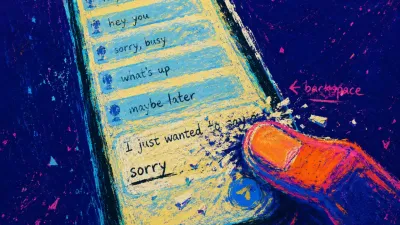
The 12:14 a.m. U Up? Text—And the Night I Stopped Negotiating

Finding Clarity in the 11:58 p.m. Notification
If a weekend notification after 11 p.m. can flip your whole mood in two seconds, welcome to situationship limbo.
Jordan (name changed for privacy) sat down across from me with the particular posture of someone who’d been “fine” all day and then quietly unraveled in bed. She was 27, a marketing coordinator in Toronto, the kind of job where you can write a crisp Slack update at 3 p.m.—and then spend twenty minutes rewriting one text at 12:30 a.m. because the tone feels like it might decide your value.
She described last night like a scene she’d replayed too many times: 11:58 p.m. in a condo bedroom, streetlight glow through the blinds, laptop half-open on the duvet like a second heartbeat. The hallway outside was so quiet you could hear the faint elevator hum. Her phone sat face-up, screen dark but expectant—like a tiny stage waiting for the actor to arrive.
“When it lights up,” she said, and her fingers fluttered once, as if the buzz lived in them, “my stomach just… clamps. And my hands get this restless static.”
It wasn’t abstract anxiety. It was a tight stomach and a restless buzz in the hands when the phone lights up—like her nervous system got put on an on-call shift she never agreed to.
“He sends the ‘u up?’ text,” she went on. “And I pause whatever I’m doing to decide whether to reply. If I respond fast, I feel… connected. If I don’t, I feel powerful for five minutes and then I spiral.” She gave a small, embarrassed laugh. “I don’t want to be the girl who makes it a thing.”
Underneath that laugh I could hear the real contradiction: keeping the situationship vs setting a clear boundary. Wanting to be chill, and also wanting to matter.
I leaned in, gentle but direct. “We’re not going to moralize this. We’re going to map it. Let’s use tarot the way I use excavation sites: not to invent a story, but to reveal the structure that’s already there. Our journey today is about finding clarity—so you can act from self-respect instead of availability.”

Choosing the Compass: A Decision Cross Tarot Spread
I asked Jordan to take one slow breath—not as a ritual of mystery, but as a simple gear shift out of reaction and into reflection. While she exhaled, I shuffled deliberately, the way I used to brush soil from a shard before guessing what it belonged to.
“For this,” I said, “we’ll use the Decision Cross.”
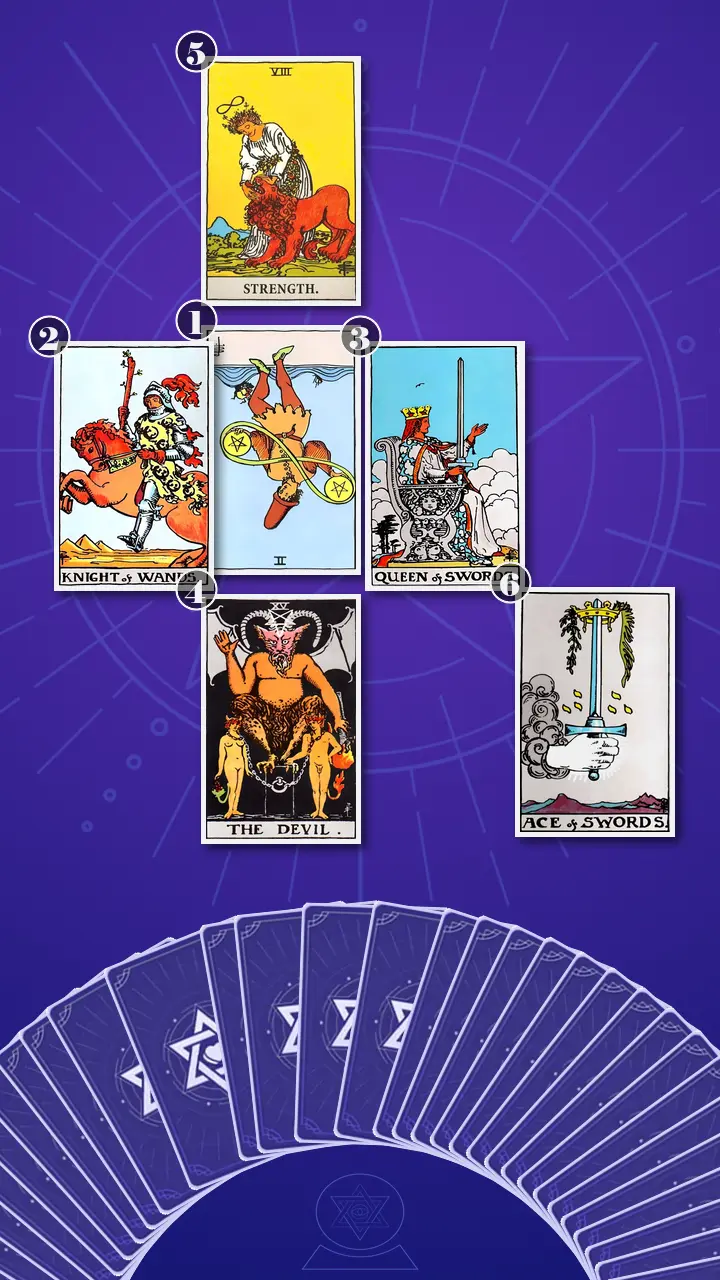
For the reader: a Decision Cross tarot spread is ideal when the question is cleanly two-path—keep the situationship or set a boundary—and you don’t want a performance of prediction. The structure begins with the current pattern (what the ‘u up?’ text actually triggers), then compares Path A vs Path B, drops down into the hidden hook beneath the surface, rises into the inner resource that makes change sustainable, and ends with one grounded next step. It keeps the focus on self-trust, standards, and communication—what you can actually influence.
I pointed to the positions as I laid them out: “This center card shows the observable dynamic right now. Left is what you’re choosing if you keep it as-is. Right is what you’re choosing if you set a boundary. Below is the hidden hook—what keeps the loop running. Above is the stabilizing strength you’ll need. And this last card gives you one practical action you can live with.”
Reading the Map: When “Casual” Turns Into Standby Mode
Position 1 — The current dynamic: the observable pattern around the late-night text
“Now flipping,” I said, “is the card that represents the current dynamic: the observable pattern around the late-night text and how it disrupts your balance.”
Two of Pentacles, reversed.
I didn’t need to dramatize it. The image did that on its own: the juggler, the infinity loop around the coins, the choppy sea behind him. In reverse, that dance becomes less playful and more like keeping your footing on a moving subway car while answering emails.
“This is almost painfully literal,” I told her. “You’re in bed in Toronto around midnight with your work laptop half-open and your phone face-up. You keep checking whether he’s online, mentally running two schedules at once: the night you planned and the night you’ll switch into if he texts.”
I mirrored her reality the way the card demanded: “It’s like you’ve got two tabs open all night—one for your life and one for ‘what if he hits me up’—until your brain is overheating. A late-night text shouldn’t get voting rights over your evening, but right now it does.”
In terms of energy, this is blockage: not a lack of intelligence, but an unstable Earth-energy—routines, sleep, plans—getting flipped and made reactive. The loop isn’t only about him; it’s about the constant toggling that keeps your nervous system busy and makes every message feel urgent.
Jordan’s reaction came fast and unexpectedly sharp. She didn’t nod politely. She let out a short laugh that had a bitter edge. “Okay,” she said, eyes narrowing like she was offended on her own behalf. “That’s… too accurate. Like, rude.”
“I know,” I said, calm. “Accuracy can feel rude when you’ve been surviving on ‘it’s no big deal.’ This card is not calling you out. It’s calling the pattern out.”
Position 2 — Path A: what you are choosing when you keep the situationship as-is
“Now we look at the left,” I said. “This is Path A: what you are choosing when you keep the situationship as-is.”
Knight of Wands, upright.
The rearing horse, the desert, the heat—movement without a promise of staying power.
“Keeping it means choosing the thrill,” I said. “Last-minute meetups, flirty texts, that ‘he wants me right now’ hit. It’s the hot text, no calendar invite energy.”
Energetically, this is excess Fire: momentum, chemistry, immediacy. It feels alive. It also doesn’t naturally slow down into consistency unless someone deliberately introduces structure.
I gave her a clean trade-off, no moralizing. “Chemistry is real. So is the cost of being on call.”
Jordan nodded, conflicted but relieved to hear it stated without judgment. “It is hot,” she admitted, almost whispering it like a confession. “And then Monday comes and I’m like, why do I feel… hungover?”
“Because you’re living rooftop-bar energy in a Monday-morning life,” I said. “Fireworks are bright. They aren’t a training plan.”
Position 3 — Path B: what you are choosing when you set a boundary
I let my hand hover a beat longer over the right-side card. “Now we turn to the fork you’re afraid to take,” I said. “This is Path B: what you are choosing when you set a boundary and ask for a different standard.”
Queen of Swords, upright.
Her sword was raised—not as a threat, but as a clean line. Her gaze held the horizon like it belonged to her.
“This,” I said, “is you drafting one clear message while you’re calm. Not at 12:30 a.m. with adrenaline in your thumbs. You state what you’re available for—planned hangouts, daylight effort, respectful timing—and what you’re not.”
“It’s giving: concise HR email, but make it dating,” I added, and Jordan’s mouth twitched despite herself. “Clear, polite, no wiggle room.”
Energetically, this is balance in Air: language that creates structure. Not a power game. Not punishment. A boundary isn’t a fight—it’s a filter.
And here is where my own mind always reaches for the long view. I’ve spent decades watching how civilizations treat their borders. Not the dramatic invasions—the quiet erosions. A city doesn’t fall because of one spectacular breach. It falls because the gates become symbolic, and the night visitors start coming and going with no terms.
“Jordan,” I said, “I’m going to use one of my tools—what I call Historical Case Matching. When I see the Queen of Swords in a boundary decision, I think of societies at a crossroads: do they keep ‘open gates’ because it feels hospitable and avoids conflict, or do they define terms so the city can actually function?”
“Open gates aren’t immoral,” I continued. “They’re just expensive. They demand you stay alert. You start sleeping lightly. You stop building. Eventually your whole culture becomes reactive.”
Her eyes fixed on the card like it was a mirror that didn’t blink.
I lowered my voice. “We’re flipping the logic: the goal isn’t to convince him to become different. The goal is to make your standard visible—so the dynamic can finally tell the truth about itself.”
Stop auditioning for late-night attention and start choosing daytime-level clarity—let the Queen’s raised sword be one clean sentence that defines your terms.
The room changed the way it does at a dig site when you realize the soil color has shifted—meaning you’ve hit a new layer. Jordan’s immediate state was familiar: that moment in bed when your phone lights up after 11, your stomach tightens, and suddenly you’re negotiating with yourself like your whole night depends on a two-word text. It’s not the message—it’s the automatic “I should respond” reflex.
Her reaction came in a three-beat chain. First, a small physical freeze—her breath held, and her fingers stopped moving entirely. Second, the cognitive seep—her eyes unfocused, as if she was replaying every “lol yeah” she’d ever sent at midnight. Third, the emotional release—she exhaled, long and shaky, shoulders dropping like they’d been holding up something heavy.
“But if I do that,” she said, and there was a flash of anger under the fear, “doesn’t it mean I’ve been… I don’t know. Wrong? Like I played myself?”
“No,” I answered immediately. “It means you were adapting. Humans adapt brilliantly. The question is whether the adaptation still serves you.”
I gestured gently to the Queen. “This isn’t a verdict on your past. It’s a new governance model. And yes—switching models can feel like grief. Even when it’s the right call.”
Then I gave her the reinforcement exactly as I would in a tutorial with a student: small, concrete, and kind to the nervous system.
“Open Notes,” I said, “and write two lines: (1) ‘What I’m available for:’ and (2) ‘What I’m not available for after 11pm:’. Then draft one sentence you could actually send—no explaining, no apology. Set a 60-second timer, read it once, and stop. If your chest tightens or you feel panicky, pause—put the phone face-down and come back later. You’re allowed to go slow.”
I watched her actually do it. That matters. Tarot only becomes clarity when it becomes behavior.
“Now,” I asked, “use this new lens and tell me: last week, was there a moment when this would have changed how you felt?”
Jordan swallowed. “Friday. 12:14,” she said instantly, like her body kept receipts. “I replied in ten seconds. And then I hated myself for an hour.”
“That,” I said softly, “is the step from anxious standby mode—self-worth tied to responsiveness—toward grounded self-trust and standards-based clarity.”
Position 4 — The hidden hook: what keeps the loop running
“Now flipping,” I said, “is the card that represents the hidden hook: the underlying attachment, fear, or need that keeps the loop running.”
The Devil, upright.
The loose chains. The enclosed space. The downward torch—light used to keep you mesmerized, not to guide you out.
“Intermittent attention feels like hope, but it behaves like a hook,” I said, letting the words land cleanly. “This is the slot-machine logic: just enough payout to keep you pulling the lever.”
And I tied it directly to her lived loop: “Underneath the ‘it’s casual’ story is a dopamine pattern. The late-night text becomes less about him and more about the temporary quiet it brings to your fear of being forgettable.”
Energetically, this is excess attachment: not love, not devotion—compulsion. A habit-loop that borrows your freedom and pays you back with a few minutes of relief.
Jordan stared at the card, then at her phone on the table as if it was suddenly suspicious. “That’s… gross,” she said, but without self-blame. More like someone noticing a design flaw. “Like I’m not even choosing. I’m just… responding.”
“And the chains are loose,” I reminded her. “Which means you can move. It will feel risky, because the relief has trained your body. But the card is precise: you’re not trapped. You’re conditioned.”
Position 5 — The integrating strength you need to access
“Now we look above,” I said. “This is the integrating strength you need to access to make a choice you can actually sustain.”
Strength, upright.
The woman’s hand on the lion’s mouth was gentle. The infinity symbol above her head echoed the Two of Pentacles—same shape, opposite meaning. One loop is endless juggling. The other is self-mastery.
“This isn’t ‘be tough,’” I told Jordan. “This is be steady.”
Energetically, it’s balance: courage that regulates impulse instead of pretending impulse doesn’t exist. You don’t have to deny desire—you just don’t let it drive the steering wheel.
“Here’s the practice,” I said. “One breath. One minute. One choice.”
Jordan’s shoulders visibly dropped on the exhale, like she’d been bracing for a fight and realized we were building a skill instead. “Okay,” she said. “I can do one minute. That doesn’t feel like… moral superiority. It just feels like… a speed bump.”
“Exactly,” I replied. “A speed bump before an impulse purchase.”
Position 6 — The next grounded step: turning insight into a livable boundary
“Last card,” I said. “This represents the next grounded step: one clear action or message that turns insight into a boundary you can live with.”
Ace of Swords, upright.
The single blade, upright, crowned. One cut through confusion. Not a manifesto—an incision.
“One clean sentence beats a week of spiral math,” I said. “This is the opposite of negotiating in real time. It’s clarity: a straightforward text, a defined response window, and a willingness to let his response be information—not a verdict on your worth.”
Energetically, it’s deficiency corrected: Air arriving to replace chaotic toggling with one decision. You stop hinting. You stop performing chill as strategy. You stop doing timing calculations like it’s a marketing report on read receipts.
Jordan nodded, already half in action mode. “So it’s not ‘ignore him forever.’ It’s… decide when I respond.”
“Yes,” I said. “Decide your terms while you’re in daylight.”
The One-Page Boundary Plan: From Insight to Actionable Advice
I gathered the story the spread had told, the way you might gather artifacts on a tray and finally see the pattern of a whole household.
“Here’s the arc,” I said. “The Two of Pentacles reversed shows your present: your life split into two calendars—your real plan and the backup ‘if he texts’ plan. The Knight of Wands explains why it’s compelling: chemistry and momentum, but not naturally structured. The Devil names the mechanism: intermittent validation that feels like relief and quietly chains your self-worth to responsiveness. Then Strength offers the sustainable bridge: a small nervous-system pause so you can choose. And the Queen of Swords plus Ace of Swords show the exit: clean language and one decisive action.”
“Your cognitive blind spot,” I continued, “is thinking the main task is to interpret him—what the text ‘means,’ what the timing implies—when the real task is to define you: your standard.”
“That’s the key shift,” I said, letting it be plain: “From interpreting his late-night attention as proof of value to treating your boundary as the proof of your value.”
I brought in one of my intervention frameworks—the one that tends to land for people who feel torn between impulse and long-term dignity. “I call this the Time Stratigraphy Method,” I said. “In archaeology, we separate layers: what’s recent, what’s durable, what lasts. We’re going to separate the midnight impulse layer from the lasting-value layer.”
Then I gave Jordan the smallest possible actions with the highest leverage—things she could actually do in a tired body on a real weeknight.
- Write the One-Sentence Standard (Queen of Swords)In your Notes app (not the text box), draft one sentence you can send: “I’m not available for late-night hangouts. If you want to see me, let’s plan something in advance.” Keep it to one message—no backstory, no apology.If guilt spikes, remind yourself: clean language isn’t cruelty. Draft three versions and pick the calmest. Sleep first if you’re activated.
- Set a Response Window RuleChoose your cutoff time (e.g., 11:00 p.m.). If he texts after that, you reply the next day within a pre-chosen window (for example, between 10 a.m. and noon). No real-time negotiations at midnight.Write the rule down as a personal standard, not a punishment. You’re protecting sleep, plans, and emotional bandwidth.
- Use the 60-Second Strength PauseWhen his name pops up, inhale for 4, exhale for 6, and wait 60 seconds before touching the keyboard. During the minute, ask: “If my standard mattered, what would my next move be?”If one minute is too much, do 10 seconds. If you spiral, put the phone in another room and do something physical (water, stretch, balcony air).
Jordan raised her eyebrows, practical mind clicking in. “But what if I genuinely can’t handle the panic when I put it on Do Not Disturb?”
“Then we treat it like an experiment, not a personality test,” I said. “A week. Just data. You’re not proving you’re unbothered. You’re proving you can be steady.”

A Week Later: Ownership, Not Certainty
Six days after our session, Jordan sent me a message that wasn’t dramatic—just light enough to be true. She’d set Do Not Disturb from 11 p.m. to 8 a.m. She’d saved her boundary sentence as a keyboard shortcut. And on Thursday, when his “u up?” arrived at 12:09 a.m., she didn’t bargain with herself in the dark. She put the phone face-down, rolled onto her side, and slept. In the morning she replied, calmly, with the sentence she’d written—then made coffee and didn’t stare at the typing bubble like it held her fate.
“I felt weirdly lonely for like… three minutes,” she wrote. “Then it passed. And I felt proud. Not like ‘girlboss’ proud. Just… quiet.”
That’s what I look for in a Journey to Clarity: not certainty, but ownership. Not controlling the outcome, but choosing the standard you can live inside.
When a late-night text can reroute your whole nervous system, it’s not because you’re “too much”—it’s because you’ve been trying to keep connection and self-respect in the same hand without dropping either.
If your boundary was the proof of your value (not his response), what would your most honest “I’m available for this / I’m not available for that” sentence sound like?
Every reading at AceTarot is a Journey to connect with inner wisdom and empower next step.
Learn more about our Journey to Clarity.