From Lease-Deadline Panic to a Fair Living Agreement: A Tarot Case

The Lease Email and the 27-Tab Spiral
You’re a hybrid tech PM in Toronto and the lease renewal email just hit your inbox—now your brain is doing decision fatigue Olympics instead of letting you enjoy a perfectly good relationship.
Taylor (name changed for privacy) said it like they were confessing to a small crime. We were on a video call, and I could see the particular glow of a Toronto weeknight on their face—the kind you get from a laptop that’s been open too long. Behind them: a condo living room that looked tidy in the way a room looks when you’re trying to prove you’re fine.
“It’s due in, like, days,” they told me. “And I keep thinking: move in together… or stay separate. And whichever I pick, it’s going to mean something.”
I watched their shoulders rise—an almost automatic shrug toward their ears—like their body was trying to protect its own neck from the word lease. Their stomach had been doing that restless, buzzing flip all week, they said, and the buzz spiked every time their partner stayed over and left a mug in the sink. Not because they didn’t love their partner. Because the mug suddenly felt like evidence in a trial they never agreed to be in.
Under the surface question—do we move in or stay separate?—I could hear the deeper contradiction: wanting a shared home and clearer commitment, while fearing the loss of independence and the pressure that can expose incompatibilities.
Uncertainty doesn’t always feel like doubt. Sometimes it feels like standing in a hallway with two doors and a countdown timer, trying to calculate the perfect door without touching either handle. It’s a kind of mental sprinting that still gets you nowhere—like running in place on a treadmill that someone else keeps turning up.
“I don’t want to move in just because a calendar says so,” Taylor said, rubbing their palm over their thigh, a grounding gesture that wasn’t quite working. “If we do this, I need it to feel like a choice, not a trap.”
I let that land. “That makes sense,” I said, steady and simple. “When a deadline hits, your nervous system treats the whole thing like a survival exam. Today, let’s try something different. Let’s make a map—something that gives you clarity without forcing a destiny verdict.”

Choosing the Compass: The Decision Cross Spread
I don’t begin with incense or spectacle. I begin with focus—because focus is often the first form of relief.
I asked Taylor to put one hand where they felt the buzz most clearly (they chose their upper stomach), and to take three slow exhales, longer on the way out. While they did that, I shuffled—not to summon a prophecy, but to help their mind step out of the loop and into a conversation that could hold real information.
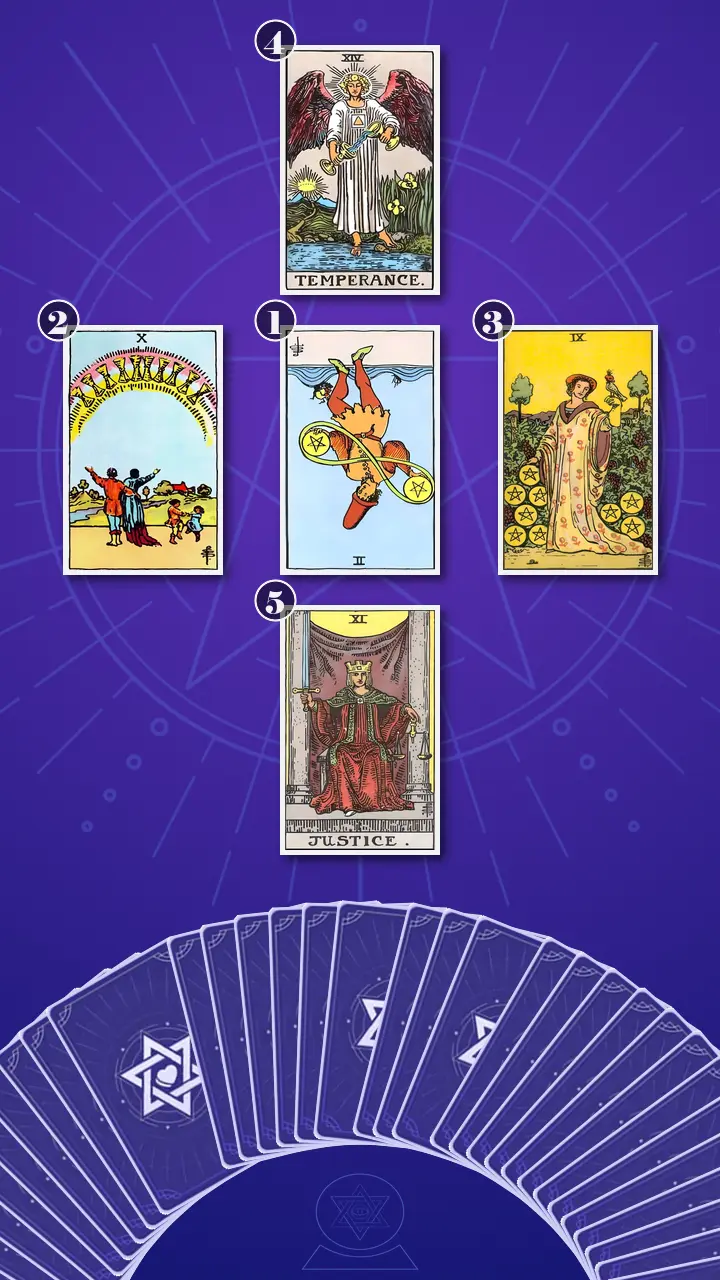
“For this,” I said, “I’m going to use a five-card layout called the Decision Cross.”
And for you reading along: this is why it works so well as a tarot spread for a lease renewal relationship decision. A cohabitation question under a deadline is a two-path choice that needs both emotional truth and practical structure. The Decision Cross separates Option A (move in) and Option B (stay separate) so you’re not mixing them into one anxious soup, and then it adds two crucial pieces: an integrating ‘bridge’ card (how to decide and talk about it well) and a grounding ‘anchor’ card (what makes the choice fair and sustainable once you do choose).
In other words, it’s designed for lease-renewal cohabitation anxiety: when you feel forced to choose between closeness and independence, and you spiral into research and hypotheticals instead of having a direct logistics-and-boundaries conversation.
“The first card,” I told Taylor, “will show what the deadline is activating in your day-to-day body and behavior. Then we’ll lay out both paths—what moving in is truly offering, what staying separate is truly protecting. The top card gives us the integrating process. The bottom card is the standard that keeps everything fair once the feelings settle.”
Reading the Map: Options, Autonomy, and the Real Stress Loop
Position 1: The Current Stress Pattern — Two of Pentacles (reversed)
“Now flipping over,” I said, “is the card that represents the current stress pattern: what the lease deadline is activating in your day-to-day behavior and nervous system.”
Two of Pentacles, reversed.
I didn’t need to dramatize it. The card did that on its own: a figure trying to juggle two coins while the sea behind them churns. Reversed, the juggling isn’t skillful anymore—it’s overload. Too many moving parts, too little stable ground.
“This is so specific it almost feels rude,” I told Taylor gently. “It’s 10:30 PM and you’re toggling between a rent calculator, condo listings, and a spreadsheet called ‘Cohabitation Costs v6.’ You keep adjusting tiny numbers like they’re going to answer the real question, while your stomach stays restless.”
I watched their eyes flick down, like they’d just been caught mid-tab-switch.
“The energy here is blockage through motion,” I continued. “Not laziness. Not lack of love. It’s your brain trying to hold both futures at once because it thinks that’s how you stay safe. But the sea never calms while you’re juggling.”
And because I’ve spent a lifetime watching how people repeat emotional scripts—my family calls it a form of listening, my work calls it Relationship Pattern Recognition—I named the loop without shaming it.
“It’s like having 27 browser tabs open and calling it ‘being responsible,’ when your brain is actually overheating,” I said. “The inner operating system goes: If I just research a little more, I’ll feel sure. If I feel sure, I won’t mess it up.” I paused. “But busy isn’t the same as clear.”
Taylor let out a small, bitter laugh—exactly the kind that says this is painfully accurate without wanting to admit it too quickly.
“Okay,” they said. “Yeah. That’s literally me. It’s… kind of brutal.”
“Brutal,” I agreed, “and also fixable.” I softened my voice. “Research feels safe. Agreements feel real. And the lease deadline is pushing you toward ‘real’ before your body feels ready.”
Their shoulders dropped a fraction, a tiny exhale escaping like a pressure valve finally allowed to work.
Position 2: Option A — Ten of Cups (upright)
“Now flipping over,” I said, “is the card that represents Option A: what moving in together is really offering emotionally and practically, beyond the headline idea.”
Ten of Cups, upright.
Even through a screen, the card’s feeling was unmistakable: a rainbow-arc of fulfillment, the pull of home-as-belonging. This is the part of the story where your heart makes a montage without asking permission.
“This is your highlight reel,” I told Taylor. “A modern happy-home montage. Sunday groceries at Loblaws. Shared keys on a hook. The kettle clicking on. A sleepy ‘morning’ from the other room. The soft status of ‘settled.’”
Taylor’s face changed—just slightly. The tension in their jaw eased. Their mouth pressed into a small smile that had sweetness in it, and a pinch of grief too, like wanting something and being scared that wanting it is naïve.
“That’s the picture in my head,” they admitted. “Especially after a good weekend.”
“Of course,” I said. “And it matters. The Ten of Cups is the emotional north star.”
Then I interrupted the montage with one grounded question, because this card can tempt you to let the vision replace the plan.
“What makes that scene actually work,” I asked, “who does what—and what stays yours?”
Taylor blinked, like they’d been pulled gently out of a movie and back into their own apartment.
Position 3: Option B — Nine of Pentacles (upright)
“Now flipping over,” I said, “is the card that represents Option B: what staying separate is protecting or enabling, and what it might cost emotionally.”
Nine of Pentacles, upright.
This card doesn’t apologize for solitude. It’s composed. It’s earned. It’s a walled garden with enough quiet to hear yourself think.
“Your apartment isn’t just a place,” I told Taylor. “It’s your reset button after a high-input hybrid week. You know exactly how you sleep best, where your things go, how quiet you need it to be to recover.”
I saw it in their body when I said the word quiet: their shoulders lowered again, a little more. Their breathing slowed. Their eyes softened as if they were imagining a door they could close.
“Staying separate,” I continued, “can be a resource—nervous-system stability, identity stability. Not a relationship failure.”
Taylor swallowed. “I feel relief hearing that,” they said, and then, immediately, “and also guilt. Like… if I need space, does that mean I’m not serious?”
“That guilt is a cultural script,” I said, “not a moral truth. Separate space can be stability. Separate space can also be avoidance. The card isn’t calling you avoidant. It’s asking you to tell the truth: is this your long-term preference, or a temporary structure that lets love grow without your nervous system paying for it?”
When Temperance Poured Between Two Cups
Position 4: The Integrating Guidance — Temperance (upright)
As I reached for the next card, the air in the room—yes, even through a screen—felt like it changed. Like a conversation that’s been circling finally deciding to land.
“Now flipping over,” I said, “is the card that represents the integrating guidance: what mindset and process will help you make a values-aligned decision and talk about it well.”
Temperance, upright.
Here’s the setup I’ve seen in a thousand modern living rooms, and Taylor was living it: it’s 9:43 PM, you’re on the couch with your laptop half-open, flipping between a rent-splitting spreadsheet and apartment photos—then you close everything and tell yourself you’ll ‘talk specifics’ later.
Stop treating this as a make-or-break leap and start mixing your needs like Temperance pouring between two cups—slowly, consciously, and with a plan you can adjust.
I let the sentence sit. No extra commentary. Just space—like you give a bell after it’s been rung.
Taylor’s reaction came in layers, not all at once.
First, a physiological freeze: their breath paused and their eyes widened, as if their brain had just received a new category of permission. Then the cognitive shift: their gaze drifted slightly off-camera, unfocused, like they were replaying the last month of tab-switching with a new caption over it. Then the emotional pushback—because clarity can sting before it soothes.
“But…” Taylor’s voice sharpened for a second. “But if it’s a plan I can adjust, doesn’t that mean it was never a real commitment? Like—aren’t we supposed to just… know?”
There it was: the recurring script I’d been hearing in their words all session. Move in = trapped.Stay separate = not serious. A false binary dressed up as adulthood.
“I’m glad you said that out loud,” I told them. “Because that’s the pattern running underneath your spreadsheets.” My Nature Empathy Technique has always been about cycles: you don’t demand spring from a tree in February. You build conditions—light, water, time—and you let growth happen in rhythm. “Adjustment isn’t a lack of commitment,” I said. “It’s commitment to reality.”
“Temperance is the third option,” I continued, keeping it simple. “Not ‘together’ or ‘independent.’ It’s: design. As a PM, you already understand this. You don’t ship your entire product roadmap in one release. You run a test. You version it. You check what’s true in real life.”
I saw Taylor’s shoulders drop again, but this time it came with something else: a tiny dizziness, like someone who’s been clenching for months and suddenly realizes they have muscles. Relief can feel strange at first.
“Let’s make it concrete,” I said, and I guided them through the exact kind of micro-structure that calms a chaotic nervous system.
“Set a 10-minute timer and draft a two-column note titled ‘Protected Closeness / Protected Space’,” I instructed. “Under each, write just three bullets. Stop when the timer ends—even if it’s messy. If your body spikes—tight shoulders, buzzy stomach—pause and do three slow exhales. The goal isn’t to solve it tonight. It’s to make your needs visible enough to talk about without turning it into a verdict.”
Taylor nodded slowly, like their body was agreeing before their brain fully caught up.
“Now,” I asked, “with this new lens—can you think of one moment last week when you were about to spiral into tabs and hypotheticals, and this would’ve helped you feel different?”
Taylor’s eyes watered, just a little. “Sunday,” they said quietly. “I was in bed, they were asleep beside me, and I was reading a thread like ‘how to split rent with your partner without resentment’ at one in the morning. I could’ve just… written what I needed. Instead I acted like the internet was going to decide for me.”
“That’s the shift,” I said. “From deadline-driven decision fatigue and self-worth panic to calm, values-led collaboration—through clear, revisable agreements.”
When Justice Held the Scales Still
Position 5: The Grounding Integration — Justice (upright)
“Now flipping over,” I said, “is the card that represents the grounding integration: the standard you can use to check fairness and sustainability once you choose a direction.”
Justice, upright.
Justice is the opposite of juggling. The scales are held still. The sword is upright. This card doesn’t ask you to feel certain—it asks you to be honest.
“This is where you stop hoping it will ‘work itself out’ and treat it like a shared contract of care,” I told Taylor. “Who pays what. How chores rotate. How alone time is protected. What happens if one of you feels overwhelmed. How you renegotiate without turning it into a breakup threat.”
My mind flashed, briefly, to the Highlands where I grew up—stone fences laid one careful rock at a time, not because anyone loved rules, but because boundaries keep the sheep safe through winter. I’ve learned the same thing in human love: structure isn’t cold. It’s shelter.
“Clarity isn’t cold—clarity is care,” I said. “It’s kindness to your future selves.”
Taylor’s face steadied. Their voice, when it came, sounded older in a good way. “I think I can do that,” they said. “Like… it actually makes it less scary.”
“Exactly,” I replied. “Justice doesn’t punish you for not being magically sure. It supports you by making the terms visible. Balance through structure, not motion.”
From Insight to Action: Your Living Agreement V1
I leaned back and looked at the whole cross as one story.
“Here’s what I see,” I said. “The lease countdown triggered the Two of Pentacles reversed—your overload loop. You cope by keeping both futures in the air through research and hypotheticals, which gives short-term relief but keeps you from building a shared plan. Ten of Cups shows the emotional magnet: you do want a home-feeling, a ‘we’ that’s calmer. Nine of Pentacles shows the equally real truth: your independence and routines aren’t selfish—they’re how you stay regulated and kind. Temperance says you don’t have to choose one and betray the other; you can blend deliberately. And Justice says the blend has to be made explicit, fair, and revisable, or the resentment will quietly start writing its own lease.”
“Your blind spot,” I told them, “is that you’ve been treating a ‘messy’ decision process as proof you can’t trust your judgment. But the cards are showing something else: you’re not failing. You’re avoiding vulnerability by hiding inside logistics.”
“The direction forward is not guaranteeing the ‘right’ relationship outcome,” I said, “but negotiating a clear, values-based living agreement you can realistically test and revise. Adult and self-respecting. Not risk-free—just defined.”
Then I gave Taylor what I always give when the energy is chaotic: small, doable next steps that don’t require a personality transplant.
- The 5-minute Tab-Close ResetTonight, close the laptop tabs, put your phone face down, and write the single most destabilizing unknown (money or chores or alone time or conflict repair). Then send one sentence: “Can we pick a time this week to talk about (that one unknown)?”If your shoulders spike or your stomach buzzes, do three slow exhales before you hit send. The win is one clear ask—not the perfect wording.
- The 45-minute Household Design SprintPut a calendar invite on the books for 45 minutes (yes, like work). Agenda: Money, Chores, Alone Time, Sleep/Quiet Hours. Before you meet, each of you writes 3 non-negotiables + 3 flexible preferences in a shared note. Show up with lists, not vibes.Start the conversation with 90 seconds of the couple breathing sync: inhale together for 4, exhale for 6, three rounds. It lowers the ‘this is a fight’ signal before you say a single word.
- Living Agreement V1 + 30/90-Day Check-In ClauseDraft a one-page “living agreement v1” with headings: Money, Chores, Alone Time, Guests, Quiet Hours, Conflict Repair, Renegotiation. Add: “We revisit this in 30 days and again at 90 days.” If you decide to move in, this becomes your shared terms; if you decide to stay separate, it becomes your ‘how we keep closeness and space’ plan.If it feels overly formal, anchor it to something warm: write it after a shared meal. Food softens the nervous system, and a table is a better place for Justice than a late-night bed-scroll.
As a final option—not a rule—I offered a nature-rhythm hack that fits my lineage without asking anyone to “trust the universe.” “If scheduling the talk feels hard,” I told Taylor, “choose a repeating rhythm. Some couples like a Sunday check-in; others prefer midweek. If moon cycles appeal to you, use them like a recurring reminder: new moon for ‘start the next version,’ full moon for ‘review what’s working.’ If not, ignore that and pick any predictable cadence. The point is consistency, not mystique.”

A Week Later: Quiet Proof in a Calendar Invite
Eight days later, Taylor messaged me. Not a novel. Just a screenshot.
A calendar invite titled: “Household Design Sprint (Money + Alone Time)”. Forty-five minutes. An agenda. A shared note link. Under it, two headings: Protected Closeness and Protected Space, each with three messy, honest bullets.
They added: “We didn’t decide everything. But we didn’t spiral. And I slept through the night for the first time in a while.”
Clear but not perfect—exactly what real transformation looks like. They hadn’t escaped uncertainty forever. They’d just stopped letting it run the relationship like an unchecked background app.
In the days that followed, Taylor told me they still had moments of fear—brushing their teeth, remembering the lease, feeling that familiar chest-tighten. But now they had terms. They had a process. They had proof that closeness and autonomy can sit at the same table.
When a lease deadline puts a countdown on your relationship, it can feel like every spreadsheet cell and every dirty dish is secretly a test of whether you’re wise enough to choose the “right” future—and that’s a brutal amount of self-worth to load onto one decision.
If you let this be a design conversation instead of a destiny verdict, what’s the one small rule or boundary that would make a shared life feel both closer and freer—this week, not forever?