From Hovering Over Send to Warm Self-Trust: The One-Edit Rule

Finding Clarity in the 11:26 p.m. Hinge Draft
If you’ve ever rewritten the same Hinge message for 30 minutes like it’s a client email—then decided “now it’s weird if I text,” this is for you.
Jordan showed up on my screen from a Queens walk-up with one lamp on behind her and that particular NYC-night soundtrack—radiator clicking, a siren smoothing out into distance. Her phone was warm in her palm like it had been there all evening. She angled it toward me for half a second, embarrassed, like she was showing a bad grade.
“I typed, ‘Hey, I had a really good time,’” she said. “Deleted it. Then I tried ‘lol same,’ deleted that too. I just want to send something normal, but nothing sounds normal once I’ve read it five times.”
I watched her thumb hover in midair, not even touching the screen now—muscle memory still doing the hovering. Her chest rose and didn’t fully fall. Her jaw looked like it was holding a secret.
Dating perfectionism has a very specific body. It’s like your throat becomes a narrow straw, your hands turn into restless little animals over the keyboard, and your chest tightens the way it does right before a train doors-close beep—like you’re about to miss something, but you’re also terrified to step in.
“So the question,” I reflected back, keeping it simple, “is: before you hit send to them… what is your dating perfectionism hiding?”
Jordan nodded fast. “Yeah. Because I’m not trying to play games. I’m trying to not be… cringe. Or needy. Or whatever.”
“We can work with that,” I told her. “Not by ‘fixing’ you, but by finding clarity—what’s actually happening in that last ten seconds before you send, and what your nervous system thinks it’s protecting you from.”

Choosing the Compass: The Celtic Cross for Dating Text Anxiety
I began the way I always do: not with drama, but with focus. I asked Jordan to put both feet on the floor, loosen her grip on the phone, and take one slower exhale than inhale—just enough to tell her body, we’re here, not in a courtroom.
“Today,” I said, “I’m going to use the Celtic Cross spread.”
For anyone reading along: the Celtic Cross is perfect for questions like this because it maps a chain. It doesn’t just tell you what you’re doing; it shows why you’re doing it—present behavior, the specific obstacle, the root fear under the behavior, your conscious desire, and the integration path. When you’re stuck in decision fatigue—especially at a dating crossroads where one tiny message feels huge—you want structure that can separate truth from noise.
I also told Jordan what to expect. “The center cards will show the freeze and what crosses it. A lower card will show what this pattern is protecting. And later, we’ll climb the right side—your stance, the environment of apps and comparison, what you hope and fear, and what integration looks like.”
In my family’s old language from the Highlands, we’d say: we’re not predicting weather. We’re learning the season you’re in, so you stop blaming yourself for the temperature.
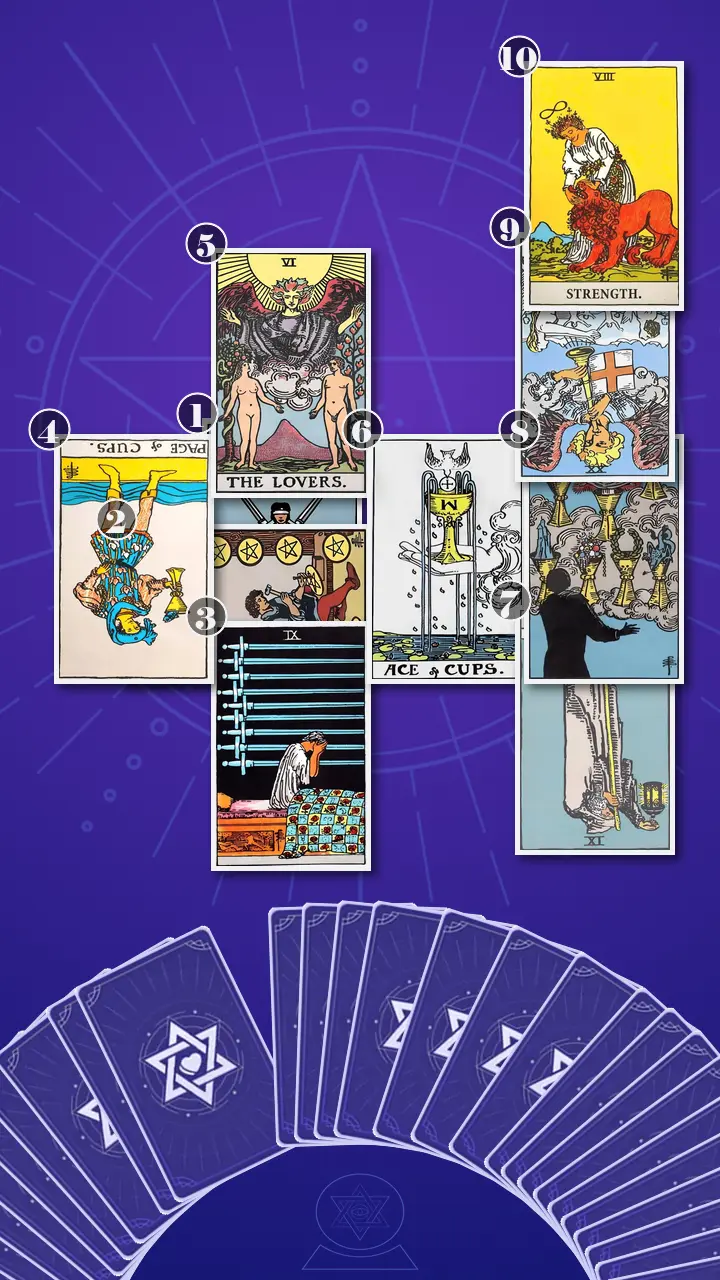
Reading the Map: Card Meanings in Context
Position 1: The exact “hovering over send” freeze — Two of Swords (upright)
I turned over the first card. “Now we’re looking at the card that represents the exact ‘hovering over send’ freeze: what is happening in your body and behavior right now.”
The Two of Swords, upright.
The image is a person blindfolded, arms crossed, holding two swords tight to their chest. Still water behind them. It’s such a clean freeze-frame.
“This,” I told Jordan, “is like when you reread a text until you can’t tell what it actually sounds like anymore—because you’re trying not to feel exposed.”
Energy-wise, this is blockage. Not because you don’t know what to say, but because part of you believes safety equals not choosing. If you don’t press send, you don’t have to feel the first ten seconds after sending—the little drop in your stomach, the open space of not knowing.
Jordan’s fingers tightened around her phone and then loosened. She stared at the card on her side of the screen like it had just described her browser history.
“It’s literally my body,” she said quietly. “Like… I lock up.”
Position 2: How perfectionism blocks movement — Eight of Pentacles (reversed)
I drew the next card. “Now we’re looking at the one that represents how perfectionism blocks movement—the pattern that turns communication into overwork.”
The Eight of Pentacles, reversed.
In the traditional image, someone is meticulously crafting—pentacle after pentacle—learning by doing. Reversed, the craft becomes a trap: effort without progress, revision without life.
“This is the part where your draft becomes a final deliverable,” I said, and I saw Jordan’s eyes flash with recognition. “Like your marketing brain kicks in—pixel-perfect, stakeholder-approved, five rounds of revisions.”
“Except the ‘stakeholder’ is someone you barely know,” I added. “And the more you polish, the less human it sounds.”
The energy here is excess—too much effort applied in the wrong place. Editing becomes a substitute for the real risk: letting someone receive you in real time.
Jordan let out a small laugh that had a sting in it. “That’s… yeah. That’s exactly what I do. It’s kind of brutal.”
“Brutal,” I agreed gently, “but not shameful. It makes sense. You’re trying to earn safety through control.”
Position 3: What the perfectionism is protecting you from feeling — Nine of Swords (upright)
I turned over the third card. “Now we’re looking at the card that represents what your perfectionism is protecting you from feeling—the deeper fear underneath the editing.”
The Nine of Swords, upright.
In the picture, someone sits up in bed, face in hands, swords lined up on the wall like accusations you can’t unsee. And immediately, the room around Jordan seemed to get quieter—like her night brain had walked in and sat down between us.
“This is 2 a.m. rumination,” I said, letting my sentences go short and sharp the way worry does.
“What if that emoji was cringe. What if I’m misreading everything. What if they’re laughing. What if I send it and they don’t reply, and I have to hold that feeling in my body.”
The energy here is overload—Air running too fast, turning one message into a whole trial in your head. And the sensory details matter: dim phone glow, buzzing silence, jaw clenched so hard you wake up with a headache.
Jordan exhaled in a long line, like she’d been holding her breath for weeks. She didn’t nod. She just went still—eyes unfocusing for a second, as if replaying a thread from months ago.
“I do that,” she whispered. “I replay everything. Like I’m… searching for the mistake.”
Position 4: Recent emotional learning — Page of Cups (reversed)
I moved to the next card. “Now we’re looking at the recent emotional learning that trained you to self-edit in dating conversations.”
The Page of Cups, reversed.
This is the tender part of you—the one who wants to say something sweet—getting flipped upside down by self-consciousness.
“This,” I said, “is when you type something warm and sincere… and then delete it and replace it with something flatter that you don’t even like. Because warmth feels like exposure.”
The energy here is deficiency: not a lack of feeling, but a lack of permission to show it.
Jordan’s mouth pulled to one side. “I almost sent ‘I’d love to see you again’ last week,” she admitted. “Then I changed it to ‘Yeah that was fun.’ And I was mad at myself immediately.”
“That’s the Page reversed,” I said. “You can be warm without making it a promise.”
Position 5: The real desire beneath the overthinking — The Lovers (upright)
I turned the fifth card. “Now we’re looking at what you’re truly trying to create beneath the overthinking.”
The Lovers, upright.
People often reduce this card to romance, but in readings like this, I watch for its deeper spine: values-based choice. Mutuality. Saying something that sounds like you, not like a performance designed to manage someone’s reaction.
“This is important,” I told Jordan. “Your goal isn’t a perfect line. Your goal is alignment—texting in a way that matches your values.”
I asked her, “When you look at your draft, does it sound like you—or like you trying to become unjudgeable?”
Jordan blinked, as if that question had finally named the real opponent.
Position 6: Supportive next-step energy — Ace of Cups (upright)
I drew the sixth card. “Now we’re looking at the most supportive next-step energy available if you loosen control and act with warmth.”
The Ace of Cups, upright.
This is the release valve. The overflow. The moment you stop sculpting ice and just pour water.
“I want you to picture this,” I said, and my own Nature Empathy Technique kicked in—because water always teaches faster than lecture. “A cup doesn’t become meaningful because it’s decorated perfectly. It becomes meaningful because it holds something real.”
Energy-wise, this is balance: simple warmth and emotional clarity over cleverness. A short message that’s kind and clear. Not a thesis statement. A doorway.
Jordan’s shoulders lowered a fraction. Her face softened in a way that said, I could actually do that.
Position 7: Your inner stance — The Hermit (reversed)
I turned over the seventh card. “Now we’re looking at your current inner stance and self-image while dating—how you relate to vulnerability.”
The Hermit, reversed.
Reversed Hermit is when reflection turns into isolation. When you treat dating like a solo puzzle you can solve in your Notes app if you just think hard enough.
“This is ‘living in drafts,’” I said. “The lantern is turned inward so long you forget it’s meant to light a path through the world, not keep you in a cave.”
The energy here is blockage again—wisdom stuck in private rehearsal. And I felt an old memory flicker in me: a Highland winter where you can survive by staying indoors, yes—but you can also lose your sense of time. In cities, the cave is often your phone at midnight.
Jordan nodded, slow and resigned. “I try to figure out the whole relationship trajectory before I send one sentence.”
Position 8: The modern dating context — Seven of Cups (upright)
I turned the eighth card. “Now we’re looking at the environment—apps, comparison, social media noise—that amplifies the pattern.”
The Seven of Cups, upright.
Too many imagined outcomes. Too many projections. The way one unsent text balloons into five parallel universes: the rooftop date pic universe, the soft-launch universe, the ‘they’re already talking to someone cooler’ universe.
“This is the Instagram Stories spiral,” I said. “It’s also Hinge culture—pressure to be effortlessly witty, like you’re A/B testing your personality in real time.”
Energy-wise, this is excess—choice overload. Not more options in the app necessarily, but more options in your head. Twelve tabs open, all running at once.
Jordan’s thumb reflexively tapped her screen off, like she’d just closed a tab.
Position 9 (Key): The hidden verdict layer — Judgement (reversed)
I paused before turning the ninth card. The way I do when I can feel the room ready to tell the truth.
“This,” I said, “is our key position: what you hope will happen, what you fear it would mean if it doesn’t.”
When I flipped it over, even through the distance of a video call, I felt Jordan’s attention snap into place.
Judgement, reversed.
In the upright card, there’s a trumpet call—an awakening, an invitation to rise. Reversed, that trumpet becomes something else: the fear of being evaluated. And the bigger fear—your own inner verdict.
I’ve spent decades watching relational patterns repeat like seasons. My signature skill is Relationship Pattern Recognition: naming the emotional script that keeps running even when you change the cast. And Jordan’s script was suddenly unmistakable:
Bid → Panic → Polish → Pre-Judge → Withdraw.
“Here’s the courtroom,” I told her, using the metaphor the card was begging for. “Your draft becomes evidence. Their reply becomes the ruling. And you become both defendant and judge.”
Her breathing got shallow. She held still—like she didn’t want to move and accidentally admit it was true.
Setup: She was back on that couch at 11:26 PM, rereading three lines like they were a performance review. Thumb hovering over “Send,” chest tightening, tone-checking again—because a slow reply wouldn’t just feel awkward. It would feel like a score.
Delivery:
Stop treating your text like a verdict; let it be a trumpet call toward honesty, even if your voice shakes.
I let the sentence sit between us for a beat, the way you let thunder finish echoing before you speak again.
Reinforcement: Jordan’s reaction came in layers, not all at once. First, her body froze—breath caught high, fingers hovering above the phone like she’d been interrupted mid-compulsion. Then the idea seeped in: her eyes drifted off-screen, unfocused, as if she’d just remembered every time she’d watched “active now” and decided it meant something about her worth. Finally, the release: her shoulders dropped, her jaw unclenched, and she let out a shaky half-laugh that turned into a softer exhale.
“But if I send something imperfect,” she said, and there was a flash of anger in it—protective, young, honest—“doesn’t that mean I’ve been doing it wrong this whole time?”
“No,” I said, steady. “It means you’ve been trying to stay safe with the tools you had. Judgement reversed isn’t here to shame you. It’s here to stop the sentencing.”
I guided her through a tiny reset—my modern version of an old Highland practice: not magic, just nervous system care. “One hand on your chest. Exhale longer than you inhale three times. Then type one private line above your draft: ‘This is a bid for connection, not a verdict on me.’ Make exactly one edit for clarity. Then either send… or close the app on purpose. Pausing on purpose is different than spiraling.”
Then I asked, “Now, with this new lens—can you think of a moment from last week when you treated a reply like a ruling? Where this could have made you feel different?”
Jordan swallowed. “Sunday. I saw couples on Stories, and my draft suddenly felt like proof I’m failing at dating. I wasn’t even thinking about him. I was thinking about… me.”
“That’s the shift,” I said. “From outsourced worth to self-kindness while you wait.”
And I named it plainly, so her mind could stop spinning: this is the movement from tense hyper-control toward steadier self-trust and warmth—data replacing guessing, presence replacing performance.
Position 10: Integration pathway — Strength (upright)
I turned the final card. “Now we’re looking at the integration pathway—what this becomes when you practice self-trust and send anyway.”
Strength, upright.
Strength isn’t hype. It’s not “be confident.” It’s the calm hand on the lion—the part of you that can feel your own fear and not punish yourself for having it.
The energy here is balance: gentle courage. The ability to act while your voice shakes—and stay on your own side afterward.
“This card is you,” I told Jordan, “not forcing yourself to be chill, but being gentle with your nerves while still moving.”
“So I don’t have to be… flawless,” she said.
“No,” I said. “You have to be present.”
The One-Page ‘Bid, Not Verdict’ Plan: Actionable Advice for Your Next 48 Hours
I gathered the whole spread into a single story, the way I’d describe weather to someone who only has an umbrella and ten minutes to leave the house.
Here’s what I saw: the Two of Swords shows the freeze—your body protecting your heart by stalling. The Eight of Pentacles reversed shows the method—perfectionism dressed up as productivity, turning one text into a deliverable. The Nine of Swords reveals the engine underneath—night-brain rehearsal and self-critique. The Page of Cups reversed shows what gets edited out: your warmth. The Lovers reminds you of the real goal: mutual, values-based connection. The Ace of Cups offers the corrective: one simple, sincere line. And Judgement reversed exposes the deepest layer—your inner courtroom—until Strength turns it into a practice of gentle bravery.
Your cognitive blind spot is this: you’ve been treating “perfect wording” as if it can control the outcome. But the outcome is not controlled by punctuation. Perfectionism is trying to protect you from the feeling of being evaluated—especially by you.
The transformation direction is just as practical as it is emotional: shift from “write the perfect message” to “send one clear, kind message after one edit, then let real interaction provide the feedback.”
Here are your next steps—small, concrete, and designed for real NYC life (work brain, late-night spirals, all of it):
- The One-Edit Rule (3-minute send experiment)Tonight or this week, write the message once, revise it exactly once for clarity (not tone-polishing), and hit send within 3 minutes. Keep it to 1–3 sentences max—“kind + understandable” is your definition of good enough.Expect your brain to yell “cringe” like an alarm. Treat it as a normal noise, not a command. One edit for clarity. Zero edits for approval.
- The “Bid, Not Verdict” Note (90-second reset)Before you send, add one private line above the draft: “This is a bid for connection, not a verdict on me.” Then make one clarity edit and either send—or close the app on purpose (no doom-hovering).If your throat tightens or hands shake, pause and do three slow exhales. Pausing on purpose is different than spiraling.
- The No-Analysis Window (30 minutes)After sending, put the phone face-down and do something physical for 30 minutes (shower, dishes, quick block walk). No rereading the thread. No decoding punctuation. Let your body discharge the adrenaline first.If you catch yourself about to screenshot for a group-chat “tone committee,” send the version you were about to screenshot—then text your friend the outcome instead.
And because my work is relational—not just individual optimization—I offered one more option from my own toolkit, adapted for modern dating without forcing anything.
“If this turns into an actual conversation,” I told Jordan, “I have a simple breathing sync practice I teach couples. You don’t need to be a couple to use it. Before a vulnerable text, do three breaths where your exhale is longer than your inhale. Later, if you’re sitting across from someone over dumplings or tacos, you can take one subtle shared breath before an important topic. It’s not cheesy—it’s regulation. It turns arguments into growth opportunities because you’re not fighting from a clenched body.”
Jordan smiled, small but real. “That feels… doable. Like I’m not trying to become a different person overnight.”

A Week Later: The Quiet Proof
A week later, Jordan DM’d me a screenshot—not of a draft, but of a sent message. One edit. No apology paragraphs. No over-explaining.
“I wrote: ‘I’d like to see you again—are you free this week?’” she said. “My heart was racing. I did the hand-on-chest thing. I sent it. Then I literally went downstairs and walked to the bodega before I let myself look at my phone.”
She added something that mattered more than the outcome: “Even while I was waiting, I didn’t sentence myself. I kept thinking: don’t outsource your worth to a notification.”
That’s what a real Journey to Clarity looks like in practice. Not a perfect ending. A softer nervous system. A cleaner boundary. A message that’s a bridge instead of a performance review.
When a three-line text makes your chest tighten, it’s usually not because you don’t know what to say—it’s because you’re trying to want connection without risking the possibility that someone won’t choose you back.
If you stopped treating your next message like a score, what’s the smallest honest line you’d be willing to send—just to let reality answer instead of your imagination?