From Two-Tab Dating Anxiety to a Calm-Enough Choice: One Weekend
The 8:47 p.m. TTC Two-Tab Spiral
You’re a late-20s city professional who can ship a design system at work—but two dates in one weekend has you stuck in dating choice paralysis, rereading texts like they’re user research.
Jordan said that to me with a half-laugh that didn’t quite land as humor.
They were 29, a UX designer in Toronto, and when they showed up for our session (camera on, hoodie on, hair still damp from a rushed post-commute shower), the story spilled out in the same rhythm as the TTC: stop, lurch, stop again.
“It’s literally just two dates,” they said. “But it feels like Google Calendar Tetris with my entire future. I keep thinking, if I choose Friday, what if Saturday was the better story?”
I could picture it because they described it with the precision of someone used to looking for patterns: 8:47 p.m. on Line 1 heading south, wedged between winter coats and tote bags. The car rattling. The overhead lights buzzing. Their phone warm in their palm from switching between two Hinge threads—two browser tabs with autoplay sound—while their thumb hovered over confirm.
“I draft replies in Notes,” Jordan admitted, eyes flicking down like they could still see the timestamps there. “Copy it over. Delete it. Check ‘last active.’ Then I open Instagram Stories for context like that’s… ethical research.”
When they tried to commit to one plan, their body didn’t feel uncertain so much as physically intercepted—restless energy in their legs, a tight flutter in their stomach, like they were about to submit a final exam they hadn’t studied for. The anxiety wasn’t a thought; it was a tremor living in their limbs.
“I’m not trying to be flaky,” they said quickly, like preemptive damage control. “I’m trying to be thoughtful.”
I nodded, letting the pace slow. “Thoughtful makes sense. But I also hear the cost—this isn’t just a scheduling question anymore. It’s turning into a referendum on your judgment.”
Jordan exhaled through their nose. It was the kind of exhale you do when your shoulders have been braced so long you forgot they were doing it.
“Let’s make this smaller,” I said. “Not smaller as in ‘it doesn’t matter,’ but smaller as in: we’re going to map the decision clearly enough that you can move without betraying yourself. A Journey to Clarity, not a trial.”

Choosing the Compass: The Decision Cross Spread for Two Dates
I’m Hilary Cromwell. I’ve spent most of my life in archives and excavation trenches—places where people desperately want certainty, and the only honest answer is usually, not yet. Tarot, when it’s done well, works the same way: it doesn’t promise a guaranteed outcome; it organizes what’s true now so your next move is clean.
I asked Jordan to take one slow breath, then another. “Not as a ritual,” I clarified, “just as a handoff—from the part of you that’s scanning for danger to the part that can actually choose.” While they breathed, I shuffled and asked them to hold one question steady: Two dates, same weekend—how do I choose who to pursue?
“We’ll use a simple layout called the Decision Cross,” I told them, and—because Jordan’s mind liked frameworks—I told them why. “It’s built for a clean compare-and-choose situation. It centers the real reason you’re stuck, lets each option speak as an energy rather than a prediction, then checks your inner compass and lands on a practical next step. It’s a spread for ethical decision-making, not fortune-telling.”
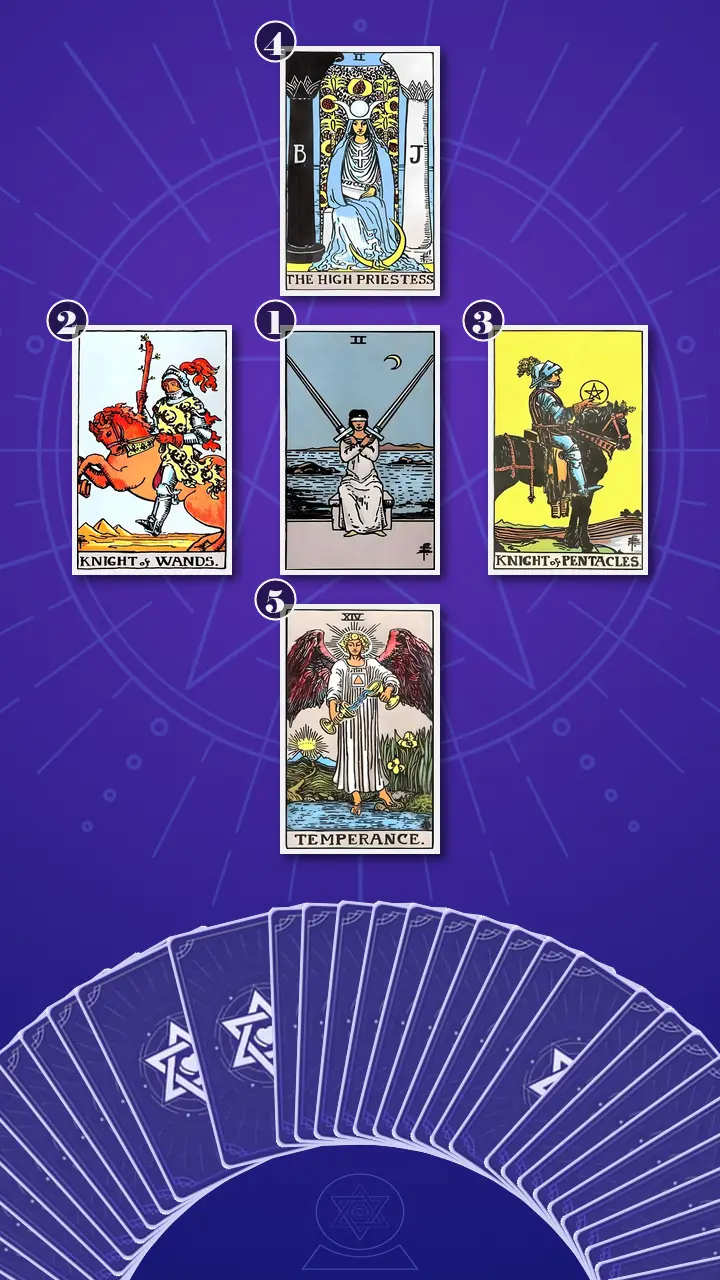
I angled the camera slightly so Jordan could see the cross on my table: one card in the center, two to either side, one above, one below.
“Position 1,” I said, “shows how the stuckness is actually operating—on your phone screen, in your calendar, in your body.”
“Positions 2 and 3 let each date talk: Option A’s energy versus Option B’s energy.”
“Position 4 is the one most people skip in modern dating: what you value beneath chemistry and optics.”
“And Position 5 is the landing: the best next step—how to choose and communicate in a way that keeps your integrity intact.”
Reading the Map: Two Swords, Two Speeds
Position 1: The Freeze Point on Your Phone Screen
“Now we turn over the card that represents your current stuck point and the concrete way indecision is showing up in your dating behavior.”
Two of Swords, upright.
“This is the archetype of protective neutrality,” I said. “It’s not that you don’t care. It’s that staying undecided feels safer than risking regret.”
I pointed to the blindfold and the crossed swords over the chest. “In modern terms, this is you on a weeknight ride home in Toronto keeping both message threads open like two tabs you can’t close—drafting replies in Notes, checking timestamps, rereading earlier jokes for clues—without confirming a plan. The vibe isn’t apathy. It’s self-protection.”
“Energetically,” I added, “this is blockage. Air energy—thinking—has overfilled the room. The result is a stalemate: your mind keeps you ‘safe’ by refusing to choose.”
Jordan gave a small, bitter laugh. “Okay, wow. That’s… brutal. Accurate. But brutal.”
I let that sit without rushing to soften it. “It can feel harsh because it’s clean. And here’s the line I want you to hear without shame: You’re not indecisive—you’re trying to optimize your self-worth.”
I described the scene the card was already describing for us—tight and cinematic: 11:26 p.m. in a Toronto condo bedroom, streetlight spill cutting a thin orange stripe across the duvet, one AirPod in, switching between threads, then jumping to Instagram “for context,” then back to Notes. Inner monologue like a looped audio track: If I choose, I’m exposed. If I don’t choose, I feel smart.
Jordan’s reaction came in a three-part chain. First, a brief freeze—eyes held still, breath caught high in their chest. Then the recognition seeped in—their gaze went slightly unfocused, like they were re-watching their own week on fast-forward. Finally, the release: a long exhale, shoulders dropping a fraction.
“So,” I asked gently, “what’s the exact moment you freeze—when it’s time to confirm a day and time, when someone asks a direct question, or when you imagine regretting it later?”
Position 2: Option A’s Energy—Spark and Momentum
“Now we turn over the card that represents Option A’s energy: what pursuing this person invites you to experience and learn right now.”
Knight of Wands, upright.
“This is forward motion,” I said. “It’s chemistry, momentum, the thrill of pursuit. Option A feels like a last-minute concert ticket—fast, exciting, and you learn by showing up, not by predicting.”
I leaned into the modern-life translation. “You can picture it: new bar, spontaneous plan, a vibe that makes you feel bold and alive. And then—immediately—the critic voice: Don’t fumble it. Don’t be reckless.”
“Energetically, this is Fire in a healthy state,” I said, “but it can tip into excess if you use intensity as relief from overthinking. Sometimes spark feels good because it temporarily drags you out of your head—like an app that shuts down background noise by blasting music.”
Jordan swallowed, then nodded once. “I hate that I know what you mean.”
“Notice your body when you imagine confirming this,” I said. “Does it feel like your shoulders drop—or like your fingers want to refresh the chat for reassurance?”
Position 3: Option B’s Energy—Steady and Structured
“Now we turn over the card that represents Option B’s energy: what pursuing this person invites you to experience and learn right now.”
Knight of Pentacles, upright.
“This is the builder,” I said. “Consistency. Follow-through. Practical alignment. Option B feels like meal-prepping: not flashy, but it’s how trust gets built quietly.”
I connected it to Jordan’s lived pattern. “In real life it looks like: they confirm a time, they’re consistent, the plan is calm—coffee, a walk, a reservation made in advance. You can imagine feeling respected.”
“And then,” I added, “a different voice appears: Don’t settle. Don’t choose boring. Don’t choose ‘safe’ because you’re tired.”
“Energetically, this is Earth,” I said. “Often it’s balance—grounding. But if you’ve trained yourself to equate ‘meaningful’ with ‘electric,’ steadiness can get misread as a deficiency of romance.”
Jordan’s mouth tightened, then relaxed. “That’s the exact fear. If I pick the steady plan, am I just… choosing a less exciting story?”
“That’s a crucial sentence,” I said. “Because it tells me the real decision isn’t ‘who is better.’ It’s what pace your nervous system can handle without turning dating into a performance review.”
Position 4: The Inner Compass Beneath the Group Chat
“Now we turn over the card that represents your deeper need—your values-based compass beneath chemistry, optics, and friends’ opinions.”
The High Priestess, upright.
The room felt quieter as soon as she appeared—maybe because I’ve seen this card interrupt spirals like a hand on the shoulder. “Clarity doesn’t come from more tabs open,” I said, and Jordan’s eyes flicked up like that sentence had grabbed their hoodie drawstring.
“This card is the boundary between public performance and private knowing,” I explained. “It’s the moment you step out of the loud group chat and into a quiet hallway. No new information. Just the first moment you can actually hear yourself.”
I watched Jordan unconsciously mirror the image: they took one AirPod out, even though they weren’t wearing any, as if their body understood the assignment.
“In modern terms,” I continued, “this is you putting the phone face down for five minutes and noticing which plan makes your body soften—even slightly. It’s not dramatic. It’s a small exhale.”
Jordan looked down and admitted, “If no one could judge me—not my friends, not Instagram, not… future me—I think I know who I’m more curious to meet. But that feels too simple. Like I’m cheating.”
“That’s the part of you that wants a dashboard,” I said. “You’re used to work decisions with metrics. Dating doesn’t give you that. It gives you something older and messier: discernment.”
And because my first career was archaeology, the analogy arrived naturally. “On a dig, you don’t get to declare the whole civilization from one pottery shard,” I told them. “You record what you have, you choose a trench, and you excavate carefully. A date is data, not a verdict.”
When Temperance Poured Between Two Cups
Position 5: The Grounded Next Step—Balance, Integrity, and Pace
I let my fingers rest on the final card for a beat. “This is the one we land on,” I said. “The best next step for self-respecting action—how to choose and communicate in a way that keeps you grounded.”
Temperance, upright.
The image is famously calm: water moving between two cups, an angel with one foot on land and one in water, a path leading toward a bright horizon. It’s not a dramatic card. It’s a competent one.
Jordan’s face tightened before I even spoke, like their body was bracing for the part where they had to actually pick.
In my mind, I saw the setup like a field note I’d written a hundred times: You’re on the TTC home with two chat threads open, thumb hovering over “confirm,” stomach doing that tight flutter like you’re about to submit a final exam you didn’t study for. They were stuck inside the belief that the right choice should be defensible now, from partial data.
Stop treating this weekend like a verdict and start blending spark with steadiness, like Temperance pouring between two cups until your decision feels calm enough to live in.
I paused after saying it, the way I used to pause in lectures when I wanted a room full of clever people to actually feel a point land, not just understand it.
Jordan’s reaction wasn’t immediate relief. It was messier—and more real. First, a flash of resistance: their eyebrows pulled together, jaw set. Then a little anger leaked through. “But if it’s that… then what have I been doing?” they asked. “Like—does this mean I’ve been wrong? That I’m bad at this?”
I kept my voice steady. “No. It means you’ve been trying to protect something tender with a strategy that only works in spreadsheets.”
The tension shifted. Their shoulders stayed high for a second longer, then dropped in a slow surrender. Their eyes got wet in that annoying, surprised way—like the body deciding to be honest before the mind approves it. They took a breath that sounded like a small door unlocking.
“Temperance isn’t telling you to pick ‘the perfect person,’” I said. “It’s telling you to pick the plan you can actually show up for—then behave with integrity. That’s how you stop feeding FOMO without going numb.”
This is where my signature lens—what I call Emotional Historiography—does its best work. “When we look at relationships through time,” I told Jordan, “we stop demanding that a single moment prove everything. Ancient commitments weren’t built on one ‘correct’ choice; they evolved. A first meeting is not a covenant. It’s a first entry in the record.”
Jordan blinked, as if the idea of dating as a timeline—rather than a final exam—was a new muscle.
“Now,” I said, “use this new lens and look back at last week. Was there a moment when you felt that fluttery panic, and this could have helped you feel different?”
They stared off to the side, replaying. “Yeah,” they said quietly. “In the PATH on Friday. Both chats lit up and I stopped walking. I wasn’t choosing between people. I was choosing between… stories.”
“Exactly,” I said. “Temperance brings you back to lived reality: one evening. One plan. One honest experiment.”
The One-Plan Integrity Rule
I drew the story together the way I’d piece together a site report: not romantic, not cynical—just coherent.
“Here’s the arc,” I told Jordan. “The Two of Swords shows you freezing because neutrality feels like safety. The two Knights show the real tug-of-war: Fire’s spark versus Earth’s steadiness. The High Priestess says the answer won’t come from more scrolling or more friend polls—it comes from your inner signal beneath the noise. And Temperance says: integrate. Don’t swing between extremes. Make a balanced choice you can live in, and communicate cleanly.”
“Your cognitive blind spot,” I continued, “is the belief that there’s a correct choice you should be able to figure out right now—and that if you can’t, it proves something unflattering about you. That’s why confirming a 7 p.m. drink feels like choosing your entire future timeline.”
“The transformation direction is simpler than your brain wants,” I said. “Shift from optimizing for the best outcome to choosing one date based on your values and present curiosity—then gather real information through lived experience.”
Jordan frowned. “But what if I can’t even do the ‘quiet check-in’ thing? My friends are already polling the group chat, and my phone is basically a vibrating brick.”
“Good,” I said, not unkindly. “That’s an honest constraint. Temperance loves constraints. We’ll scale it down. This is not a personality overhaul. It’s a small behavioral pivot.”
Then I offered concrete next steps, using one of my own practical frameworks—Pictogram Dialogue—which is my way of keeping communication simple when emotion makes language slippery. “In conflict—or in dating ambiguity—people drown in paragraphs. Pictogram Dialogue is: one clear signal per line. Like a museum label. Short, true, readable.”
- Do the 2-minute capacity checkTonight, open your calendar and ask: “With my actual energy—sleep, work stress, social battery—what plan can I fully be present for?” Choose based on capacity, not the ‘best story.’If your brain argues, answer it once: “I’m choosing one evening, not a future.” Then stop negotiating.
- Confirm one plan with clean logisticsSend one text with day/time/place. No “maybe.” No hedging. Example: “Friday 7:30 at Bar X works for me—see you then.”Before you hit send, take three slow breaths and unclench your jaw. If your body calms even slightly, treat that as valid data.
- Send the clean, kind rain-check within the same dayTo the other person, send a brief message: appreciation + clarity + (optional) alternate. Example: “Hey—this weekend filled up faster than I expected. I’m going to keep it to one plan, but I’d like to meet. Are you free next week?”If guilt spikes, shorten your message rather than over-explaining. Integrity is a strategy—especially in dating.
“That’s Temperance in modern clothing,” I said. “One plan you can show up for. One honest message. Two cups turned from a standoff into a pour.”
And because Jordan’s mind loved a sentence it could hold onto when the spiral returned, I gave them one to save in Notes: “I’m choosing the plan that feels calm enough to live in.”

A Week Later: Ownership, Not Certainty
A week later, Jordan messaged me on a Tuesday afternoon—no preamble, just the kind of update that tells you someone actually used the advice.
“I did it,” they wrote. “Confirmed one plan. Sent the other person a clean rain-check. I didn’t over-apologize. I hated it for five minutes. Then I felt… quiet.”
They told me they went to a coffee shop near Ossington afterward, sat alone by the fogged window, and watched people come and go while their phone stayed face down. It wasn’t fireworks. It was something better for their nervous system: a small, steady proof that choosing didn’t destroy them.
“The date was fine,” they added. “Not a soulmate thing. Just… real. I asked direct questions. I didn’t treat it like a final exam.”
That, to me, is what finding clarity often looks like in the beginning: not certainty, but ownership. The shift from FOMO-driven dating choice paralysis and anxious text-analysis to calm, values-based decision-making with integrity and present-moment self-trust—one small, honest move at a time.
And if you’re reading this with your own two tabs open—two chats, two options, two competing weekend storylines—hold onto this: when you try to pick the “right” person from partial data, your stomach knots not because you’re indecisive, but because you’re treating one weekend plan like proof you either have good judgment or you don’t.
If you let this be just one honest experiment—one evening, not a verdict—what would a “calm enough to show up” choice look like for you this weekend?