From Post-Button Self-Doubt to Steadier Self-Trust: A Creator Shift

The 10:56 p.m. Hover, or: Visibility Anxiety in One Thumb
If you can write a great post… until your thumb hovers over “Post” and your chest does that tight little spike of imposter syndrome.
Taylor said that to me on a Tuesday night from her Toronto condo, laptop balanced on a throw pillow like it was both comfort and evidence. The room looked colder under the blue light. The fridge hum had the audacity to sound loud. Her phone screen was warm in her palm from being held too long, and she kept toggling between her draft and someone else’s perfectly formatted carousel—like her brain needed fresh proof she was behind.
“I’ll polish it,” she said, eyes flicking to the top-right corner where the “Post” button waited. “Then I reread it so many times it stops sounding like English. And right before I share… my hands get buzzy. Like I’m about to send a risky text. I just don’t want to sound stupid.”
I watched her swallow. Not dramatic, but the kind you do when your body is bracing for impact. Wanting to share your work publicly vs fearing you’ll be exposed as not good enough—there it was, in the smallest movement of her throat.
To me, that kind of self-doubt looks less like a thought and more like a weather system: a pressure drop in the chest, a sharp gust in the hands. Taylor’s felt like trying to breathe through a scarf that’s been pulled just a bit too tight—air still there, but suddenly hard-earned.
“You’re not ‘bad at posting’—you’re stuck in a safety strategy,” I told her. “And safety strategies are clever. They just aren’t always kind. Let’s make this moment less like a verdict and more like a map. We’re not here to force confidence. We’re here to find clarity.”

Choosing the Compass: The Celtic Cross Spread (How Tarot Works Without the Hype)
I asked Taylor to take one slow breath and feel her feet through the floor—nothing mystical, just a clean transition from spinning to noticing. While she held the question in mind, I shuffled the deck the way I’ve always done: steady, like sorting seeds before planting. My family in the Highlands used to say you can’t read the river if you keep throwing stones into it.
“Today,” I said, “we’ll use a Celtic Cross.”
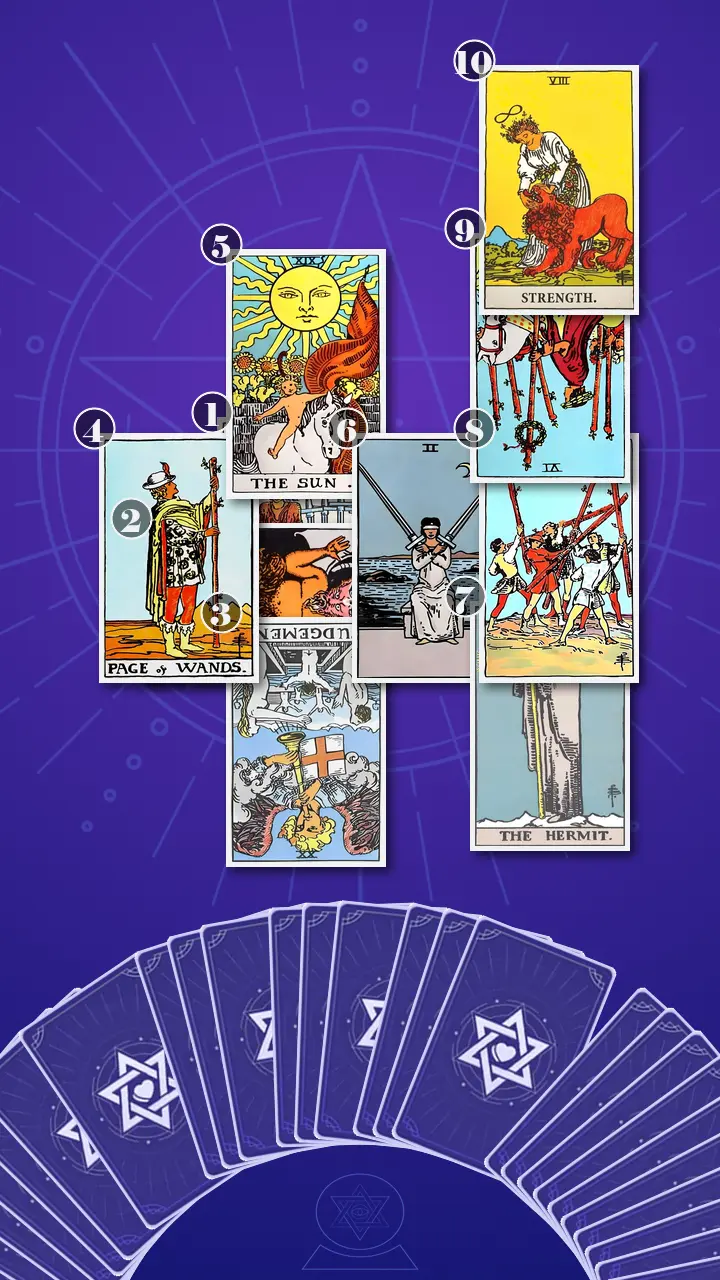
For readers who are curious about how tarot works in a practical way: I like the Celtic Cross for moments like this because imposter syndrome around visibility is rarely a simple yes/no. It’s a loop—create → approach visibility → freeze → retreat—that keeps reinforcing itself. This spread lets me track the chain from the very specific symptom (that split-second at the button) down to the deeper belief underneath it, and then back up to a grounded next step. No fortune-telling. Just pattern, pressure points, and options.
I told Taylor what to expect: “The first card will show the micro-moment right at ‘Post.’ The crossing card will show the main friction—what your nervous system thinks the danger is. Then we’ll look at the root belief under it all, and later we’ll climb toward your hopes, fears, and the most empowering integration outcome.”
Walking the Staircase: Card Meanings in Context
Position 1 — The immediate “Post button” moment: what’s happening right before visibility
“Now flipping over is the card that represents the immediate ‘Post button’ moment—what’s happening in your body and mind right before visibility,” I said.
Eight of Swords, upright.
“This is you inches from publishing—draft formatted, caption ‘almost done’—and then your brain spins up a worst-case comment section. It feels like there are only two options: post and get exposed, or don’t post and stay safe. Meanwhile your body is screaming—tight chest, buzzy hands—even though nothing has happened yet.”
I tapped the image lightly with my finger. “In this card, the bindings look firm, but they’re loose. That’s the tell. This isn’t a real block. It’s a felt one.”
Energetically, this is blockage—Air energy overworking itself until choice feels impossible. A browser tab that keeps throwing “Are you sure you want to submit?” pop-ups… even though you’re the one clicking them.
Taylor let out a laugh—quick, bitter, almost impressed. “That’s… brutal. Like, accurate, but brutal.” Her shoulders lifted a fraction, then dropped like she’d finally admitted the weight was there.
Position 2 — The main block: what makes posting feel risky or impossible
“Now flipping over is the card that represents the main block or friction—what makes posting feel risky,” I said.
The Devil, upright.
“This is the part where the post stops being ‘sharing’ and becomes a negotiation with validation. You keep tweaking to try to guarantee approval. You call it being strategic, but it’s really the feeling that attention equals safety—so you chase certainty you can’t get.”
I said it plainly, because this card likes honesty. “It’s Black Mirror: Nosedive energy—ratings-as-worth. Metrics as a leash.”
And as I spoke, I let the scene land where it lives in her body: a Monday morning on the TTC Line 1, finger tapping Insights like it’s a vital sign. The smell of wet coats and coffee. The overhead lights flickering. “You haven’t even posted anything new, but you’re bargaining with an imaginary audience: If I can predict the reaction, I can avoid embarrassment. That’s The Devil.”
Energetically, this is excess—too much attachment to external response, too much meaning poured into numbers. Feedback becomes verdict in a single breath.
Taylor didn’t nod right away. She went still first—breath held, eyes fixed on the card—then her gaze slid off to the side like she was replaying a memory, and finally she exhaled through her nose. “Yeah,” she said softly. “I do treat likes like proof I’m safe.”
Position 3 — The psychological root: the deeper belief fueling imposter syndrome
“Now flipping over is the card that represents the psychological root—the deeper belief that fuels the spike,” I said.
Judgement, reversed.
“Under the freeze is a private belief that you need to earn the right to speak. You treat every post like it has to prove you’re legit forever, so you keep waiting for a future version of you who can’t be questioned.”
I’ve worked with enough people—artists, founders, nurses, marketers—to recognize this particular kind of self-evaluation. It’s not discernment. It’s a courtroom.
So I gave it the form it was already using inside her:
Inner Court Transcript:
“Objection—unqualified.”
“Objection—someone will misunderstand.”
“Objection—if you can’t defend it flawlessly, you don’t get to say it.”
Then comes the overcorrection: more credentials, more tutorials, rewriting the post into jargon so it sounds “legit.” The human voice gets delayed. The trumpet in Judgement—your inner call to step forward—turns into “permission pending.”
Energetically, this is deficiency—not enough inner permission, not enough self-trust to tolerate being a real person in public.
Taylor’s hand moved to her chest without thinking. “Oh,” she whispered, and the word carried both sting and relief. “I’m waiting for permission that isn’t coming.”
“And that’s why it hurts,” I said. “Because the permission you’re waiting for isn’t external. It’s internal.”
Position 4 — The recent conditioning: the pattern that trained posting to feel like danger
“Now flipping over is the card that represents the recent conditioning—what trained your system to treat posting like danger,” I said.
Page of Wands, upright.
“There was a version of you who shared ideas in a smaller space—group chats, internal channels, a niche community—when it felt playful and curious. You weren’t trying to sound unchallengeable; you were trying to learn out loud.”
The Page doesn’t hold the wand like a trophy. They study it like a new tool. That’s balanced Fire: experimentation without needing a crown.
Taylor smiled, surprised. “I used to post in a Slack group for marketers,” she said. “No one cared if it was perfect. It was just… helpful.”
“Exactly,” I said. “Your nervous system remembers that ‘being seen’ used to be a conversation, not a trial.”
Position 5 — The conscious desire: what you actually want beyond metrics
“Now flipping over is the card that represents your conscious desire—what you actually want from posting,” I said.
The Sun, upright.
“What you want isn’t just engagement. You want to speak clearly without hiding behind caveats. You want to post like it’s daytime: straightforward, human, and not written from a crouch.”
I’ve seen The Sun show up when someone is tired of living in half-light. In the Highlands, my grandmother used to say winter isn’t the problem—pretending it isn’t winter is. The Sun isn’t demanding you be perfect. It’s asking you to be real and visible in a way that feels clean.
Energetically, this is balance: clarity, directness, simple warmth. A self that doesn’t need to perform complexity to earn respect.
“That sounds… nice,” Taylor said, and she looked a little embarrassed by wanting it. “Like I could just say the thing.”
“You can,” I said. “And we’ll build the conditions that make it doable.”
Position 6 — The next pivot point: the near-term mindset shift that unlocks action
“Now flipping over is the card that represents the next pivot point—what’s approaching if you work with this pattern,” I said.
Two of Swords, upright.
“A near-term shift looks like choosing rules over feelings: one final edit, then post, then step away. You stop trying to feel certain before acting, and instead you build a boundary that keeps you from spiraling in the first hour after you publish.”
The blindfold appears again—but it’s different. In the Eight, the blindfold was panic. In the Two, it’s deliberate. The crossed swords aren’t punishment; they’re containment. This is balance through boundaries.
I told her, “Don’t negotiate with anxiety—write the rule, then follow it.”
Taylor’s exhale was small but real, like the first crack in a jammed window. “I could actually do that,” she said. “I always thought I needed to feel confident first.”
“Confidence is a weather report,” I replied. “Boundaries are architecture.”
Position 7 — How you’re positioning yourself: your identity posture in the visibility moment
“Now flipping over is the card that represents how you’re positioning yourself—your self-talk and coping style,” I said.
The Hermit, upright.
“Your default posture is: ‘I’ll figure it out privately first.’ You retreat into research, refinement, and quiet integrity. That’s not wrong—but if it becomes endless, the lantern never leaves the room and your work never gets the feedback that makes it real in public.”
Energetically, The Hermit can be balance—discernment, truth, standards. But in this spread, it brushes up against blockage when it becomes a hiding place.
Taylor gave a tiny nod. “I always tell myself it’s ‘being thoughtful’,” she said. “But it’s… me disappearing.”
“Sometimes,” I said gently, “it’s wisdom. Sometimes it’s a very polite fear.”
Position 8 — The digital room: social dynamics, comparison pressure, perceived audience
“Now flipping over is the card that represents the digital room you’re posting into—the environment,” I said.
Five of Wands, upright.
“The room is loud: hot takes, launches, humblebrags, constant opinions. Your nervous system interprets the feed like a competition you have to win to be allowed to speak, so your voice starts trying to fight instead of communicate.”
This is excess external noise. No clear leader. No shared rhythm. And importantly: it’s contextual chaos, not proof you’re unworthy.
Taylor rolled her eyes, half amused, half exhausted. “LinkedIn is literally like… everyone yelling ‘thrilled to announce’ at the same time.”
“Exactly,” I said. “And your body responds like it’s walking into a crowded room where you’ll be graded.”
Position 9 — The hidden bargain: what you hope the post will prove, and what you fear it will prove
“Now flipping over is the card that represents the hidden bargain—the emotional stakes,” I said.
Six of Wands, reversed.
“Part of you wants the post to finally prove you’re legit and calm the doubt. Another part is terrified that low engagement will feel like public humiliation. So you pre-emptively rewrite for applause, which makes posting feel like a performance review you’re taking in public.”
And because this card demands naming the contract out loud, I did: “You want recognition to quiet the imposter voice. You fear silence will confirm you never should have spoken.”
Energetically, this is blockage through unstable foundation—applause as the thing holding up your self-worth, even though it can’t. The laurel wreath looks sturdy until you realize it’s just a symbol.
Taylor winced, then gave a sharper nod. “I’m not afraid of posting,” she said. “I’m afraid of what the numbers will mean.”
“A post is a snapshot, not a sentencing,” I said. “And metrics are data, not destiny.”
When Strength Spoke: Holding the Lion, Not Battling It
I could feel the shift before I turned the final card. The condo behind Taylor looked the same, but the air between us had changed—less frantic, more attentive, like a room after someone finally tells the truth.
Position 10 — Integration outcome: the most empowering direction when you practice a new relationship with visibility
“Now flipping over is the card that represents the integration outcome—the most empowering direction available when you practice a new relationship with visibility,” I said.
Strength, upright.
“This is you posting with a racing heart—and being kind to yourself anyway. Discomfort becomes a loud inner animal you can hold, not an enemy you must defeat. Your choice to post becomes self-led, not metric-led.”
For a moment, Taylor was right back on that couch at 10:56 PM—draft open, blue light in her face, thumb hovering. Her chest tightened, and I could almost hear the rehearsed heckles her mind was queueing up, like a comment section that hadn’t even been born yet.
Stop treating visibility like a fight you must win; choose steady inner strength and let the lion be held, not battled.
It landed in her the way a real insight lands: not as inspiration, but as permission.
Her breath paused—just a beat. Her fingers, which had been gripping her phone, loosened. Her eyes went glossy, not with tears spilling, but with that heat that shows up when something true finally stops arguing with you. She pressed her lips together, then they trembled into a small, disbelieving smile.
“But…” she started, and then stopped. A flash of frustration crossed her face—quick, honest. “If I don’t fight it… does that mean I’ve been doing it wrong this whole time?”
I nodded, slow. “It means you’ve been doing what your nervous system thought would keep you safe. That’s not ‘wrong.’ It’s just not the only way. Strength doesn’t shame the lion for being a lion. She doesn’t pretend it’s not there. She holds it steady.”
This is where my Nature Empathy Technique always speaks up. Fear behaves like weather: you can’t argue a storm into stopping, but you can stop building your house out of paper. When wind hits, you don’t run outside to fight it—you close the windows, steady the flame, and wait in a way that honors reality.
“Now,” I said, “use this new lens and think back to last week. Was there a moment when you hovered over ‘Post’ and the discomfort drove the decision?”
Taylor’s gaze unfocused, as if she was replaying a clip on mute. Then she nodded once. “Sunday night,” she said. “Netflix paused. I pictured getting, like, 17 likes. And I just… couldn’t.”
“That’s your lion,” I said. “Not a villain. A body signal that you’re visible. Strength is the part of you that can say, in customer support mode: ‘I hear you, and we’re still proceeding.’”
I could see her shoulders drop—then the slight wobble that comes after letting go of tension you didn’t realize you were holding. Clarity can feel like relief and responsibility at the same time.
“This,” I added, “is a shift from self-doubt into grounded self-trust. Not because the internet becomes kinder, but because you stop outsourcing your worth to the room.”
From Insight to Action: A Small Rule, A Smaller Room, and a Kind Exit
I gathered the spread into one story for her—simple, coherent, usable.
“Here’s what the cards are saying,” I told Taylor. “Right now, your mind creates a trap at the button (Eight of Swords), because you’re attached to approval as safety (The Devil). Under that is an inner court that keeps postponing your right to speak (Judgement reversed). But you didn’t start this way—you started curious and brave in smaller rooms (Page of Wands), and you actually want clear, daylight communication (The Sun). The pivot isn’t more confidence. It’s boundaries that stop renegotiation (Two of Swords), plus a kinder relationship with your own fear (Strength).”
Her cognitive blind spot, I said gently, was this: she’d been treating visibility like a moral test of legitimacy, instead of a practice that builds legitimacy through repetition. The transformation direction was clear: shift from posting to be validated to posting to be in conversation and learning.
Then I gave her next steps—actionable advice, not a motivational speech. I pulled in one of my own strategies, because Taylor didn’t need “try harder.” She needed a ritual her nervous system could trust.
- The One-Edit Rule (7 minutes)Pick one draft this week. Set a 7-minute timer. Do exactly one final pass for clarity (not perfection), then hit Post when the timer ends—not when you feel ready.If 7 minutes feels impossible, do the 3-minute version. Expect your brain to call it “irresponsible.” That’s the old safety strategy trying to stay in charge.
- A 24-Hour “No Metrics” BoundaryAfter you post, use Screen Time limits or delete the app for 24 hours so you physically can’t check Insights. Tell yourself: “This is a snapshot of my thinking, not my entire credibility.”Pre-plan your exit: put your phone in another room for 15 minutes right after posting. Discomfort is uncomfortable, not dangerous.
- Walking Meditation: Let the City Hold You (2–5 minutes)Right after you hit Post, stand up and walk—slowly—while naming three environmental sounds (fridge hum, streetcar bell, radiator tick, your own footsteps). Let your attention sit in sound, not in imagined comments.This is energy protection in plain clothes: you’re shielding yourself from the immediate pull of the algorithm by moving your awareness back into your body.
“That last one,” Taylor said, “I actually like. It’s… not cringe.”
“Good,” I said. “We’re not doing cringe. We’re doing effective.”
Before we ended, I added the line I wanted her to keep: “The goal isn’t to feel fearless. The goal is to stay kind while you’re visible.”

A Week Later: The Quiet Proof
Six days later, Taylor messaged me a screenshot: a short LinkedIn post—three sentences, clean daylight language, no “I’m not an expert” armor. Under it, a simple note: “Posted. Didn’t check Insights. Walked around my living room listening to the fridge like you said. Felt ridiculous for 10 seconds. Then… I calmed down.”
She added, a little bittersweet: “I still wanted to look. I made tea and sat by the window instead. It’s weirdly lonely not chasing the numbers. But it also feels… mine.”
That’s what I love about this kind of clarity. It isn’t fireworks. It’s ownership. A small rep that changes the nervous system’s math: visibility doesn’t have to equal danger.
When your thumb hovers over “Post” and your chest tightens, it’s not that you have nothing to say—it’s that you’re bracing for the internet to turn one imperfect paragraph into proof you don’t belong.
If posting could be a practice instead of a verdict, what’s one tiny boundary you’d want around the moment right after you hit Post?