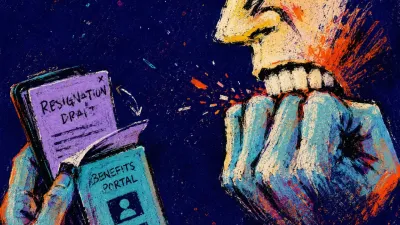
From Battery Panic to Steadier Self-Trust: Leaving the Life Audit Loop
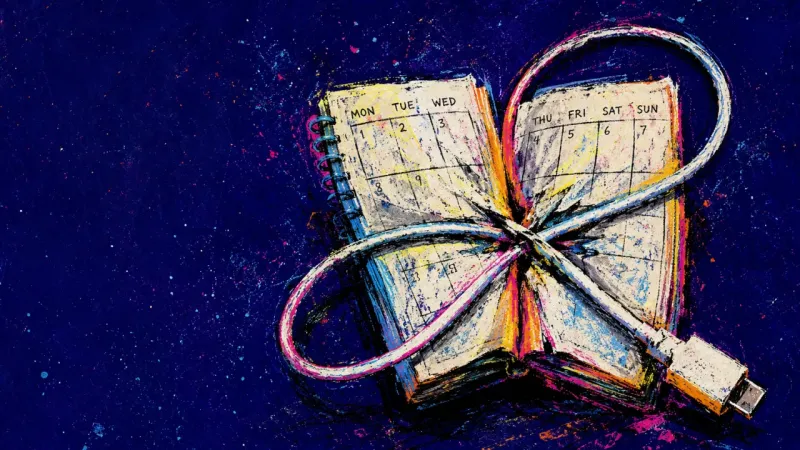
Finding Clarity in the 20% Warning
If your phone hits Low Power Mode and your brain immediately opens a life-optimization spiral—work KPIs, sleep score, and whether your last text sounded “too much”—this is for you.
Alex met me on a Zoom call from New York, and the first thing I noticed wasn’t her face—it was her hands. Restless, always half-moving, like her thumbs were still searching for a screen to refresh.
“It sounds so stupid when I say it out loud,” she said, and then she gave me that NYC kind of laugh—quick, sharp, like you’re stepping over something on the sidewalk. “But my phone hit 20% on the L train last week and I swear my stomach dropped. Like I’d just gotten feedback at work.”
She described it with the precision of someone who’s rehearsed it in her head: 8:47 p.m., fluorescent lights flickering, the plastic seat warm from someone else. Her battery warning popped up, and her thumb started pinballing between Slack, her calendar, and iMessage—like speed could outrun consequence.
“And then I’m… auditing,” she said. “Work. Sleep. Dating. Like it’s all one spreadsheet and if any number is low, I’m failing at life.”
I watched her swallow. Her jaw flexed like a hinge that didn’t want to open. In her chest, the pressure wasn’t abstract—it was physical, like someone had tied a thin cord under her sternum and kept pulling every time she thought the word low.
“You want to feel in control of your energy,” I said, keeping my voice steady, “across work, sleep, and love. But the moment you feel low, your brain treats it like a verdict.”
Alex nodded too fast, then stopped herself, almost annoyed at her own agreement.
“Let’s not shame that reflex,” I added. “It’s trying to protect you. Our goal today is simpler: we’re going to draw a map through the fog—something that helps you move from auditing yourself like a device to attuning to yourself like a living person. That’s the journey to clarity we’re aiming for.”

Choosing the Compass: The Celtic Cross · Context Edition
I asked Alex to take one slow breath—not as a ritual for magic, but as a handoff. A moment where the nervous system gets the message: we’re not sprinting right now.
On my end, it was morning in Tokyo. The planetarium was still dark and quiet before the first school group arrived. The projector’s soft hum in the next room always reminds me of distant machinery—like the universe has its own patient engine.
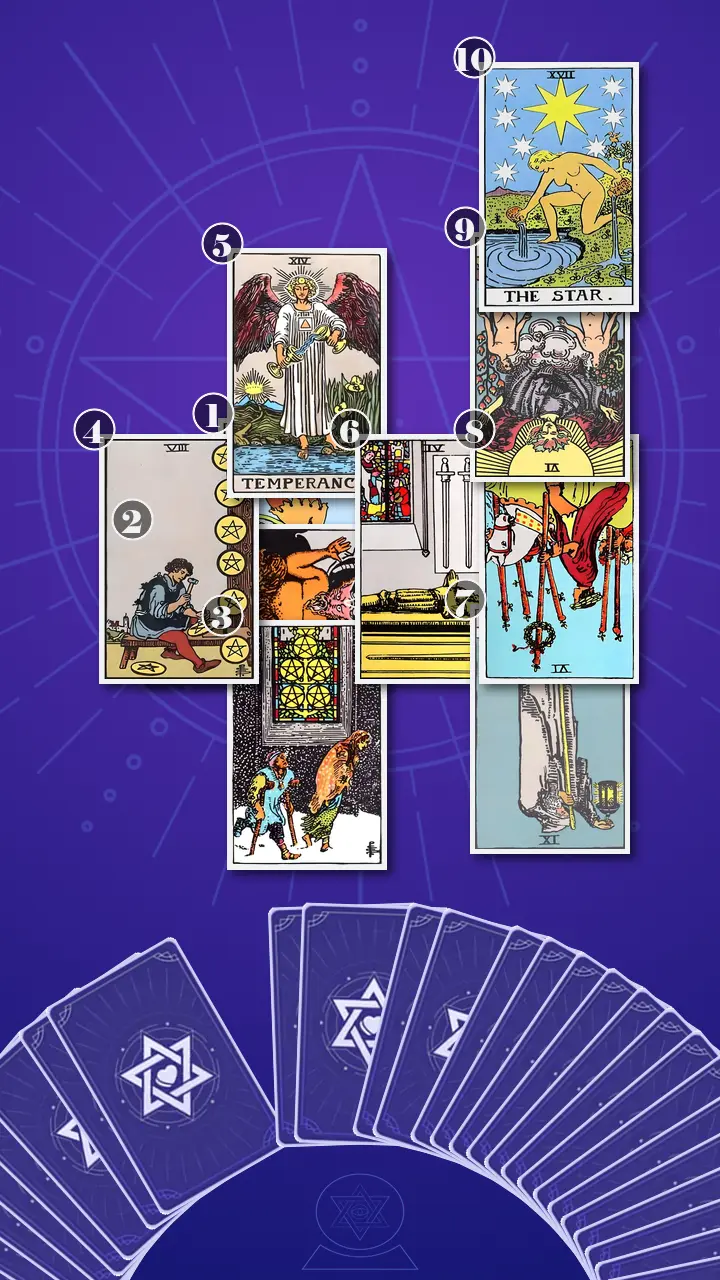
“Today,” I told her, “we’ll use a spread called the Celtic Cross · Context Edition.”
For anyone reading along: this spread works well when you’re asking why a pattern keeps looping. It gives us a clear chain from the symptom (the audit reflex the moment you sense ‘low’) to the root driver (the fear underneath it), then to the precise mindset shift that restores balance. In this version, we name modern pressure directly—performance culture, comparison, and the invisible audience—and we treat the final card as an integration path, not a fixed prediction. Choice stays in your hands.
“Here’s what to watch for,” I said. “The first card shows your automatic low-battery protocol. The crossing card shows what blocks rest—what feels non-negotiable. And the card above, the crown, will reveal what you’re actually reaching for beneath all that optimizing.”
Reading the Map: From Juggling to Loose Chains
Position 1 — The current coping loop
“Now flipped over,” I said, “is the card representing the current coping loop: what you do when you sense you’re ‘running low’.”
Two of Pentacles, in reversed position.
I pointed to the image: the infinity loop around two coins, the choppy sea behind the juggler.
“This is like constantly switching tabs,” I said, and I used her exact world on purpose. “Slack. Sleep tracker. Calendar. iMessage. You’re trying to keep every domain balanced by moving faster—like if you keep the coins in motion, nothing can drop.”
Reversed, that juggling energy isn’t balanced—it’s blocked and overloaded. The movement stops being skill and becomes scramble. It’s the life-optimization spiral as a reflex: the moment you feel low, you juggle harder, and you end up more scattered—never steadier.
Alex stared at the card, then let out a small laugh with a sting in it. “That’s… kind of brutal.”
“Brutal,” I agreed gently, “but also accurate in a way that gives us traction. Because if we can name the loop, we can interrupt it.”
I leaned in a little. “When your battery icon drops, what’s the first lever you pull? Work? Sleep? Love?”
“Work,” she said immediately. “If I can just ‘fix’ work, everything else feels… less dangerous.”
Position 2 — The main challenge
“Now flipped over is the card representing the main challenge: what actively blocks rest and creates the urge to optimize and control.”
The Devil, upright.
This is the part where I always slow down. Not for drama—because The Devil is rarely about being “bad.” It’s about being bound to a rule that once kept you safe.
“Monitoring can feel like safety, but it rarely feels like care,” I said.
And then I described the scene the card was already showing me, translated into her life: 12:38 a.m., charger cord stretched across the bed like a leash. Thumb hovering over the screen, toggling between Slack, a sleep app, and iMessage—like switching tabs can prevent something bad from happening.
“If I don’t check, then…” I started.
Alex finished it in a whisper. “Then I’ll miss something. Or I’ll fall behind. Or they’ll think I don’t care.”
“And if you do check?” I asked.
“I get… thirty seconds,” she said, exhaling sharply. “Thirty seconds of relief. And then I’m worse.”
That exhale was exactly what I look for: recognition. Not as self-blame—more like seeing the shape of the maze from above.
“The chains in this card are loose,” I said, tapping the table lightly. “That matters. It means the compulsion feels non-negotiable, but choice still exists. Our work is to make that choice feel safe enough to use.”
Position 3 — The root driver
“Now flipped over is the card representing the root driver: the deeper fear underneath the auditing behavior.”
Five of Pentacles, upright.
Even through a screen, I could feel her body react. Shoulders lifting a millimeter. Chin tucking in like bracing for wind.
“This one,” I said, “is the shame layer. Not loud shame—quiet shame. The belief that if you’re depleted, you’re… outside.”
In my mind, I saw New York in winter the way I’ve experienced it on visits: coming off the train, wind cutting down the avenue, passing bright restaurant windows where people look warm and unbothered. The card’s image carries that exact contrast—cold street, lit window.
“When you’re low,” I said, “your brain tells you: I don’t get to belong unless I earn it. Like there’s a warm room of life—productivity, romance, being on top of it—and tiredness means you’ve been locked out.”
Alex blinked hard, once. “I hate that it’s true.”
“You learned it somewhere,” I said. “And it’s not a character flaw. It’s a belief that got installed.”
Position 4 — Recent patterning
“Now flipped over is the card representing recent patterning: what you’ve been trained to do, or rewarded for, that makes this loop feel necessary.”
Eight of Pentacles, upright.
“This is the part of you that’s competent,” I said plainly. “The part that learned: focus, iterate, improve, win. And you probably did win. You’ve been rewarded for being responsive, polished, able to handle a lot.”
Upright, this is balanced diligence—but the problem is where it got applied. “Work responds to effort,” I continued. “But sleep and love don’t respond the same way. When you treat them like projects, you start hammering on feelings as if they’re deliverables.”
Alex looked away from the camera, like she was seeing her own desk. “I’ve literally color-coded my bedtime routine before.”
“Of course you have,” I said, not teasing. “That’s the craftsperson in you. We’re not deleting her. We’re just going to stop making her run your whole nervous system.”
When Temperance Poured Between Two Cups
When we reached the next card, the planetarium next to me made a soft mechanical click—like something aligning into place. The timing felt almost scripted, and I noticed the hairs lift on my forearm.
Position 5 — Conscious aim
“Now flipped over,” I said, “is the card representing your conscious aim: what you think you’re trying to achieve by auditing.”
Temperance, upright.
Alex’s face changed immediately—not relaxed yet, but… less armored. Like someone hearing their real name spoken correctly.
“This is important,” I told her. “Because it means you’re not actually craving perfect metrics. You’re craving steadiness. You’re reaching for a life that feels integrated—where work, sleep, and love don’t compete like three loud tabs open at once.”
Temperance upright is measured balance. Not intensity. Not a ‘complete overhaul.’ The angel pours between cups: the instruction is literally blend.
Setup
You know the moment: your phone drops into Low Power Mode, and suddenly you’re mentally re-scoring your whole day—work output, sleep quality, and whether that last text sounded “too much.” Alex lived right there—caught between “I have to fix this now” and “I’m so tired I can’t even think straight,” treating depletion like evidence in a case against herself.
Delivery
Stop treating your energy like a score to fix, and start blending rest and effort like Temperance pouring from cup to cup.
I let the sentence hang for a beat. No extra explanation. Just air.
Reinforcement
Alex’s reaction came in a chain—exactly the way truth hits when it lands before defenses can translate it.
First, a small freeze: her breath paused, and her eyes held still on the card like she didn’t want to blink and lose it.
Then the cognitive seep-in: her gaze drifted slightly off-camera, unfocused, as if her brain was replaying last week—her thumb toggling apps, her jaw locked, the charger cord across her bed.
Then the emotion: she swallowed, and her shoulders dropped with a shaky exhale that sounded like it came from her ribs instead of her throat.
And then—unexpectedly—her eyebrows pulled together. “But… if that’s true,” she said, voice tightening, “doesn’t that mean I’ve been doing it wrong? Like, this whole time?”
I didn’t rush to soften it. “No,” I said. “It means you’ve been doing what worked—until it started costing you more than it gave you. That’s not failure. That’s a rhythm change.”
This is where my astronomy brain always joins my tarot brain. “At the planetarium, I talk about pulsars,” I told her. “They’re these dead stars that send out incredibly consistent beams—like cosmic lighthouses. Their power isn’t that they’re ‘always full.’ Their power is the steadiness of their rhythm.”
“Your nervous system is asking for rhythm,” I continued. “Not a higher number. And the moment your first response to ‘low’ is a spreadsheet, you’re not listening to your energy—you’re putting it on trial.”
I could see her jaw unclench in real time, like someone finally set down a weight they didn’t realize they were holding in their teeth.
“Now,” I said, “use this new lens and look back: was there a moment last week when you felt low and went straight to auditing—when you might have tried blending instead?”
Alex’s eyes flicked up. “Tuesday. I had a slow reply from someone I’m seeing. My battery was at 9% and I opened Notes and wrote, like… a whole analysis. I could’ve just… gone to bed.”
“That’s the step,” I said. “Not from chaos to perfection—from alarm to attunement.”
And I named it for her, and for anyone who needs the words: “This is you moving from self-doubt and constant self-checking toward grounded self-trust. It’s small. It’s real.”
Let a Pause Be a Pause
Position 6 — Near-term direction
“Now flipped over is the card representing near-term direction: what becomes possible if you respond to depletion differently.”
Four of Swords, upright.
“Let a pause be a pause. Not a new way to win,” I said, because I’ve watched too many smart people turn rest into a performance sport.
I painted the container scene for her: Tuesday, 6:40 p.m. A dim lamp. City noise muffled through the window. Phone in another room. A timer running. Not planning. Not tracking. Just a deliberate downshift—like stepping into a small chapel of quiet inside a loud week.
“This card is intentional stillness,” I explained. “Air energy that’s finally allowed to settle. Not procrastination. A reset that actually counts.”
Alex breathed out, slower this time. “I can’t picture doing that without thinking I’m wasting time.”
“That’s exactly why it matters,” I said. “And if silence feels too sharp, borrow a background.”
I smiled a little, because this is one of my stranger-but-useful tools. “One of my favorite grounding tricks is letting something ordinary become cosmic: the sound of a washing machine. It’s steady, cyclical—like a tiny planet in orbit. If you have laundry going, let it be your metronome for a 7-minute rest block. Not aesthetic. Not optimized. Just steady.”
Position 7 — Self-position
“Now flipped over is the card representing self-position: how you’re holding yourself in this story.”
The Hermit, in reversed position.
“This is the ‘lantern as spotlight’ card,” I said. “The part of you that thinks wisdom means figuring it out alone—so you open Notes and title a page ‘What’s wrong with me lately,’ while the group chats sit unread.”
Reversed, the Hermit’s energy is excess and distortion: introspection that turns into interrogation. Solitude that turns into isolation.
“Here’s the question,” I told her. “When you’re alone with your thoughts at night, are you seeking insight—or are you punishing uncertainty until it shuts up?”
Alex’s mouth twitched, like she wanted to deny it and couldn’t. “I don’t want to bother anyone,” she said, then immediately added, “which is funny because I bother myself constantly.”
“Exactly,” I said softly. “We’re going to practice being witnessed without asking for fixing.”
Position 8 — External pressures
“Now flipped over is the card representing external pressures: how your environment reinforces the auditing mindset.”
Six of Wands, reversed.
“This is the invisible audience,” I said. “The feeling that your energy level is a public scoreboard.”
Reversed, this energy is deficient confidence fed by comparison. Instagram Stories full of rooftop bars and ‘hot girl walk’ discourse when you’re barely standing upright. A workplace that rewards constant output and fast replies. A culture where being exhausted is somehow both a flex and a failure.
“No wonder a low-battery moment feels like public embarrassment,” I said. “Even if no one’s actually judging you.”
Position 9 — Hopes and fears
“Now flipped over is the card representing hopes and fears: what you hope auditing will protect you from, and what you fear it confirms.”
The Lovers, reversed.
“This is where work and sleep suddenly aren’t the whole story,” I said.
Reversed, The Lovers points to misalignment and fear-based choice. Monitoring love like it’s data: response time, punctuation, tone. Watching the typing bubble like it’s a weather report for your worth.
“Part of you hopes the audit will make love safe,” I said. “And part of you fears that being depleted makes you less lovable—less chosen.”
Alex’s eyes watered, just slightly. “I hate that I do that,” she whispered. “I don’t want to be… that person.”
“You’re not ‘that person,’” I said. “You’re a person with a nervous system looking for certainty. The shift here is values over metrics.”
Position 10 — Integration path
“Now flipped over is the card representing integration: what a healthier relationship with energy looks like if you practice the key shift.”
The Star, upright.
In the planetarium, we teach that the night sky doesn’t rush. The Star card carries that same medicine: wide perspective, gentle restoration, steady pouring.
Upright, this is balanced replenishment. Not dramatic. Not performative. Not “I fixed my life in one weekend.” It’s quiet refilling.
“Refill is allowed to be quiet. It still counts,” I said.
Alex’s shoulders looked lower than when we began. Not fully relaxed—more like she’d finally stopped holding her breath between notifications.
The Two Tiny Pours Rule: Next Steps That Actually Fit
I leaned back and let the whole spread become one story, not ten separate meanings.
“Here’s the thread,” I said. “You’ve been trained to craft your way into safety (Eight of Pentacles), so when you sense ‘low’ you start juggling and tab-switching (Two of Pentacles reversed). The blockage is the belief that monitoring equals protection (The Devil), and underneath that is a fear of being shut out—outside the warm room—if you’re depleted (Five of Pentacles). Your conscious aim is real balance (Temperance), and the near-future opening is a protected pause that lets your system downshift (Four of Swords). The work is to stop isolating with your inner spotlight (Hermit reversed), step out of the invisible audience (Six of Wands reversed), and choose love by values and needs—not metrics (Lovers reversed). The integration path is steady renewal (The Star).”
“Your cognitive blind spot,” I added, “is that you treat energy as a number you must maximize—so every dip becomes a moral judgment. But your transformation direction is different: energy is a rhythm you can listen to. Balance isn’t a perfect day—it’s a repeatable blend.”
Alex nodded, then hesitated. “Okay, but—realistically—sometimes I can’t even find five minutes. Like, Slack is still going, my brain is still… on.”
I appreciated the honesty. “Then we go smaller,” I said. “We’re not building a new system. We’re testing a new relationship with ‘low.’ Tiny is not a consolation prize. Tiny is how you prove safety to your nervous system.”
- Two Tiny Pours (Temperance)For 7 days, when you plug in your phone at night, do one boundary + one care action before you open Notes, Slack, or any tracker. Example: (1) Boundary: “No Slack after 9:15.” (2) Care: 10 minutes—shower, stretch, tea by the window, or lying on the rug.If your brain turns it into a KPI, cut it in half: 2 minutes of care + 2 minutes of boundary. You’re experimenting, not proving.
- Protected Pause Block (Four of Swords)Schedule one 20-minute “no-input” block this week (calendar it like a meeting). Phone in another room. No socials, no planning, no tracking. Dim light, one timer. If silence feels edgy, use a neutral background sound—like your washing machine—like a tiny cosmic orbit to rest against.If 20 minutes feels impossible, do 7. Let a pause be a pause. Not a new way to win.
- One-Sentence Star QuestionThe next time you notice “low,” replace the audit with one sentence in Notes: “What would refill me in a way that still counts even if no one sees it?” Answer with one sentence only. No lists.If you start writing a second sentence, stop mid-word. The point is to exit the courtroom.
Before we ended, I gave her one more tool—my favorite micro-reset for nights when the body won’t downshift.
“I call it CMB Resonance,” I said, and I heard her small amused breath. “Cosmic Microwave Background. It’s basically the universe’s oldest, steadiest ‘hum.’ You don’t have to believe anything mystical. Just do this: five minutes in bed, phone face-down, one hand on your chest, and match your breath to something steady—like counting slow, even pulses. Your job isn’t to fix. It’s to sync.”

A Week Later: Quiet Proof
Eight days later, Alex messaged me: “I did the Two Tiny Pours thing three nights. Not seven. But three.”
She told me about Tuesday—how she plugged in her phone, felt the familiar stomach-drop, and started to open Notes. Then she stopped. Put the phone face-down. Two minutes of stretching on the kitchen floor. One sentence boundary: “No relationship data review after midnight.”
“I still woke up and my first thought was, ‘What if I’m messing everything up?’” she wrote. “But it was quieter. And I literally laughed because I realized… my battery percentage isn’t my worth.”
That’s what I mean by a journey to clarity. Not certainty. Ownership. A nervous system learning it doesn’t have to go to trial every time it runs low.
When your energy dips, it can feel like you’re standing outside the warm room of your own life—so you start auditing harder, not because you’re shallow, but because you’re scared “low” will expose you as not enough.
If you didn’t have to prove you were fully charged to deserve rest, what would one tiny, no-audience refill look like for you tonight?