From Mental Fog in Bed to a One-Surface Home Rhythm That Holds

Finding Clarity in the 9:10 a.m. Everything-Zone
If your day starts with opening Slack before your feet hit the floor and somehow ends with takeout beside your pillow, the Sunday Scaries are not random. When Maya (name changed for privacy) joined me from her Toronto apartment, I recognized the pattern at once: small-space boundary collapse, the kind that turns a bed into a desk, a dinner table, and then somehow a place that is supposed to feel restful again.
She angled her camera down for a second and I saw enough. At 9:10 a.m. most mornings, she told me, she is propped against the headboard with her laptop already open, pale winter light leaking through the blinds, the radiator hissing, yesterday's water glass still on the floor. The duvet is warm under her legs, the room air a little stale, and there is already a dull pressure behind her eyes before the day has properly begun.
“I know this is making me feel worse,” she said, giving me the kind of half-laugh people use when they are trying not to sound as worn down as they feel. “But it is also the path of least resistance.” Then she added, “My bed is basically my entire apartment at this point.” Toronto rent had done what Toronto rent does, and now one room was being asked to hold too many versions of her.
I told her what I could see. Wanting the bed to stop functioning as a desk and dinner table was real. Relying on it because it was the easiest place to work and eat was also real. Those two truths were grinding against each other all day long. When every part of the day happens on one square of fabric, nothing fully starts and nothing fully ends. The depletion she described felt to me like trying to run a whole operating system on the last 8 percent of battery while keeping every app open.
“You are not failing adulthood,” I said. “Your room has just stopped giving your body clear instructions. Let me help you draw a map out of that fog.”

Choosing the Compass: A Situation-Obstacle-Advice-Outcome Spread
I asked her to put both feet on the floor for one full breath while I shuffled. Not as theatre. Just as a clean little hinge between spiraling about the habit and actually looking at it.
For this question, I chose a Situation-Obstacle-Advice-Outcome spread. When someone asks me how to stop working from bed in a small apartment, or why their bed does not feel restful anymore, I do not reach for a sprawling spread. I want the smallest structure that still shows the whole chain clearly: the visible symptom, the hidden payoff, the pivot, and the sustainable next pattern. This is how tarot works at its most practical. It separates fused experiences so the person can see where choice actually lives.
I told her I would read the first card as the present situation and how the bed-as-everything-zone is showing up right now. The second would reveal the mechanism underneath it: the scarcity logic, the control strategy, the reason staying put keeps feeling easier. The third, which I suspected would be our hinge, would show the behavior or mindset shift that could interrupt the loop. The fourth would show what finding clarity looks like when it becomes livable rather than aspirational.
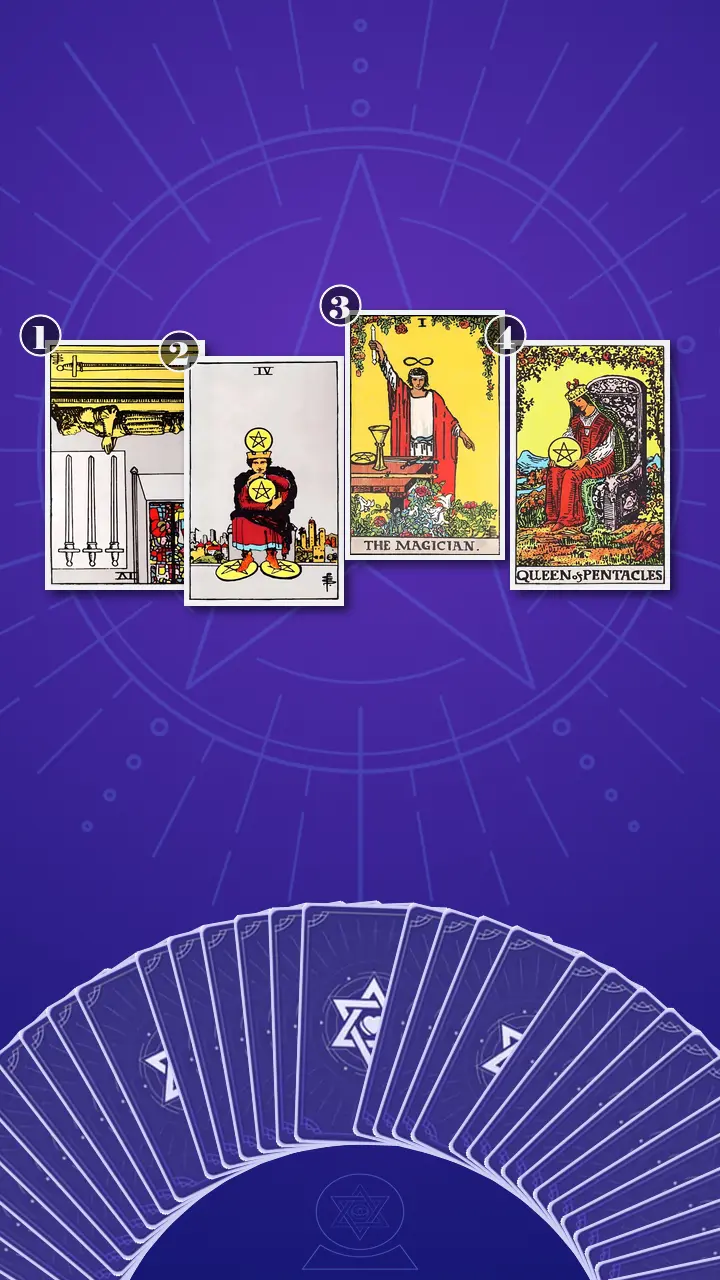
The Fours and the Feeling of Being Stuck
Position 1: The Bed That Never Clocked Out
The first card I turned was the one representing the visible symptom from the diagnosis: how work, meals, and rest are currently collapsing into the same physical zone. It was the Four of Swords, reversed.
I love this card for questions about rest because it is brutally literal. A body lies down in a space meant for recovery, yet the swords still hang overhead. In Maya's life, that became very modern very fast: opening email before fully leaving bed, then trying to sleep later in the same spot where the laptop imprint, charger cable, and takeout napkins have been sitting all day. The surface is soft, but the mind reads it as unfinished business. It is Severance, except the work self never leaves the mattress.
Reversed, the energy here was blocked recovery. Not a lack of tiredness—she had plenty of that—but a lack of landing. Rest was not getting to be rest. “When was the last time your bed clearly stopped being a work zone during the day?” I asked her. She let out a tight, almost amused breath and said, “Wow. That is accurate to the point of being rude.” Her mouth smiled, but her fingers started rubbing the rim of her mug. The recognition was there, along with the sting.
Position 2: Convenience in a Death Grip
The next card showed the obstacle, the reinforcing factor that keeps the pattern alive. It was the Four of Pentacles, upright.
This is where shame often tries to rush in, and I do not let it. I told her plainly, “This isn't laziness. It's convenience that got too expensive.” The card showed exactly that: laptop within inches, charger plugged in by the pillow, water bottle close, food easy to grab, phone ready for one more notification without even sitting up. A guarded reach zone. What feels efficient in the moment slowly turns the room into a bunker.
Upright, the energy here was excess Earth hardened into control. Over-conservation. Protecting every ounce of time and effort so tightly that movement itself starts to feel costly. I have lived through enough seasons to know this pattern well. Frozen ground can look stable, but roots cannot breathe in it. The repeated Fours in these first two cards told me that protection had hardened into stasis.
This was where I brought in one of the tools I am known for, what I call Somatic Fatigue Diagnosis. I do not begin by asking whether a habit sounds rational. I ask what the body is already paying for it. “When you picture moving your laptop three feet away,” I asked, “what happens first in your body—your shoulders, jaw, stomach?” She did not need to think long. “My shoulders go up,” she said. “And I get this instant thought that if I stand up now, I will lose the tiny bit of momentum I have.”
That was the whole card. The block was not messiness. It was the belief that one more transition would cost more than it gave back. She nodded slowly after saying it out loud, then looked away from the screen for a moment, as if seeing the charger, the water bottle, the notebook, and the takeout container all gathered beside her like tiny proof.
When the Magician Claimed a Table
Position 3: Upright Intention in a One-Room Life
By the time I reached the third card, the radiator had gone quiet, and somewhere outside her window a streetcar bell rang once. Even through a screen, I felt the room change. This was the advice position, the bridge card, the one that points to the central transformation: the shift from optimizing for immediate convenience to creating one small physical transition before work and meals. I turned it over and found The Magician, upright.
I felt relief before I even spoke. After two cards of horizontal collapse and clutched stillness, here was a figure standing at a table with tools laid out in view. Not more tools than he needs. Just a dedicated surface and a clear intention. Whenever I see this card, I think of the old kitchen tables from my childhood in the Highlands. They were never fancy, but they taught the body what was happening there—bread here, herbs there, rest after. Bodies trust surfaces faster than they trust promises.
In Maya's life, The Magician was not a dream desk setup from TikTok. It was a tray, a chair, a windowsill, a cleared table corner, a kitchen counter. One chosen surface. One job. One cue. Like setting a default app instead of letting every task open in a random window.
I asked her to do something with me in real time. “Stand up for twenty seconds,” I said, “and place your laptop on the nearest non-bed surface you already have.” She hesitated, then set it on a dining chair beside the window. That was my Somatic Fatigue Diagnosis again, used as a lever instead of a label. I wanted her body to answer before her inner critic did. She stood there with her hand still resting on the lid of the laptop, caught between thinking this was absurdly small and feeling that the whole room had changed by a notch.
She was still stuck in the old question: Do I need a better apartment, more discipline, a whole new personality, a clean-girl morning routine, a proper desk? I could feel that thought trying to take over.
Stop waiting for a perfect setup before you draw a line; start with the Magician's table and let one chosen surface teach your body what work and meals are for.
She froze first. Her breath paused high in her chest, and her fingers stayed hovering over the chair back as if she had forgotten what came next. Then her eyes went slightly unfocused—not blank, but replaying something. I knew she was back in that Wednesday evening: Uber Eats on the duvet, Slack still glowing, soy sauce in the air, her jaw tight though the workday was technically over. When she spoke, there was a flash of irritation in it. “But that is so small,” she said. “Are you telling me a chair would have made that much difference? Because honestly that makes me a little mad.” I nodded. “Not at the chair,” I told her gently. “At how long you have been asking one soft surface to hold work, food, and recovery all at once.” Her jaw softened. One shoulder dropped, then the other. The next breath came out long and shaky, almost an aha and almost grief. There was relief in it, but also that brief, dizzy vulnerability that comes when the path gets clearer and the responsibility becomes yours again. I asked, “If you look back at last week through this lens, where would one chosen surface have changed the feeling of the day?” She glanced toward the window ledge and said, very quietly, “Dinner. My body would have known work was over.”
That was the turning point. Not a personality makeover. A shift from depleted bed-bound drift toward practical self-trust. The problem was never that she was bad at adulting. The problem was that her room kept sending mixed messages, and The Magician was giving her a way to answer with one clear one.
Position 4: The Least Glamorous Version of Peace
The final card showed the likely direction when the advice is applied, how the change becomes embodied instead of performative. It was the Queen of Pentacles, upright.
I was glad to see her. The Queen of Pentacles is not interested in aesthetic perfection. She cares about whether dinner lands in the body, whether the lamp is low, whether the sheets are clear, whether the room feels one degree more nourishing and less improvised. In Maya's life, this looked like putting food on an actual plate, sitting somewhere with both feet on the floor that was not the bed, and clearing the charger and laptop before bedtime so sleep did not have to negotiate with work.
Here I brought in my second lens, Organic Routine Restructuring. I told her that sustainable routines rarely begin with society's fantasy clocks and aspirational content. They begin with biology. Hunger wants a seat. Focus wants a signal. Sleep wants an arrival. The Queen was asking for humble domestic honesty, not a makeover montage. Maya gave me the first truly settled nod of the reading. “That,” she said, “actually sounds manageable.”
From Insight to Action: The One-Surface Reset
When I laid the whole story of the spread back to her, it was clean. First, the Four of Swords reversed showed why working from bed, eating dinner in bed, and trying to sleep in the same spot leaves her foggy and wired at once: the bed had stopped being a landing place. Then the Four of Pentacles showed the hidden payoff: conserving energy so tightly that even tiny resets looked expensive. The Magician interrupted that loop by replacing vague motivation with one deliberate surface and one repeatable cue. The Queen of Pentacles grounded it into a livable home rhythm where care became visible in posture, dishes, lighting, and timing.
I named her blind spot as gently and directly as I could. She had been treating the habit like a character flaw, when it was really a nervous system bargain: immediate convenience now, worse recovery later. She also believed that if a change felt small, it must be meaningless. Tarot said the opposite. In a one-room life, small cues are not cosmetic. They are instructions. You don't need a dream apartment first. You need one chosen surface and one repeatable cue. If moving three feet feels weirdly huge, that's information, not failure. Make the reset small enough that your tired self won't argue with it.
- Feet-on-floor before screen onFor the next three mornings, put your phone charger or laptop on a chair, in a tote, or in a drawer before bed so it cannot be reached from the pillow. When you wake up, place both feet on the floor before opening Slack, Gmail, or TikTok, and take three sips of water at the sink or kitchen counter.Keep it to three days, not forever. If standing feels like too much, do the minimum version: sit up, put both feet down, and take one breath before touching a screen.
- The one-surface ruleChoose one non-bed surface this week—a chair, tray, windowsill, coffee table edge, or one cleared corner of the table—and give it one job only: your first work task or your dinner. Add one visible cue there, like a placemat, coaster, folded towel, sticky note, or lamp, so your brain reads it as a docking station for that mode.Temporary still counts. The surface does not need to stay clear all day; it only needs to exist for the task window.
- Grounding Disconnect and plate before pillowAfter your last work task, do my Grounding Disconnect Protocol for sixty seconds at an open window, sink, or beside a houseplant: both feet flat, one hand on something cool or living, and three exhales longer than your inhales. Then remove only the laptop, charger, dishes, and packaging from the bed, put dinner on an actual plate or bowl, and eat somewhere that is not the mattress.If a full minute feels annoying, do twenty seconds. You are lowering nervous-system static, not auditioning for a perfect routine.

A Week Later, the Room Spoke More Clearly
A week later, Maya sent me a message. “I ate dinner at the windowsill,” she wrote. “Same apartment, same tired Wednesday, still slightly annoyed that three feet matters this much. But the bed smelled like laundry instead of soy sauce, and I slept better.”
That was the kind of proof I wanted for her. Not perfection. Not a before-and-after montage. Just the first evidence that her room could stop acting like an endless browser tab and start giving her clearer signals again. The tarot did not rescue her. It showed her where choice had been hiding inside the routine all along.
That is why I trust a Situation-Obstacle-Advice-Outcome spread for small-apartment work-from-home boundaries: it turns shame into sequence, and sequence into next steps.
When your bed becomes the place for everything, the hardest part is not the mess itself; it is the quiet dread that even moving three feet might reveal how depleted you already are. If your room only needed one clearer signal today, what would your own Magician's table be—a tray, a chair, a windowsill, a cleared corner—and would you be willing to claim it?
Every reading at AceTarot is a Journey to connect with inner wisdom and empower next step.
Learn more about our Journey to Clarity.