Saying "Checked Is Complete": From Night Watch to a Softer Close

Bills Paid, Meds Refilled, Still Waiting for Disaster
If I’m sitting across from the reliable ops-brain friend in an expensive city whose bedtime routine keeps turning into a doom-loop of checking balances, refill dates, and locks, I usually know within minutes that the issue is not a lack of responsibility. It’s mistrust of relief.
That was exactly the feeling in the room when Jordan (name changed for privacy) sat down with me. She was twenty-nine, lived alone in Toronto, and carried herself with the dry competence of someone who remembers deadlines before other people remember the project exists. She described Sunday at 9:18 p.m. in her apartment kitchen so clearly I could almost smell it: the lemon-cleaner still hanging in the air, the fridge humming, the blue phone light turning her hand cold-looking as she tapped through her bank app after the rent confirmation had already come in. Tomorrow’s pills were lined up beside the kettle. The counter was wiped. The room was handled. Her jaw was still locked.
“Bills paid. Meds refilled. Room clean,” she said, giving me a look that was half amused, half exhausted. “So why do I still feel like something bad is about to happen?”
When she said it, I could hear the real contradiction underneath: one part of her wanted to feel safe because the basics were handled, while another part was convinced disaster was merely late. The dread in her did not look dramatic. It looked like nine browser tabs left open in her ribs, each one quietly draining the battery. Prepared isn’t the same as relaxed.
I nodded and let that land without trying to tidy it up for her. “That makes more sense than you think,” I told her. “Sometimes the body keeps standing at the peephole even when the apartment is locked. Let’s make a map of that. If we can see the mechanism clearly, we can stop treating every quiet night like an incoming emergency and start finding some real clarity.”

Choosing the Compass: A Five-Card Cross for Suspicious Calm
I asked Jordan to put both feet on the floor and take one unforced breath. Not a perfect breath. Just an honest one. Then I shuffled slowly while she held the question in mind: why she couldn’t relax when everything was done, and why calm felt suspicious instead of welcome.
I chose the Five-Card Cross · Context Edition. I use this spread when the problem is not really a decision between two external options, but a compact inner mechanism that needs to be seen in sequence. This is how tarot works best for me: not as abstract prediction, but as card meanings in context. Here, the spread lets me separate the visible symptom from the coping strategy, the coping strategy from the root fear, and the root fear from the medicine that can actually shift it.
I showed her the structure on the table. The center card would name the present symptom as she consciously experienced it. The crossing card would reveal what was complicating it—specifically, the habit that made calm feel unsafe. The card below would expose the deeper root. Above the center, I would look for the corrective stance, the medicine. And the final card, extending outward, would show the grounded next step: not a fantasy outcome, but how safety could become embodied rather than merely administered.
The layout always reminds me of a compass after a storm: center, pressure, root, north, then direction. I’ve spent a lifetime watching weather in the Highlands, and human systems are not so different. Before the sky clears, it helps to know which wind is actually moving the clouds.
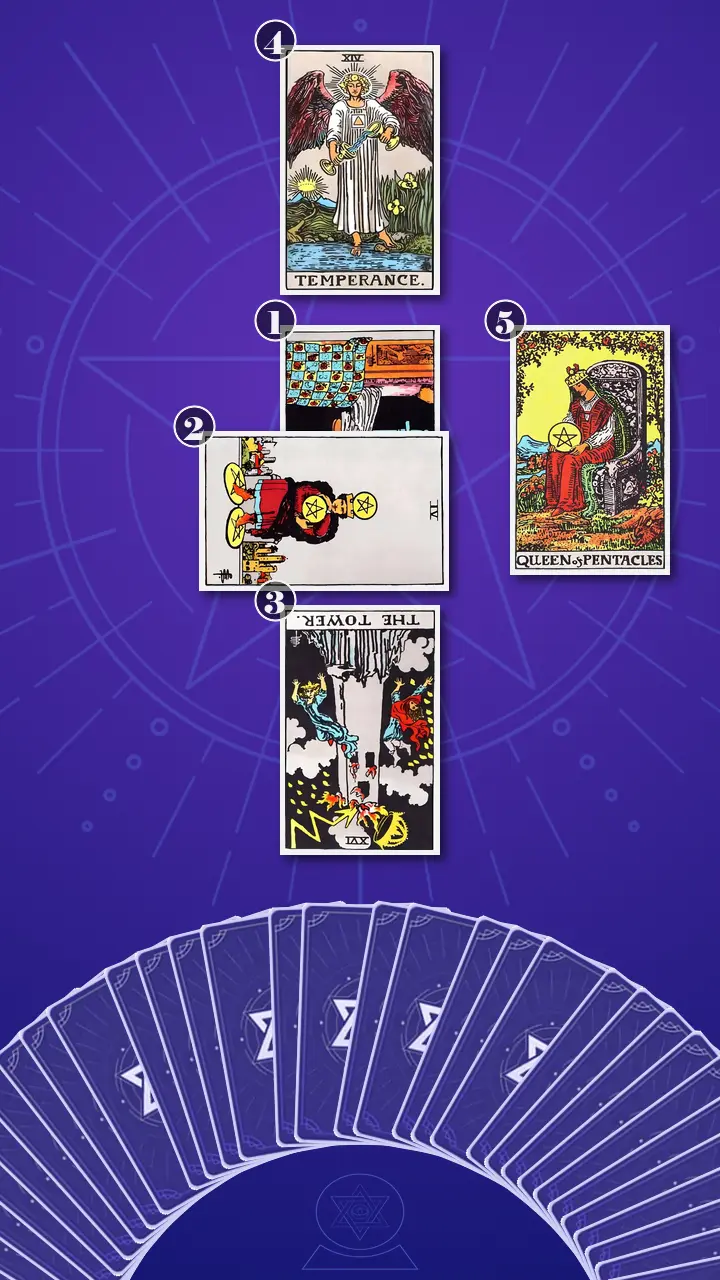
Reading the Night Watch
Position 1: The Symptom That Starts After “Done”
I turned the card in the center first. “This position presents the visible symptom in the diagnosis,” I said. “The post-checklist expectation that something bad is still coming.”
Nine of Swords, reversed.
I didn’t have to reach far to translate it. I could already see Jordan inside the card: finally in bed after a responsible night, lights off except for the phone glow, rent paid, pharmacy reminder checked, lunch packed, room tidy—and instead of winding down, mentally replaying due dates, refill timing, and whether one tiny oversight could wreck tomorrow. Just one more check, then I’ll settle. Just one more. The room goes quiet, and the mind logs back into the emergency dashboard.
In energy terms, this was trapped Air. Thought had become night watch. Reversed, the card didn’t tell me she was overreacting to an active crisis; it told me the dread had turned inward and stayed online long after the practical tasks were complete. Her body knew the shift was supposed to be over, but her system had not received the memo.
Jordan let out one short laugh, bitter around the edges. “Wow,” she said. “That’s accurate enough to be rude.” Her fingers tapped once against the mug I’d set beside her, then went still.
“I’m not trying to be cruel,” I said, smiling a little. “I’m trying to be precise. This card doesn’t say you’re failing. It says the threat-scanning is happening after the checklist, not because the checklist was wrong.”
Position 2: When Responsibility Turns into Armor
I placed the second card across the first. “This position identifies the blocking strategy,” I told her, “the way control and upkeep are being used as armor.”
Four of Pentacles, upright.
This card was almost painfully modern in her case. I described what I saw: refreshing the banking app after the payment confirmation had already landed, re-counting pills that were already sorted, straightening a stack of mail that was already aligned, re-wiping a counter TikTok would have called part of a Sunday reset even though nothing on it was actually dirty. Useful routines, yes. But useful routines recruited into private inspection rituals.
The energy here was over-armored Earth. Earth is supposed to give structure, steadiness, support. In excess, it grips. The pentacle pressed to the chest was the exact posture of her life: shoulders up, stomach braced, competence held so tightly it had stopped feeling like foundation and started feeling like a shield. Calm feels suspicious when your body only trusts monitoring.
That was the moment I felt my own practice click into place. I call it Body Signal Interpretation: before I listen to the explanation, I listen to what the shoulders, jaw, breath, and hands are saying. Jordan’s jaw had been answering the question since she walked in. It was saying, I do not believe we are off duty.
When I said that, she drew in a quiet breath that barely reached the bottom of her lungs. “I always tell myself I’m just being responsible,” she said. “But yeah. It feels more like… guarding.”
Position 3: The Collapse Trailer Playing Underneath It All
I turned the card below the center. “This position reveals the deeper root,” I said. “The fear that one missed detail will trigger collapse and prove a lack of control.”
The Tower, reversed.
This one did not read to me as literal disaster. It read as pre-lived disaster. I asked her to picture something small: an odd charge notification on the streetcar ride home, a delayed reply, a minor symptom, a weird email subject line. Then I named the jump. What happened so far: one detail. What the mind predicts next: late fee, refill issue, admin failure, shame, everything snowballing because she got careless. Like seeing one weird charge and mentally fast-forwarding to a full life Jenga collapse.
In the elemental story of the spread, this was Fire reversed—impact energy turned inward, rehearsed before anything had actually hit. The Tower reversed often shows me a person standing in a locked apartment while still living at the peephole. It is waiting for the other shoe to drop, then designing a whole season finale around the shoe before the first scene has even started.
I asked her quietly, “If one small detail did go sideways, what would that seem to prove about you?”
Her hand tightened around the mug. Her eyes went unfocused for a second, as if she were replaying half a dozen nights at once. “That I wasn’t really on top of it,” she said at last. “That I missed the one thing that mattered.”
There it was. Not just fear of inconvenience. Fear of collapse as verdict.
When Temperance Poured Between Two Cups
Position 4: The Antidote
When I turned the fourth card, the room changed. The radiator gave one soft click, and then everything felt strangely still, the way a room can go still right before someone tells the truth they’ve been circling all evening.
“This position names the key shift,” I said. “The regulating stance that allows ‘done’ to be enough.”
Temperance, upright.
I could see Jordan’s face change before I even began. This was the exact moment after the bill was paid, the pills were lined up, and the counter was clean—the room looked finished, but her body was still standing there like the night had not been cleared yet. That was the gap. Not between chaos and order. Between order and permission.
I leaned forward slightly. “You don’t need another check. You need an ending.”
You do not have to earn safety by rehearsing collapse; let the angel keep pouring between the cups until ‘done’ feels real in your body.
I let the silence hold it for a beat, then gave her the practical translation. “Your system is not asking for more proof. It is asking for a believable ending, so ‘done’ stops feeling like negligence.”
This is where I brought in the lens I call Elemental Balance. The first card had shown trapped Air: thought loops, red notification dots in the mind. The second showed Earth hardened into a brace: pinning, locking, refreshing, clenching. The third held reversed Fire: impact rehearsed before impact. Temperance was the first card in the spread that let water move. One foot on land, one in water. Practical care and emotional regulation in the same scene. Not all thought. Not all control. Not all alarm. Just enoughness. Like mixing hot and cold water until the shower stops shocking you—not perfect, just workable and steady.
Jordan froze first. Her breath caught. Then her fingers stopped moving entirely around the mug. Then her gaze drifted past me, not dissociating exactly, but replaying memory at high speed. When she came back, the reaction was not relief. It was anger.
“But doesn’t that mean I’ve been doing all this for nothing?” she asked. Her voice was low, clipped, sharper than before. “Like I’ve been exhausting myself just to stay scared?”
I shook my head. “No. It means your system picked a job it thought would protect you, and it got very, very good at it. I’m not interested in shaming that part of you. I’m interested in giving it a smaller job.”
Her face softened by degrees. First the eyes widened. Then the tight line around her mouth loosened. Then came the exhale she had not managed when she arrived—deeper this time, audible, almost surprised. Her shoulders dropped, and for a second she looked slightly unsteady, the way people often do when a burden leaves faster than their body expected. Release can feel strange when you’ve been braced for years.
“Now,” I said gently, “with this new angle, think back to last week. Was there a moment when this would have changed how the night felt?”
She nodded slowly. “Sunday. After I checked the meds. If I’d just… stopped there. Put the phone down. Maybe the whole night wouldn’t have turned into a trial.”
That was the first real step of the transformation: from suspicious calm and private threat-scanning toward grounded enoughness and body-level relief. Not a miracle. A crossing.
Position 5: A Room You Can Actually Live In
I turned the final card to the right. “This position shows how the shift gets integrated,” I told her. “How safety becomes embodied rather than merely administered.”
Queen of Pentacles, upright.
I loved seeing her here. Not because it promised some perfectly serene future, but because it translated the insight into a livable image. I described the same apartment from the opening—but altered. Same clean room. Same stocked meds. Same paid rent. Same soft lamp. Only now she sits down before reopening anything. The blanket is already on the couch. The tea is warm. The phone is charging across the room. The environment she built stops functioning as evidence in an ongoing court case and starts functioning as care.
The energy had returned to Earth, but now it was settled Earth rather than armored Earth. The Queen does not grip the pentacle like a life raft. She holds it with ease. She does not confuse maintenance with punishment. She knows that safety is meant to be inhabited. Less overhead survival lighting. More actual home mode.
Jordan looked at the card for a long second and smiled in a way she hadn’t before—small, almost wistful. “I want my apartment to feel like that,” she said.
“It already partly does,” I answered. “The structure is there. We’re teaching your body to join you in it.”
Let Completed Care Count as Completed Care
By the time I gathered the spread into one story, the pattern was clean. Jordan’s mind went on night watch after ordinary tasks were finished. To manage that dread, she used control as armor—more checking, more tightening, more upkeep. Underneath it sat a collapse-fear so quick it could turn one loose thread into a whole internal disaster series. The blind spot was not irresponsibility. It was the belief that relief was a loophole and that vigilance was the reason life had not fallen apart.
I told her the direction of change was simple, though not easy: move from earning safety through monitoring to practicing brief, believable endings. In Highland weather, I’ve seen the ground stay frozen even after the air warms. You don’t scream at the soil for being slow. You give it repeated, gentler conditions. Bodies are like that. A quiet night is not an emergency just because your mind treats it like one.
- The 2-Minute No-Recheck WindowPick one nightly admin task this week—paying one bill, checking tomorrow’s meds, or confirming the next day’s calendar—and allow yourself exactly one check. Then say out loud, “Checked is complete,” put the phone on a charger or shelf that is not in your hand, and stay with the next 2 minutes without reopening anything.If 2 minutes feels too exposed, start with 30 seconds. If sitting still makes your chest spike, use my shower water-flow meditation technique instead: let warm water hit your shoulders for half a minute and notice the temperature change as your transition cue.
- The Already-Handled ChairChoose one corner of your home—a chair, couch edge, or side of the bed—to become your admin-to-safe-landing spot. After your evening checklist, switch on one warm lamp, sit there for 5 minutes, and let one sensory cue mark the shift: tea, lotion, a blanket, or both feet flat on the floor.Before you get up, name three things already taking care of you: clean sheets, stocked meds, paid rent, packed lunch, full water bottle. Don’t make it aesthetic. Make it real.
- Evidence vs. Prediction NoteOnce this week, when a small surprise happens—an odd charge, a delayed reply, a weird body sensation, a messy surface—write two lines in your phone: “What actually happened so far?” and “What am I predicting next?” Then choose one low-stakes pleasant thing anyway: finish the episode, take the walk, eat the snack, leave the text until tomorrow.Keep this for low-risk moments only. The goal is not denial; it’s interrupting the jump from one detail to full collapse storyboard.

The Quiet Proof
Four days later, I got a message from Jordan at 9:11 p.m. It was just a photo of a couch corner: one warm lamp on, a mug on the armrest, her phone charging across the room. Beneath it she wrote, “Did one meds check. Said the line out loud. Felt ridiculous. Then I noticed my jaw unclench before I picked the phone back up. So I didn’t pick it back up.”
A week after that, she told me something even better: she had slept through the night once, then woke with the old thought—What if I missed something?—and laughed before turning over. Clearer, but still human. That was enough proof for me.
Readings like this are why I trust tarot as a tool for finding clarity. Not because it erases uncertainty, but because it shows the mechanism with enough honesty that the next step becomes actionable advice instead of self-judgment. Jordan did not need a stricter system. She needed a softer close. She needed completed care to count as completed care.
Sometimes the hardest part isn’t the bill, the refill, or the mess—it’s standing in a perfectly okay room with your jaw tight, waiting for one missed detail to prove you were never really safe. If ‘done’ were allowed to count tonight, what is one tiny way—one lamp, one mug, one chair, one phone left out of your hand—you would let your body know the shift is over?
Every reading at AceTarot is designed to connect you with your inner wisdom and empower your next step.
Learn more about our Journey to Clarity.