The 9:47 p.m. Slack Reflex—and the 10-Minute Off-Ramp After

The 9:47 p.m. Slack Reflex
It’s 9:45 p.m., you make tea, sit down, and immediately start rewriting tomorrow’s plan in your Notes app because the silence feels suspicious.
Taylor (name changed for privacy) said it like they were confessing something minor—like they were admitting they double-dipped a chip. But their body told the truth: jaw tight enough to ache, shoulders lifted like they were bracing for impact, fingers still making the micro-movements of someone who’s been answering pings all day.
They were in a Toronto condo living room that looked exactly like so many of my clients’ weeknights: laptop clicked shut, kettle’s soft roar fading into the constant city hum, TV casting that idle bluish glow that makes everything feel both cozy and slightly unreal. The couch gave under Taylor’s weight—and still their system didn’t land. Their phone lit up (no notification, just the screen waking), and their thumb opened Slack before they even decided to. You’re done, and then… you’re not done.
“I did everything on my list,” they told me, voice careful, like if they phrased it right they might finally crack the code. “So why do I feel worse now. I just… keep checking. And then I start ‘one more small thing.’ I want one kind next step, not a whole new productivity system.”
I watched the way they swallowed, as if their throat was trying to hold back a whole week’s worth of unfinished alarms. Their restlessness wasn’t loud—it was like a phone vibrating on silent somewhere in the room, impossible to ignore once you know it’s there.
“If you can’t relax after you’re done, it’s not laziness—it’s a system that never learned ‘done = safe,’” I said gently. “Let’s not blame you for a pattern that was rewarded for years. Let’s make a map for it. Tonight’s journey is about finding clarity—enough clarity to take one kind step toward an actual downshift.”

Choosing the Compass: The Four-Layer Insight Ladder
I invited Taylor to put both feet on the floor and take one slow breath—not as a mystical ritual, but as a nervous-system handoff. “Just for the next few minutes,” I said, “we’re not fixing. We’re noticing.”
I shuffled while they held the question in plain language: To-do list done—why can’t I relax, and what’s one kind next step?
“Today I’m using a spread called the Four-Layer Insight Ladder · Context Edition,” I explained. “It’s a simple 4-card linear ladder—symptom → root driver → key shift → gentle action.”
For you reading this: this kind of tarot spread works well when the problem isn’t about predicting a future outcome, but about changing an internal loop—especially the kind that shows up at night as decision fatigue, productivity guilt, and that wired-but-tired feeling after work. Four cards is enough to show the mechanism without overwhelming someone whose mind is already spinning.
Card 1 will show what “can’t relax after the to-do list is done” looks like in real behavior and nervous-system energy. Card 2 will name the belief underneath—the hook that keeps the system in doing-mode. Card 3 is our pivot: the reframe that turns rest into something you can access without earning it. Card 4 gives one kind next step for the next 24–72 hours—small, doable, and human.
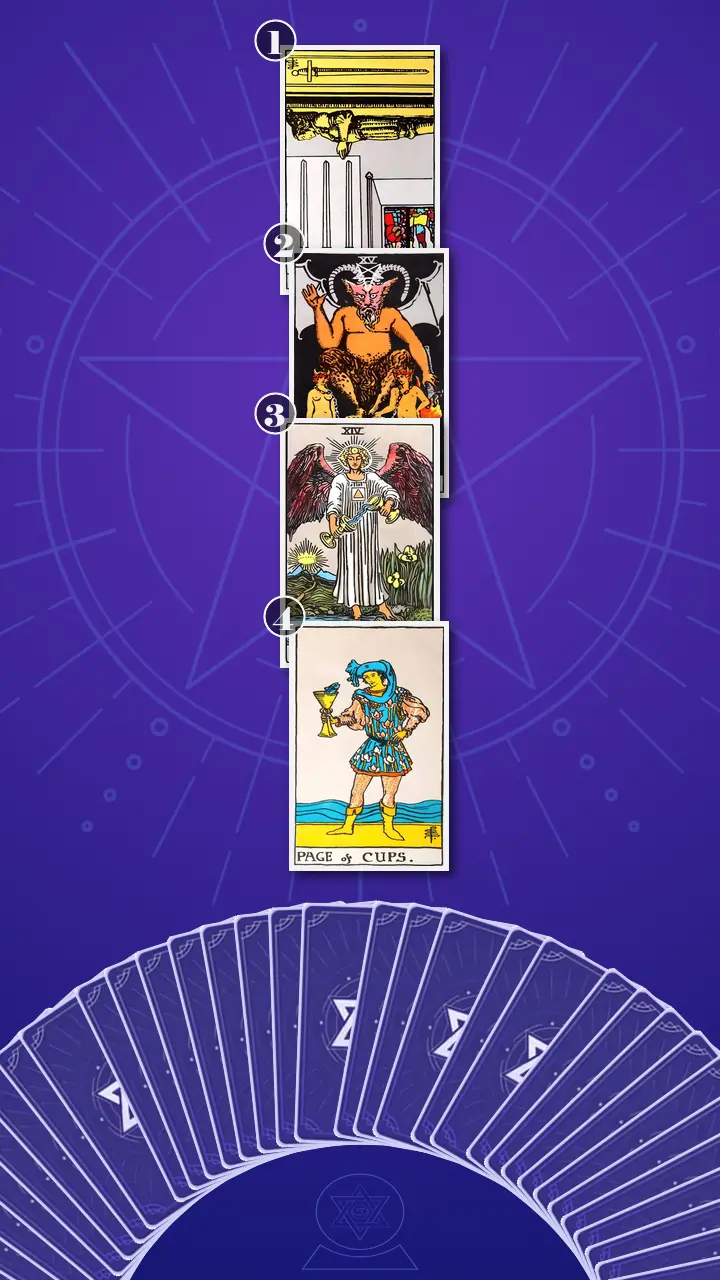
Reading the Map: A Tarot Spread for Restlessness and Overthinking
Position 1: Surface Symptom — Four of Swords (reversed)
“Now flipped over,” I said, “is the card that represents the surface symptom: what ‘can’t relax after the to-do list is done’ looks like in real behavior and nervous-system energy.”
Four of Swords, reversed.
I didn’t need to reach for poetic language; Taylor’s life was already speaking in the card’s vocabulary. “You’ve finished the list, sent the last email, and even prepped lunch for tomorrow. You sit on the couch with tea… and your body stays wired like you’re still in a meeting. Within two minutes you’re up again: wiping the counter, reopening your planner, re-ordering tomorrow’s tasks, checking Slack ‘just in case.’ Nothing is actually on fire—your nervous system just doesn’t believe ‘quiet’ means ‘safe.’”
In the traditional image, the figure is finally meant to rest. Reversed, that rest is blocked—like a car parked in the condo garage, engine still revving because you never shifted into neutral. This is Air energy (mind, thinking, scanning) running too hot: not balanced, not helpful—just overactive.
I leaned in, not to intensify, but to be precise. “This isn’t you failing at relaxing,” I said. “This is your body staying in contracted mode. ‘Done’ happens on paper, but it doesn’t register in your nervous system. So your mind keeps reopening tabs.”
Taylor let out a tight, almost-laugh—half humor, half wince. Their eyes flicked down to their hands like they were catching themselves doing it in real time.
“That’s… yeah,” they said, and the honesty landed with a bitter edge. “It’s like—my list is checked off and I still… start another list. Every night.”
Position 2: Root Driver — The Devil (upright)
“Now we open the card that represents the root driver: the belief or attachment that keeps the mind in doing-mode even when there’s nothing left to do,” I said.
The Devil, upright.
“The list isn’t the real chain,” I told them, keeping my voice steady. “The chain is the identity hit you get from being the responsive one. You keep your phone close during downtime because being available feels like being valuable. Rest starts to feel like a risk: if you go offline, you imagine tomorrow punishing you with surprises. So you do the safest thing you know: monitor, optimize, stay ‘on.’”
The Devil is famous for its chains—but the chains are loose. That’s the detail that matters in modern life. This isn’t fate. It’s habit. It’s an invisible contract you forgot you signed: Proof-Of-Worth Premium, billed nightly in anxiety.
“Not because you love work,” I added, letting the truth have its shape, “but because being reachable feels like being worthy.”
I saw Taylor’s gaze go soft and far away, like the moment in Severance when the elevator doors close and you realize you never actually left. Their breath paused—then came back shallow.
“Oh,” they said quietly. The word was small, but it carried weight. “I’m not chasing tasks. I’m chasing permission.”
“Exactly,” I said. “Your ‘one more thing’ is often a safety ritual, not a character flaw.”
Position 3: Key Shift — Temperance (upright)
When I reached for the third card, the room felt quieter—not because the city outside had softened, but because Taylor stopped fighting their own experience for half a second. Even the TV’s idle glow seemed less demanding.
“Now we turn over the card that represents the key shift: the regulating reframe that turns rest into something you can access without earning it,” I said. “This is the pivot.”
Temperance, upright.
Temperance is the alchemist. In the image, water pours between two cups—steady, patient, unhurried. One foot on land, one in water. A path leading toward a rising sun. Not an on/off switch. A dimmer.
“Instead of trying to ‘finally relax,’” I said, “you build a repeatable in-between: a 10-minute off-ramp right after the last task. You close tabs, put the work device away, wash one mug, change into softer clothes, lower the lights—small cues that tell your body the context has changed. You’re not doing less forever; you’re mixing effort and recovery so you don’t swing from overdrive to collapse.”
Then I used the lens my family taught me—my Nature Empathy Technique, the way I read humans the way I read weather. “I want to name something I’m seeing in your body,” I told Taylor. “Your jaw is doing what your mind has been doing—clenching to create certainty. That’s a body signal. It’s not wrong; it’s communication.”
“In elemental terms,” I continued, “your Air is overactive—thoughts scanning like they’re on shift. The Devil showed Earth gripping tight—worth equals output, control equals safety. Temperance is Fire used wisely: not a blaze, but a controlled warmth that recalibrates. And when Fire does that, it finally becomes possible to arrive in Water—softness, feeling, real rest.”
They nodded once, almost reluctantly—like agreeing would make the next part real.
The Aha Moment: The Two-Cup Transition
Setup: It’s 9:45 p.m. You close the laptop, the kitchen light feels too bright, and your thumb is already hunting for Slack like it’s a reflex—because silence is when your brain starts forecasting tomorrow.
Stop treating rest as a prize you unlock, and start pouring yourself from “doing” into “being” like Temperance moving water cup to cup.
I let the sentence hang there. Like a drop of water held at the lip of a cup, right before it falls.
Taylor’s reaction came in a chain—fast, physical, honest.
First, a freeze: their breath stopped mid-inhale, and their fingers hovered above their phone as if they’d been caught reaching for it in a dark room.
Second, the mind trying to argue its way back into control: their eyes narrowed, then unfocused—like they were replaying every night they’d ever tried to “earn” permission to rest by doing one more thing. Their mouth tightened, almost angry. “But if I don’t keep momentum,” they said, “things will slip. And then I’ll spiral.”
Third, the release—small, but real: their shoulders dropped a fraction, like a backpack strap finally loosened. They exhaled through their nose, slow and shaky. The skin around their eyes went pink in that way that isn’t exactly crying, but is definitely the body surrendering a little.
“You won’t relax by finishing more; you relax by practicing the transition,” I said, keeping it practical, keeping it kind. “Relaxation isn’t something you unlock by completing more—it’s something you practice by teaching your body, in small transitions, that stopping is safe.”
They stared at Temperance again. “So… the goal isn’t perfect rest,” Taylor murmured. “It’s… training.”
“Yes,” I said. “This is you moving from wired vigilance into the first hint of permission—toward a steadier calm that doesn’t require earning.”
I asked them the question that turns insight into lived memory. “Now, with this new lens—think back to last week. Was there a moment when you finished something and immediately went into checking or planning? If you’d had an off-ramp right then, what would have changed in your body?”
Taylor blinked slowly. “Thursday,” they said. “I finished a deck for Monday. I was done early. And I felt… guilty. Like I’d stolen time. I could’ve… just stopped. Even for ten minutes.”
I nodded. “That’s the training ground. Not a perfect night routine. A small, repeatable handoff.”
Position 4: One Kind Next Step — Page of Cups (upright)
“Now we flip the card that represents one kind next step: a gentle, doable action for the next 24–72 hours that supports integration,” I said.
Page of Cups, upright.
The Page holds a cup at chest height, and a fish pops up—an unexpected little feeling, a surprise softness that can’t be forced.
“One kind next step tonight,” I told Taylor, “is to pick a single comfort that isn’t a project—one song on repeat while you wash your face, a 7-minute walk around the block with no podcast, or sitting by the window watching streetlights flicker on. The rule is: you don’t measure it. You let it be small and sincere, like practicing ‘I’m allowed to feel okay without producing anything.’”
I watched their hands unclench slightly on the mug. It wasn’t a dramatic shift. It was the kind that actually lasts.
“Tonight’s goal isn’t perfect rest,” I reminded them. “It’s a small downshift you can repeat. If it feels awkward, that doesn’t mean it’s failing—it means it’s new.”
The Off-Ramp Ritual: Actionable Advice That Doesn’t Become Another Task
Here’s the story the ladder told, in plain language: you finish the day (Four of Swords reversed), but your mind stays braced because “done” doesn’t feel safe. Underneath, there’s a Devil-contract—worth equals output—so you keep checking and planning to buy a feeling of permission. Temperance doesn’t ask you to be less ambitious; it asks you to stop using overdrive as regulation. It offers a transition ritual—an off-ramp—so your body can learn a new rule: stopping is safe. Then Page of Cups makes it human: one small comfort, no metrics, no optimization.
The cognitive blind spot I want you (and Taylor) to hear clearly is this: you’ve been treating rest like a reward you earn after perfect performance—so your brain tries to “solve” discomfort with more planning. But what you actually need is a daily regulation practice that protects your future capacity.
So I gave Taylor a plan that is deliberately too small to become a new system:
- The 10-minute Off-RampRight after your last task, set a timer called “Off-Ramp.” Close your laptop, plug it in, and leave it there. Put your phone in another room (or at least face-down across the room). Choose exactly one low-stimulation action: make tea, take a shower, slow stretch, or sit by a window—nothing else.Expect your brain to protest. Discomfort doesn’t mean it’s wrong; it means the pattern is changing. If “another room” is too intense tonight, start with “out of reach.”
- Shower Water-Flow Meditation (Temperance in real life)If you choose a shower as your off-ramp: stand under the water for 2 minutes with no agenda. Feel the temperature, the sound, the way water moves from your shoulders down your arms—like pouring from one cup to the next. When your mind tries to plan, label it once: “planning,” then return to the sensation.Keep your eyes open if you feel too activated. You’re not trying to “win calm.” You’re practicing the handoff.
- One No-Optimization ComfortWithin 24–72 hours (tonight counts), do one small comfort for 7–10 minutes max: one song on repeat, a warm drink on the balcony, or a short walk with no podcast. No tracking. No researching the “best” version. Let it be enough.If your brain tries to turn it into a project, choose the simplest version on purpose. The point is sincerity, not improvement.
Before we ended, I added one more option from my own toolkit, made for city living: “If you have even a sliver of balcony,” I told Taylor, “do my 5-minute balcony energy awakening practice tomorrow—stand outside, feel the air on your face, name the weather without judging it, and let your shoulders drop one notch. It’s a body cue that the workday is not the whole world.”

A Week Later: The Quiet Proof
A week later, Taylor messaged me at 10:12 p.m.
“Did the Off-Ramp,” they wrote. “Phone in the hallway. Ten minutes. Showered and just… listened to the water. Didn’t fix anything. It was weird. But I didn’t open Slack.”
Then, after a pause bubble, another text: “I still felt itchy. But my jaw wasn’t locked. That feels like… proof.”
I pictured it clearly: a person who used to treat silence like a threat, standing under water like Temperance—same life, same responsibilities, just poured into a different cup for ten minutes.
They told me they celebrated by sitting alone on the balcony in a hoodie, watching streetlights flicker on. They didn’t feel euphoric. They felt quieter. The next morning, their first thought was still, What if I mess up?—but this time they noticed it, exhaled, and didn’t reach for Slack.
That’s what a Journey to Clarity often looks like in real life: not a grand transformation, but a small, repeatable downshift—permission practiced until it becomes believable.
We’ve all had that moment where the list is finished, the room is finally quiet, and instead of relief your jaw stays tight—because part of you is terrified that slowing down will prove you’re not enough.
If rest didn’t have to be earned tonight, what’s one tiny ‘off-ramp’ you’d be willing to practice—just enough to teach your body that stopping is safe?