Case File to Memory: Letting a Kind Text Land Before You Save It
The 12:47 a.m. Hidden Album
If your iPhone Hidden album is full of compliments, plans, and 'thinking of you' texts because part of you does not fully trust good things unless they are saved, I know exactly why a question like this lands in my tarot room. Maya (name changed for privacy) came to me from Toronto with the kind of problem people usually Google at 1 a.m.: why do I screenshot texts I care about, and why does it feel like kid me still needs proof?
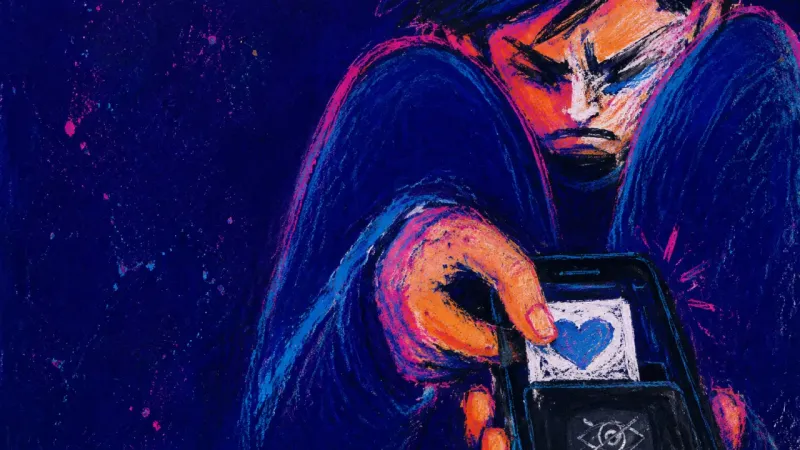
Before she even sat all the way back in the chair, she gave me the scene in one breath. Wednesday, 12:47 a.m., west-end roommate apartment, blue phone light striping the duvet, streetcar hum leaking through the window, her phone hot in her hand. A kind text already read twice. Pinch-zoom. Screenshot. Move to Hidden. Jaw set. Chest hollow. Relief for maybe three seconds.
'I know it sounds dramatic,' she said, looking down at her thumbnail, 'but if I don't save it, part of me acts like it never really happened.'
I shook my head. 'That isn't dramatic. Your camera roll is not random; it's organized uncertainty.'
She laughed once, without much joy. Out in daylight she looked like the competent junior brand strategist who could keep a deck moving, answer a Slack thread, and survive a packed TTC commute. But in private, she was caught between wanting to feel secure without saving every meaningful moment and fearing that without proof the warmth would be doubted, forgotten, or somehow stop feeling real. She was outsourcing self-trust to digital receipts. Her self-doubt felt, to me, like a notification buzz trapped under a pillow: small, constant, and impossible to fully ignore.
'A lot of screenshot-hoarding is just reassurance-hoarding with better folders,' I told her. 'So let's not shame the habit. Let's map it. Our whole journey today is about finding clarity, about why your thumb reaches for evidence, and how to let your own noticing count again.'
Choosing the Map: A Five-Card Cross for Self-Trust
I asked Maya to take one slow breath with me, not as a mystical performance, just as a way to get her out of the scroll and back into the room. Then I shuffled slowly, the soft paper sound filling the space the way a record needle settles before the music starts.
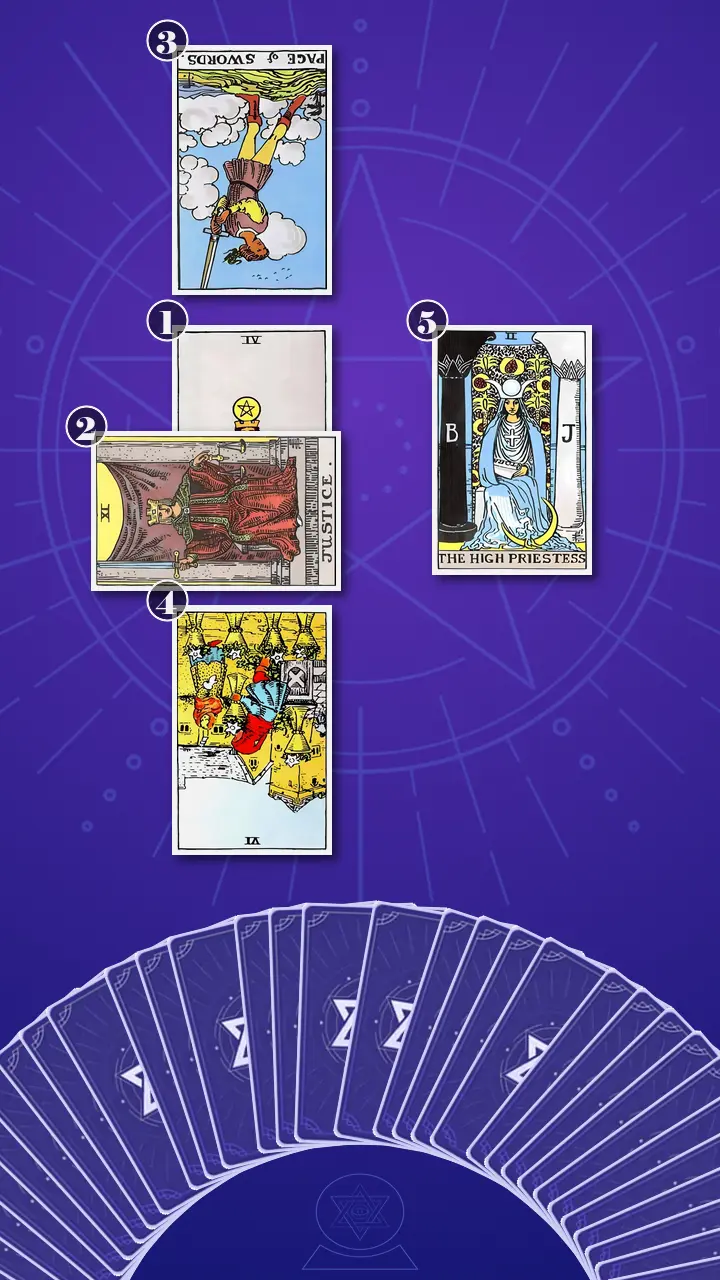
'Today I'm using the Five-Card Cross · Context Edition,' I said. For anyone who has ever wondered how tarot works with a habit like this, this is why I chose it: her question was not really about predicting an outcome. It was about tracing a modern digital reflex back to its emotional logic with the fewest cards needed. One card would show the visible behavior. One would show the friction point. One would name the mental script. One would take us under the floorboards to the older pattern. And one would point toward the corrective wisdom, the actual next step.
I laid the cards into the cross. The first card sat at the center as the most visible pattern in her life right now. The second crossed it, because the blockage in this kind of reading is rarely subtle. The third rose above it, where the mind keeps running its script. The fourth dropped below, where the younger echo usually lives. And the fifth opened to the right like a side door: the integration path, the place where self-trust can begin.
Holding, Arguing, Watching, Remembering
The Center of the Knot: Four of Pentacles, Upright
I turned over the first card. 'Now we're looking at the position that presents the observable problem: saving and hoarding screenshots as emotional evidence. The card is the Four of Pentacles, upright.'
I always pay attention to the body language of this card. The pentacle pressed to the chest. The coins pinned under the feet. The fixed posture. In Maya's life, it looked exactly like this: late at night, she screenshots 'proud of you,' 'thinking of you,' or a sweet plan and moves it into Hidden before sleep. The moment feels safer once it is pinned down than when it is simply felt. Saving becomes the first response instead of receiving.
'This is contracted Earth,' I told her. 'An excess of holding. Not clutter for clutter's sake, control as comfort. Each screenshot says: if I can keep this close enough, maybe it can't move, maybe I can't lose the meaning of it.'
She gave a small, pained laugh and tipped her head back. 'That is so accurate it's honestly a little rude.'
'I know,' I said, smiling. 'But it's useful. This card asks a simple question: what kind of loss are you trying to prevent each time you hit save?'
Her fingers started rubbing the edge of her sleeve. Defensive humor first, then recognition. That was the first soft crack in the pattern.
The Crossbar: Justice, Reversed
I touched the second card where it lay horizontally across the first. 'This position reveals the core blockage: the internal demand that truth, worth, or safety must be justified and documented. And here we have Justice, reversed.'
'This is the inner courtroom,' I said. 'Not memory. Litigation.'
I described the modern scene the card brought up for me with painful clarity: a TTC ride home, fluorescent light flickering, somebody's tote brushing her knee, her phone hot in her palm while she zooms in on one sentence, then the punctuation, then the timing of the reply, trying to decide whether the warmth was real or whether she read too much into it. The scales weigh every word. The sword cuts a living moment into evidence and verdict.
'This is blocked balance,' I said. 'Justice reversed is not asking for truth. It's asking for a harsher standard than truth. It says your experience only counts if it can survive cross-examination.'
For a second I had a flash of the radio booth I spent years in before I ever read cards professionally, me staring at a waveform blown up on a studio screen, every tiny peak looking definitive. Sound taught me something early: zooming in does not create truth. It only creates more detail. Human moments are exactly the same.
'A screenshot can store words,' I told her softly. 'It cannot decide whether your experience was real.'
Maya winced. Her breath stalled halfway in, then left her in one long exhale. 'Inner courtroom is exactly it,' she said. 'I keep thinking, I know this sounds intense, but I need the exact wording.'
'Right,' I said. 'And that is the blockage. Reflection turns into prosecution, and the proof never quite feels like enough.'
Above the Knot: Page of Swords, Reversed
I turned to the card above the center. 'This position names the conscious cognitive pattern: the hyper-vigilant scanning, replaying, and collecting data instead of resting in direct experience. The card is the Page of Swords, reversed.'
This one was all weather. Sideways stance. Raised sword in the wind. Trees bent by nervous air. In Maya's life it looked like a good message from a manager or a warm text from someone she liked landing on her phone while she was still on the TTC. Within seconds she was rereading it, comparing the tone to last week, checking timestamps, and screenshotting it before her own mind could invent a harsher version. She was not just reading. She was monitoring.
'This is excess Air,' I said. 'Fast, clever, restless. It's the part of you that mistakes surveillance for safety. You read tone shifts like stock-market movement when the market is your nervous system. A nice moment barely arrives before your brain starts running QA on it.'
'That is... offensively correct,' she said, and this time the laugh came with a tight nod.
'What sentence usually fires in the ten seconds before you save?' I asked.
She answered immediately. 'What if this changes later?'
'Exactly. That's the Page reversed. Connection turns into surveillance footage. The archive grows faster than clarity.'
Her shoulders had crept nearly to her ears without her noticing. When I named it, she let them drop a fraction. Not peace yet. But she could see the loop in real time now.
Beneath the Archive: Six of Cups, Reversed
I turned over the fourth card below the center. 'This position uncovers the deeper past imprint behind your phrase kid me and the older need to keep proof. The card is the Six of Cups, reversed.'
The whole room softened when this card appeared. Two children. A protected courtyard. Cups full of flowers. In modern life, I translated it like this: Sunday night at the tiny kitchen table, dish soap and garlic still in the air, laptop warm from weekend catch-up, and suddenly Maya is inside months of screenshots: 'so proud of you,' 'can't wait to see you,' calendar invites, little moments of being chosen. It has an almost Inside Out core-memory feeling, except the memories are stored in Hidden.
'This is old Water coming up,' I said. 'Not random nostalgia. A younger part of you learned that warmth might disappear, or get revised later, or stop feeling accessible unless it was preserved. So the phone became a tiny digital museum of proof.'
Her face changed then. First the jaw loosened. Then her eyes went glassy in that unfocused way people get when they are not looking at me anymore but at a much older room inside themselves.
'When every feeling becomes evidence,' I said more quietly, 'the moment never gets to become memory.'
She swallowed. 'I think the worst trigger is being remembered,' she said. 'Like if someone follows up, or says they were thinking about me, I want to save it before my brain ruins it.'
'That makes sense,' I told her. 'It does not make you ridiculous. It makes the pattern understandable. The screenshot is not just about now. It's soothing an older safety rule.'
When the High Priestess Asked for No Receipt
The Side Door: The High Priestess, Upright
I placed my fingers on the final card before I turned it. The radiator had just clicked off, and the sudden quiet felt like a fader pulled down in a studio. 'This is the heart of the reading,' I said. 'The position that offers the key shift and integration path from evidence-seeking toward self-trust.'
I turned the card over. 'The High Priestess, upright.'
I looked at the veil, the scroll resting in her lap, the calm between the pillars. Then I translated it into Maya's life: a kind message lands, and instead of saving it immediately, she puts the phone face-down for one minute, notices whether her chest softens or stays braced, and writes in Notes, 'What I know right now is...' Only after that does she decide whether a screenshot is actually needed.
'This card does not offer more data,' I told her. 'It offers stillness.'
'Here is the setup,' I said. 'It is 12:47 a.m. in a dark Toronto bedroom. Your phone is hot in your hand. You are moving one kind text into Hidden like a document you might need for court later. You're still living inside the old logic that the right archive will finally make you feel safe.'
Stop putting every feeling on trial; step behind the High Priestess's veil and let inner knowing count before the screenshot does.
'The screenshot reflex is not proof that you're dramatic,' I added. 'It is proof that some part of you still thinks only documented feelings are safe. The shift is letting your own noticing count first.'
I let the sentence sit there.
Maya's reaction came in three visible waves. First, a freeze: her breathing paused and both hands went still in her lap, as if even her fingers had forgotten what to do. Then the recognition: her eyes lost focus, not blank exactly, but replaying: bedroom, Hidden folder, the manager's Slack message, the after-date text, all of it stitching together at once. Then the feeling broke open in a way neither of us expected.
'But if I stop doing that,' she said, sharper now, a flash of anger underneath the ache, 'doesn't that basically mean I've been wrong this whole time?'
'No,' I said immediately. 'It means you've been protected by a system that learned to overwork. Protective is not the same thing as wrong.'
That landed. I watched her shoulders come down in slow motion, watched the fight leave her jaw, watched the tiny disorientation that sometimes follows a real insight, the almost dizzy feeling of putting down a heavy bag you've carried so long it felt like part of your body. Her eyes filled, but her face looked less embarrassed than relieved.
'In my practice, I call this a Breath Soundtrack,' I told her, bringing in the tool I've built from years of sound work. 'Before the screenshot, give your nervous system a beat to hear itself. Inhale for four, exhale for six, and leave one quiet beat at the bottom. Not to force calm. Just to let the body register the song before the archive starts. It is how I teach people to hear the body's push notification before the app notification: before I save, what do I already know?'
'Try this once in the next 24 hours,' I continued. 'When a message lands and your thumb wants to save it, set a 60-second timer. Put the phone face-down. Notice your chest, jaw, and shoulders. Then write one line: What I know right now is... You can still screenshot after the minute if you want. This is not a ban. And it's not for logistics, safety, abusive dynamics, or anything you genuinely need documented. It's a permission-based experiment.'
She nodded, slower this time. I asked, 'With this new lens, was there a moment last week when that would have changed how you felt?'
'Yeah,' she said after a beat. 'My manager Slacked me great job on this and I screenshotted it before I even let myself feel proud.'
'That's the shift,' I told her. 'Not from caring to not caring. From evidence-driven self-doubt to quiet self-trust. From inner courtroom to inner witness.'
'Let your noticing arrive one beat before the receipt,' I said. 'That's the medicine in this card.'
From Case File to Memory
Once all five cards were on the table, the story was clean. The Four of Pentacles showed the Holder, the part that keeps emotional evidence close. Justice reversed showed the Internal Judge, the part that demands proof before a feeling can count. The Page of Swords reversed showed the Watcher, the mind that rereads, monitors, and screenshot-hoards instead of settling. The Six of Cups reversed showed the Younger Self, the old safety rule that says warmth should be preserved before it can vanish. And the High Priestess showed the Inner Witness, the adult part capable of holding truth calmly, privately, and without putting it on trial.
That was the blind spot: Maya had been treating documentation as the source of safety, when the real need was self-witness plus the courage to name what mattered. More evidence was never going to finish the job. It could soothe the spike, but it also trained her to trust the archive more than her own perception. What looked like a weird phone habit was actually a coherent internal system: holding, arguing, watching, remembering. Now she had a way to interrupt it.
I gave her small, practical next steps. Not a purge. Not a phone detox lecture. Just a way to move from screenshot-hoarding and reopening chats for proof toward body-first trust and actionable advice she could actually use in Toronto life.
- The No-Receipt MinuteThe next time a kind text, Slack compliment, or 'thinking of you' message lands, set a 60-second timer where you already are: on your duvet, at your desk, or standing at the kitchen counter. Put the phone face-down and name three things out loud or in Notes: what happened, what you felt, and what your body did.Use my Breath Soundtrack if your mind races: inhale for 4, exhale for 6, one quiet beat. Even 20 seconds counts. You are not banning screenshots; you are letting your perception go first.
- What I Know Before I SaveCreate one Notes page called 'What I know before I save.' After one emotionally loaded interaction this week, write a single sentence before opening the screenshot or scrolling back through the thread: what you believe happened and why it mattered.Start with one recent, low-stakes interaction, not the most loaded thread of your life. If shame spikes, that is information, not failure.
- One-Stop White Noise First AidOn your commute home or anytime you catch yourself rereading for tone, put your phone in your bag for one TTC stop, one elevator ride, or the length of the kettle boiling. Track your jaw, chest, and shoulders instead of the message thread.If city noise makes the spiral louder, use my White Noise First Aid: low pink noise, rain, or plain train rumble in one ear, just enough to interrupt surveillance mode. Skip this for urgent work, logistics, or anything that truly needs a fast response.
None of these steps asked her to become a different person overnight. They asked her to practice one new order of operations: body first, archive second. That is how self-trust grows in real life.

A Week Later: The Quiet Proof
A few days later, Maya sent me a message. Short, almost casual: 'Did the one-minute thing with a friend's thinking of you text. I still wanted to screenshot it. But I wrote, What I know right now is that I felt softer before I felt suspicious. I didn't need Hidden right away.'
That was enough for me. Not because her whole life was suddenly solved, but because the first evidence of change was there: she had let a meaningful moment register before turning it into a receipt. She had made the smallest possible move from surveillance to receiving.
Clear but still human: she told me she finally slept a full night, but woke with the old thought, what if I read it wrong? This time she smiled, checked her Notes before her screenshots, and got out of bed.
That is what a Journey to Clarity usually looks like in my room. Not certainty descending like stage lights. More like the nervous system softening enough that your own voice becomes audible again.
When your chest tightens the second something tender lands and your thumb moves to save it before you even feel it, you are not being dramatic; you are trying to keep reality from being rewritten.
If one meaningful moment this week did not have to become evidence right away, what might it feel like to let your own noticing hold it first, one beat before the receipt?
Every reading at AceTarot is a Journey to connect with inner wisdom and empower next step.
Learn more about our Journey to Clarity.