Paid Bills, Clean Room, Replied Texts: Learning What Counts as Enough

The 7:18 Kitchen Counter
If you're a late-20s office worker in Toronto who does the Friday adulting lap—rent, cleaning, text replies—and still ends up refreshing your banking app at the kitchen counter, I know that look. When Maya (name changed for privacy) came to me, she was living inside that exact kind of life admin burnout: productivity guilt after chores, paid bills, and a clean room that still did not feel like enough.
She was 27, a marketing coordinator in hybrid work, which meant her day technically ended on schedule while her brain kept running like a three-tab security system long after the laptop closed.
She described 7:18 p.m. in her small apartment kitchen so clearly I could almost smell the citrus spray myself. Rent was paid. The counter was wiped down. Two overdue texts were finally answered. She was barefoot on cool tile with the fridge humming behind her and that faint overhead-light buzz above, flipping from her bank app to Google Calendar to Gmail with one thumb, shoulders rising higher each time the screen refreshed.
"I did all the adult things today," she told me, "so why do I still feel late to my own life?"
I asked her, "You did the responsible thing, the responsible thing, and the responsible thing—so why does your body still act like you forgot something?" She gave me a tight little laugh, because she knew that was exactly it.
That was the whole contradiction in one sentence: she wanted proof that daily life was finally under control, and at the same time she feared that if even one small thing slipped, it meant she was already behind. The feeling on her face was not dramatic panic. It was smaller and crueler, like trying to breathe in a top pulled one size too tight—nothing visibly wrong, just a chest that would not fully open and shoulders that never got the memo that the emergency was over. I told her gently, "You are not failing adulthood; you are stuck in a moving finish line. Let me help you draw a map through it."

Choosing the Ladder for Finding Clarity
I asked her to plant both feet on the floor and take one breath she did not need to earn. Then I shuffled slowly. I never use that moment as theater. It is simply a way of helping the mind stop sprinting ahead long enough for the real question to come into focus.
For her, I chose the Four-Layer Insight Ladder tarot spread. When people ask me how tarot works with something as ordinary and maddening as, "Why can't I relax after chores and errands are done?" this is exactly the kind of spread I trust. The visible tasks are not the true problem. The pain comes from the meaning attached to them. Four cards are enough to show the whole chain without turning clarity into one more complicated system.
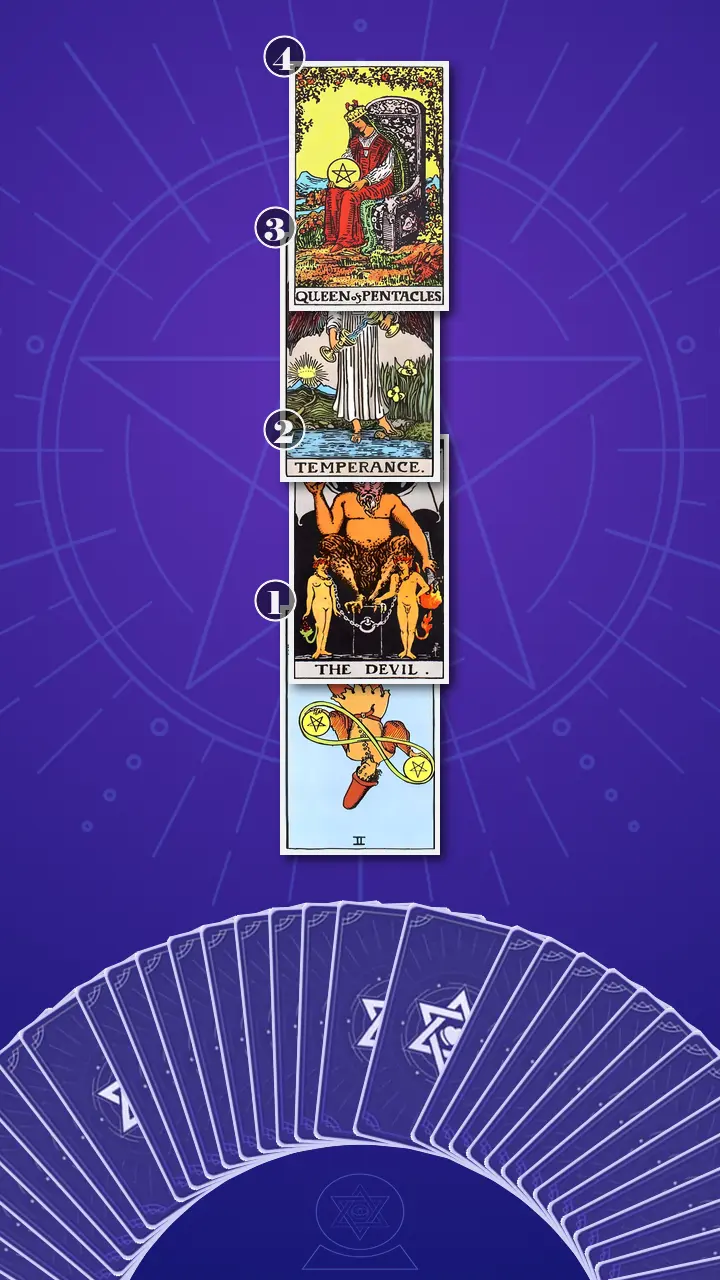
I told her what I was looking for: the first card would show the catch-up behavior she could already name; the second would reveal the hidden belief feeding it; the third, the key turning point—the card that could replace urgency with rhythm; and the fourth would show the embodied next step, the way responsibility could become care again instead of a scorecard. In card meanings in context, this ladder matters because the eye rises from symptom to root to remedy to real-life action.
Reading the Map: Where Completion Turns Back Into Scanning
Position 1: The Tab That Never Quite Closes
I turned over the card representing the observable catch-up behavior named in her story: completing practical tasks, then instantly scanning for what still needed attention. It was the Two of Pentacles, reversed.
I told her what I saw immediately. This card was Maya on a Friday evening after rent, cleaning, and delayed text replies were technically done, yet she was still at the counter toggling between her banking app, inbox, and calendar because every finished task instantly mutated into the next thing she had to keep in motion. The infinity ribbon around the pentacles became that app-switching cycle: check, reassure, recheck, still not settled. It had the exact energy of the too-many-tabs-open meme, except the tabs were her actual life.
Reversed, the card showed earth energy in excess motion and no ground—practical things everywhere, but no place for completion to land. This was not laziness. It was distorted balance. Her evenings had a bit of The Bear energy to them, except the dinner service was bills, laundry, unread messages, and one nervous system trying to plate all of it at once. "Okay. Done. Wait—what about..." That was the rhythm of the card.
She let out a short laugh and rubbed her forehead. "Why is the bank app, Gmail, calendar combo so real?" she said. Her mouth smiled, but her shoulders stayed braced, which told me recognition had arrived before relief.
Position 2: The Loose Chain Under the Checklist
I turned to the card representing the hidden root: the fear that unfinished life admin meant personal inadequacy. The Devil appeared upright.
I always look at the loose chains first in this card. This was the private rulebook underneath her behavior: a slightly messy room, a late reply, or one budget category going off plan stopped being ordinary life and started feeling like evidence that she was irresponsible, slipping, or not worthy of relaxing yet. Care and surveillance can look similar from the outside. Paying rent is care. Wiping the counter is care. Answering a text is care. But when each one becomes evidence in a private performance review that never closes, The Devil has entered the room.
Its energy was constriction—earth hardened by shame, urgency taking the place of trust. In the Highlands where I was raised, I learned to watch how animals keep leaning against a gate long after it has swung open; the body can go on obeying a boundary the land no longer requires. This card felt like that to me. The chains were loose, but the belief was still wearing them. Her mind had started treating neutral notifications like Black Mirror-coded verdicts.
I asked her quietly, "If one message waits until tomorrow, or one hoodie stays on the chair, what does your mind say that proves about you?" She went still, swallowed once, and looked away from the screen. "That I'm the kind of person who can't keep it together," she said. "It's not the task. It's what I think the task says about me."
That was our hinge. The problem was no longer just overchecking. It was the moral weight glued to overchecking.
When Temperance Poured Between Two Cups
Position 3: The Turning Point from Urgency to Rhythm
When I turned the third card, the whole reading seemed to inhale differently. This was the position that identifies the key transformation: moving from earning rest through completion to practicing moderation, pacing, and enoughness. The card was Temperance, upright.
I felt the room soften around us. On my desk, the lamplight caught the pale edge of the card, and on her side of the screen even the fluorescent buzz in her kitchen seemed less like an accusation and more like background noise. Temperance is not dramatic. That is precisely why it changes people. It is the card of measured flow. One foot on land, one in water. Enough energy here, enough there. Not finished forever. Just enough for tonight.
In my work, I call this Body Signal Interpretation. When I said the words "realistic stopping point," Maya's shoulders dropped half an inch before her jaw agreed. Her body recognized relief before her inner taskmaster permitted it. Then I brought in what I think of as elemental balance: the reading had begun with unstable earth and trapped fire—chores, money, messages, and urgency all sparking against each other. Temperance introduced water between them. It did not erase responsibility; it gave responsibility a livable pace. For a brief moment I thought of Highland streams after rain. They do not prove themselves by emptying the whole hillside in one night. They move steadily because they have banks.
I asked her to picture that Friday night again: rent paid, kitchen smelling clean, the overdue text finally sent, and still standing there refreshing the bank app because her body had not accepted that the shift was over.
You are not here to keep proving your worth by spinning every plate; you are here to pour your energy with intention, like Temperance, until balance becomes stronger than urgency.
I let that sit between us for a moment, then added, "Being on top of life is not the same as being at peace with life. Relief is not the reward for clearing everything; it starts when you decide what counts as enough tonight."
When the sentence landed, Maya froze in three visible stages. First, her breath stopped halfway in and her thumb held against the rim of her mug as if she'd been caught mid-scroll. Then her eyes lost focus, not on me and not on the card, but somewhere just over my shoulder where I could almost see her Friday kitchen replaying itself—paid rent, clean counter, open apps, no arrival. Then came the emotion she had not expected: irritation, almost anger. "But doesn't that mean I've been doing this wrong?" she asked, and there was a sharpness in it that told me relief had shown up carrying grief behind it. I answered softly, "No. It means your nervous system learned that urgency was safer than stopping." Her shoulders dropped another inch. Her jaw unclenched more slowly. She let out a shaky breath that sounded like the first real exhale of the session. I asked, "With this new lens, can you think of one moment last week when ending the night on purpose would have changed how your body felt?" She nodded. "After the hydro payment," she said. "I could have stopped there."
That was the crossing. Not from irresponsibility to discipline, but from tight, restless catch-up mode toward grounded enoughness and paced self-trust. An unfinished task is not a character reference.
I told her we would make the insight concrete with a simple Enough for Tonight experiment: choose up to three maintenance tasks, stop when they are done, write down any leftover task instead of solving it, and keep the phone out of reach for ten minutes. If ten felt too sharp, I said, we could make it two. The point was never to force calm. It was only to practice a boundary.
The Queen Who Sat Down in a Lived-In Room
Position 4: The Grounded Caretaker
The final card sat in the place of embodied action: the practical daily stance that could make this insight livable. It was the Queen of Pentacles, upright.
I loved seeing her there. This card looked like a home rhythm where dinner, laundry, budget awareness, and friendship maintenance belonged inside an ordinary, supportive life—not inside a courtroom. The pentacle in the Queen's lap is not being chased around the room. She is holding practical life steadily. Less clean-girl perfection, more a cozy apartment that actually supports you.
Its energy was balanced earth: grounded, warm, sufficient. The healing move was not doing more perfectly. It was staying in the body long enough to receive what had already been done. I told Maya, "This is support, not a score." Phone face down. Actual dinner. Soft socks. A lamp on. Laundry half-finished and still not a crisis. That was the card. She gave me the first calm nod of the night.
From Insight to Action: The Enough-for-Tonight Path
By the time I looked at the full line of cards, the story was clean. Two of Pentacles reversed showed the visible loop: completion instantly turning into the next scan. The Devil showed why it felt so loaded: ordinary upkeep had fused with worth, so a budget check, a messy chair, or an unanswered text could feel like evidence in a case against her. Temperance broke that closed circuit by replacing constant juggling with measured pouring. The Queen of Pentacles finished the lesson by returning her to healthy earth—daily life not as damage control, but as grounded care. In other words, the issue was never that she needed a better personality or a more optimized Sunday reset routine. The blind spot was that she kept using upkeep as proof she deserved rest.
I told her the transformation direction plainly: stop using completion to earn relief, and start setting a finite daily threshold so "enough for today" can count. A sustainable life has edges. When responsibility has no stopping point, it becomes surveillance.
I gave her three practical next steps, small enough to survive a real week in Toronto and specific enough to interrupt the loop without becoming another impossible system:
- Finite Threshold Evening On one evening this week, write down no more than three maintenance tasks before you start—something like pay one bill, answer two texts, wipe the kitchen counter. When the third task is done, draw a line under the list, write "Enough for today. Carry forward is allowed," and move anything left into tomorrow's notes instead of doing it tonight. Keep the bar deliberately small. If three feels like too much, make it two. The discomfort that rises is the old loop complaining, not proof the boundary failed.
- Single Closeout Window Set one 7-minute timer to check your bank app, inbox, and calendar once, in that order. When the timer ends, close all three apps and put the phone face down or across the room for at least 10 minutes. If something important appears, write it in one neutral sentence—"Call hydro tomorrow"—rather than solving it on the spot unless it is truly urgent. Use the same closing phrase every time: "Seen is enough for tonight." If you reopen an app once, simply notice it and begin again the next evening.
- Water-Flow Reset Because Temperance arrived as water in motion, I taught her my shower water-flow meditation technique: after the closeout window, take a three- to five-minute shower or even just wash your hands slowly under warm water, let your shoulders drop, and name out loud what belongs to tonight and what belongs to tomorrow. Pair it with one comfort task before any bonus checking—heat dinner, make tea, put on clean socks. This is not a spa performance. Soup, steam, and one full exhale count. Comfort keeps the system running too.
These were not productivity hacks. They were boundary practices—ways to turn care back into care, and stop treating every unfinished edge as unsafe.

A Week Later: The Quiet Proof
A week later, Maya sent me a voice note. She had tried the three-task threshold on a Thursday: paid one bill, answered two texts, wiped the counter, wrote "Enough for today" on a sticky note, and put her phone on charge across the room. "I hated it for about ninety seconds," she said, laughing, "and then I made noodles instead of reopening the bank app." That was the kind of proof I wanted for her—not a transformed personality, just one interrupted loop.
Her apartment was still lived in. A hoodie was still on the chair. The next morning her first thought was still, "What if I missed something?" But this time she smiled at it, made tea, and checked once. Clearer, not perfect. That is how real change usually enters a life.
When I think back on her reading, that is the Journey to Clarity I trust most. Tarot did not tell her to care less about her life. It showed her how to stop making daily care audition for the role of worth. The Four-Layer Insight Ladder gave her something simpler and kinder: a path from self-monitoring to self-trust, from urgency to rhythm, from scorekeeping to grounded care.
If tonight you are standing in a mostly clean room with the bills paid and the texts answered, and your chest still acts like one unchecked detail could expose something wrong with you, I want you to know I recognize that feeling. Sometimes just naming the difference between care and surveillance is the first loosening.
So when the urge rises to do one more lap through the bank app, inbox, and calendar, what would the first five calmer minutes of your evening look like if "enough for today" were allowed to be real?