Dragging the Same Calendar Blocks Again—And the One-Task Rule That Stuck

The Calendar–Bank–To-Do Toggle Loop, or: Bargaining With the Sink at 10:12 p.m.
You’re the kind of person who looks competent at work, but at 9:30 PM you’re bargaining with the sink like it’s a final boss—classic high-functioning burnout.
Jordan (name changed for privacy) sat across from me in my small Toronto studio space, still half-wearing the day: blazer creased at the elbows, tote bag strap indenting one shoulder like a faint bruise. When they talked, their words came out fast, as if the room itself were on a deadline.
They described Tuesday nights like a loop they couldn’t exit. The faucet drip. The overhead light buzzing. One plate in their hand while their phone glowed with a banking app balance that never felt like “enough.” And in the same breath: Google Calendar open, meeting blocks dragged around like Tetris, again. Their jaw would lock, shoulders rising toward their ears, stomach buzzing like a phone that wouldn’t stop vibrating.
“Sink full, calendar packed, bank low,” they said. “I keep telling myself I’ll just do one thing. One dish. One email. Then I’m in my calendar, then my bank app, then TikTok or Reddit looking for a better system… and suddenly it’s too late to start anything. Why does something as small as dishes feel like a breaking point?”
I watched their fingers worry at a cuticle, the way their foot searched for a stable rung on the chair leg. Overwhelm, yes—but underneath it, a bright thread of fear: if they slowed down, they’d be exposed as incompetent. The feeling had a shape in their body, like standing in winter wind without a coat, bracing for impact that never quite lands.
“We can work with this,” I told them, keeping my voice gentle and plain. “Not by adding more apps, more rules, more pressure. Let’s try to draw a map through the fog—something that gives you one clear next step toward breathing room.”

Choosing the Compass: How This Tarot Spread Creates Actionable Advice
I asked Jordan to take one slow breath—not as a ritual, but as a signal to the nervous system: we’re not sprinting right now. While they exhaled, I shuffled, steady and unhurried, letting the sound of the cards do what rain does on a roof—soften the edges of the room.
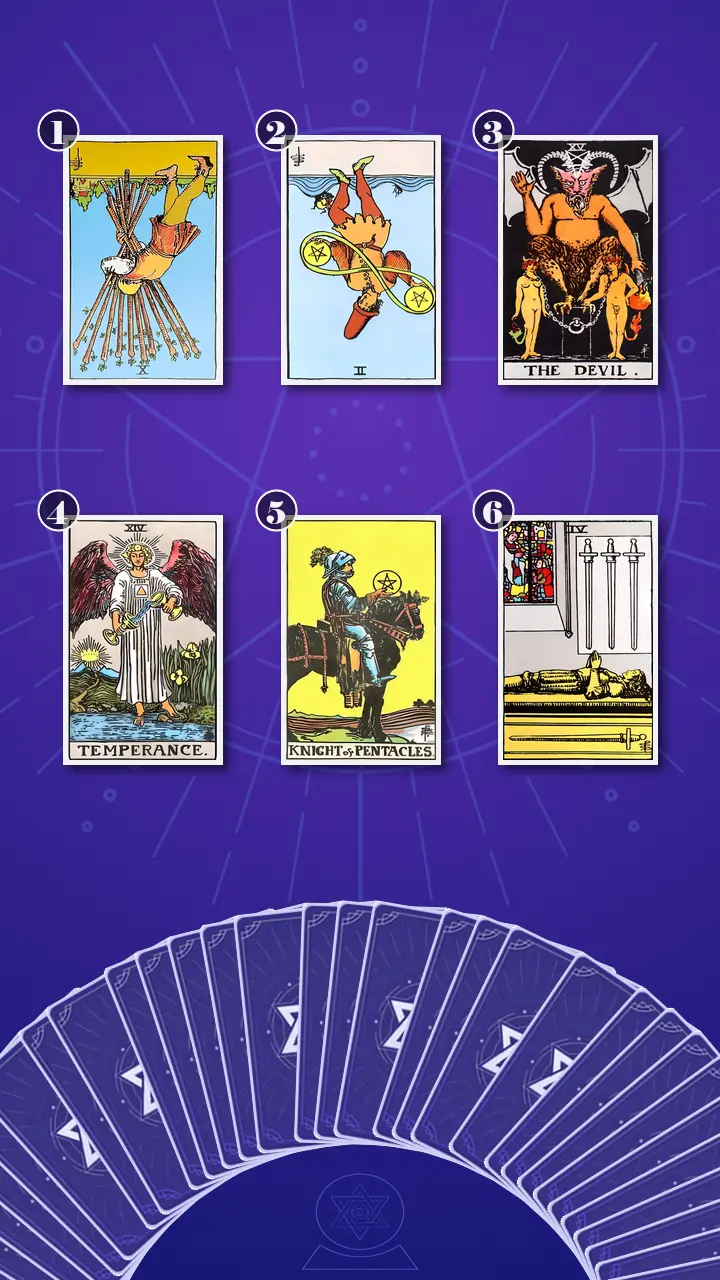
“For this,” I said, “I’m going to use a six-card spread I call the Transformation Path Grid (6) · Context Edition.”
For anyone reading along and wondering how tarot works in moments like this: I’m not using the cards to predict whether Jordan’s life will magically get easier on Thursday. I’m using them as a structured mirror—one that turns a messy, multi-domain problem (home + work + money + body) into a sequence: symptom → blockage → root driver → turning point → next step → integration. That’s why this spread fits a career crossroads / feeling stuck moment that’s really “decision fatigue wearing a suit.” It’s the smallest structure that still holds the whole reality.
In this grid, the first card names what the overwhelm looks like in repeatable behaviors. The second shows the habit that keeps you in motion without completion. The third reveals the underlying rule you’re obeying. Then we find the turning point—what shifts you from urgency to pacing—and we translate that into one practical, repeatable next step, ending with what “this is actually working” feels like in your mind and body.
Reading the Map: Card Meanings in Context, Not in Theory
Position 1: The Overwhelm You Can See (and Feel in Your Shoulders)
“Now flipped over,” I said, “is the card representing your current state as lived behavior—what the overwhelm looks like day-to-day.”
Ten of Wands, reversed.
Even before I spoke, Jordan gave a small, sharp laugh—more exhale than humor. “Okay,” they said, with a bitterness that didn’t try to hide. “That’s… too accurate. Almost rude.”
I nodded. “That reaction makes sense. This card isn’t subtle.”
I told them what the card was already saying through its image: a figure bent forward under too much, carrying a bundle so large it blocks their line of sight. Then I used the life version of it—the one that had brought them here: 9:38 PM in a Toronto apartment, the overhead light too harsh, telling yourself ‘I’ll just do one plate,’ while your mind is also carrying Slack pings, tomorrow’s meetings, and rent math.
In terms of energy, reversed Ten of Wands is overload trying to correct itself. The fire element—drive, effort, responsibility—has become excessive, then collapses into a kind of “I can’t even begin.” The packed calendar and full sink aren’t separate problems; they’re two symptoms of the same bundle.
Jordan’s shoulders tightened as if the card had reached out and hooked its fingers under their trapezius. That was my first opening to use what my family calls listening to the body—what I teach as Body Signal Interpretation. “Notice what your shoulders just did,” I said. “They rose the moment we named carrying. Your body is telling us it’s been treating every task like a weight you must hold at once. Not a sequence. Not a rhythm. A pile.”
Position 2: The Habit That Keeps You Busy but Not Done
“Now we turn to the card representing your primary blockage—the specific habit or pattern that prevents choosing and completing one next step.”
Two of Pentacles, reversed.
I didn’t rush. I mirrored their world back to them, exactly as it happens: the finger hovering over apps, the calendar blocks dragged for the third time, the quick bank-check “just to be safe,” the slide into searching TikTok or Reddit for a better productivity system. And in the background, life keeps rolling like choppy water—new emails, TTC delays, a grocery total that jumps for no reason.
Then I said the line I’ve learned people need to hear when they feel ashamed of their own coping: “If planning feels productive but nothing finishes, you’re not broken—you’re overloaded.”
Reversed Two of Pentacles is imbalance and reactive switching. Earth energy—money management, time management, logistics—gets shaken. When earth is unstable, everything feels like it could tip. So you keep juggling, thinking motion equals control.
I let the contrast land, the inner monologue most people don’t admit out loud: “I’m being responsible” versus “I’m avoiding the risk of choosing.”
Jordan went still in a very particular way: breath paused, eyes unfocused as if replaying a familiar night, then a slow swallow. “The problem isn’t my motivation,” they said quietly, almost to themselves. “It’s the toggle loop.”
“Exactly,” I replied. “And a loop can be interrupted. A personality flaw can’t.”
Position 3: The Rule Under the Rule
“Now we’re looking at the root mechanism—the deeper belief or fear driving the overload cycle.”
The Devil, upright.
There’s a reason this card unsettles people. Not because it predicts doom, but because it names the bargain you didn’t realize you were making.
I spoke in plain language: “The chain isn’t your workload. It’s the inner contract underneath it: ‘If I’m not responsive, I’m not competent.’ So being offline feels like being caught. Leaving dishes overnight feels like a character flaw. A low balance doesn’t just mean ‘tight month’—it triggers ‘I’m unsafe.’ And then your brain tries to regain safety through checking.”
In energy terms, this is compulsion. Not laziness. Not a lack of discipline. A binding pattern that equates worth with output and control.
Jordan’s throat worked, like they were pushing down something hot. Their hands clenched, then opened, then clenched again. “It’s… embarrassing,” they admitted. “Because objectively I’m doing fine at work. People trust me. But I’m terrified someone’s going to realize I’m one missed step away from everything collapsing.”
“That’s the Devil’s specialty,” I said softly. “It makes ‘one missed step’ feel like exile.”
When Temperance Spoke: A Pace Your Nervous System Can Believe In
Position 4 (Key Trigger): The Turning Point That Changes the Transfer Method
“Now we turn over the card representing your key trigger for change—the balancing principle that shifts you from urgency to pacing.”
The room felt quieter as I revealed it, the way a kitchen quiets when the kettle clicks off.
Temperance, upright.
I described the angel’s steady pour between two cups. One foot on land, one in water. A path leading to sunrise. Not a sprint—an integration. In modern life, it looks like this: stopping the “solve my whole life tonight” spiral and doing a measured transfer instead—ten minutes of one home task, then a short reset, then one tiny work prep—and then you stop.
Then I brought in my second lens—Elemental Balance, the way I was taught to read humans the way you read weather. “Your spread begins with overloaded Fire,” I told them, “the pushing and pushing of responsibility. Then shaky Earth—money and time management that won’t settle. The Devil tightens the air in the room, like a pressure system that won’t move. Temperance is what happens when we bring in Water—regulation, flow, kindness to the body—without losing Earth. It’s not ‘do less because you’re weak.’ It’s ‘sequence your energy so it stops spilling.’”
Jordan’s eyebrows pulled together. Resistance flashed across their face, quick as a match strike. “But I don’t have time to pace,” they said. “If I slow down, things pile up. I’m not being dramatic. It’s rent. It’s work. It’s…” Their voice thinned at the end.
That was the setup, the exact moment the old system argues for itself: the plate in hand, brain dragging calendar blocks, bank balance feeling like an emergency. You can hear the urgency trying to hire itself as your manager.
You don’t need to carry more or juggle faster; you need to pour your energy with intention, one measured step at a time, like Temperance.
Silence. Not awkward—alive.
Jordan’s reaction came in a small chain, the way truth often arrives. First: a physical freeze, breath caught high in the chest, fingers suspended above their own knee. Second: the mind conceding a crack—eyes glossy, unfocused, as if they were watching their last month from above, seeing the pattern without being inside it. Third: the release, almost imperceptible at first—shoulders dropping a centimeter, then another; jaw loosening like a knot finally given permission to untie.
“But if that’s true…” they whispered, and there was a brief flare of anger under it, not at me—at the whole bargain. “Does that mean I’ve been doing it wrong? Like… I’ve been punishing myself for no reason?”
“It means you’ve been surviving with the tools you had,” I said, and I meant it. “And now we’re negotiating a new contract: worth is no longer paid in exhaustion.”
I offered them the Temperance contrast—two versions of the same evening, so their body could feel the difference, not just understand it.
Version one: overhead light harsh, phone face-up, calendar open, bank app checked, one dish half-washed, then scrolling ‘how to stop being like this’ until midnight. You go to bed wired-tired, jaw still braced, brain still working a shift.
Version two: you set a timer for ten minutes. You do one home task—dishes—until the timer ends. You stop. You turn the overhead light off and switch to a softer lamp. You take a shower like a reset, not a rush. You do one tiny work prep—one email draft, one meeting note—and then you stop again. Phone goes face-down. Breath slows. The day is not “solved,” but your nervous system receives a new message: we are not in danger because one thing remains undone.
“Now,” I asked, “with this new perspective—can you think of one moment last week when this would have changed how you felt? A moment when pacing would have been kinder and, ironically, more effective?”
Jordan blinked hard. “Sunday,” they said. “The meeting wall. I kept dragging blocks around like it would make me feel safe. If I’d just… picked one thing and stopped… I would’ve eaten dinner.” They exhaled, shaky but real. “This isn’t about the perfect system. It’s… a pace my nervous system can believe in.”
That was the pivot I wanted them to taste: not from “lazy” to “productive,” but from wired-tired compulsive checking to paced, grounded follow-through. From panic-at-the-backlog toward a small, protected calm.
Position 5: One Finished Cycle, Not Five Rewritten Plans
“Now we turn to the card representing your actionable next step—a practical behavior that embodies ‘one step’ in real life.”
Knight of Pentacles, upright.
The knight sits still on a steady horse, holding one pentacle at eye level like it’s the only thing that exists. I told Jordan the modern version: pick one boring, stabilizing routine and commit to it like it’s a standing meeting—fifteen minutes of dishes with a timer, or a weekly money check-in once, not five times a day.
In energy terms, this is Earth in balance: reliable, repeatable, not dramatic. And I gave them the phrase that cuts through decision fatigue: “One finished step beats five re-written plans.”
Jordan nodded, but then they winced. “What if I do the one thing and everything else still feels like it’s on fire?”
“Then we don’t pretend it isn’t,” I said. “We just stop responding to fire by throwing your whole body into it. The knight doesn’t chase every alarm. The knight completes one cycle. That’s how you rebuild trust—with yourself.”
Position 6: Rest as Infrastructure, Not a Reward You Earn
“Finally,” I said, “this card represents integration—what it feels like when the new approach is working and becomes sustainable.”
Four of Swords, upright.
I described the protected stillness: a deliberate pause after strain, a space where the nervous system can stop treating every task as urgent. Then I said it exactly, because Jordan needed it to be simple: “Rest isn’t a reward. It’s part of the architecture.”
Jordan’s eyes drifted to the window, to the dull winter light fading early—the Toronto kind that makes you forget what “off” even feels like. “I don’t know how to stop,” they admitted. “The moment I stop, guilt shows up.”
“Guilt is often just urgency wearing a different coat,” I said. “We’ll build an off-switch that’s real enough for your body to trust.”
From Insight to Next Steps: The Temperance Pour Method in the Next 24 Hours
Here’s the story your spread told, start to finish: you’ve been carrying raw materials like the Ten of Wands—too much responsibility creeping into every corner of life. Then you try to manage it with juggling—re-planning, checking, switching—Two of Pentacles reversed, which keeps you moving without completion. Underneath, The Devil holds the contract that says your worth depends on output and availability. Temperance breaks that contract not with a grand reinvention, but with a new transfer method: measured pacing. The Knight of Pentacles turns that pacing into one repeatable cycle. And the Four of Swords makes recovery the roof that lets the whole structure stand.
The cognitive blind spot I want to name gently but clearly: you’ve been treating your nervous system like an obstacle—something to push through—when it’s actually part of the plan. No system will work if your body is braced like every undone dish is a threat. The transformation direction is equally clear: from managing everything simultaneously to choosing one stabilizing anchor action per day, letting “good enough” be the system, and protecting rest as infrastructure.
Jordan looked at me like they were about to object again, then stopped. “Okay,” they said. “But I need it to be… embarrassingly simple. Or I won’t do it.”
“Good,” I said. “Temperance likes embarrassingly simple.”
- The 10-Minute Temperance Pour (Tonight)Pick ONE container: home, time, or money. Set a 10-minute timer. Do ONE stabilizing action inside that container (e.g., wash dishes until the timer ends). When the timer ends, stop—even if it’s unfinished.If your brain yells “This won’t be enough,” name it: “That’s urgency talking.” If 10 minutes feels impossible, do the 5-minute version and still stop on time.
- One-Task-Before-Tabs Rule (Tomorrow)Before you reopen Google Calendar, your banking app, or your to-do list, finish ONE small task to completion (send one email, wash five items, pay one bill). Only then are you allowed to “plan.”Put a sticky note by your laptop or sink that says: “One pentacle.” It’s a visual interrupt when the toggle loop starts.
- A Water Reset You Don’t Have to Earn (This Week)Use my shower water-flow meditation technique once this week: stand under the water for 2 minutes and let it be a boundary between “work mode” and “human mode.” No problem-solving. Just feel the temperature, the pressure, your jaw unclench.If guilt spikes, place one hand on your chest and breathe out longer than you breathe in. This is not self-care as performance; it’s nervous-system regulation so you can actually do the next small step.

A Week Later: The Quiet Proof of Finding Clarity
Eight days later, Jordan messaged me at 7:14 a.m. It wasn’t a victory speech—just a photo of their sink with a visibly smaller pile and a caption: “I did the 10-minute timer thing. Stopped when it went off. Didn’t spiral. Also—only checked my bank once yesterday. My jaw feels… different?”
They added, after a pause: “I went to bed at 11:30. Woke up and my first thought was still ‘what if I’m behind?’—but this time I laughed a little, made coffee, and did one anchor task before opening anything.”
That’s the kind of change I trust. Not perfect. Not cinematic. But structural. A tiny off-switch installed. A single finished cycle. A nervous system learning, inch by inch, that life admin is not a moral trial.
This is what our Journey to Clarity looked like in real terms: moving from wired-tired overwhelm and compulsive checking to paced, grounded follow-through and protected calm—one measured pour at a time.
When everything feels urgent, even washing one plate can feel like a test of whether you’re secretly failing—so your body stays braced and your mind keeps switching, because stopping feels riskier than sprinting.
If you let “one measured step” be enough for the next 24 hours, what’s the first tiny action you’d choose—not to prove anything, just to make tomorrow feel 5% more manageable?
Every reading at AceTarot is a Journey to connect with inner wisdom and empower next step.
Learn more about our Journey to Clarity.