From Sick-Day Overwhelm to Steadier Self-Trust: A 48-Hour Reset

Third Sick Day and Still Checking Slack: Burnout Triage on a Third Sick Day
Third sick day and you still open Slack “just to check”—because being unresponsive feels like a character flaw (hello, Sunday Scaries but on a Wednesday).
Taylor (name changed for privacy) said it like a confession, but their thumb was already doing it anyway—screen up, Slack half-loaded, the little spinning wheel acting like a metronome for panic. They were 29, in Toronto, propped against pillows in a condo bedroom where gray light leaked through the blinds and a humidifier rattled softly like it was trying to keep up with them.
The laptop sat balanced on the duvet. The glow made their eyes sting. Their phone was warm from scrolling. Their limbs had that sandbag heaviness—each movement slow, delayed—yet their chest kept spiking sharp and fast whenever they imagined their inbox.
“It’s my third sick day,” they said. “Work is piling up, my money situation is already tight, and my partner keeps texting ‘How are you?’ which… should be sweet, but it lands like another thing I have to do right. I just need one clean reset, but I don’t know which part of my life gets it first.”
I watched the way their gaze ping-ponged between the laptop and the phone—like their nervous system was trying to keep four plates spinning while their body was actively shutting the power down.
Overwhelm, for Taylor, wasn’t an abstract feeling. It was like trying to keep thirty browser tabs open while the battery sat at 2%—and still attempting a video call with the brightness on max.
“Okay,” I said, gently. “We’re not here to punish you into productivity. We’re here to find clarity: what to stabilize first, so everything else becomes solvable in smaller, cleaner moves. Let’s draw a map through the fog.”

Choosing the Compass: How the Energy Diagnostic Map Works
I asked Taylor to take one slow breath—not as a mystical ritual, just a gear shift. A way to move from doom-scrolling brain to decision-making brain. While they exhaled, I shuffled slowly, keeping their question simple and specific: Third sick day—work, money, love, health: what do I reset first?
“Today we’ll use a spread I call the Energy Diagnostic Map (7) · Context Edition,” I told them. “It’s a circular layout. We circle the problem, name the knot at the center, then walk out with one grounded next step.”
For you reading this: this is why this spread fits burnout triage. The question isn’t binary—health or work. It’s a low-capacity system trying to manage multiple domains at once: symptoms, inner conflict, external pressure, the root belief holding it all together, then resources, transformation, and a next step. Seven cards is enough to cover the whole ecosystem without overwhelming someone who’s already running on fumes.
“A quick preview,” I said. “The first card shows what the third sick day is revealing on the surface—your observable behavior. The center card shows the core blockage, the belief-bond that keeps the loop running. And the sixth card—the transformation position—shows the reset principle that reorders everything without an all-or-nothing crash.”
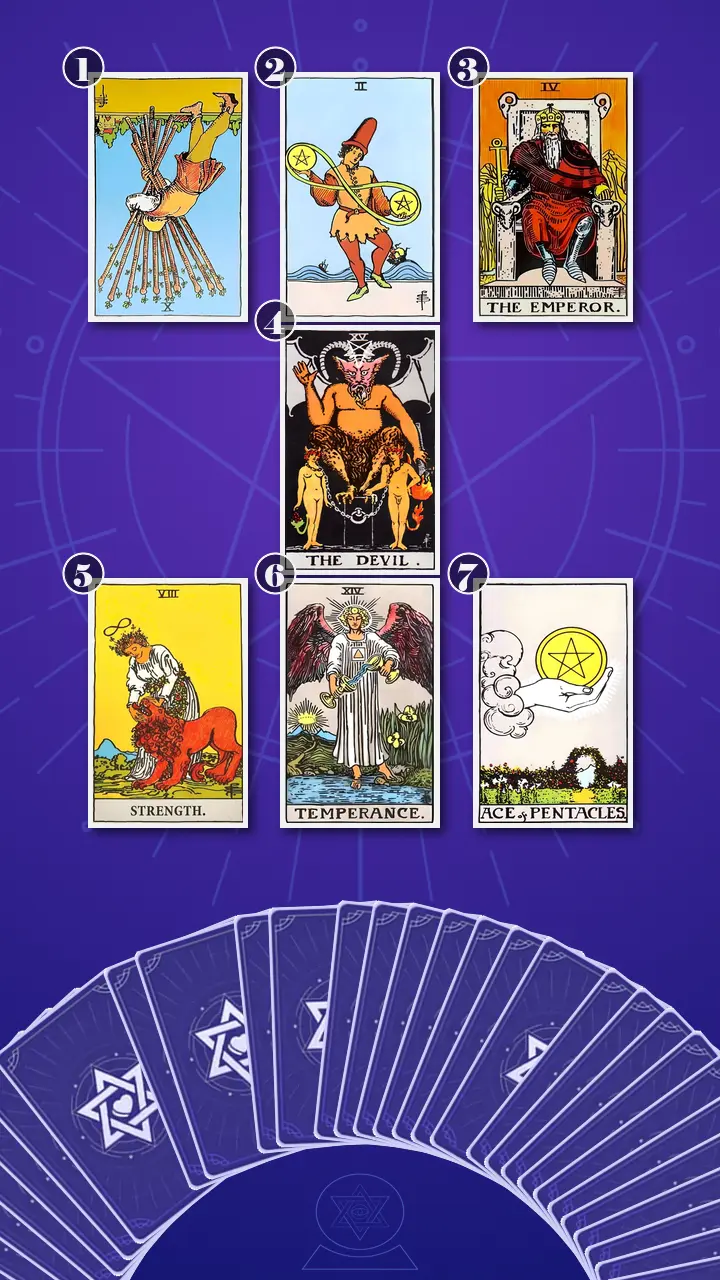
Reading the Map: Card Meanings in Context
Position 1 — Surface symptoms: what the third sick day is showing
“Now the card we turn over is for surface symptoms: what the ‘third sick day’ is showing in observable behavior and energy right now.”
Ten of Wands, reversed.
In modern life, this looks exactly like the scene you already described: it’s 8:30 a.m. and you’re carrying four invisible backpacks—Slack expectations, rent math, relationship responsiveness, and the guilt of being sick. You answer one message from bed, then immediately feel you owe three more so nobody tags you as “unreliable.” Your body throws up a hard stop—fog, heaviness, that weighted-limb gravity—and you interpret the boundary as personal failure instead of… a boundary.
Reversed, the Ten of Wands is overload reaching a limit. The energy here isn’t “more responsibility.” It’s blockage and collapse: too much being carried, too little being set down. The image matters—the wands stacked so high the figure can’t see. That’s what half-working from bed does: it blocks your line of sight until everything is equally urgent.
I mirrored the scene back to them—laptop on duvet, phone warming their palm, eyes darting between Slack and bank balance—then I gave the inner monologue its two clashing scripts: “If I just do one more thing, I’ll earn rest… / If I stop, I’ll look unreliable.”
Taylor let out a short laugh that had a bitter edge to it. “That’s… painfully accurate. Like, rude,” they said, then immediately softened. “But yeah. That’s me.”
“It’s not rude,” I said. “It’s precise. And precision is useful. Your body is already enforcing a boundary. The question is whether you’ll make it intentional—by choosing one burden to put down for seven days—so it doesn’t become a collapse.”
Position 2 — Inner tug-of-war: the juggling pattern and its cost
“Now the card we turn over is for the inner tug-of-war: how work/money/love/health are being juggled and what it’s costing internally.”
Two of Pentacles, upright.
Late morning, you’re toggling like it’s a reflex: Slack → banking app → grocery cart → partner’s text → back to Slack. Nothing gets completed, but the switching itself feels like you’re staying afloat. By evening, you’re exhausted and still feel behind, because juggling isn’t prioritizing—it’s just preventing you from landing anywhere long enough to feel stable.
Upright, the Two of Pentacles is balance under pressure, but in this context it’s balance that’s become a performance. The energy is excess motion. That infinity loop around the juggler’s hands? That’s the “just one more look” muscle memory. It creates the illusion of control while draining the last of your capacity.
“If you had to name the two things you’re juggling every ten minutes,” I asked, “what are they?”
They didn’t hesitate. “Work and money. And then—randomly—my partner’s feelings. Like I’m trying to keep everyone’s dashboard green.”
“Right,” I said. “And your body is the only tab you keep minimizing.”
Position 3 — External pressure: structures that push your priorities
“Now the card we turn over is for external pressure: what structures, expectations, or constraints are pushing the prioritization dilemma.”
The Emperor, upright.
You’re not just sick—you’re also trying to be “solid.” You imagine your manager reading your response time like it’s your work ethic. So you draft a message that sounds composed, efficient, and apologetic all at once. The Emperor is the invisible policy you’re following: be available, be dependable, don’t be messy. Like Severance, where the work-self is expected to keep running even when the real self is very much not okay.
Upright, The Emperor can be helpful structure. Here, the energy is over-identified authority: rules you didn’t consciously choose are deciding your priorities. This is where I get very practical: “Which rule is real—a concrete deadline—and which is assumed—constant availability?” If you can’t point to evidence, it’s likely fear in a blazer.
Taylor stared at the card, then at their laptop. “No one said I had to be online,” they admitted. “But it feels like… everyone is.”
“That feeling is powerful,” I said, “and it’s not the same as a requirement.”
Position 4 — Core blockage: the belief-bond keeping the loop alive
“Now the card we turn over is for the core blockage: the belief-bond or compulsion that keeps the loop going even when your body says stop.”
The Devil, upright.
This is the moment you realize the chain isn’t your job or your bills—it’s the bargain: “If I keep producing, I stay safe. If I rest, I become replaceable.” So you keep half-working while sick, not to get ahead, but to quiet the panic. You refresh your bank balance for reassurance, reread your sent messages for tone, and treat your partner’s care like another requirement. The Devil isn’t saying you’re doing something wrong; it’s naming what’s running the system.
Upright, The Devil is attachment and compulsion. The energy here is bonded fear: a loop that tightens the more you try to escape it through checking. I pointed at the detail people miss—the chains are loose. The figures could remove them. Choice exists, even if it doesn’t feel convenient.
Then I gave Taylor a “receipt list,” gently, like laying artifacts on a table: reopening the inbox two minutes later, rewriting the same sick-day message five times, rereading a manager’s tone, checking rent autopay, checking the credit card, checking Slack again. “Notice the pattern,” I said. “This isn’t rest. It’s negotiation.”
You’re not resting—you’re negotiating for safety.
Taylor went still in a three-beat sequence I’ve come to recognize: first their breath caught—like a tiny freeze. Then their eyes unfocused, as if replaying the last 72 hours in fast-forward. Then a quiet, involuntary “oh” escaped them, and their shoulders dropped a fraction, like a strap sliding off.
“Yeah,” they said. “That’s exactly it. I’m not trying to get ahead. I’m trying not to get… erased.”
My mind flashed, uninvited, to excavation sites: the way a settlement’s decline rarely announces itself with one dramatic event. It’s usually small system failures repeating—water access disrupted, storage mismanaged, trade routes stressed—until people start making desperate, short-term decisions that accelerate the collapse. The Devil isn’t the collapse. It’s the bargain that keeps picking short-term fear over long-term viability.
“If you’re replaceable the moment you get sick,” I said carefully, “was that ever stability—or just constant proof-of-worth?”
Position 5 — Usable resource: what you can access in low capacity
“Now the card we turn over is for usable resource: an internal strength or supportive quality you can access while low-capacity.”
Strength, upright.
Instead of forcing productivity out of a body that’s asking for recovery, you practice a different kind of discipline: you speak to yourself like someone worth taking care of. You set one small boundary (“I’ll check messages once at 12:30”) and notice the world doesn’t end. Strength looks like water, soup, and sleep—plus the quiet courage to let “being dependable” include being offline when you’re unwell.
Upright Strength is balanced power: not adrenaline, not self-threats—just steadiness. The lion here is your alarm system: the chest-tightening, the urge to fix everything at once. Strength doesn’t kill the lion. It keeps a gentle hand on it.
“What would it look like,” I asked, “to treat yourself exactly how you’d treat a friend on day three of being sick? One sentence. One action.”
They swallowed. “I’d tell them… ‘Stop. You’re sick.’ And I’d bring them soup.”
“Good,” I said. “That’s not indulgence. That’s leadership.”
When Temperance Poured Between Two Cups: Finding Clarity Without the Dramatic Reset
Position 6 — Key transformation: the reset principle that changes the order
As we moved to the sixth card, the room felt quieter—not in a mystical way, but in that human way where attention gathers. Even the humidifier’s rattle seemed to recede behind the moment.
“Now the card we turn over is for key transformation: the reset principle that reorders priorities without all-or-nothing thinking.”
Temperance, upright.
Temperance in modern life is the opposite of the one-day overhaul fantasy. It says: your first reset isn’t work, money, or love—it’s your baseline. Sleep, hydration, simple food, meds, a calmer schedule your body can actually sustain. Then—only then—you choose repeatable doses: one contained work boundary, one money snapshot (minimums and dates only), and one honest relationship check-in—then you stop. Balance becomes a practice, not a performance.
Upright, Temperance is integration and pacing. Here, the energy is balance—not “perfect equilibrium,” but measured pouring. One foot on land, one in water: reality and feeling, admin and care, duty and recovery, held at the same time without drowning in either.
And this is where my academic brain offers something useful. I call it Historical Case Matching: comparing a personal crossroads to the kinds of crossroads civilizations face. When a city’s foundation systems—water, food storage, basic governance—are offline, every problem feels existential. Leaders start chasing fires instead of rebuilding capacity. The wise move is almost always unglamorous: get the aqueduct running, secure grain, stabilize the routine. Only then do trade and culture flourish again. Your body is your aqueduct. Your baseline is the infrastructure.
Aha Moment (Setup)
Third sick day: you’re on the duvet with Slack half-open, your banking app in the background, and a “sorry I’m still sick” draft you keep rewriting—like your whole life is waiting for a reply. You’re trapped in the logic that if you can just pick the “right” category to fix first, you’ll finally earn permission to rest.
Aha Moment (Delivery)
Stop chasing a perfect reset in one dramatic swing; start mixing small, repeatable doses—like Temperance pouring between two cups—until your life feels livable again.
I let the sentence sit for a beat.
Aha Moment (Reinforcement)
Taylor’s face changed in layers. First: a tiny widening of the eyes, like someone opening a window in a stuffy room. Then their jaw—tight enough to look painful—loosened, and they exhaled in a way that sounded almost surprised, as if they’d been holding their breath for days without noticing. Their hands, which had been clenched around the phone, slowly uncurlled; the phone slid to the duvet like it had become heavier than it deserved to be. Their shoulders dropped, and then—because relief is rarely pure when you’re exhausted—there was a flicker of dizziness in their expression, that brief wobble that comes when you realize the thing you’ve been doing for safety has also been hurting you.
“So… I don’t have to decide between my job and my body,” they said, voice quieter now. “I decide on baseline first. And then I contain everything else.”
“Exactly,” I said. “If everything feels urgent, it’s usually because your baseline isn’t online yet.”
I slid the card a little closer. “Now, use this new lens and look back at last week: was there a moment—one Slack ping, one bank refresh, one text from your partner—where this could have changed how you moved?”
Taylor stared at the ceiling for a second, eyes tracking memory. “Monday,” they said. “I was sick then too. I still tried to ‘catch up’ at night. I could’ve just… sent one contained message and stopped.”
“That’s the path,” I said. “Not dramatic. Repeatable.”
Position 7 — Next grounded step: one tangible seed
“Now the card we turn over is for next grounded step: one practical action that supports recovery and reduces pressure this week.”
Ace of Pentacles, upright.
You don’t need a full financial plan or a total life reset while you’re sick. You need one practical seed: place an easy grocery order (soup, electrolytes, something you’ll eat), confirm minimum payments, or create a ‘sick week’ note with dates and essentials. The Ace is the kind of action you can physically point to afterward—without costing your recovery—so your nervous system stops treating your life like an emergency.
Upright, the Ace of Pentacles is supportive Earth. The energy is balanced and available: one small stabilizer that reduces pressure without requiring you to become a new person by tomorrow.
Contain the Week. Don’t Conquer It: Actionable Advice for the Next 48 Hours
I leaned back and stitched the cards into one clean story, the way you’d reconstruct a timeline from layers of soil.
“Here’s what your map says,” I told Taylor. “On the surface, your body has forced a stop, but you’re still trying to carry everything (Ten of Wands reversed). Inside, you’re juggling categories so fast it feels like progress, but it’s really just burning what’s left of your battery (Two of Pentacles). Outside, an Emperor-script—responsiveness as character—pushes you to perform professionalism even from bed. At the center, The Devil names the bargain: worth traded for output, rest treated as danger. Strength is the resource that gets you out: gentle self-leadership. And Temperance is the turning point: baseline first, then measured doses. The Ace says: make it tangible—one small seed.”
“Your cognitive blind spot,” I added, “is thinking the most urgent-looking thing is the most important. That’s the Emperor and the Devil teaming up: urgency-as-proof. The transformation direction is the opposite: choose the minimum recovery-and-baseline actions that make every other reset possible.”
I use a strategy I call the Time Stratigraphy Method: separate what is an impulse layer (fear, urgency, reputation management) from what is a foundation layer (baseline and long-term value). In archaeology, you don’t rebuild a site by panicking at the newest debris. You stabilize the layer that holds everything.
Then I offered Taylor a simple, navigable plan—my Voyage Log Technique, adapted for sick-week reality: short entries, fixed check-ins, no heroic detours.
- The Two-Sentence Work ContainmentWrite and send one Slack update: (1) “Out sick today; low capacity.” (2) “Next check-in: tomorrow at 12:30 p.m. with status.” Post it once, then mute notifications until your chosen window.If you start rewriting it to sound “acceptable,” you’re in Devil territory. Use a saved template. One channel, one update, one next time.
- Baseline Before Admin (Temperance First Pour)Before you open any app: drink water + eat one salty/protein-ish thing (toast, soup, yogurt). Then put screens face-down for 10 minutes—eyes closed counts.Lower the bar. This is not a wellness routine; it’s turning the baseline “online.” If your brain bargains (“one email first”), return to water/food.
- One Money Snapshot, Seven Days OnlyOpen your banking app once and check only the next 7 days: confirm rent date + minimum card payment date. Write those two dates in a note titled “Sick Week Dashboard.” Close the app.No deep budgeting today. If you feel the spiral start, set a 5-minute timer and stop when it ends—even mid-thought.
- One Honest Love TouchpointSend your partner: “Still wiped. I care about you. I’m going offline to recover. A heart emoji back helps.”Keep it low-demand and true. You’re not performing wellness; you’re communicating capacity.
Taylor blinked at the list, then frowned slightly. “But I can’t even fit five minutes without something pinging,” they said. The practical obstacle wasn’t dramatic; it was real.
“Then we make the container smaller,” I replied. “Two minutes counts. The point is not to win. The point is to stop feeding the loop. Contain the week. Don’t conquer it.”

A Week Later: The Quiet Proof of a Baseline-First Reset
Six days later, I got a message from Taylor. Not a paragraph. Just two lines: “Did the Sick Week Dashboard. Sent the two-sentence Slack update and muted everything. Paid the minimum. Ordered soup.”
They added, almost as an afterthought: “Slept for four hours straight. Woke up and still thought ‘what if I’m screwing this up?’—but it didn’t spike my chest the way it did before. I just… did the next dose.”
That’s the journey to clarity I trust most: not a perfect ending, but a simpler dashboard—one anchor, one snapshot, one touchpoint—chosen on purpose. From overwhelm-and-guilt-driven half-working while sick to baseline-first self-trust and calmer, sustainable momentum.
When you’re sick and still half-working, it’s not because you don’t know how to rest—it’s because a part of you is terrified that the moment you pause, you’ll be seen as replaceable.
If you treated your baseline like the thing that makes everything else possible, what’s one small “dose” you’d choose for the next 24 hours—work, money, or love—that doesn’t cost your recovery?