Rewriting the OOO for the Sixth Time—And What Work Guilt Protects

Finding Clarity in the 11:47 p.m. Out-of-Office Spiral
You’re a startup UX designer in London, drafting your out-of-office reply like it’s a performance review—because you’re terrified the wrong wording will make you look replaceable (hello, Sunday Scaries).
Maya (name changed for privacy) said it like a confession, but her screen said it louder: an OOO draft on the left, Slack on the right, and a Gmail tab sitting there like a threat she refused to name.
She’d booked time off—nothing dramatic, just a few days—but the flat was lit only by her laptop glow. The radiator clicked in its tired little rhythm. Her tea had gone cold in that specific way tea does when you stop tasting anything. Every few seconds, her cursor hovered over a sentence like it could decide her reputation: “I’ll have limited access…” delete. “Feel free to reach me if it’s urgent…” retype. Refresh inbox. Check Slack. Back to the sentence.
I watched her shoulders creep up toward her ears as if she were physically trying to hold her job in place. Her jaw kept setting, unclenching, then setting again—like she was chewing on an argument with someone who wasn’t in the room. The guilt didn’t read like a feeling; it read like a body posture. Like she was packing for a holiday while still carrying her work laptop open in her arms.
“It’s ridiculous,” she said, half-laughing in a way that had no humor in it. “I’m literally drafting an auto-reply. But it feels like… evidence. Like if I sound too relaxed, someone will decide I’m not serious.”
That sentence held the whole contradiction: resting and being unavailable versus the fear of being seen as unreliable or replaceable.
I leaned forward a little—my version of saying I’m here without crowding her. “That isn’t ridiculous,” I said. “It’s a very intelligent nervous system trying to protect you. Let’s not fight it—we’ll map it. We’re not here to ‘just relax.’ We’re here to find clarity about what’s fair, what’s yours to hold, and what isn’t.”
Then I asked the question that had been flickering behind her refresh button all night: “What are you really protecting—your project, or your place?”

Choosing the Compass: The Four-Layer Insight Ladder Tarot Spread
I invited her to take one slow breath—not as a mystical ritual, but as a hard reset. The kind you do before you hit “Send” on something that matters. As I shuffled, I asked her to hold the exact moment in mind: the OOO draft, the Slack green dot politics, the urge to add one more “just in case” line.
“I’m going to use a spread called the Four-Layer Insight Ladder · Context Edition,” I told her. “It’s built for situations exactly like this—where a practical question (‘how do I write my OOO?’) is really a deeper system issue (‘why does rest trigger work guilt?’).”
For you, the reader: this is how tarot works at its most useful. Not as prediction, but as a structured way to separate layers—what you’re doing, what triggers it, what belief keeps it running, and what shift actually changes the pattern. This ladder spread is efficient: we descend into the mechanism, then climb back out with an actionable boundary.
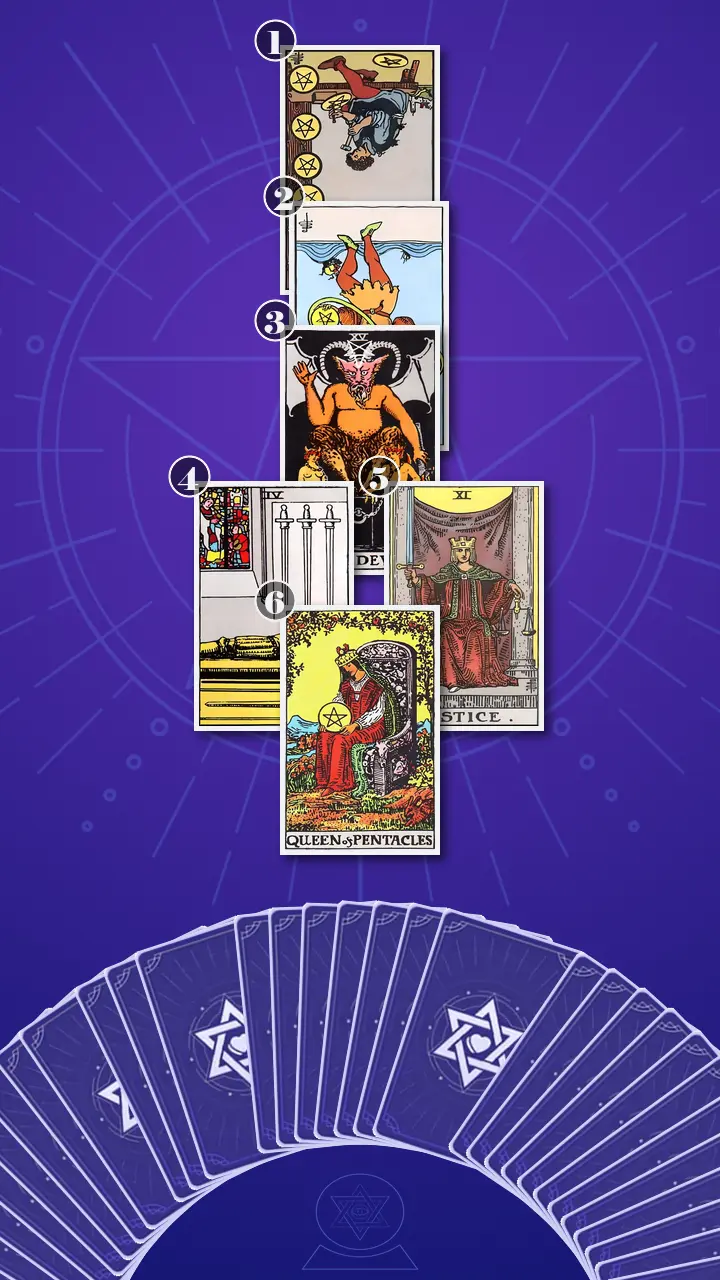
Card 1 would show the surface symptom—what’s literally happening on the screen. Card 3 would expose the core mechanism—the binding belief that makes “unavailable” feel unsafe. And Card 5 would be the key shift—the turning point that turns guilt into something cleaner: a boundary you can honor.
The Workbench Loop That Pretends to Be “Professionalism”
Position 1: Surface symptom — Eight of Pentacles (reversed)
“Now flipped open is the card representing the surface symptom: the specific, observable way work guilt shows up while drafting the out-of-office reply,” I said. “Eight of Pentacles, reversed.”
Even before I spoke, Maya’s eyes narrowed like she recognized the posture of the figure on the card: head down, stuck at the workbench, doing the same motion again and again.
“Here’s the modern-life translation,” I told her, using the exact scene the card was insisting on: “You’re polishing your out-of-office message like it’s going to be graded. You reopen the same draft for the sixth time, swap ‘unavailable’ for ‘limited access,’ add a contingency line, then reread it with your stomach tight—because perfect wording feels safer than actually stepping away.”
Reversed, this isn’t about skill-building. It’s an energy problem: Earth energy in excess and blockage—effort that no longer equals satisfaction. The work keeps happening, but it stops feeling meaningful. It becomes reassurance-seeking dressed up as diligence.
Maya let out a small, bitter laugh—one sharp puff of air—then covered her mouth as if she’d made a noise in a library. “That’s… yeah. That’s actually nasty,” she said. “Accurate, but nasty.”
“I’ll take ‘nasty’ over ‘vague,’” I replied gently. “If your OOO reads like an apology, your rest will feel like one too. The card is showing us the loop, not judging you for being in it.”
Half-Rest and the Infinity Loop
Position 2: Immediate trigger — Two of Pentacles (reversed)
“Now flipped open is the card representing the immediate trigger: what destabilizes rest and pulls your attention back into work,” I said. “Two of Pentacles, reversed.”
“This one is the ‘27 tabs open’ card,” I continued, bringing it into her life precisely. “You’re technically off, but you’re juggling: handoff notes, inbox scanning, a quick ‘just checking’ Slack scroll, plus trying to plan your time off so it looks productive. Your attention keeps snapping back to work like a rubber band, and you end the day tired without the relief of actually being present.”
Reversed, the juggling becomes deficiency of balance. You’re trying to run rest and responsibility at the same time, which means your nervous system never gets the message that you’re safe. It stays braced, waiting for the next ping—like you’re watching the “Severance” elevator doors and still hearing the office music through them.
Maya’s fingers made a tiny, unconscious tapping pattern on her mug. “The worst part,” she said, “is it doesn’t even help. I check, there’s nothing, and I still feel… wound.”
“Because you’re not responding to a message,” I said. “You’re responding to a feeling. The card is naming the trigger: the moment rest flips into vigilance.”
The Loose Chains Under the Desk
Position 3: Core mechanism — The Devil (upright)
“Now flipped open is the card representing the core mechanism: the underlying attachment or fear that keeps the guilt cycle running,” I said. “The Devil, upright.”
The room felt a degree quieter—not because anything changed outside, but because Maya stopped moving for a second, as if she didn’t want to make a sound that might confirm what she already suspected.
“The Devil isn’t about you being ‘bad,’” I said, keeping my voice plain. “It’s about an internal contract that starts to feel like law.”
And the modern-life scenario landed with a bluntness I didn’t need to embellish: “You tell yourself you’re choosing to stay available, but it doesn’t feel like a choice. Your phone becomes a leash: each check is a tiny attempt to buy back safety. Underneath the OOO wording is an old contract—prove you’re needed, or risk being judged and replaced.”
I watched her body do a three-step reaction chain: first, a brief freeze—her breath held mid-inhale. Second, her gaze unfocused, like she was replaying a specific Slack moment in her head. Third, a low exhale that came from the chest, not the mouth.
“Yeah,” she whispered. “It’s literally: If I’m not reachable, I’m replaceable.”
“Exactly,” I said. “And notice how the chain works. You can tell yourself you’re ‘just checking,’ but your body treats it like a panic button. Tight jaw. Buzzing hands. That sinking stomach. The green dot becomes a tiny approval token.”
This is where my archaeologist’s mind always goes. I’ve spent years on digs watching people mistake a temporary scaffold for a permanent wall. The Devil is that: a coping strategy that once protected you, now acting like authority.
“You’re not avoiding rest,” I told her. “You’re avoiding the story you think rest will prove.”
The Chapel Hour in a London Flat
Position 4: True need — Four of Swords (upright)
“Now flipped open is the card representing the true need: what restoration would actually look like if it were allowed,” I said. “Four of Swords, upright.”
“This card doesn’t negotiate,” I continued. “It doesn’t bargain with your inbox. It builds a container.”
Its modern-life scenario was almost painfully simple: “You create a small sanctuary: laptop fully shut, phone in another room, one hour with notifications blocked. The first few minutes your mind protests and your fingers twitch to check—but then the room feels quieter, and your body starts to realize nothing is collapsing without you monitoring it.”
That’s the energy shift: from on-call vigilance to protected pause. Not a mood. A structure. A permission structure.
Maya’s shoulders softened half an inch when I said “phone in another room.” Then her face tightened immediately after, like she’d remembered she was “not that kind of person.”
“I could try,” she said, and then—honest and practical—“but I can’t do, like, a whole day. My team… it’s a startup. There’s always something.”
I nodded. “Good. That’s real. We’re not aiming for perfect unplugging. We’re aiming for clean edges—a boundary your nervous system can actually trust.”
Her eyes flicked back to the cards. “So… the medicine is literally… stopping.”
“Yes,” I said. “And doing it with enough structure that you don’t have to re-decide every five minutes.”
When Justice Held the Sword Steady
Position 5: Key shift — Justice (upright)
When I reached for the next card, the atmosphere changed—not theatrically, just noticeably. The way a room changes when someone says your name in a meeting.
“Now flipped open is the card representing the key shift: the boundary or reframing that most directly transforms the guilt dynamic,” I said. “Justice, upright.”
“Here’s the modern-life version,” I told her: “You write an out-of-office message that doesn’t negotiate against itself: clear dates, clear response expectation, one backup contact. You notice the urge to add ‘sorry’ or ‘feel free to reach me’ is actually the urge to manage how people feel about your absence—and you choose clarity anyway.”
Justice is balance, but not the people-pleasing kind. It’s proportional responsibility. Scales that don’t tip because you keep leaning on them. And the sword is a single, clean statement—no extra emotional labor embedded in your punctuation.
Maya frowned, and her voice sharpened with a flash of anger that surprised even her. “But if I write it like that,” she said, “won’t I sound… cold? Like I don’t care?”
“That’s the old contract talking,” I said. “And this is where I use something I’ve learned both in academia and in field archaeology: Skill Archaeology. We excavate what’s already there but overlooked.”
“Right now, the only ‘skill’ your mind credits is responsiveness,” I continued. “But there are other competencies buried under the noise: setting expectations, designing clear systems, making handoffs readable. Those are real skills. In a healthy team, they’re respected.”
Her eyes held on the card’s sword.
Here’s the setup—the exact trap she’d described all night: she was drafting her OOO with Slack still open, rewriting one line so she could sound unavailable—but not too unavailable—because she could almost feel someone judging her silence.
Stop negotiating your right to rest and write the boundary like Justice holds her sword—clean, specific, and steady—then let the scales balance without you constantly tipping them.
The sentence sat between us like a door closing—firm, not cruel.
Maya’s reaction came in layers. First, her face went still, like someone had pressed pause. Then her eyes widened slightly, not in fear, but in recognition—like she’d just noticed she’d been carrying a bag she didn’t have to carry. Her lips parted as if she wanted to argue, and then didn’t. The tension in her jaw loosened, and her shoulders dropped with a small, involuntary surrender. After a beat, she let out a shaky exhale and looked down at her hands, flexing her fingers open and closed as though she’d been gripping something for hours. “I hate how… right that is,” she said quietly. “Because I can feel the exact line I always add. The ‘please still like me’ line.”
I kept my tone steady, the way you do when you’re guiding someone across a narrow bridge. “Now, with this new perspective, think back to last week,” I said. “Was there a moment when you checked Slack—not because you’d been messaged, but because you felt the chain tighten? If you’d had this Justice lens in that moment, how might your body have felt different?”
That was the pivot: not from work to no work, but from guilt-driven vigilance to boundary-based self-trust. From proving worth in five-minute response times to practicing one fair rule you can live by.
The Queen’s Garden After the Verdict
Position 6: Integration — Queen of Pentacles (upright)
“Now flipped open is the card representing integration: the next practical way to embody rest without turning it into another performance,” I said. “Queen of Pentacles, upright.”
“This is the part people skip,” I added. “They set the boundary, but they don’t give their body anything to hold onto.”
The modern-life scenario was grounded, almost stubbornly so: “Instead of turning time off into another project, you choose one simple, tangible comfort that signals ‘safe’ to your body: a slower breakfast, a walk, a tidy space, food you actually like. You’re still competent—but you’re not performing competence through availability.”
The Queen’s energy is balanced Earth: steady, nourishing, practical. A life where value isn’t constantly auditioned. And for Maya, it’s a reminder that once Justice writes the rule, the Queen makes it livable.
“Clean rest needs clean edges,” I said, watching her nod. “But it also needs a soft landing.”
The One-Page “Justice Sheet”: Actionable Next Steps for Work Guilt and Rest Anxiety
I gathered the spread into one story—clear enough to remember tomorrow, not just tonight.
“Here’s the arc,” I told her. “The reversed Eight shows you stuck at the workbench: refining the OOO like it’s proof of competence. The reversed Two shows the trigger: half-rest, juggling and tab-switching, never fully off. The Devil names the real binding force: an internal contract that says unavailability equals danger. Four of Swords offers the medicine: a protected pause, not negotiated minute-by-minute. Justice is the turning point: one fair, clean boundary communicated once and then honored. And the Queen of Pentacles is how you live it: one small, embodied ritual that tells your system it’s safe to stop.”
“Your blind spot,” I said carefully, “is that you’ve been treating guilt as a moral verdict—like it proves you’re wrong to rest. But in this spread, guilt is more like a boundary alarm. It blares when you stop obeying the old contract.”
Then I offered her a framework from my own tool kit—my fieldwork strategy for moving something massive without pretending it’s weightless. “In archaeology, we don’t drag a megalith in one heroic pull,” I said. “We use Megalith Transport: we break it into steps and move it steadily. Let’s do that with your OOO boundary.”
- The 10-minute OOO Edit TimerSet a timer for 10 minutes. Draft a 4-line out-of-office that includes only: (1) you’re out, (2) dates, (3) what happens to emails, (4) one backup contact. No apologies. No “limited access.” No extra access points.Expect it to feel “too blunt” if you’re used to over-explaining. That discomfort is information, not a failure. If you panic, remove just one appeasing line and stop there.
- The One-Owner Handoff NoteWrite one 10-minute handoff message to one person: one owner + one next step + one link. Then stop. You are accountable for clarity—not for eliminating all inconvenience.Before you send it, do “Relic Authentication”: check whether you’re adding anything just to manage feelings. Keep facts (what/when/who), delete emotional bargaining.
- The 60-minute Phone-Away ContainerOnce during time off, create a protected rest container: phone in another room (or Focus mode blocking Slack/email) for 60 minutes. When the urge hits, do a 2-minute body check—jaw, shoulders, stomach—then label the urge: “the chain.”If 60 minutes feels impossible, start with 5. Your body learns by repetition, not by force. This is practice, not a test.

A Week Later: Ownership, Not Certainty
A week later, Maya messaged me a screenshot. Four lines. Clean dates. One backup contact. No apology.
“I hit send,” she wrote, “and I genuinely felt sick for like… two minutes. Then I did the phone-in-the-other-room thing. I still wanted to check. But I didn’t. And nothing collapsed.”
The proof wasn’t fireworks. It was quieter than that: a boundary held for one hour, and a nervous system learning it didn’t have to stay clocked in. She told me she slept a full night for the first time in weeks—then admitted, almost laughing, that the first thought in the morning was still what if I missed something? “But this time,” she wrote, “I didn’t obey it.”
That is the Journey to Clarity in its real form: not perfect peace, but a shift from compulsive availability to a fair rule you can honor. A clean edge. A small return of self-trust.
When you’re ‘out of office’ but still mentally on-call, it’s not that you don’t know how to rest—it’s that part of you believes being unreachable could prove you don’t matter.
If you didn’t have to earn rest with constant responsiveness, what would one clean, fair boundary look like—just for the next 24 hours?