The 10:56 p.m. Bank-App Loop—And the Minimum-Battery Reset Plan

Finding Clarity in the 10:56 p.m. Banking App Loop
If you’ve ever checked your bank balance before you’ve even sat up in bed—then lost 40 minutes to doomscrolling because your brain started doing money math you didn’t ask for—this will feel uncomfortably familiar.
Maya (name changed for privacy) met me over a video call from her downtown Toronto apartment. It was late enough that the light in her room looked like it came from two places only: her bedside lamp and the cold glow of her phone screen. I could hear a radiator click on and off in the background like a metronome that didn’t care what day it was.
She held her phone as if it had weight. “My phone’s at one percent,” she said, half laughing, half not. “My bank account is… also basically one percent. And my body is like—done. I’m not even asking for a glow-up. I just need to function again.”
I watched her swallow, the way her jaw stayed clenched even when she wasn’t talking. The exhaustion on her wasn’t a vague mood—it was a low-voltage shutdown: heavy limbs, tight jaw, shoulders creeping up like they were trying to become earrings. The kind where opening an email feels oddly physical, like pushing a stuck subway door.
“And here’s the worst part,” she added, voice quieter. “If I rest now, I’m scared I’ll pay for it later.”
I nodded, letting that contradiction land in the room between us: wanting a real rest-and-reset vs fearing that slowing down will make money stress and responsibilities spiral.
“Okay,” I said gently. “We’re not going to make a twelve-step ‘perfect reset’ you can’t start. We’re going to find your first, smallest reset—something that actually refills your battery and makes life 5% easier. Let’s draw a map through the fog.”

Choosing the Compass: The Transformation Path Grid (6) · Context Edition
I asked Maya to take one slow breath—not as a mystical thing, just as a clean transition. Then I shuffled, steady and unhurried. I’ve trained intuition on noisy cruise ships and in quiet cabins mid-Atlantic; the point is always the same: focus your attention so your nervous system stops treating every alert like a fire.
“Today we’ll use a spread called the Transformation Path Grid (6) · Context Edition,” I told her.
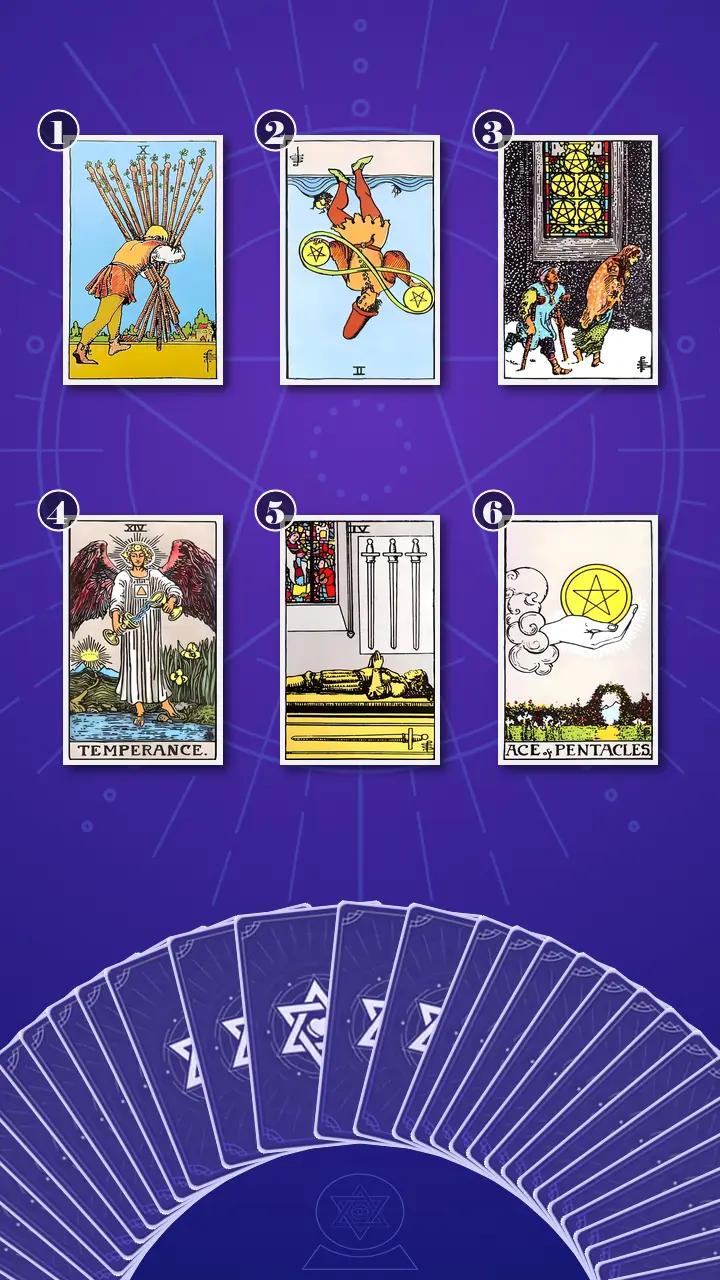
For you, reading along: I like this six-card grid for survival-mode burnout—especially when money stress is real—because it separates the problem into something workable. It shows (1) what’s visible, (2) what’s actively blocking recovery, (3) what’s underneath driving it, then it pivots into (4) one balancing principle, (5) one first reset step for the next 24–48 hours, and (6) what stability looks like after a week of keeping it simple. Symptom → mechanism → root → catalyst → action → integration. Grounded. Non-fatalistic. Practical.
“Think of it like your phone screen,” I added. “Two rows of tiles. First we see what’s draining the battery. Then we tap the reset functions.”
Reading the Tiles: From Overload to the Real Blockage
Position 1 — Surface snapshot of burnout: the most visible, day-to-day load and how it shows up in behavior.
“Now we’re opening the card that represents your surface snapshot of burnout—what it looks like on a normal day,” I said, and turned the first card.
Ten of Wands, upright.
I pointed to the figure bent forward under the bundle. “This is the body-language of ‘still pushing.’ And it matches what you told me: it’s 7:30 a.m. and you’re already mentally carrying rent, groceries, a work request that came in late, a friend you haven’t texted back, and three tiny admin tasks. Nothing is catastrophic on its own—together, it sits on your chest like weight.”
In energy terms, this is excess—too much output, too much responsibility kept ‘open’ at once. The wands even block the figure’s line of sight, and that’s the cruel part of burnout: when your load gets big enough, you can’t see which single step would actually help.
Maya let out a short breath and her mouth twitched into a small, bitter smile. “That’s… accurate,” she said. Then she gave a tiny laugh that wasn’t amused. “It’s almost mean.”
“It’s not mean,” I replied. “It’s honest. And honesty is how we get leverage.”
Position 2 — The immediate blocker: the specific pattern that prevents rest from actually restoring you.
“Now we’re opening the card that represents the immediate blocker—the loop that makes ‘rest’ not actually work,” I said, and turned the second card.
Two of Pentacles, reversed.
“This one is the juggling trap,” I told her. “You’re flipping between your banking app, email, calendar, and Notes like you’re air-traffic control for your own life—trying to keep everything in the air. The problem is you’re not landing anything.”
In reversal, the balance energy is in blockage. The ‘infinity loop’ becomes messy. You keep moving so you can feel safe, but your system never gets the payoff of completion.
As I spoke, I pictured the exact scene she’d described—bank app → close → reopen—then Gmail, then the calendar, then Notes, like refreshing tabs faster would finally produce relief. The inner monologue writes itself: If I just check one more time, I’ll feel safer.
“Motion isn’t the same as relief.”
Her shoulders, which had been practically up by her ears, dropped a fraction. She nodded once—small, immediate, like recognition instead of agreement.
“Yeah,” she said. “It’s like… I’m busy, but I’m not done.”
Position 3 — Root driver: the deeper scarcity story or fear that keeps the system in emergency mode.
“Now we’re opening the card that represents the root driver—what’s fueling the emergency mode underneath,” I said, and turned the third card.
Five of Pentacles, upright.
“This is the part people don’t post on TikTok,” I said softly. “A low balance doesn’t just feel like a number. It feels like being outside in the cold, watching other people live with a buffer you don’t have.”
My mind flashed a Toronto winter scene so vivid I could almost hear it: wind cutting down a side street, hands going numb around a phone, walking past warm café windows near Queen Street—warmth visible, but somehow not for you. That’s this card: the lit stained-glass window right there… and still feeling shut out.
In psychological terms, it’s a scarcity story: I’m behind and I have to handle it alone. In energy terms, it’s a stagnant state—your system clamps down, bracing for impact, and then wonders why it can’t recover.
Maya’s eyes went slightly unfocused, like she’d replayed a memory. Her lips parted, then pressed together. “I hate that you said ‘alone,’” she whispered. “Because that’s the exact word.”
“I’m going to be careful here,” I added, keeping my tone grounded. “I’m not diagnosing anything medical. But your body signals matter. That jaw clench, those shoulders up—it’s your nervous system trying to keep you ‘ready.’ Not because you’re broken. Because you’re carrying a lot under perceived threat.”
She blinked hard once, then looked down at the table in front of her, as if the wood grain had answers.
When Temperance Poured Between Two Cups
Position 4 — Catalyst for reset: the balancing principle that can shift the whole system with the least drama.
I let my hand hover for a beat before turning the next card. The room felt quieter, like the call had found a deeper bandwidth.
“Now we’re opening the card that represents the catalyst—the turning point that shifts everything with the least drama,” I said, and turned it.
Temperance, upright.
“This is your reset lever,” I said. “Not a dramatic overhaul. A regulated pacing. A two-part daily blend: one thing that refills you, and one thing that stabilizes pressure.”
Temperance is balance—but not ‘balance’ as a personality trait. Balance as a system: measured transfer instead of frantic juggling. Catch-up sprint vs measured pour.
Then I watched Maya’s face tighten, not soften. Her brows pulled together.
“But if it’s that simple,” she said, a flash of anger in her voice, “does that mean I’ve been doing it wrong this whole time?”
I didn’t flinch. “It means you’ve been doing what works in emergency mode—monitoring, bracing, keeping everything open. That’s not a moral failure. It’s a strategy that got too expensive.”
And this is where my own signature lens kicks in. I’ve spent years watching how people’s bodies tell the truth before their words catch up—on ships, in therapy rooms, on city sidewalks. I call it Energy Flow Diagnosis: when the shoulders and neck lock up, it often means the mind is trying to carry what the body can’t metabolize.
“Right now,” I told her, “your shoulders are doing unpaid labor. That’s an energy blockage pattern. We don’t fix it by demanding a new personality. We fix it by changing the flow—closing background apps.”
She opened her mouth, then closed it. Her throat bobbed. She looked almost relieved and offended at the same time.
The Aha Moment
In that familiar moment—lying back down “for five minutes” after checking your bank app, and it turns into forty—your jaw clenched, your brain doing math you didn’t ask it to do—your body is basically telling you it’s out of battery and out of bandwidth.
Not “power through until you crash,” but “pour a little at a time” — Temperance turns your 1% battery into a sustainable recharge cycle.
She froze first—like her breath paused mid-chest. Then her gaze drifted slightly to the side of the screen, unfocused, as if she were watching herself do the loop in real time: bank app, close, reopen, Gmail, calendar, Notes, back to bank. Finally, her shoulders dropped with a slow, almost involuntary surrender, and her jaw unclenched just enough that her words came out softer.
“I hate how much I needed that sentence,” she said, voice rough. “Because it means I don’t have to… earn the reset by suffering first.”
“Exactly,” I said. “This is the shift from survival-mode depletion and anxiety-driven monitoring to compassionate triage and grounded steadiness. Not perfect. Just steadier.”
I leaned in a little. “Now—with that new lens—think back to last week. Was there a moment when one tiny ‘pour a little at a time’ choice would’ve changed how you felt?”
She nodded slowly. “Tuesday morning. TTC. I kept refreshing my balance instead of just paying the minimum on one thing and moving on.”
Position 5 — First reset step: the most realistic action for the next 24–48 hours that refills capacity.
“Now we’re opening the card that represents your first reset step—what you can do in the next 24–48 hours that actually refills you,” I said, and turned the fifth card.
Four of Swords, upright.
“This is Low Power Mode for your nervous system,” I told her. “A maintenance window. A protected container.”
In energy terms, it’s balance through containment. Your mind can’t stop running background processes if you keep feeding it inputs. This card is permission and structure: dim room, phone charging away from your bed, Do Not Disturb, fewer tabs.
“Rest isn’t collapse—rest is a container,” I said, and I could see her swallow again, but this time it looked like relief. She pressed her palm against her thigh, grounding.
“And when guilt tries to negotiate,” I added, “we keep it bounded. You’re not ‘disappearing.’ You’re doing maintenance so your system stops glitching.”
I offered her one of my Quick Recovery Techniques—something I used to teach crew members between back-to-back passenger demands: “For three minutes: drop your shoulders one inch, unclench your tongue from the roof of your mouth, inhale through your nose, exhale longer than you inhale. That’s it. It’s not a wellness performance. It’s an interrupt.”
Position 6 — Integration: what “stability” looks like after you take the first reset step and keep it simple for a week.
“Now we’re opening the card that represents integration—what stability looks like after a week of keeping this simple,” I said, and turned the last card.
Ace of Pentacles, upright.
“This is the seed,” I said. “Not a miracle. A small, tangible foundation.”
In energy terms, it’s grounding—earth energy that you can actually hold. After rest, you don’t try to fix finances in one night. You plant one boring, reliable default: one autopay minimum, one weekly 15-minute check-in, one groceries cap note. And your body feels it first: less chest tightness because the plan is small enough to trust.
“Make next week 5% easier,” I said. “That counts.”
Maya exhaled, longer than before. “I can do 5%,” she said. “I can’t do ‘new life.’”
The Minimum Viable Battery Plan: Actionable Advice Without the Overhaul
I brought the whole grid together for her, like tracing a route on a map.
“Here’s the story the cards are telling,” I said. “You’re carrying too much (Ten of Wands), and the way you cope is by juggling alerts and switching tabs (Two of Pentacles reversed) because underneath there’s a real scarcity fear—‘one slip proves I’m not in control’—and a loneliness about having to handle it quietly (Five of Pentacles). Temperance is the bridge: regulated pacing. Not more force. Better flow. Then Four of Swords gives you the container for rest, so Ace of Pentacles can become one small stabilizing seed instead of a fantasy overhaul.”
“Your cognitive blind spot,” I added, “is believing you have to fix everything to earn rest—or that pausing means failing. The transformation direction is the opposite: restore the minimum viable battery first, then do one pressure-reducing task at a time.”
I reached for my Venetian metaphor—because it’s how my brain makes things practical. “In Venice,” I said, “water doesn’t move because you yell at it. It moves because you clear a channel. Venetian Aqua Wisdom is the same: we don’t force your energy. We improve circulation—tiny, steady movement between containers.”
- Build a 24-hour Low-Stimulation ContainerTonight or tomorrow: turn on Do Not Disturb, put your phone charging away from your bed for at least one hour, and set one quiet block (20–40 minutes) with no scrolling—dim light, water nearby, nothing “productive.”Your brain will argue this is irresponsible. Treat that argument as a depletion symptom, not a verdict. If guilt spikes, do the 15-minute version.
- Do the Two-Cup Blend (10 minutes total)Set a 10-minute timer. On paper, draw two boxes: “Refill” and “Stabilize.” Write ONE 5-minute refill (water + something salty, shower, lie down with eyes closed) and ONE 5-minute stabilize (pay the minimum on one bill, email one person, confirm one appointment). Do only those two things, then stop when the timer ends.If your chest tightens or your brain starts sprinting, your only job is to return to the timer—not to fix everything. One refill + one stabilize. That’s the whole plan.
- Plant One “Boring Seed” for Next WeekWithin 48 hours (after you’ve slept at least once): set one autopay minimum for one bill or create a rent reminder + calendar alert if autopay isn’t possible. Keep it to one setup.Perfectionism will push you toward a full budget overhaul. Downgrade on purpose: minimums count. The goal is reducing future panic, not performing organization.

A Week Later: The Quiet Proof
Six days later, Maya messaged me. Not a paragraph. Just: “Did the two-cup thing three times. Phone charged in the kitchen. Paid the minimum on one bill. I slept a full night. I’m still stressed, but it’s not… teeth-grinding loud.”
I could picture it: the same city, the same costs, the same responsibilities—but a different internal weather. Not sunny. Just less storm. Clarity, in real life, often looks like that: the first night you sleep, and the morning you wake up still unsure—but no longer trapped in the bank-app loop before your feet hit the floor.
When you’re running on 1% and still trying to keep every life tab open, even rest starts to feel dangerous—like if you stop moving for a second, the whole thing will collapse and prove you didn’t have control after all.
If you let ‘reset’ mean “refill one thing and stabilize one thing” for the next 24 hours, what would you choose as your two small pours?