From App-Switching Overwhelm to Fair Triage: A One-Night Reset
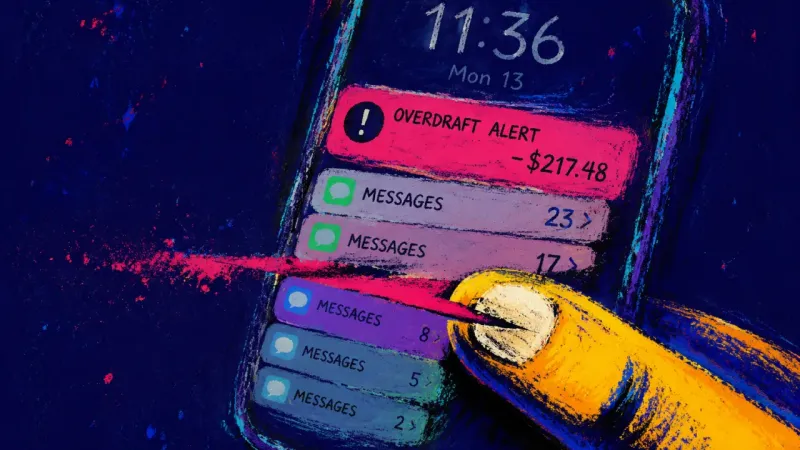
The 9:07 PM TTC Lurch, and the Two Red Banners
You’re an early-career coordinator in a fast-moving team, and your brain treats Slack pings + group chats + a banking alert like one giant red emergency banner—classic triage paralysis.
Jordan (name changed for privacy) told me about it the way people confess something they’ve been trying to laugh off for weeks.
“9:07 PM on the TTC Line 1 heading north,” they said, staring past their laptop camera like they could still feel the train’s side-to-side rock. “The fluorescent lights were doing that buzz. My phone vibrated—overdraft alert—and at the same time the group chat jumped from 12 to 50 unread. I opened the bank app, my chest tightened, and I literally swiped it away like… nope. Then I opened the chat, scrolled the wall of texts, and my shoulders just locked.”
On my screen, I watched their hand keep traveling to their sternum, then dropping, then hovering again—like their body was trying to press the panic back into place. Their breathing had that stop-start rhythm people get when their nervous system can’t decide whether to sprint or hide.
“Overdraft alert + 50 unread texts,” they said. “What do I reset first? Because if I do money first, I’m a bad friend. If I do texts first, I’m irresponsible. And either way I feel like I’m about to get in trouble.”
The overwhelm wasn’t an abstract feeling—it was physical: a tight chest with a buzzing urge to do everything at once, followed by a heavy drop when nothing got finished. Like trying to close thirty browser tabs by opening more tabs—movement without resolution.
I let the silence sit for a breath. “I get it,” I said, steady and direct. “And I want you to hear this up front: we’re not treating this like a moral failing. We’re treating it like a systems overload. Let’s draw a map through the fog—something that gives you clarity you can actually use tonight.”
Choosing the Compass: How Tarot Works in a Triage Moment
I asked Jordan to put both feet on the floor and take one slow inhale, one slower exhale—not as a ritual for luck, but as a hard reset for attention. While they did that, I shuffled, listening for the moment their shoulders dropped a millimeter.
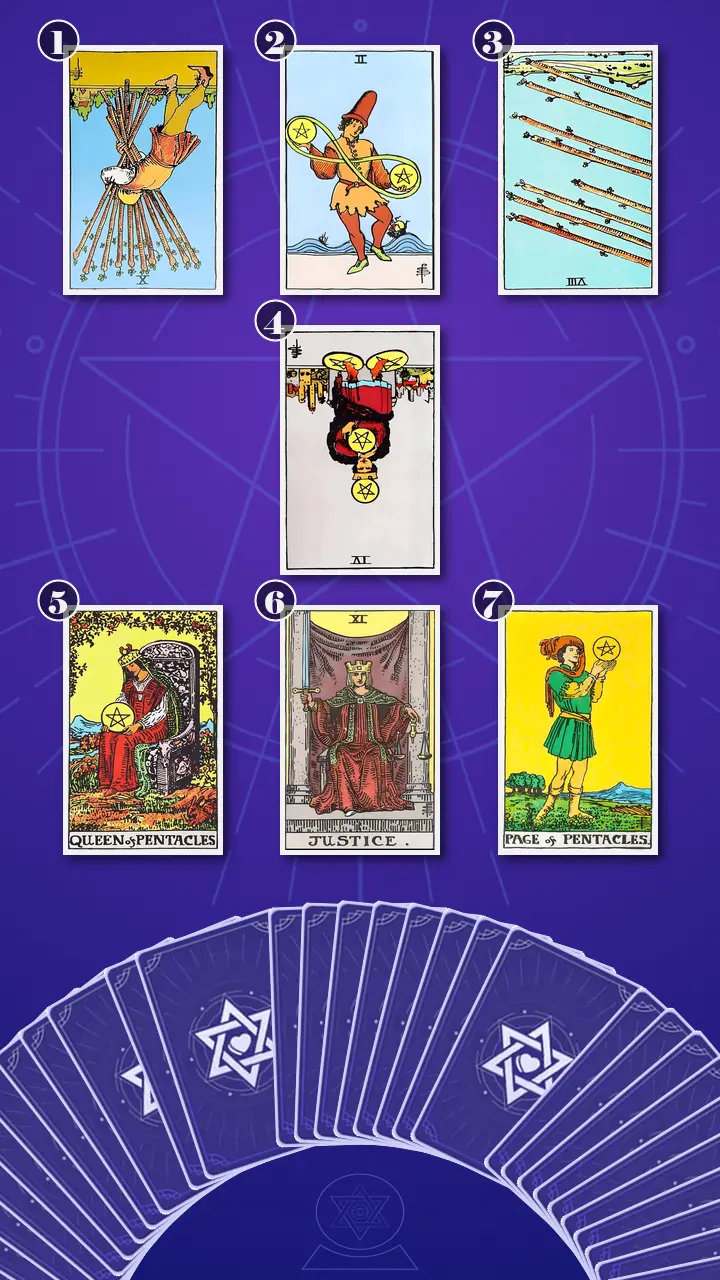
“For this,” I said, “I’m using a spread I built for exactly this kind of modern triage: Energy Diagnostic Map (7) · Context Edition.”
To you reading: this spread works because the problem isn’t one choice—it’s a multi-input overwhelm loop. It separates what’s loud (the phone, the overdraft banner, the unread count) from what’s actually driving the freeze (scarcity/control beliefs), then shows what resource is available and what single next step creates traction. Seven cards is the smallest structure that still makes the chaos legible.
I also told Jordan what to expect. “The first card captures what your ‘reset panic’ looks like in real life. The middle card—the knot—shows the belief that makes prioritizing feel unsafe. And the last card gives one concrete move you can finish today.”
Reading the Map: From Notification Chaos to Stewardship Mode
Position 1 — The Observable Reset Panic
“Now turning over,” I said, “is the card that captures the most observable reset-panic behavior in the moment.”
Ten of Wands, reversed.
I didn’t need to reach far for the translation—Jordan had already handed it to me. “This is 9:18 PM in your kitchen,” I said, “phone in one hand, fridge open like you’re making a decision, but you’re actually ping-ponging between your banking app and iMessage. You open the overdraft alert—chest tightens—close it. You open the group chat—‘+50’—start typing ‘Sorry I’ve been so MIA…’ delete it. Then you check Slack ‘just to see,’ then back to the bank, then you put the phone face-down like that freezes reality.”
Reversed, this card is Fire energy in blockage: the engine overheats, so it stutters. The wands in the image block the figure’s face—like unread counts and tab-switching literally blocking your perspective. You can’t see what’s in front of you because you’re trying to carry every open loop in your head.
Jordan let out a short laugh that sounded like it scraped on the way up. “That’s… painfully accurate,” they said. “Like, rude.”
I nodded. “That bitter laugh is your system recognizing itself. And here’s the de-shame line I want you to hold onto: A notification isn’t a verdict. This card isn’t calling you lazy. It’s showing capacity limits.”
Position 2 — The Inner Tug-of-War: Money vs People
“Now turning over,” I said, “is the card that names the specific internal split: financial responsibility versus social availability.”
Two of Pentacles, upright.
“Your brain is running two scripts at once,” I told them. “If I fix the overdraft first, I’m a bad friend / unreliable person versus If I answer texts first, I’m irresponsible and I’ll get hit with fees. So you do a little of both—skim balances without reading, react to a few messages without finishing any thread—and you stay in a loop that feels productive but resolves nothing.”
Upright, this is balancing energy in excess—too much juggling, not enough sequencing. The infinity loop on the card is the mental loop: same two worries swapping places all night.
I asked, “If you had to say it in one sentence: ‘If I do X first, it means I’m Y’—what’s your sentence?”
Jordan swallowed. “If I do money first, it means I don’t care about people.”
There it was—clean, brutal, honest.
Position 3 — External Pressure: The Velocity of Incoming
“Now turning over,” I said, “is the card that maps the real-world inputs that amplify urgency and fragment attention.”
Eight of Wands, reversed.
“This is your phone lighting up like a conveyor belt,” I said. “Group chat jokes, a friend’s ‘are you alive??’, a calendar reminder, a Slack @mention you shouldn’t even be seeing after hours. None of it arrives with a label for urgency, but your nervous system treats every banner like it’s time-sensitive. You scroll message previews like you’re triaging mail while new envelopes keep dropping through the slot.”
Reversed, this is Air/Fire disruption in overload: information arrives faster than it can land, so you get stuck in ‘incoming without resolution.’
“And this is where I’m going to say something that might feel almost too plain,” I added. “Being instantly available isn’t the same as being reliable. Speed has become your stand-in for competence—at work and with friends—so your body panics when you slow down.”
Jordan’s eyes flicked to the side, toward their phone. Their thumb twitched like it wanted to wake the screen. They stopped themselves.
Position 4 — The Knot: Scarcity-Control Reflex
“Now turning over,” I said, “is the card at the center—the deeper belief that keeps the loop running.”
Four of Pentacles, reversed.
I felt the room change through the webcam—one of those moments where even city noise seems to step back. In my own head I flashed to Venice, to merchants counting coins on a worn wooden table: not romantic, just precise. Numbers weren’t moral. They were navigation.
“Here’s the internal monologue this card carries,” I said, softly but plainly: “If I look at the number, it means ___ about me. If the overdraft is real and exact, it becomes proof you’re failing at adulthood.”
I watched Jordan’s gaze go slightly unfocused, like they were staring at a blurred screen on purpose. “So you keep it vague,” I continued, “because vague feels safer than exact. And then you try to regain control somewhere else—crafting the perfect reply, over-explaining, apologizing pre-emptively, trying to keep everyone happy so you can feel ‘safe’ again.”
This reversed Earth energy is distortion: not healthy stewardship, but control-through-appearance instead of control-through-data. Money stops being a tool and turns into a threat signal pressed to the heart.
Jordan went still in a three-beat chain: their breath paused, their shoulders lifted a fraction, and then they exhaled through their nose like they’d been caught. “Yeah,” they said, quieter. “It’s like… if I see it, it becomes real. And if it’s real, it means I’m bad at life.”
“That,” I said gently, “is the knot. Not the overdraft itself. Not the unread count. The belief that the number is a character judgment.”
Position 5 — The Resource You Can Access Tonight
“Now turning over,” I said, “is your stabilizing resource—the most practical inner strength for a reset.”
Queen of Pentacles, upright.
“This is Stewardship Mode,” I told them, and I could see Jordan respond to the phrase like it offered a handle. “This is you taking two minutes to eat something real—even toast—drink water, put your phone on the table instead of in your hand, and open the bank app like you’re gathering facts, not searching for a verdict.”
Upright, this Earth energy is balance: engaged, steady, calm. Not gripping. Not avoiding.
I mirrored the split-screen the cards were building: “Left side is vibration, banners, and tab-switching. Right side is one warm light, a charger plugged in, Notes open, and a calmer numbers check. Ordinary. Doable. Your nervous system comes back online because you stop trying to earn calm through frantic responsiveness.”
Jordan’s shoulders dropped in a way that looked like gravity got kinder. “That actually sounds… possible,” they said.
Position 6 — The Turning Point: Fairness as the Filter (Key Card)
“Now we’re turning over the pivot,” I said, and I slowed my hands on the deck on purpose. “This is the card that changes how you relate to the problem.”
Justice, upright.
Setup: It was late, their phone was hot from their hand, and they’d been flipping between the negative balance and a wall of unread texts—trying to decide what kind of person they were based on what they answered first.
Stop treating every notification like a verdict, and start using the scales to choose what’s fair, time-bound, and truly yours to carry.
Jordan stared at the card, then at me. Their reaction came in layers—exactly the way a truth lands when it bypasses productivity tips and hits identity. First: a freeze, breath caught high in the chest. Second: their eyes went slightly glassy, like their brain was replaying all the nights they’d drafted apologies instead of checking the number. Third: their jaw unclenched, shoulders sinking, and a shaky exhale left them like a wave finally letting go of the shore.
“But if I do that,” they said, and there was a flash of anger under the fear, “doesn’t it mean I’ve been doing it wrong this whole time?”
I didn’t rush to soothe that—Justice doesn’t do that. “It means you’ve been doing what your nervous system thought would keep you safe,” I said. “And now you’re renegotiating the terms.”
This is where I used my Choice X-Ray—my way of revealing hidden costs and benefits that urgency tries to hide. “Let’s X-ray the sequence,” I said. “If you answer texts first: benefit—instant guilt relief. Hidden cost—fees, bounced payments, and the spiral gets louder. If you do money first: cost—temporary discomfort, maybe someone’s impatience. Hidden benefit—preventing real-world harm and restoring your own trust.”
Then I anchored it with the line Justice always demands: “If everything is loud, fairness is your filter. Not guilt. Not speed. Fairness.”
I asked, “Now, with that lens—can you remember a moment last week when this would’ve changed how you felt? One moment where ‘fair sequence’ could have saved you from the spiral?”
Jordan blinked hard. “Friday,” they said. “I avoided the bank app, sent like… three paragraphs to my friend, and then still got hit with an NSF fee.” Their voice softened. “If I’d just done the money thing first and sent one clean line… I wouldn’t have spent the whole night apologizing.”
That was the emotional transformation beginning to turn: from self-doubt and frantic overthinking to grounded sequencing—air-traffic controller energy, not juggling flaming torches.
Position 7 — The Next Step: One Measurable Money Move + One Boundary Text
“Now turning over,” I said, “is the card that gives you one actionable move you can finish today.”
Page of Pentacles, upright.
“This is the apprentice,” I said. “No heroics. No ‘fix your whole life tonight.’ Just the smallest real-world step that moves the needle.”
I gave them the exact modern translation: “Check the exact overdraft amount, list the next pending charges, do one concrete action—transfer funds, pause a subscription, or message the bank. Then send one short message to the most time-sensitive thread: ‘Saw this. Dealing with a money thing tonight—can reply tomorrow.’ No essay. No apology spiral.”
Upright, this Earth energy is foundation-building. And right here I said the line I’ve watched change a thousand chaotic nights on ships crossing the Atlantic: One finished step beats ten half-started fixes.
The One-Page “Fair Order of Operations” Reset (Overdraft + Unread Texts)
When I look at the full map, the story is clean: Ten of Wands reversed shows you overloaded and trying to carry everything in your head. Two of Pentacles explains why it’s not just “poor discipline”—it’s a values conflict: money responsibility versus being socially reliable. Eight of Wands reversed shows the environment training your body to treat everything as urgent. Four of Pentacles reversed is the knot: money as self-worth, so facts feel threatening. Then Queen of Pentacles restores capacity through ordinary care. Justice is the pivot—fair rules instead of guilt. And Page of Pentacles lands it in one small, measurable move.
Your cognitive blind spot is this: you’ve been letting loudness decide priority. That’s why you keep re-ranking until you freeze. The transformation direction is the key shift: move from trying to solve everything simultaneously to setting a fair order of operations—and completing one high-impact step before opening the next loop.
I offered Jordan a simple framework from my cruise years—my Port Decision Model. “When a ship is approaching port,” I said, “we don’t dock at every pier at once. We pick the one that prevents damage first, then we communicate timing. Tonight, money is the pier that prevents avoidable harm.”
- The 12-Minute Overdraft Reality CheckSet a 12-minute timer. Open your banking app and write down: (1) the exact overdraft amount, (2) the next 3 pending charges, (3) the soonest time-bound consequence (fee/time). Then do one action before you close it (transfer funds, pause one subscription, or initiate a bank chat/call-back).If your chest clamps up, pause for two slower breaths with one hand on your sternum. Do the “6-minute version” if 12 feels impossible—one number and one pending charge still counts.
- One Boundary Text, Not a ParagraphPick the one thread that truly needs acknowledgment. Send: “Saw this—dealing with a money thing tonight. Can reply tomorrow.” Then mute the noisiest group chat for 24 hours.If guilt spikes, treat it as data—not a command. You’re practicing fairness, not proving you’re invincible.
- Lock-Screen Policy (Justice in Your Pocket)Create a one-line lock-screen note: “Fees first. Replies in a window.” Put a reply window on your calendar for tomorrow (e.g., 12:30–12:50 PM) like a meeting with yourself.This is a 48-hour reality test, not a personality change. If you miss the window, don’t compensate with over-explaining—just reschedule and keep the next one.

A Week Later: The Quiet Proof of Finding Clarity
Six days later, I got a message from Jordan. No long backstory. No apology for “being bad at replying.” Just: “Did the 12-minute timer. Wrote the exact number. Paused a subscription. Sent the ‘reply tomorrow’ text. Nobody died. Also… I slept.”
They admitted one bittersweet detail in the next line: “Muting the group chat felt weirdly lonely for like, three minutes. Then it felt peaceful.”
That’s the kind of proof I trust—the small, real shift from buzzing dread to calm sequencing. Not certainty. Ownership. A system you can repeat when the phone goes loud again.
When money and messages hit at the same time, it can feel like your chest is bracing for punishment either way—like choosing one first means you’re automatically failing the other.
If you gave yourself permission to be fair instead of instantly available, what’s one tiny ‘order of operations’ you’d want to try the next time your phone goes loud?