From Typing-Bubble Panic to Steadier Calm: A Group Chat Reply Policy

Finding Clarity in the Typing Bubble Spiral
If you’ve ever muted a group chat for ‘peace’ and then unmuted it ten minutes later because the typing bubbles felt like a threat, this is for you (group chat anxiety).
When Jordan showed up on my screen, it was 8:47 PM on a Tuesday in downtown Toronto. She had her laptop propped on the condo kitchen counter, a kettle hissing like it was trying to speak over her, and a pot of pasta that had been stirred into a kind of resignation. Her phone kept buzzing beside the cutting board—face-up, bright, unforgiving.
She half-stirred, half-scrolled. The typing bubble appeared… disappeared… appeared again. Each flicker looked like a tiny verdict being drafted. Her chest tightened in a way you could almost hear, and her hands kept drifting toward the phone like they weren’t fully hers.
“I don’t even know what I’m defending anymore,” she said, and her laugh came out thin. “I just can’t let it sit there.”
I watched her shoulders creep up toward her ears as she spoke. As a Jungian psychologist, I always listen for the story—and also for where the body is carrying it. As someone who used to train intuition on long transoceanic cruises, I know that when the environment gets loud, the nervous system starts acting like it’s steering a ship through fog: over-correcting, scanning, gripping.
Jordan’s core conflict was painfully clean: she wanted to stay connected and understood in the group—while also fearing she’d be misread, blamed, or quietly pushed out.
The agitation wasn’t abstract. It was like her mind had turned into a live analytics dashboard that only measured panic—refresh, refresh, refresh—while her body begged for one steady breath.
“This isn’t just drama—this is your nervous system trying to keep your belonging,” I told her gently. “And we’re not going to shame that. We’re just going to give it a better job.”
“Okay,” she said, swallowing. “I just… I want to know what boundary actually keeps me grounded after this. Because I can feel my nervous system in my thumbs.”
“Then that’s our journey,” I said. “Not to win the thread. To find clarity—so you can choose when to engage, how much to share, and what’s not up for debate.”

Choosing the Compass: The Celtic Cross · Context Edition
I asked Jordan to put her phone face-down for thirty seconds—not as a mystical ritual, just a clean psychological transition. “One hand on your chest, one on the table,” I said. “Feel the contact. Let your nervous system know you’re not in the thread right now.”
Then I shuffled slowly. Not to summon anything, but to focus the question until it had edges.
“Today we’ll use a spread called the Celtic Cross · Context Edition,” I said.
For anyone reading along: this version keeps the classic Celtic Cross diagnostic chain—present tension → obstacle → root driver → recent context → conscious aim → next stabilizing shift → your stance → environment → hopes/fears. The only adjustment is Position 10. Instead of a predictive ‘outcome,’ it becomes a practical grounding boundary, because Jordan’s question isn’t ‘what will happen?’ It’s ‘what keeps me steady?’ That keeps the reading empowerment-based and action-oriented while preserving the depth of how tarot works in real life: patterns, not prophecies.
“A few positions I want you to listen for,” I told Jordan. “The first card will name what the aftermath actually looks like—on your screen and in your body. The crossing card will show what’s hijacking your ability to respond cleanly. And the last card will give us your boundary: a rule of engagement that stays steady even if the group stays messy.”
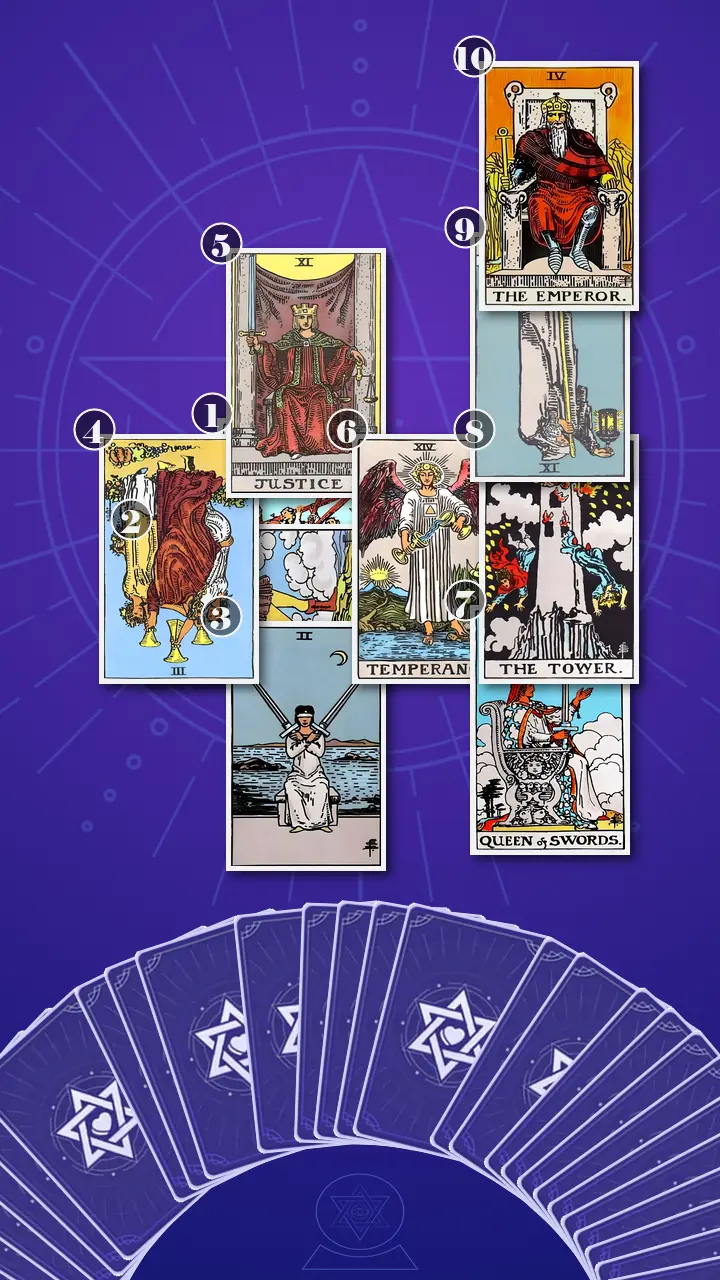
Reading the Thread Like Weather, Not Like a Trial
Position 1: The current emotional and behavioral reality — Five of Wands (upright)
“Now we’re turning over the card that represents the current emotional and behavioral reality in the aftermath of the group chat blow-up,” I said.
Five of Wands, upright.
I angled the card toward the camera. “Your group chat is moving like five people trying to talk at once in a crowded bar: overlapping messages, different agendas, everyone defending their angle. You’re trying to be understood, but the format is built for escalation—so your body reads it as noise + threat, not dialogue.”
This card’s energy is excess: too much input, too much reaction, too many interpretations colliding at once. Fire everywhere, no container.
Jordan let out a small, bitter laugh—surprising even herself. “That’s… yeah. Too accurate. It’s almost mean.”
“It’s not mean,” I said. “It’s honest. And honesty is how we stop treating this like a personality defect and start treating it like a system problem.”
Position 2: The main obstacle — Page of Swords (reversed)
“Now we’re turning over the card that represents the main obstacle—what’s making it hard to stay grounded and respond cleanly,” I said.
Page of Swords, reversed.
“The obstacle is your ‘watchtower’ mode: you keep scanning for subtext, watching who’s typing, checking who saw what, and replying fast to control how you’re perceived. It’s like you’re doing live reputation management inside a room that rewards hot takes.”
Reversed, this is a blockage of clarity. The sword is up, but it’s not cutting through confusion—it’s held like a weapon. The mind becomes surveillance instead of discernment.
I followed it with what I call my Modern Fatigue Analysis, because Jordan’s body was already telling the truth. “Look at what’s happening in your shoulders and neck right now,” I said. “They’re bracing. That bracing is your body’s version of refreshing the chat. Screen-induced exhaustion isn’t just tired eyes—it’s a whole posture of readiness.”
Jordan inhaled quietly and nodded once, like her nervous system recognized itself.
Position 3: The deeper driver beneath the reaction — Two of Swords (upright)
“Now we’re turning over the card that represents the deeper driver beneath the reaction—the internal default that keeps you engaged,” I said.
Two of Swords, upright.
“Underneath it all is the decision you don’t want to make: you’re trying to stay ‘neutral’ so nobody gets mad, but neutrality keeps you stuck in the thread. You’re bracing emotionally—holding your breath—because choosing a boundary feels like choosing who might leave.”
This card shows a deficiency of choice. Not because you can’t choose—but because you’re protecting yourself from the consequences of being clear.
Jordan’s fingers tightened around her mug. Her eyes went a little unfocused, like she was replaying every moment she’d tried to “keep things chill” and ended up paying for it in private stress.
“If I pick a side, I lose someone,” she said.
“Or,” I offered, “you stop losing yourself in the negotiation.”
Position 4: The recent background that set the stage — Three of Cups (reversed)
“Now we’re turning over the card that represents the recent background that set the stage—what was already unstable before the chat blew up,” I said.
Three of Cups, reversed.
“Before the blow-up, the group dynamic already had tiny fractures: side jokes, private follow-ups, little alliances. So when conflict hit, it didn’t feel like a disagreement—it felt like the whole friend ecosystem could re-sort without you.”
The energy here is imbalance—community that looks supportive on the surface, but doesn’t have clean structures for repair underneath. A shaky social container makes any conflict feel like a belonging test.
Jordan’s mouth tightened. She didn’t deny it. She didn’t have to.
Position 5: What you’re aiming for — Justice (upright)
“Now we’re turning over the card that represents what you’re aiming for—what you want this to mean about you and the relationship,” I said.
Justice, upright.
“What you’re secretly aiming for is not popularity—it’s a clean, fair read of you. You want the conversation to be specific and accountable (what happened, what impact), not vibe-based character judgments. You want standards, not a pile-on.”
This is balance energy: fairness with structure. And it’s important, because Justice clarifies something people forget in group chat conflict: you can care about impact without auditioning for approval.
I felt my old cruise-deck instinct rise—how quickly people try to regain social safety by over-explaining. “Justice doesn’t ask for an essay,” I told her. “Justice asks for a standard.”
Position 6: The immediate stabilizing direction — Temperance (upright)
“Now we’re turning over the card that represents the immediate stabilizing direction—the next shift that brings you back into balance,” I said.
Temperance, upright.
My voice slowed on purpose, matching the card. “The stabilizer is pacing. Instead of replying in real time, you slow the cycle: draft in Notes, wait, then send one clean sentence—or choose silence. You let your nervous system cool before you decide what access anyone gets to you.”
This is regulation. Dosage. Not cutting people off, not flooding them with explanation—measuring what’s actually needed.
Jordan’s shoulders dropped a millimeter, like gravity had permission again.
“I could try that,” she said, softer. “That feels… doable.”
Position 7: Your stance and agency — Queen of Swords (upright)
“Now we’re turning over the card that represents your stance and agency—how you can show up with self-respect,” I said.
Queen of Swords, upright.
“Your grounded voice is concise and exact: you don’t defend your character; you name the boundary. ‘I’m not continuing this in the group thread. If you want to talk, I can do a 10-minute 1:1 call tomorrow.’ Then you actually follow through.”
The energy here is precision—enough truth to be clear, not so much language that it becomes a performance.
Jordan blinked and then nodded, once, like she was trying the sentence on in her mouth without saying it out loud.
“You don’t have to argue about your character in a group thread,” I added. “The Queen doesn’t debate her humanity.”
Position 8: The social field — The Tower (upright)
“Now we’re turning over the card that represents the social field—the group dynamic and external pressures influencing this right now,” I said.
The Tower, upright.
“The environment is unstable: one message shifts everything, screenshots appear, and suddenly the social rules feel different. You can’t regulate the group’s volatility from inside the thread. Trying to ‘fix it’ with more messages just gives the chaos more fuel.”
This is rupture energy. External volatility.
And this is where the montage hit—exactly as the cards described. I said it plainly, almost like reading a weather report:
“Refreshing the thread. Watching typing bubbles flicker on and off. Checking who viewed a vague Story like it’s courtroom evidence. Drafting ‘receipts’ in Notes. DM-ing one person—‘am I being crazy?’—while the main thread keeps escalating.”
I watched Jordan’s hands as I spoke. Restless thumbs. Tight chest. Jaw locked. “More words,” I said, “but not more safety.”
She took a quiet inhale and nodded. “Yes,” she whispered. “That’s exactly the spiral.”
Position 9: The push-pull inside — The Hermit (reversed)
“Now we’re turning over the card that represents the push-pull inside—what you hope for and what you fear if you set a boundary,” I said.
The Hermit, reversed.
“Part of you wants to disappear for peace, but you’re afraid space equals exile—so you ‘take space’ while still lurking. You’re alone, but not resting. The boundary you need is structured solitude: time-limited, intentional, and not secretly monitoring the thread.”
The energy here is blockage: withdrawal without relief. The lantern turns outward—searching for certainty in other people’s reactions—instead of inward.
Jordan’s expression pinched, embarrassed and angry at herself at the same time. “If I step back,” she said, “I feel like I’ll be replaced.”
“That fear makes sense,” I told her. “And it’s also the exact fear that keeps you digitally in the room even when you’ve left it.”
When The Emperor Built a Wall with a Door
Position 10: The grounding boundary to practice — The Emperor (upright)
“Now we’re turning over the card that represents the grounding boundary to practice—a clean rule of engagement that keeps you steady,” I said. “This is the anchor of the whole reading.”
The Emperor, upright.
The card landed like a stone set gently on a table—heavy, calm, immovable. Even over video, the room felt quieter. The kettle had stopped hissing. The only sound was the low hum of Jordan’s condo and the faint city hush behind her window.
Setup: It’s that moment when the typing bubble flickers on and off, your phone is face-up like a verdict screen, and you can feel your thumbs searching for the “right” words—because not replying instantly feels like being erased from the group.
Stop trying to win the thread in the moment; start leading yourself with clear rules—like The Emperor building a wall with a door, not a cage.
Jordan froze for a beat—breath caught, hands hovering mid-air as if her phone were still there. Then her eyes softened and unfocused, the way they do when something lands too close to the bone. Her jaw worked once, unclenching. Her shoulders dropped in a slow, reluctant surrender. A faint flush rose up her neck, and for a second she looked almost annoyed—like the insight was unfairly simple.
“But if I stop trying to explain,” she blurted, voice sharper, “doesn’t that mean they’ll think I’m guilty?”
I nodded. “That’s the discomfort. That’s the exact moment your nervous system tries to buy safety with words.”
Then I used my Energy Flow Diagnosis the way I do when a person is right at the edge of changing a pattern: “Notice your chest right now,” I said. “It’s tight, yes—but it’s also still. Your body is waiting for you to choose a structure. Not a perfect sentence. A structure.”
I let the silence hold for a second, like water settling after a boat passes. “Now,” I asked, “with this new lens—rules over real-time winning—can you remember a moment last week when the typing bubble or read receipts spiked you? A moment where this would have changed how you moved?”
Her eyes went glossy, not dramatic—just real. She swallowed, then exhaled like she’d been holding air since the first notification. “Yesterday morning,” she said. “I was brushing my teeth with the chat open. I told myself I wasn’t getting involved. But I was… basically monitoring it like it was my job.”
“Exactly,” I said. “This is the shift from reactive agitation to deliberate pause. From chasing understanding from everyone to setting clear rules for your access and responses.”
And I said the line I wanted her to keep: “Your boundary isn’t a message. It’s a policy.”
The One-Page Policy That Gives You Your Life Back
I pulled the whole spread together for her, the way I would for a traveler on night watch crossing the Atlantic—clear, calm, practical.
“Here’s the story your cards told,” I said. “The Five of Wands is the noisy thread—too many angles at once. The Page of Swords reversed is your threat-scanning—trying to manage perception in real time. Underneath, Two of Swords: you’re postponing the boundary because you don’t want to disappoint anyone. Three of Cups reversed says the social container was already a little fractured. Justice shows your true value: fairness and accountability, not popularity. Temperance gives you pacing. Queen of Swords gives you clean language. The Tower says the environment is volatile. The Hermit reversed says stepping back without structure turns into lonely lurking. And The Emperor is the rebuild: a rule that makes you steady even if the group isn’t.”
“Your cognitive blind spot,” I continued, “is believing that the right explanation creates safety. In this system, more explanation often creates more surface area for misreading.”
“The transformation direction is simple but not easy: shift from trying to be understood by everyone to setting clear rules for your access and responses. Structure beats perfect wording.”
I brought in my Venetian lens—because it always fits The Emperor. “In Venice, water doesn’t behave because you beg it to,” I said. “It behaves because of channels, gates, timing. Venetian Aqua Wisdom is this: if you don’t design the flow, you get flooding. Your boundary is the gate.”
Then I gave her the smallest, most actionable next steps—things you can do even with shaky hands.
- Draft your ‘policy’ (10 minutes in Notes)Open your Notes app and pin one sentence: “I’m not resolving conflict in a group thread. I’m open to a 1:1 conversation tomorrow.” Keep it ready so you’re not inventing boundaries while activated.If you feel cringe or panic, that’s normal. Structure isn’t cold—it’s care. Read it once out loud and stop.
- Use the Temperance timer (start with 5–20 minutes)If you feel heat in your body, write your reply in Notes, set a timer for 20 minutes, and only then decide whether to send one sentence—or send nothing.If 20 minutes feels impossible, do the 5-minute version and put your phone in another room during the timer.
- Set an Emperor time window (one daily check-in)Choose one slot to check the group chat (ex: 6:30–6:45 PM). Outside that window, keep it muted and off your home screen—no “courtroom monitor” on your desk.Tell yourself: “I’m not ignoring them. I’m choosing timing.” Your calm becomes the boundary, not the group’s mood.
Jordan’s eyebrows lifted like she was seeing how small the steps actually were. Then she hit the real-life obstacle, exactly like a human: “But what if they keep going without me? Like… what if the silence makes it worse?”
“That’s the withdrawal symptom,” I said. “Not a prophecy.”
I offered one of my Quick Recovery Techniques, the kind you can do between meetings or between spirals—non-medical, just nervous system basics. “Three minutes,” I told her. “Feet on the floor. Shoulders down. Inhale for four, exhale for six. And while you exhale, unclench your thumbs. You’re teaching your body: no one gets push-notification access to your nervous system.”
And I added the cleanest permission I could give: “You’re allowed to stop mid-draft. Close the app. ‘Not now’ is a valid response.”

A Week Later: The Quiet Proof
A week later, Jordan messaged me a screenshot—not of the fight, but of her pinned Notes line. Under it she wrote: “I used the 6:30 window. I sent one sentence. Then I put my phone in a drawer. I felt weirdly lonely for ten minutes… and then I ate dinner like a person.”
That’s what a real Journey to Clarity often looks like: not a perfect ending, but a small, steady reclaiming. A calm that comes from self-leadership, not from the group’s mood.
And if you needed the reminder too: When the chat goes quiet and your chest tightens, it’s not that you’re obsessed with the conversation—you’re scared that one wrong sentence will turn you into “the problem” and cost you your place in the group.
If you let ‘being calm’ matter more than ‘being understood by everyone,’ what’s one tiny rule of access you’d want to try this week—timing, channel, or how many sentences you give it?
Every reading at AceTarot is a Journey to connect with inner wisdom and empower next step.
Learn more about our Journey to Clarity.