From Notification Overwhelm to Directed Days: Setting a Fair Order First

The Tuesday Night Triage Desk
If you wake up in a London shared flat, check Monzo before coffee, and immediately feel your chest tighten because rent, bills, and a work ping are already competing for the same minute, this is for you. Tonight, that same feeling has followed Jordan (name changed for privacy) into an 8:41 p.m. kitchen in East London, where the washing machine is humming, the kettle has gone cold, and their laptop sits open beside a cold spoon and an even colder bank app. One thumb keeps flicking between Monzo, email, and Slack as if speed alone could stop the evening from slipping apart. Their shoulders sit high enough to catch the light, and their jaw looks locked into a line that says the whole month has been lived in triage. Jordan gives me the sentence people only say when they are nearly out of patience with themselves: 'I don't need a perfect system. I need one that stops the bleeding.' That is the shape of the problem tonight: clean reset versus fear that the wrong first move will leave something important hanging. In my body-signal work, I never ignore what the shoulders and jaw are saying first. Here, they are already telling me this is not laziness; it is overload, the kind that feels like an overloaded browser with too many tabs and one fan screaming.
I tell Jordan that we are not here to judge how hard they have been trying. We are here to find clarity, and I can already see that the first task is not to do everything faster, but to make the day legible again.

Choosing the Four-Layer Insight Ladder
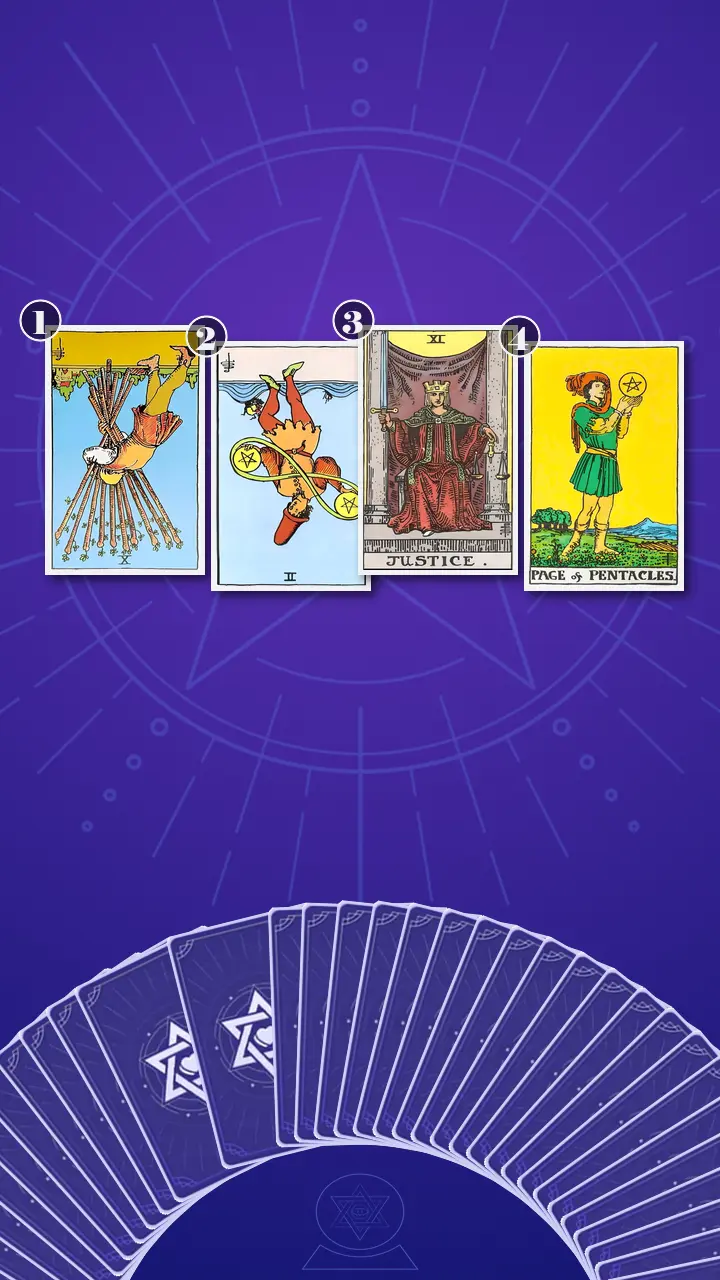
I ask Jordan to put the phone face down for one minute and take one slower breath before I cut the deck. I explain why I am using the Four-Layer Insight Ladder · Context Edition instead of something wider like a Celtic Cross: this question is not asking for a life prophecy, it is asking for a clean diagnosis of what needs resetting first. Four cards are enough to show the visible load, the hidden loop, the hinge point, and the first experiment that can prove the new order in real life. The line of cards will let us read the problem like a troubleshooting sequence: what is loud, what is underneath it, what changes the system, and what to test next. I tell them that the first card will name the overload, the second will show the switch-habit, the third will act as the reset standard, and the fourth will ground the answer in something small enough to do this week.
The Weight in Her Hands
Visible Overload, or the First Thing That Is Already Too Heavy
Now I turn over the card for visible overload and the exact shape of the month-end scramble. Ten of Wands, reversed. In the modern life translation, it looks like carrying a laundry basket, a charger cable, and a laptop between the kitchen and bedroom while Monzo, email, and Slack keep asking for the same mental grip. I do not read that as bad discipline. I read it as a load problem. The fire in the image has tipped from effort into strain: too much carried, too long, with no place to set anything down. I can see it in Jordan's body before I say it out loud — the tight chest, the buzzing shoulders, the clenched jaw. In my family, we call that a body signal, not a character flaw. The body is usually the first honest messenger. 'This isn't a discipline problem,' I say, keeping my voice low, 'this is a carrying problem.' Jordan lets out a short, bitter laugh and looks down at the table. 'That's annoyingly accurate,' they say, and the laugh has enough pain in it to tell me the card has landed.
The reversed energy here can make a person want to refuse help, ignore messages, or power through the whole list in one frantic evening. But the card is not asking for more force. It is asking for a smaller load and a visible limit. One week of naming the top three load-bearing tasks — and letting the rest wait — would already change the weight in their hands.
The Loop That Refuses to Close
Now I turn over the card for the hidden pattern that keeps the scramble going. Two of Pentacles, reversed. This is the modern habit of swapping between Slack, Monzo, and the washing machine like a DJ with no playlist: one ping, one check, one cycle, one reply, then back to the same unpaid bill because the sequence keeps breaking. I ask Jordan what the switch is trying to protect them from. For a second they go still — a tiny freeze in the hands, the eyes lifting and then drifting away as if the memory is replaying itself. Then they answer, very quietly: 'If I stay on top of it, I won't miss anything.' That is the defense strategy in one sentence: constant micro-response so nothing is ignored, even if nothing gets finished. The energy here is unstable juggling, not lack of intelligence. It is tab-switching as a survival reflex. The cost is simple and cruel: partial starts, unfinished tasks, and a leftover pile that feels louder every time you look at it.
I can hear the inner loop behind it — 'I'll just deal with this after the next ping' — and that is what keeps the whole pattern alive. I say, 'Not every ping deserves a priority.' Jordan gives me a small nod that is more recognition than agreement, and I can feel the loop begin to loosen because it has finally been named.
The Rule That Changes the Room
The room goes very still when I flip the third card. Jordan has been trying to solve the whole evening at once, which means every new ping has been arriving like a possible mistake. What they want is not more speed. It is a standard: decide what is due now, what can wait, and what needs a boundary. Justice, upright.
You do not need to treat every bill, chore, and ping as equal; let Justice's scales and sword show what deserves first attention.
For a beat, nothing happens. Then the reaction comes in three small steps: first, a breath that catches high in the chest; second, the eyes drop to the note I have not yet written, as if their mind has finally found the edge of the problem; third, the shoulders lower by a visible notch, and the jaw unclenches enough for the words to come out thinner and more honest. 'But if I stop answering everything right away,' Jordan says, and there is a flash of resistance in the voice, 'does that mean I've been doing it wrong this whole time?' That is the exact moment Justice earns its place: not by scolding, but by changing the standard. This is where the chaos becomes sortable.
I think of my grandmother's weather notes in the Highlands — when the wind changes, you do not try to move every animal at once; you close the safest gate first. That is the same movement here. In elemental terms, the spread has been all fire and unstable earth: frantic heat, then dragging weight. Justice brings air into the room. Air names the order. Air says what protects the system goes first, what is noisy goes second. It is a clean rule, not a moral judgment, and I can see the relief in the way Jordan's fingers stop worrying the edge of the mug. The transformation is beginning right there: from frazzled urgency and self-blame to steadier focus and quieter self-trust.
Now, with this new angle, look back at last week — was there a moment when this insight would have changed how it felt?
One Small Routine That Can Actually Hold
Now I turn over the fourth card. Page of Pentacles, upright. This is the part of the reading that turns Justice into a prototype instead of an idea. The modern life scene is simple on purpose: one tiny Notion page titled month-end reset, or one sticky note on the fridge, with one bill, one wash, one message window. Nothing fancy. The page is not trying to be clever; it is trying to be repeatable. That is why it works. The Page is the apprentice of practical follow-through, and it wants one real task at a time, not a performance of being organised. I tell Jordan that the first step is not a perfect system. It is a visible container. A starter checklist is enough to prove that the day can be directed instead of merely reacted to.
Jordan leans in, and I can almost hear the internal objection trying to rise: 'But if it is this small, will it even count?' I answer that with the same calm I would use for a seedling in rough weather. Yes. Small is exactly the point.
One Fair Order Beats Three Equal Emergencies
Once the spread is on the table, the story is plain. Ten of Wands reversed shows that the first problem is overload, not laziness. Two of Pentacles reversed shows the coping pattern: tab-switching, micro-response, and a nervous belief that staying available will keep everything safe. Justice shows the blind spot: every demand has been dressed up as equally urgent, which means nothing has had a chance to become the first fair priority. Page of Pentacles offers the repair: a small, repeatable routine that gives money, home, and work their own lanes. The cognitive blind spot is not that Jordan does not care enough; it is that the day keeps getting treated like one giant emergency pile. The transformation direction is simpler than they expected: stop calling all of it urgent, and let structure return before effort does. A reset is a standard, not a to-do list.
Using my weather-based activity selection guide, I matched the advice to the day itself: on a grey, low-energy evening, I would not ask for a heroic reset. I would ask for a weather-sized one — the kind that fits the energy you actually have, not the energy you wish you had. Jordan needs a routine they can repeat on a tired Tuesday, not a spreadsheet they need to audition.
Here is the version I gave them, keeping it small enough to try before the week could talk them out of it:
- Draw the fair orderOn one note, write Due now / Can wait / Needs a boundary, then move only the most load-bearing item into Due now before you open another app.If three columns feel too fussy, use two. The point is to create a fair order, not a perfect system.
- Protect one short laneSet a seven-minute no-switch block with Do Not Disturb on, close Slack or Teams, and finish one bill fully or one wash cycle fully before touching the next tab.If seven minutes feels too sharp, start with five. Once the timer ends, you can decide the next lane on purpose.

A Quieter Week, One Lane at a Time
Three days later, Jordan sent me a photo from their kitchen. It was not a glamorous victory: a sticky note on the fridge, a bill paid in one sitting, a folded wash on the chair instead of a laundry basket accusation, and Slack muted for seven minutes while the first lane closed. They told me they sat there with tea gone cold and felt something stranger than triumph — a small, almost shy steadiness. The inbox still existed. The flat still needed tidying. But the room no longer felt like it was accusing them. That is what a real reset looks like to me: not a perfect month, just a day that finally has a direction.
When the bank app, the laundry basket, and Slack all light up at once, the real exhaustion is not the chores themselves — it's the feeling that one missed thing could prove you are not actually keeping your life together. If tonight, you are standing in that exact crosscurrent, remember this: clarity often begins the moment you stop treating every demand as a verdict. So if today only had to be fair, not perfect, what would feel most natural to place first?