From the Read/Unread Spiral to Self-Soothing: A 2 a.m. Sleep Reset

Finding Clarity in the 2 a.m. Phone-Glow Check
If you’ve ever done the 2 a.m. phone-glow check after sending a vulnerable text—and your chest tightens when it’s still unopened—welcome to the read/unread spiral.
Jordan popped up on my screen from a small downtown Toronto bedroom, the kind where the radiator clicks like it’s thinking out loud. It was 2:03 a.m. there. A faint streetcar rattle slid through the window like a ghost of daytime. Her phone was face-up on the pillow, blue light washing the ceiling in a cold, aquarium glare.
She kept doing the same motion: thumb hovering, tap, thread opens, eyes lock on one tiny label—unopened—then back out, then in again. Like refreshing a delivery tracking page every thirty seconds, hoping the next scan will finally mean it’s coming.
“I hate how one unopened message can hijack my whole nervous system,” she said, and her voice had that tired-bright edge people get when they’ve been awake past their own bedtime boundaries. “I’m not trying to be intense. I just want clarity. But… if I double-text, I’ll look desperate. And if I don’t, I’ll miss my chance and they’ll move on.”
I watched her shoulders creep up toward her ears as she said it, like her body was bracing for impact from a notification that hadn’t even arrived.
What she was really describing—under the timestamps and the imagined subtext—was a contradiction with teeth: wanting reassurance and closeness, while fearing that needing reassurance makes you “too much” and therefore unlovable.
Anxiety, in her body, didn’t look like a concept. It looked like a tight chest and hands buzzing with a restless, caffeinated electricity—hands that kept reaching for the phone the way a tongue keeps finding a sore tooth.
“Okay,” I said gently, letting my voice stay calm enough to borrow. “We’re not here to shame you for wanting to feel chosen. We’re here to help you self-soothe first, so whatever you do next—text or don’t text—comes from steadiness, not panic. Let’s draw a map through this fog. A Journey to Clarity, but the kind that actually works at 2 a.m.”

Choosing the Compass: The Celtic Cross · Context Edition
I don’t treat Tarot like a spooky verdict. I treat it like a structured conversation—symbols that let your subconscious speak in an organized way when your conscious mind is stuck in tab-switching chaos.
I invited Jordan to take one slower breath than her nervous system wanted. “Not to force calm,” I said, “just to create a tiny gap.” While she breathed, I shuffled—slowly, deliberately—because the act itself helps the mind cross a threshold from spiraling to observing.
Today, I told her, we’d use the Celtic Cross · Context Edition.
For anyone reading this who’s wondering how tarot works in a situation like “unopened text anxiety at night”: a simple one-card pull can validate your feelings, but it won’t show the whole chain. The Celtic Cross is useful here because the problem isn’t the text itself—it’s a full sequence: present behavior loop → the core block → the deeper attachment fear → what triggered it → what you actually want → the near-term stabilizer → how you’re coping → what the environment is amplifying → your hopes/fears → and the most grounded outcome if you follow the advice.
I previewed the parts that mattered most for Jordan’s “how to stop checking read receipts at 2 a.m.” question:
“Card 1 will name the exact 2 a.m. loop. Card 2 will show the main blockage—where self-soothing fails because your mind demands certainty. Card 6 is the near-term stabilizer: what you can practice in the next 24–72 hours to make sleep possible even if nothing changes on the screen.”
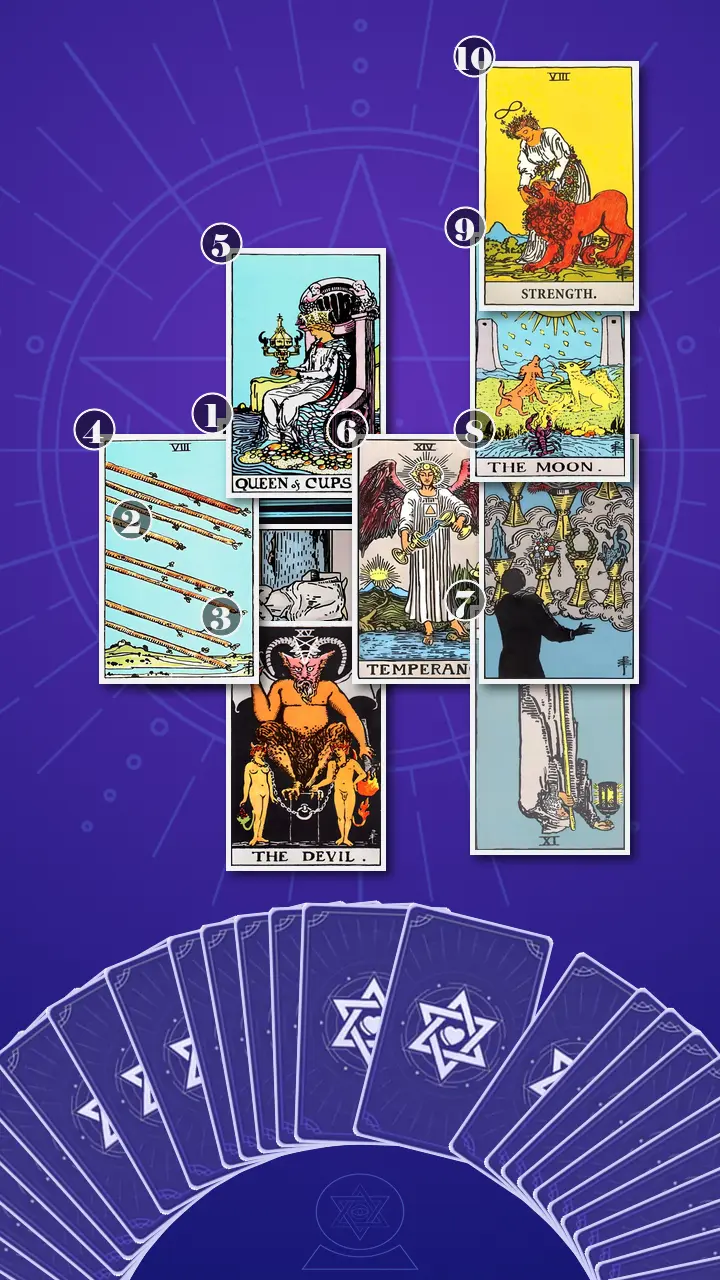
Reading the Map in Blue Light
Position 1: The 2 a.m. Loop That Feels Like “Research”
“Now flipping over is the card that represents the presenting moment: the 2 a.m. experience and the most observable current behavior loop.”
Nine of Swords, upright.
In the classic image, someone sits up in bed with their face in their hands. That’s not metaphorical. That’s literal 2 a.m. physiology—exhausted body, activated mind, and a darkness that makes every thought feel sharp.
I said, “This is like being physically wiped but still sitting up in bed re-reading the same thread, imagining every possible meaning, because your mind refuses to power down.”
And I watched the recognition hit her before it even became words. Jordan gave a small laugh—quick, bitter, almost offended.
“That’s… so accurate it’s kind of rude,” she said.
“Yeah,” I replied, letting the humor be a release valve. “Nine of Swords doesn’t flatter. It names the truth: your mind is treating uncertainty like danger. So the unopened text becomes a screen for self-blame, worst-case stories, and sleep disruption.”
Energy-wise, this is Air (Swords) in excess: thought stacked on thought until it’s heavy enough to pin you to the bed.
“Before we touch the phone again tonight,” I added, “I want you to write one sentence: ‘The story I’m telling myself is…’ That separates fear from fact. It’s the first crack in the loop.”
Position 2: The Block—Forcing Meaning From Incomplete Data
“Now flipping over is the card that represents the primary block: what keeps the self-soothing from working in the moment.”
Two of Swords, reversed.
In modern life, this is the moment you have partial information—an unread status—and your brain tries to ‘solve’ the feeling by making a definitive story anyway.
I described it the way I was seeing it in her body: “Your thumb is hovering over the app icon like it’s a lever that can pull you into safety. Meanwhile, your chest is tight, and your shoulders keep rising. This card says: you’re not pausing. You’re trying to force a verdict.”
I used a split-screen contrast, like two columns on a Figma frame:
Facts: It’s unopened.
Meaning: Busy / losing interest / playing games / talking to someone else / you said the wrong thing / you are not chosen.
“Your mind is switching tabs like this,” I said, mirroring her pattern in short, frantic beats: “iMessage → Notes app → Instagram Stories → back to iMessage.”
Then I dropped the stabilizing line that interrupts the courtroom energy:
Unopened is a status, not a sentence about you.
Jordan exhaled sharply through her nose, like she’d been holding her breath without noticing. Her eyes flicked away from the phone for the first time since we started. A tiny nod.
“Okay,” she said softly. “That… lands.”
“Good,” I told her. “Because reversed Two of Swords is Air in blockage: you’re using thinking to avoid feeling, but it backfires into mental noise.”
Position 3: The Root—The Notification as a Chain
“Now flipping over is the card that represents the root driver: the underlying fear and attachment mechanism.”
The Devil, upright.
I’ve worked with thousands of people in liminal spaces—long sea voyages, jet lagged nights, ocean between them and whatever they missed. The Devil shows up when relief gets outsourced to something external and immediate, because waiting feels intolerable.
“This isn’t about blame,” I said, carefully. “It’s about mechanism. The unread status has become a chain—not because the other person is evil, but because your nervous system is bargaining with your phone for a micro-dose of relief.”
I translated the chains into a habit loop: “Notification equals two seconds of ‘ahh.’ Then silence equals ‘oh no.’ And then your hand reaches again.”
I offered an inner dialogue snippet—Devil voice versus a calmer reply:
Devil voice: “You need to know now. Check again. Don’t be stupid.”
Temperance voice (we’ll meet her soon): “We can’t know now. But we can settle enough to sleep.”
Jordan’s mouth tightened, then loosened. “It really does sound like that in my head,” she admitted. “Like… absolute language. Like there’s no other option.”
“Exactly,” I said. “The Devil is compulsion. The chain feels tight, but in the card it’s also loose enough to remove—once you see it.”
Position 4: The Trigger—When Fast Pacing Trained Your Body
“Now flipping over is the card that represents the immediate trigger context: what conditioned expectations and set off the spiral.”
Eight of Wands, upright.
“This is rapid back-and-forth,” I said. “Quick messages. Momentum.” In the image, the wands fly through open sky like a clean delivery route.
In modern dating terms? It’s when you get used to a certain reply pace in the Hinge/Bumble gray zone—banter, quick check-ins, the feeling of ‘this is easy.’
“Then the pace changes,” I continued, “and your body reads it as a problem that must be solved right now.”
Jordan’s eyes narrowed the way a product designer’s eyes narrow when something doesn’t match a pattern. “We were texting a lot earlier,” she said. “Like, a lot. And I think I… assumed that meant something.”
“The card isn’t calling you naïve,” I said. “It’s showing a conditioning effect. Speed sets expectation. And expectation makes silence louder.”
Position 5: The Real Goal—Being Held From the Inside
“Now flipping over is the card that represents the conscious aim: what you’re truly trying to create for yourself.”
Queen of Cups, upright.
This was the first moment the spread breathed. The Queen of Cups doesn’t chase. She holds. She’s emotion with a container.
“You’re not actually asking, ‘How do I make them respond?’” I said. “You’re asking, ‘How do I stay kind to myself while I wait?’”
Jordan swallowed. Her gaze got a little shiny, and she looked embarrassed about it.
“I don’t want to be the person who needs this,” she whispered.
“Wanting reassurance doesn’t make you broken,” I said, steady. “It makes you human. The Queen is Water in balance: feeling deeply without flooding.”
I pointed out the closed cup in the image. “That cup is like a boundary: you can have emotion without pouring it straight into a chat bubble at 2 a.m.”
When Temperance Spoke: Mixing Comfort and Reality
Position 6: The Near-Term Stabilizer—A Rhythm, Not a Rescue
“Now flipping over is the card that represents the near-term stabilizer: the most helpful self-soothing regulation approach for the next 24–72 hours.”
The room—on both sides of the screen—felt quieter. As if even the phone glow dimmed a fraction.
Temperance, upright.
The angel pours between two cups. Not dramatically. Not urgently. Just… steadily. One foot on land, one in water. Practicality and feeling, in contact.
Stop trying to force clarity in the dark; start mixing small doses of comfort and reality like Temperance pouring between two cups.
I let that sit. In my head, I flashed to Venice—how water moves through narrow canals and suddenly opens into a bright campo. You can’t force the tide. You work with circulation. That’s my Venetian Aqua Wisdom: when energy is stuck, you don’t argue with it—you give it a path.
Jordan’s reaction came in a chain, exactly the way it does when something finally lands in the body: first she went very still, like her breath forgot to move. Then her eyes unfocused for a second, replaying a familiar scene—thumb hovering, chest tight, the verdict-writing brain. Then her shoulders dropped, slowly, and she released a shaky exhale that sounded like air leaving a sealed jar.
“But if I stop trying to figure it out,” she said, and there was a flicker of anger under the fear, “doesn’t that mean… I’m just letting them have all the power?”
I nodded. “That’s the protective part talking. And it makes sense. But Temperance isn’t surrendering power. Temperance is changing sequence: regulate first, then choose.”
“Let’s do a ten-minute Temperance Pour right now,” I offered, and this is where I brought in my own diagnostic lens—Energy Flow Diagnosis. “Before you move, notice your jaw, your shoulders, your hands. That buzzing in your hands? That’s not you being ‘dramatic.’ That’s energy trying to discharge through a screen.”
I guided her through it, non-medically, as an energy practice—no promises, no diagnoses. Just signals and choices: set a timer for ten minutes; put the phone face-down (or in a drawer) and step to the kitchen; drink a full glass of water slowly, noticing temperature and swallowing; do six slow breaths (in for four, out for six); then name two facts out loud: “The fact is it’s unopened. The meaning is unknown.”
“If that spikes you,” I added, “you can stop early. Your job is not to win the feeling. Just lower intensity by one notch.”
Then I asked her, softly and specifically, “Now, with this new sequence—regulate first—think back to last week. Was there a moment where an unread status made you write a story you didn’t consent to? What would Temperance have changed in that hallway moment?”
Her eyes went to the side, searching memory. “Tuesday,” she said. “I opened Notes and wrote this long thing I didn’t send. And I didn’t sleep. If I had done… water and breathing first… I think I would’ve… at least stopped making it a verdict on me.”
That was the shift: from restless urgency toward naming the story, tolerating uncertainty, and creating safety first.
Position 7: You in This—When Solitude Turns Into Surveillance
“Now flipping over is the card that represents your self-position: how you show up and cope.”
The Hermit, reversed.
“This is isolation that isn’t restorative,” I said. “It’s you alone with your phone in a feedback loop.”
Reversed Hermit is when the lantern points the wrong way. Instead of lighting wisdom, it lights obsession. You confuse monitoring with insight.
Jordan frowned. “I call it ‘processing,’” she admitted. “But it doesn’t feel like processing. It feels like… watching.”
“Exactly,” I said. “The Hermit is meant to be solitude that gives you back to yourself. Reversed, it becomes tunnel vision.”
Position 8: The Environment—Too Many Stories, Too Many Inputs
“Now flipping over is the card that represents the external field: modern dating ambiguity, social inputs, and the environment that fuels projection.”
Seven of Cups, upright.
“This is the mind’s menu of stories,” I told her. “Not a single confirmed reality.”
It’s Instagram Stories couple content at night. It’s dating discourse. It’s the friend who means well but says, “If they wanted to, they would,” like it’s universal law. It’s also the algorithm learning your anxiety: the more you check, the more your brain treats the app as the main thing to consume.
“Tonight,” I said, “your environment isn’t neutral. It’s feeding options: busy, rejecting, playing games. Each one spikes a different feeling.”
Jordan made a face. “I did scroll,” she said, a little sheepish. “And it made it worse.”
“Of course it did,” I said. “Seven of Cups is overwhelm. Too many meanings.”
Position 9: Hopes and Fears—The Night Makes Everything Feel Like an Omen
“Now flipping over is the card that represents your hopes and fears: what you want the reply to confirm and what you fear the silence confirms.”
The Moon, upright.
Moon energy isn’t “bad intuition.” It’s heightened sensitivity plus low visibility. The path between two towers is that uncomfortable middle where you can’t see the whole road, but you can still take the next careful step.
“This is your nighttime mind,” I said. “Part of you hopes your instincts will reveal the truth. Part of you fears you’ll be fooled or rejected.”
Jordan’s fingers tightened around her mug. “It feels so real at night,” she whispered. “Like… the meaning is obvious.”
“That’s The Moon,” I said. “The question becomes: what do you actually know right now, and what are you only sensing because it’s late and you’re tired?”
Position 10: Outcome—Strength, Not ‘Being Unbothered’
“Now flipping over is the card that represents integration outcome: the best-available inner stance if you follow the advice of the spread.”
Strength, upright.
Her shoulders were lower now than when we started. Even her voice sounded less brittle.
“Strength isn’t ‘being unbothered.’ It’s being kind and steady on purpose,” I told her. “It’s your nervous system—the lion—and your conscious self working as partners, not enemies.”
Energy-wise, this is embodied steadiness: not fighting the urge to check, but holding it with gentle restraint. Like choosing Do Not Disturb not as avoidance, but as a boundary that protects tomorrow-you.
“So the goal isn’t to never feel the urge,” I said. “The goal is to feel it—and still have options.”
The One-Page Night Reset: Actionable Advice for Unopened Text Anxiety
I pulled the whole story together for Jordan in plain language, the way I would for someone on a ship at 3 a.m. who can’t sleep because the ocean feels endless:
“Here’s what the spread is saying. Your mind is in a Nine of Swords loop—treating uncertainty like danger. Two of Swords reversed is the blockage: you keep trying to force meaning from incomplete data. The Devil underneath shows why it’s sticky: your nervous system is chained to an external signal for relief. Eight of Wands shows the trigger: the relationship pace trained your body to expect quick closure. Queen of Cups reveals what you actually want—self-soothing and self-trust. Temperance is the bridge: pacing, mixing comfort with reality. And Strength is the outcome: gentle restraint and kindness that let you sleep and communicate intentionally.”
“Your cognitive blind spot,” I added, “is thinking you need certainty to get calm. But your transformation direction is the opposite: calm first, then choice. That’s the shift from ‘I need a response to feel safe’ to ‘I can create safety first, then decide what I want to do.’”
Jordan rubbed her eyes. “But what if I can’t even find ten minutes?” she asked, practical obstacle on the table like a reality check. “My brain will scream.”
“Then we do the two-minute version,” I said instantly. “You’re not failing Temperance. You’re titrating. Small doses.”
Then I gave her a simple, repeatable protocol—modern solutions, not moral rules—anchored in Temperance and Strength (and yes, built to work even when you’re screen-exhausted):
- Facts vs Meaning Reset (60 seconds)Out loud, once: “The fact is it’s unopened. The meaning is unknown.” Then put your phone outside the bedroom (or at least across the room) for 20 minutes.If your brain calls this “pointless,” that’s normal—it wants certainty, not regulation. Do the smallest version: pillow → nightstand → across the room.
- The Temperance Pour Protocol (10 minutes—or 2)Set a timer. Phone face-down/in a drawer. Drink a full glass of water slowly. Do 6 breaths (in 4, out 6). Do a quick body scan: jaw → shoulders → hands, letting each area drop one notch. Only after the timer ends, decide whether you want to check.You’re not trying to “win” the feeling—just lower intensity by one notch. If 10 is too much, do 2. That still counts.
- Strength Delay Rule (30 minutes)Hand on chest, name it: “anxious + longing.” Delay any follow-up text by 30 minutes (or until after sleep). If you must draft, draft in Notes—not in the chat box.This isn’t about being chill. It’s about giving tomorrow-you the gift of choice. If you slip once, restart at the next moment—no punishment.
Before we ended, I asked one more question—because this is where clarity becomes a lived thing: “If you’re honest: when you want to double-text at 2 a.m., are you trying to communicate… or are you trying to calm your body?”
Jordan stared at the corner of her room where the blue light had been hitting the wall. “Calm my body,” she said, almost relieved to admit it. “It’s not really about the message.”

A Week Later: Ownership, Not Certainty
Six days later, I got a message from Jordan—sent at 7:12 a.m., not in the middle of the night. “Did the water thing,” she wrote. “And the ‘fact vs meaning’ line. I slept. Woke up and my first thought was still ‘what if I’m wrong?’—but then I laughed. Like… okay, moon-brain. Not today.”
That’s what I mean when I say Tarot can offer actionable advice. Not because it predicts whether someone will text back, but because it helps you find clarity about what’s actually happening inside you—and gives you a next step you can do with your real body, in your real room, with your real phone.
And that’s the quiet arc of this Journey to Clarity: from treating silence like a verdict, to learning you can create safety first—then choose how (and whether) to reach out from a regulated place.
When a tiny “unopened” label makes your chest tighten and your hand keep reaching for your phone, it’s not because you’re dramatic—it’s because part of you is begging to feel chosen without having to beg.
If you didn’t need their response to create safety first—what’s one small, kind thing you’d do tonight to help your body believe you’re still okay in the waiting?