From Read Receipt Anxiety to Plain Asks: Reclaiming the Pause

Finding Clarity in the 8:47 p.m. WhatsApp Dashboard
If you’ve ever watched your last WhatsApp message sit there unanswered while they’re “active” elsewhere and felt your stomach drop—welcome to read receipt anxiety.
Alex showed up on my screen from a London shared flat kitchen, the kind with one too-small table and a counter that’s always half taken by someone’s groceries. It was 8:47 p.m. there: extractor fan humming, a flatmate’s Deliveroo bag rustling in the background, and Alex holding their phone like it was warming their palm on purpose.
They didn’t have to say much. I could see it in the way their thumb kept making the same micro-movement—unlock, open WhatsApp, stare at the same thread, lock the screen like closing a door that won’t stay shut.
“I hate that a reply can change my whole mood,” they said, a little too fast, like they were trying to get the sentence out before shame caught up. “My friend takes forever to reply. Hours. Sometimes a day. And I spiral. I start rereading my message for tone, checking ‘last seen,’ then Instagram Stories like I’m… gathering evidence. And I don’t even know why it hits me this hard. Where did it start?”
The contradiction sat between us like a third person on the call: they wanted closeness and reassurance, but the waiting felt like proof they were being ignored—or worse, not valued.
In their body it looked like a tight chest with a drop in the stomach, restless hands that couldn’t settle, and the particular kind of late-evening agitation where even Netflix becomes background noise for one glowing rectangle.
I nodded slowly. “That makes so much sense. Not because the silence is objectively dangerous—but because your nervous system is treating it like a verdict. Let’s not shame the spiral. Let’s map it. Tonight, we’re not trying to become ‘chill.’ We’re trying to find clarity.”

Choosing the Compass: The Celtic Cross · Context Edition
I read from Tokyo most days, usually after my shift guiding visitors through the planetarium. When the dome lights go down and the projector starts its soft mechanical hum, people always think the stars arrive all at once. But they don’t. Your eyes adjust. The darkness becomes usable. That’s how I think a good tarot reading works, too—less magic, more adaptation.
I asked Alex to take one breath that was purely logistical—like resetting a browser tab. “No need to force calm,” I said. “Just give your mind one clean second to land.” I shuffled slowly, not as a ritual for the universe, but as a way to let the question become specific enough to hold.
“For this,” I told them, “I want to use a spread called the Celtic Cross · Context Edition.”
And for you reading this: I chose it because Alex’s question isn’t only “What do I do about a slow reply?” It’s the full chain—present spiral, the hook that tightens it, the root fear underneath, and the origin template where the nervous system learned what silence means. Then it needs the forward map: how they show up, what the friend’s pacing might actually be, and what integration looks like when we stop treating timestamps like a relationship scoreboard.
I previewed the map out loud. “The first card will show the spiraling moment as it’s lived in your body and mind. The crossing card will reveal what hooks you—the pattern that makes it feel urgent. One card will point to where it started, and another will crown the spread with what you’re trying to build instead.”
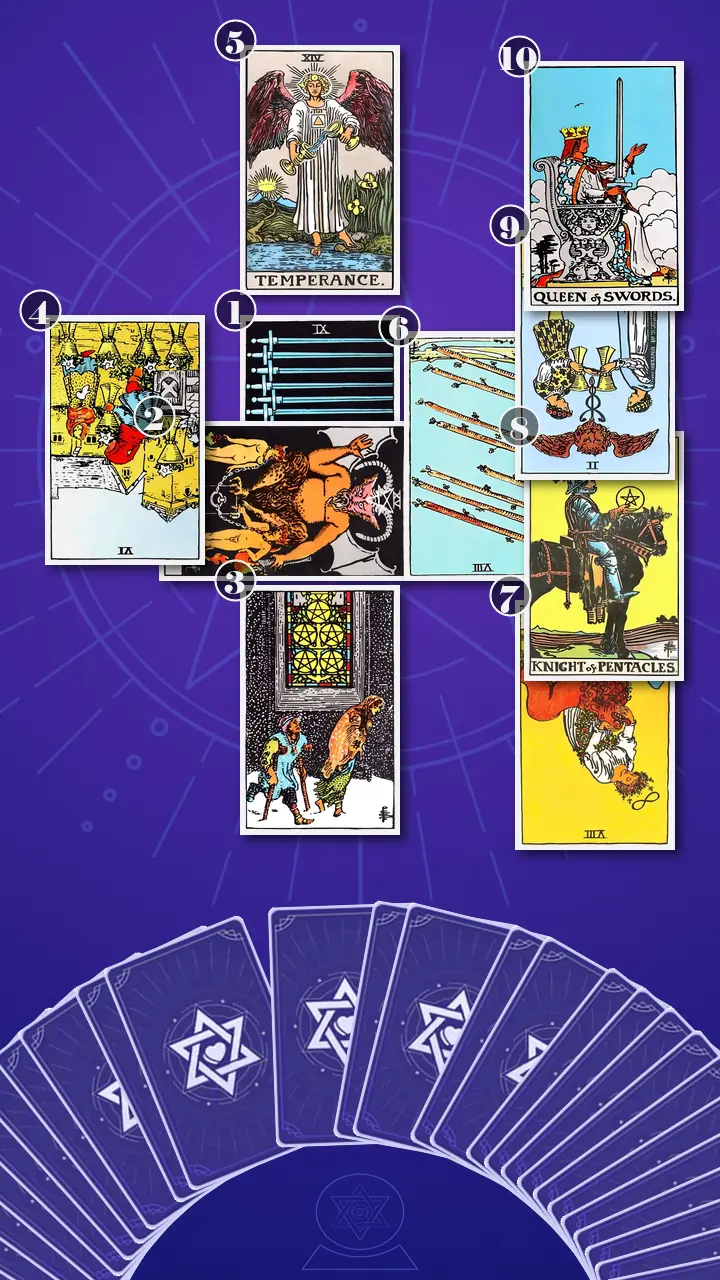
Reading the Map: How Tarot Names the Spiral Without Blaming You
Position 1: The spiraling moment — Nine of Swords (upright)
I turned over the first card. “Now opening is the card that represents the spiraling moment: what’s happening internally when the friend doesn’t reply.”
Nine of Swords, upright.
In the classic image, someone sits up in bed with their head in their hands, nine swords mounted on the wall behind them like thoughts that have turned into weapons. I didn’t need to decorate it with mysticism; Alex already lived inside this card.
“This is like when you wake up and immediately reach for your phone,” I said, “and then spend an hour replaying the chat and inventing reasons the friendship is slipping. It’s the 2 a.m. brain treating thoughts as facts—especially when the phone is within reach.”
Energetically, this is Air in excess: thinking as a storm system. Not curiosity. Surveillance. Your mind tries to protect you by building a case from tiny cues—punctuation, emoji, the time gap—because uncertainty feels intolerable.
Alex let out a small laugh that was more bitter than amused. “That’s… yeah. That’s actually kind of brutal.”
“I know,” I said, keeping my voice gentle. “But brutal isn’t the same as hopeless. This card doesn’t say you’re dramatic. It says you’re awake in the dark with a bright screen and a loud inner critic. And it asks something practical: what do you think you’re preventing by staying mentally on watch? What would happen if you stepped away for thirty minutes?”
Alex’s eyes flicked away from the camera, like they were picturing the thread. Their hand tightened around the mug they hadn’t been drinking from.
Position 2: What hooks you — The Devil (upright)
“Now opening is the card that represents what hooks you: the main pattern that tightens the spiral.”
The Devil, upright.
I could almost feel Alex brace, like they expected judgment. People hear “The Devil” and think it means they’re doing something wrong. In my experience, it’s rarely about morality. It’s about compulsion—attachment to the one thing you believe will finally make your body stop yelling.
“This,” I said, “is the part of you that believes relief only comes from getting the response.”
I used the scene loop exactly as it is in modern life: phone unlock → app open → a tiny hit of control → immediate emptiness.
“If I just check again, I’ll know where I stand…” I narrated, letting the inner monologue land. “Why am I doing this? I can’t stop.”
Then I gave Alex a line I’ve learned people need to hear without any shame attached: “If checking is the only thing that calms you, it’s not information you’re seeking—it’s relief.”
Alex’s reaction came in a three-beat chain: their breath paused; their gaze unfocused like a quick memory replay; then a sharp exhale slipped out. “Oh… yeah,” they said quietly, and their shoulders lifted and fell like they’d been holding something heavy without noticing.
“The good news,” I added, “is that The Devil’s chains are always loose enough to slip off once they’re named. The hook is interruptible.”
Position 3: The underlying fear — Five of Pentacles (upright)
“Now opening is the card that represents the underlying fear beneath the spiral that your body is reacting to.”
Five of Pentacles, upright.
Two figures in the snow. A warm lit window behind them—stained glass, shelter, belonging—and yet they’re outside it, convinced they can’t enter.
“This is the ‘outside the circle’ feeling,” I told Alex. “When you see the unanswered message, you don’t just feel a delay. You feel excluded. Overlooked. Like you’re in the rain staring at a warm pub window, sure you’re not allowed in even though the door isn’t locked.”
Energetically, this is Earth in deficiency: a lack that isn’t about facts; it’s about safety. Your body reacts like it’s about to lose belonging.
Alex swallowed. “It’s embarrassing how accurate that is. I literally get this thought like… I’m easy to forget.”
“That’s not embarrassing,” I said. “That’s the root. When that fear lights up, the Nine of Swords starts collecting clues, and The Devil starts demanding relief. Your brain calls it ‘being reasonable.’ Your body calls it survival.”
Position 4: Where it started — Six of Cups (reversed)
“Now opening is the card that represents where it started: the origin template that taught you what silence means.”
Six of Cups, reversed.
On the surface, this card is sweet—children, gifts, a safe little garden of cups. Reversed, the sweetness gets complicated. It’s the past intruding, not as a clear memory but as an old rule your nervous system still follows.
“This suggests your reaction isn’t only about this friend,” I said. “It’s also about what slow or inconsistent responses used to mean to you.”
I offered the “This reminds me of when…” bridge, and I kept it small on purpose, because origin work doesn’t need to be dramatic to be real.
“This reminds me of when…” I began, and Alex finished the sentence with a quiet honesty that made their face soften. “School. Waiting for someone to pick me for a group. Or like… messaging someone and then checking my inbox like it’s a hallway I have to stand in.”
There it was—the micro-memory texture: the waiting, the not knowing, the way a child learns, unconsciously, that attention is conditional.
“And now,” I said, “your body reacts before your logic can speak. That’s why telling yourself ‘just relax’ doesn’t work. It’s not a logic problem first. It’s a nervous system template.”
Alex blinked hard, like they were surprised by the tenderness of it. “So it started earlier than this one chat.”
“Exactly,” I said. “Meaning without blame.”
When Temperance Spoke: The Pause That Isn’t a Trial
Position 5 (Key Card / Bridge): What you’re trying to build — Temperance (upright)
I let my hand rest on the deck for a second before turning this one over. The planetarium projector behind me made its low, steady whir—an accidental metronome. “We’re opening the most important card in this reading,” I said. “The bridge.”
“Now opening is the card that represents what you’re trying to build instead: your conscious goal for steadiness and communication.”
Temperance, upright.
An angel pours between two cups, one foot on land and one in water. This isn’t about becoming a different person. It’s about learning a repeatable rhythm.
I used the two-cups split the way it shows up in a London flat at night: one cup is the feeling (tight chest, stomach drop, longing); the other is the message (words on a bright screen). Dump the feeling cup straight into the chat and you get a test text—engineered, “casual,” secretly begging for reassurance. Pour slowly, and you get one clear ask that respects both people.
And I gave them the reframe they could actually use in the moment: “A slow reply isn’t a verdict—it’s a pause. Don’t turn the pause into a trial.”
The air on the call changed. Alex’s shoulders lowered a fraction, like someone finally loosened a drawstring around their ribs.
Setup. Alex was still stuck in that Tube-commute moment—opening the same thread for the fifth time, watching “last seen” like it’s a relationship score. Their stomach dropped, their thumb kept refreshing, and their mind insisted: if I can just get certainty, I can finally breathe.
Delivery.
Stop treating the silence like a verdict, and start practicing the Temperance pour: blend self-soothing with one clear ask instead of chasing relief through monitoring.
I let the sentence sit in the quiet for a beat, the way I let visitors sit in the dark long enough to notice the faint stars they missed at first.
Reinforcement. Alex’s reaction arrived in layers. First: a small freeze—mouth slightly open, eyes widening like they’d been caught mid-scroll. Then: their gaze went soft and unfocused, as if the past week replayed in fast-forward: the Notes drafts, the Instagram “evidence,” the sudden shame the moment a reply finally came through. Finally: a long breath out, shaky at the end, and their shoulders dropped more visibly, as though their body finally believed it could stand down from alert mode. “So I’m not trying to become ‘low-maintenance,’” they said, voice quieter now. “I’m trying to become steady.”
“Yes,” I said. “Steady is learnable.”
Then I invited the pivot that makes Temperance practical: “Now, with this new lens—can you think of one moment last week when you were about to check again, and this would’ve changed how it felt inside your body?”
Alex looked down, one hand unconsciously pressing against their chest through their hoodie. “Yesterday. I was at my desk, Figma open, Slack going off, and I kept snapping back to the thread. I thought I was being productive, but I was… taking evidence.”
“That’s the shift,” I said, naming it clearly. “This is you moving from tight alarm and compulsive monitoring toward naming the story you’re telling—and building the ability to tolerate a small pause. That’s the first step from insecurity to steadier self-trust.”
And here is where my research brain always shows up: in astrophysics, distance changes the information we receive. Light stretches. Signals redshift. In relationships, the mind panics and assumes every delay means distance. My Cosmic Redshift Communication skill is a way to check for real distancing without spiraling: you don’t judge one data point. You look for a trend line. Is the “signal” consistently weakening over weeks—less initiation, less follow-through, less warmth? Or is it just a human with a different pace? Temperance is what lets you assess the pattern without turning tonight’s silence into a final sentence.
Climbing the Staff: Reality Checks, Self-Soothing, and Clean Words
Position 6: Near-term texture — Eight of Wands (reversed)
“Now opening is the card that represents near-term texture: how timing and communication may feel in the next stretch, and what it asks of you.”
Eight of Wands, reversed.
Wands mid-flight, momentum suspended. In modern terms: messages that don’t land when you want them to.
“This validates something important,” I told Alex. “The speed may not improve immediately. The growth edge isn’t outrunning the pause—it’s how you respond inside it.”
Energetically, this is Fire blocked: urgency has nowhere clean to go, so it turns into frantic refreshing or over-explaining. The risk here is flooding the conversation—multiple messages, extra context, a joke to soften it, another ‘just one more thought’—and then feeling even more exposed when the reply still doesn’t come fast.
Alex winced like they’d been personally dragged. “I do that.”
“Most people do,” I said. “This card doesn’t scold. It asks for a boundary you can keep for one week.”
Position 7: Your stance — Strength (reversed)
“Now opening is the card that represents your stance and self-talk inside the spiral.”
Strength, reversed.
The image is always misunderstood. Strength isn’t about forcing yourself to be tougher. It’s about gentle authority over your own instincts. Reversed, it often shows up as white-knuckling: “I should be able to handle this,” followed by shame when you can’t.
“This tells me the spiral isn’t a lack of logic,” I said. “It’s a lack of gentleness with yourself when uncertainty shows up.”
Energetically, this is inner confidence in deficiency. You reach outside for control because inside feels unstable.
Alex’s jaw worked like they were chewing on the word “gentleness.” “I always tell myself I’m being ridiculous. Which… doesn’t help.”
“Exactly,” I said. “Self-criticism isn’t self-control. Temperance plus Strength is: comfort your body first, then decide.”
Position 8 (Catalyst): The external reality — Knight of Pentacles (upright)
“Now opening is the card that represents the external reality: the friend’s pacing style and the context around the replies.”
Knight of Pentacles, upright.
This is one of my favourite reality-check cards for “they take forever to reply” situations, because it refuses the drama without dismissing your need for connection.
I used the calm cutaway scene: “Imagine your friend on a late bus, finishing a shift, phone on 2% battery. They get home, plug it in, shower, and then reply—thoughtful but slow. Not because they don’t care. Because they treat texting like a task they do after the day is done.”
Air inside you: fast, scanning, urgent. Earth in them: slow, methodical, steady. Two different Wi‑Fi speeds.
Alex paused. Their eyes shifted, and I saw the blame loosen just a little. “They are like that,” they admitted. “In person they’re solid. They just… don’t do rapid back-and-forth.”
“That’s important data,” I said. “It doesn’t erase your needs. But it changes the story.”
Position 9: Hopes and fears — Two of Cups (reversed)
“Now opening is the card that represents what you hope for and what you fear you’ll discover about the bond.”
Two of Cups, reversed.
Reversed, the space between the two cups becomes loud. It’s misattunement. Assumptions. A fear that care won’t be met with care.
“You’re not only waiting for a message,” I said. “You’re waiting to feel met. And the gap makes you doubt the whole bond.”
Then I asked the question that usually reveals the hidden stake: “Are you asking for mutuality—or are you asking for proof you’re safe from being left?”
Alex looked almost irritated for a second, then their expression softened into something more honest. “Both,” they said. “And I hate that it’s both.”
“You can want closeness without making response time the proof of it,” I said, letting the sentence be permission, not correction.
Position 10: Integration direction — Queen of Swords (upright)
“Now opening is the card that represents integration direction: what changes when you apply the lesson, in your mindset and boundaries.”
Queen of Swords, upright.
Raised sword. Clear gaze. A hand that can say “pause” without making it a fight.
“This is where you stop hinting and start asking,” I said. “Where you stop monitoring and start stating. Not cold. Not dramatic. Just clean.”
I offered a message example, firm-soft the way the Queen speaks: “Hey—no rush, but when you get a sec, can you let me know if you’re up for catching up this week?”
Alex’s face steadied, like they could feel their spine again. “I can be direct without being dramatic,” they said, almost as if they were testing the sentence in their mouth.
“That’s the Queen of Swords,” I said. “Clarity is a boundary you hold inside first.”
The One Upgrade: Regulate First, Then Ask in Plain Language
I leaned back and let the whole spread settle into one story, because that’s where tarot becomes actionable advice instead of a pile of meanings.
“Here’s what I see,” I told Alex. “The Nine of Swords shows the lived spiral—your mind turning a neutral delay into a verdict. The Devil shows the hook: checking as relief-seeking, a loop that feels like control but keeps the fear alive. Under it, the Five of Pentacles says the real pain is belonging—‘I’m easy to forget.’ The Six of Cups reversed shows an older template that taught your body what silence means. Temperance is your bridge: a repeatable way to steady yourself in the pause. And once you’re steadier, Queen of Swords is the integration—clear boundaries and one clean ask. The Knight of Pentacles reminds us the external reality may simply be a slower pacing style, not rejection.”
“Your cognitive blind spot,” I continued gently, “is this: when you’re activated, you treat timestamps as truth. You start collecting clues instead of making one clear request. You outsource your belonging to a timestamp.”
“And the transformation direction is exactly what Temperance and the Queen are asking for: shift from ‘their response time decides my value’ to ‘I can soothe first, then ask for clarity and boundaries in plain language.’”
Then I gave Alex small, testable experiments—because in my world (astronomy and tarot), the fastest way to trust a pattern is to observe it over time, not argue with it in one night.
- The 3-Breath Reset (before any follow-up)When you feel the urge to double text, pause where you are (Tube platform, kitchen, desk). Inhale normally and exhale longer than you inhale, three times. Then decide: is your next message a clear ask, or a reassurance-seeking test?Expect your brain to protest (“This is silly, I just need them to reply”). Lower the bar: do the 90-second version. The point is choice, not perfection.
- The “Not Evidence” Checking Boundary (one-week trial)Create a tiny rule for seven days: only open that thread at the top of the hour—or pick two windows (lunch + after dinner). Put WhatsApp in a folder literally called “Not Evidence.”If you slip and check, you haven’t failed; you’ve found where the hook is strongest. Return to the next hour window and restart—no punishment.
- Single-Send Week (stop flooding the pause)Once this week, send one message with one question or one plan. No follow-up for 24 hours unless it’s genuinely time-sensitive. If you want to add “just one more thought,” put it in a Notes draft titled “Not For Sending.”Add an exit ramp for real deadlines: “Need to confirm by 6 p.m.—if not, I’ll assume next week.” Clear, calm, no chasing.
And because my work is built on rhythm—not just insight—I offered my own tool as a way to make this sustainable. “If you want,” I said, “we can use my Social Star Map approach. Not astrology as fate—just rhythm as support. Pick two predictable ‘orbit points’ in your week for connection: one midweek check-in, one weekend plan. When you know there’s a scheduled next touchpoint, your nervous system stops treating every silence like free fall.”
Alex immediately hit the real-world obstacle, the one that makes advice either useful or insulting. “But I can’t even find ten minutes sometimes,” they said, a little sharp. “Work is intense, and the flat is loud, and if I don’t check, it feels like I’m… letting it happen.”
I nodded. “That’s honest. So we shrink it. Ninety seconds. Phone face-down. One long exhale. One sentence: ‘The story I’m telling is…’ You’re not letting anything happen. You’re choosing to stop taking evidence while you’re dysregulated.”

A Week Later: Stop Outsourcing Your Belonging to a Timestamp
Six days later, Alex messaged me—not a long paragraph, just a screenshot and one line: “I did the single-send thing. I sent one clean ask, then put WhatsApp in ‘Not Evidence’ and went for a walk.”
The friend had replied later that night: warm, specific, and—predictably—slow. Alex wrote, “I still felt the first stomach-drop. But it didn’t take my whole day. I didn’t spiral on the Northern line. I’m weirdly proud of myself.”
The bittersweet part was there, too—because growth is rarely a full glow-up montage. “I slept,” they added, “but when I woke up my first thought was still ‘what if they don’t care?’ It just… didn’t run the whole show.”
I closed my laptop after reading that, and for a second I thought about the dome at the planetarium: how the sky looks like it’s moving when really it’s us rotating beneath it. Clarity isn’t always the stars changing. Sometimes it’s you recognising the motion—and realising you can set down the phone and still belong to yourself.
When a chat goes quiet, it can feel like your chest tightens around one thought—“If I mattered, I wouldn’t be this easy to forget”—and suddenly you’re not waiting for a text, you’re waiting for proof you belong.
If you didn’t need the timestamp to confirm your worth, what’s one small, plain-language ask you’d feel willing to make from a steadier place?