The 9:12 PM 'Seen' Spiral: Choosing One Clean Text or a Clean Pause

Finding Clarity in the 9:12 p.m. Scroll
If you’re a 20-something in a city like Toronto who can answer Slack in 30 seconds but turns into a detective the second you see “Seen” with no reply (read receipt anxiety), this is for you.
Taylor (name changed for privacy) didn’t start our session with a grand story. She started with a timestamp.
“It was 9:12,” she said, like she’d been in court. “Tuesday. I had dinner. Netflix was on. And then… I saw it. Seen. No reply.”
I could picture it with uncomfortable clarity: a Toronto condo kitchen, overhead light buzzing just enough to grate on your nerves, a half-eaten bowl going cold, Netflix murmuring like it’s trying to be helpful but can’t compete with your brain. The phone sits face-up beside the dishes, warm through the glass from being handled too many times. Your thumb hovers, not even tapping—just hovering, as if hovering might change the outcome.
And there it was—the core contradiction, spoken in the language of anyone who’s ever been left on read: you want connection and clarity—yet the silence feels like rejection, and chasing it costs your self-respect.
Taylor’s chest had that pinched, hollow pressure she couldn’t talk herself out of. Her hands kept drifting toward her phone the way your fingers drift toward a scab you know you shouldn’t pick. “I hate that I’m like this,” she said. “But I need to know what’s going on. Like… should I double-text? Or is this the moment I stop doing the approval thing?”
The insecurity wasn’t abstract. It was physical—like her nervous system had turned her phone into a lie detector, and every second of silence was another interrogation.
I leaned forward, keeping my voice steady—warm, but not syrupy. “We’re not here to judge you for caring,” I said. “We’re here to get you out of the spiral and back into choice. Let’s try to draw a map through the fog—something that leads to clarity, not more draft-delete loops.”

Choosing the Compass: The Decision Cross · Context Edition
I asked Taylor to take one slow breath—not as a mystical ceremony, but as a practical gear shift. Then I shuffled, slowly, the way I’ve learned to do after decades of handling fragile things: pottery fragments, field notes, and yes—people’s tender questions. “Just keep the question in mind,” I said. “Left on read—double-text, or break the old approval habit?”
“Today,” I told her, “we’ll use a spread called the Decision Cross · Context Edition.”
For anyone reading along: I choose this spread when a question looks like a simple fork in the road—Option A versus Option B—but the real problem is hidden underground. A classic decision spread compares the paths. The Context Edition adds one crucial layer: it excavates the belief that makes the decision feel life-or-death, and it ends with a grounded next step rather than a fortune-telling prediction.
I explained the layout in plain terms. “The center card shows the exact ‘left on read’ moment—what you do and feel when the read receipt hits. The left card is the double-text path—what that could offer, and what it might reinforce. The right card is the boundary path—what you protect by not chasing, and why it feels hard. The card above reveals the hidden driver—the fear that turns silence into an emergency. And the bottom card is guidance—your best next move this week, in a way you can actually live.”
Taylor nodded, but I could see the real motion was internal: a mind trying to sprint, while her body quietly pleaded for a pause.
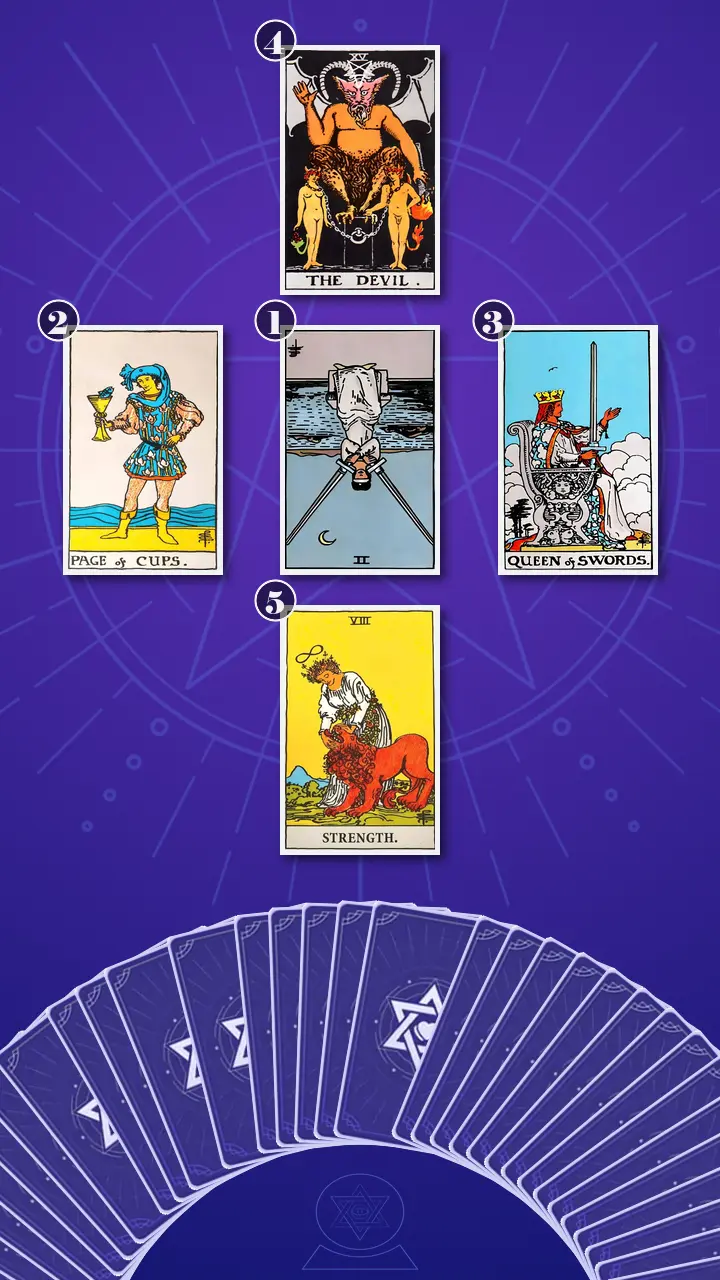
Reading the Map: Four Cards That Explain the Spiral
Position 1: The Spiral Snapshot
“Now turning over the card that represents the immediate moment: what you do and feel when you notice you’ve been left on read,” I said.
Two of Swords, reversed.
In the old decks, a figure sits blindfolded with crossed swords—defending the heart by refusing to choose. Reversed, that defense doesn’t stay calm. It slips. It agitates. The energy becomes a blockage that turns into over-action: the mind flails because it can’t bear not knowing.
“This is like being on your couch after dinner,” I told Taylor, “Slack finally quiet, but your brain keeps treating the chat thread like a work problem. You reread your last text for ‘tone.’ You rewrite a follow-up five different ways. You toggle between ‘be chill’ and ‘be clear’ while your chest tightens.”
I watched her face react before her words did.
She let out a short laugh that wasn’t amusement so much as recognition with teeth. “Okay,” she said, half-grimacing. “That’s… that’s literally me. It’s almost rude how accurate that is.”
“It’s not rude,” I said gently. “It’s diagnostic. The Two of Swords reversed shows your nervous system trying to force clarity before you’re ready. The more you try to decide from panic, the less you can tell what you actually want—reassurance, clarity, or closure.”
She rubbed her thumb across her palm like she was trying to erase an urge.
Position 2: The Double-Text Path
“Now turning over the card that represents the double-text path: what a follow-up message could offer, and what it might reinforce,” I said.
Page of Cups, upright.
The Page is the messenger, but not the strategist. There’s softness here—emotion without armor. In modern terms: the healthiest version of double-text is one warm, honest line you’d feel okay reading tomorrow. Not a campaign. Not a paragraph-long explanation. A check-in.
“This card supports curiosity and sincerity,” I told her. “If you choose to follow up, it’s one message only. Something simple that shares intent without cornering them. You send it once, and then—you actually return to your evening instead of hovering.”
The Page’s energy is balance when it’s clean: honest, not demanding. But if the Two of Swords reversed is driving, Page energy can get hijacked and become a plea disguised as politeness.
Taylor swallowed and asked the question I was waiting for. “But what if one message still makes me look needy?”
“We’ll answer that,” I said. “But first we look at the other path.”
Position 3: The Boundary Path
“Now turning over the card that represents the boundary path: what holding back could protect, and what it challenges as you break approval habits,” I said.
Queen of Swords, upright.
The Queen holds her sword upright—not to threaten, but to define reality. In a reading like this, her energy is balance in the form of standards: clarity without cruelty.
“This is the path where you let silence be information,” I told her. “Not a moral verdict. Information. You decide: ‘I’m not going to audition for attention.’ You set a clean standard for yourself—follow up once, or not at all. The boundary isn’t punishment. It’s you refusing to negotiate your dignity every time someone goes quiet.”
I let the comparison land, then gave her the litmus test I’ve learned to offer people at crossroads—because, historically, civilizations don’t collapse from one battle; they collapse from the standards they quietly stop enforcing.
“In the Decision Cross · Context Edition, this is where we ask: Is this a check-in… or an audition?”
Taylor’s eyes flicked down to her phone and back up again, as if the question had physically moved the object.
Position 4: The Mid-Article Reveal—What’s Actually Driving This
“Now turning over the card that represents the underlying driver: the core fear that makes silence feel urgent and turns texting into a self-worth test,” I said.
The Devil, upright.
When I was a younger archaeologist, I once uncovered an iron shackle in a damp trench. It wasn’t locked. It didn’t need to be. Its power was what it implied—what people believed it could do. The Devil works like that: the chain is often loose, but the fixation is absolute.
“Here’s the pivot,” I told Taylor. “This isn’t ‘double-text or don’t.’ It’s ‘compulsion or self-trust.’”
I kept my tone clear—no shaming. “Sometimes you don’t want the text—you want the feeling to stop. The read receipt becomes a slot machine: refresh is the lever, the reply is the payout. You check, and for a second you feel like you’re doing something. You watch their Stories while your message sits there, and your brain whispers, ‘They’re choosing everything except you.’”
She went still—classic three-step reaction, almost textbook. First: a tiny freeze, like her breath paused at the top. Second: her gaze unfocused, as if replaying the last time she’d tapped the thread for the fifth time on autopilot. Third: a quiet exhale through her nose, annoyed and relieved at once.
“Yeah,” she said softly. “It’s like… I’m not even trying to connect. I’m trying to stop feeling unsafe.”
I nodded. “Exactly. This isn’t a texting problem—it’s a nervous system problem wearing a messaging app as a costume.”
The Devil’s energy is excess: too much urgency, too much meaning-making, too much bargaining. And the long-term cost is always the same: your self-respect starts to feel conditional on someone else’s response.
When Strength Held the Lion: Regulate First, Then Choose
Position 5: The Grounded Next Move
“We’ve reached the last card,” I said, letting my voice slow. “Now turning over the card that represents the grounded next move: a self-respecting action or inner stance you can take within the next week.”
The room—my book-lined study on one side of a screen, her Toronto kitchen on the other—felt momentarily quieter, as if the world was also waiting to see what we’d do with all this information.
Strength, upright.
In Strength, the power isn’t the lion. The power is the calm hand that doesn’t wrestle the lion, and doesn’t obey it either. This is regulated courage. Not performative chill. Not cold withdrawal. Just steadiness.
Stop chasing a read receipt for proof, and choose your next move from the calm strength that can hold the lion without wrestling it.
I let the sentence sit between us for a beat.
Setup. It’s 9:12 PM, your show is on, your phone is face-up, and you’ve reopened the same thread so many times your thumb does it on autopilot—like the read receipt might change if you stare hard enough.
Reinforcement. Taylor’s reaction wasn’t cinematic, but it was unmistakably human. Her shoulders, which had been hovering near her ears, dropped a fraction as if someone had quietly loosened a strap. Her mouth opened, then closed—like her brain had been about to argue and realized it didn’t have to. Her fingers curled once around the edge of her phone, then slowly released it. She stared at the Strength card, eyes glossy but not quite tears, the way eyes get when you’ve been holding your breath for hours and only notice now.
Then—another three-beat chain: a tiny inhale that caught, a moment of faraway focus as if she pictured her own hand hitting refresh, and finally an exhale that sounded like giving up a weight. “So… the win isn’t ‘getting a reply,’” she said. “It’s not letting that ‘Seen’ decide if I’m… worth anything tonight.”
“Precisely,” I said. “A read receipt is data, not a verdict.”
And this was where I brought in my own tool—what I privately call time stratigraphy, borrowed from the way archaeologists separate layers in the earth. “Your urge to text is the topsoil,” I told her. “Fresh. Loud. Immediate. But your lasting value—your standards, your dignity, your ability to self-soothe—that’s a deeper layer. Strength asks you to pause long enough to tell the difference between an impulse layer and a value layer.”
I asked her the question that turns insight into memory. “Now, with that new lens—regulate first, then choose—can you think of a moment last week when this would have changed how you felt?”
Taylor blinked, then nodded slowly. “Sunday night,” she said. “I sent my draft to my friend for a tone check. If I’d done five minutes first… I think I would’ve sent one sentence, or nothing. I wouldn’t have made it a whole… referendum.”
That was the shift in real time: from read-receipt urgency and self-doubt to calmer self-respect and cleaner communication without chasing.
The One Clean Message (or Clean Pause) Plan for the Next 48 Hours
I gathered the story the cards had told, the way I might gather scattered artifacts on a table and finally see the shape they make together.
The Two of Swords reversed showed the surface loop: panic-decision disguised as “being logical,” drafting and deleting as if the right sentence could guarantee safety. The Page of Cups offered the healthiest version of reaching out—warm, honest, one message only. The Queen of Swords offered the healthiest version of holding back—standards, not punishment. And the Devil revealed why this all felt so high-stakes: the compulsion to outsource your nervous system to someone else’s reply.
The blind spot, plainly: you’re treating silence as an emergency because you’re quietly letting it mean something about your worth.
The transformation direction was equally plain, and wonderfully practical: pause to regulate your body for five minutes before choosing one intentional action—a short check-in or no message—so you’re not negotiating your self-respect inside the draft box.
Here are the next steps I gave Taylor, designed for real life (busy schedule, twitchy phone hand, and all):
- The 5-Minute Strength PauseOnce per day this week at a predictable time (Taylor chose 9:00 PM), put your phone face-down, set a timer, and press one hand to your chest. Breathe out slowly until your shoulders soften even a millimeter.If five minutes feels cringe or pointless, do two minutes. The goal isn’t “be chill.” It’s to interrupt the reflex long enough to regain choice.
- Name What You Actually Want (Don’t Send It)Open Notes and write one sentence: “What I actually want here is: ____ (clarity / reassurance / connection / closure).” This is for you, not for them.If you can’t name it, that’s the Two of Swords blindfold. Naming is how you take the blindfold off without forcing a decision.
- One Rule for 48 Hours + The Check-In TestChoose one personal rule for this thread: either “one clean follow-up only” or “no follow-up tonight.” Before any text, ask: “Is this a check-in… or an audition?” If it’s an audition, shrink it to one sentence—or choose the clean pause.Physically move your phone out of arm’s reach afterward (charge it across the room). Make your environment collaborate with your standards.
I added one more layer—my Voyage Log Technique, stolen from ancient navigators who couldn’t control the sea, only their steering. “Log what you did,” I told her. “Date, time, what you wanted, what you chose, what happened in your body. Not to obsess—just to prove to yourself that you can survive uncertainty and still act with dignity.”

A Week Later: Ownership, Not Certainty
Six days later, I got a message from Taylor.
“I did the 5-minute thing,” she wrote. “Phone face-down. Hand on chest. Hated it for the first minute. Then I sent one line: ‘Hey—hope your week’s going okay. No rush, just checking in.’ And I put my phone on the charger across the room.”
There was a pause in her story—an honest, bittersweet detail she didn’t try to polish. She added: “I still stared at the empty thread for like three minutes afterward. But I didn’t spiral. I watched my show. I slept. In the morning, I didn’t feel embarrassed.”
That’s what a Journey to Clarity often looks like in real life: not a perfect outcome, but a reclaimed steering wheel. Strength doesn’t promise you’ll never feel the urge. It promises you can hold the urge without being owned by it.
When you’re left on read, it can feel like your chest is waiting for permission to unclench—like one reply would decide whether you get to feel chosen or foolish.
If you gave yourself five minutes of steadiness before touching the thread again, what’s the one clean choice you’d want to make from that version of you?