When Jeans Won’t Zip: Trading the Shame Trial for One Fair Choice

Finding Clarity in the Jeans-Won’t-Zip Moment
You’re a late-20s NYC marketing person who can run a campaign like a pro, but one jeans-won’t-zip moment turns into a full performance review—hello, Sunday Scaries energy on a random Thursday.
Jordan (name changed for privacy) said it like she was trying to laugh it off, but her voice kept catching on the word jeans, like it had teeth. “It’s just jeans,” she told me, “but it feels like a full character assessment.”
She’d joined our session from her apartment in New York City. Even through the screen, I could picture it: 8:12 AM in a small NYC bathroom, the overhead light harsh and buzzing like a fluorescent mosquito. Cold tile under bare feet. That half-dressed, half-holding-your-breath posture while you tug the zipper up and it stops—right at the point where your throat tightens and your stomach clenches, like the waistband is delivering a verdict instead of… information.
Jordan described what happened next the way people describe a minor car accident: the moment keeps replaying while you’re still standing there. Mirror-check. Tug fabric. Pinch at skin. Outfit-switching until you’re late. Then the control reflex: opening Instagram Stories “just for a second,” landing on someone’s effortless outfit post, and suddenly she’s deep in “how to lose belly fast” searches, MyFitnessPal macros, and a tight, punishing promise for the next week.
In my head I called it what it is: a jeans-won’t-zip moment triggering a body-shame spiral—mirror-checking, outfit-switching, comparison scrolling, restricting, even canceling plans. But I didn’t start there. I started with what I could hear.
Because shame has a sound. It’s the way someone’s breath gets higher, shorter, like it doesn’t want to take up space. It’s a throat that feels too narrow for an honest sentence.
“I’m really glad you’re saying this out loud,” I told her. “Not because it’s dramatic—because it’s real. And today, we’re not going to let one inch of denim run your whole nervous system. Let’s try to draw a map through the fog. We’re here for clarity, not perfection.”

Choosing the Compass: The Four-Layer Insight Ladder Tarot Spread
I invited Jordan to take one slow breath with me—not as a ritual to summon anything, but as a clean transition. The kind of breath that tells your body, we’re not in danger, we’re in inquiry. While she exhaled, I shuffled slowly, listening to the familiar paper-on-paper hush that always reminds me of cueing up a track on my radio show: you’re not changing the world yet, you’re setting the frequency.
“Today I’m going to use a spread called the Four-Layer Insight Ladder · Context Edition,” I said.
And for you reading this—especially if you’ve ever googled why do I spiral when jeans won’t zip—here’s why this spread works so well: it’s not built to predict outcomes. It’s built to expose a repeating inner script and then move it, rung by rung: trigger → origin → maintaining strategy → inner resource → reframe → one practical step. Six cards is the fewest that still holds both depth (the old story and the control mechanism) and practicality (what to do next) without drifting into vague reassurance.
I placed the cards in a vertical ladder, bottom to top. “The first card,” I told Jordan, “will describe what happens in the exact zipper moment—what your brain says, what your body does. The second card will point to the older story underneath. The fifth card is the turning point—the medicine. And the last card is one grounded step you can actually do this week.”
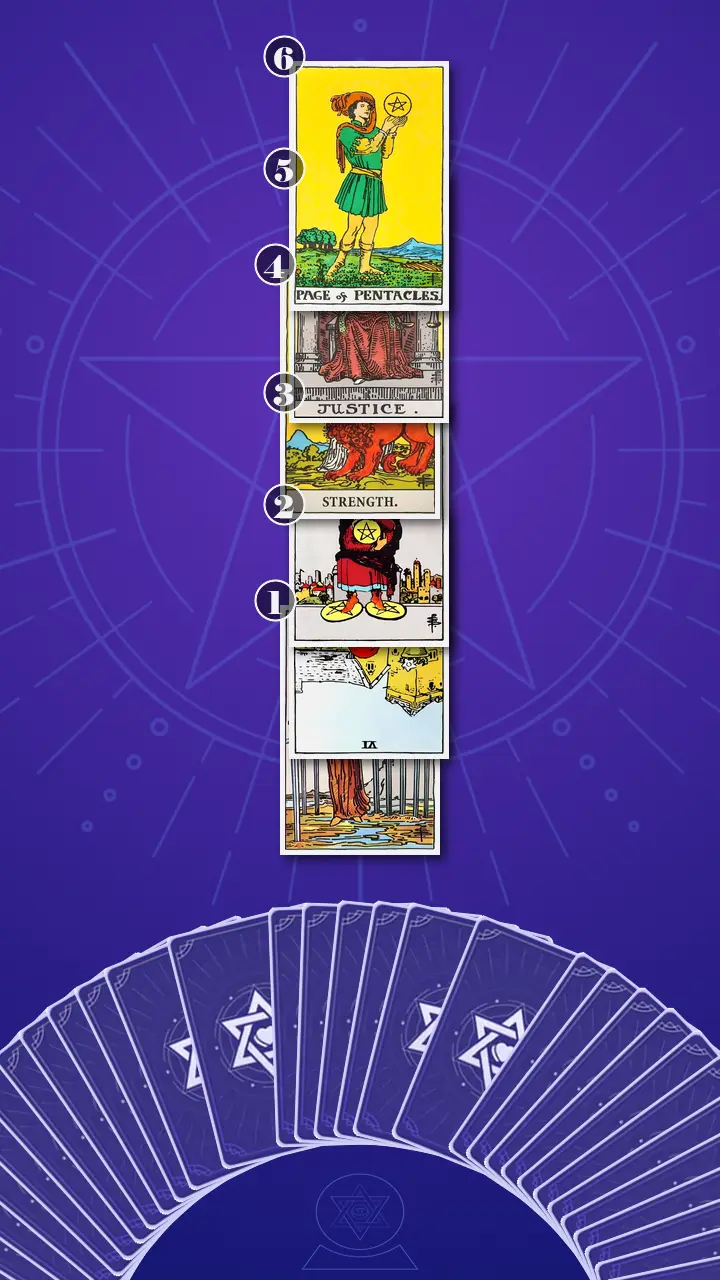
Reading the Ladder: From Reflex to Choice
Position 1: The Surface Trigger and Observable Spiral
“Now we turn over the card that represents the surface trigger and observable spiral—what you do and tell yourself in the exact jeans-won’t-zip moment,” I said.
Eight of Swords, upright.
“This card is painfully literal,” I told her. “It’s that frozen feeling where you believe you have no options—even though you do.”
I leaned in, keeping my voice steady. “The modern-life version looks like this: you’re standing in front of the mirror in your NYC apartment with one leg already in the jeans, tugging the waistband and holding your breath while the zipper sticks. Your mind instantly goes into courtroom narration—pulling up ‘evidence’ from photos, old numbers, and other people’s bodies—until it feels like you’re trapped, even though the simplest option (changing clothes and leaving on time) is right there.”
In this position, the Eight of Swords is a blockage—not because you’re weak, but because your perception tightens. Air energy gone sharp. Thoughts become bars. The blindfold in the image matters: when shame spikes, you stop seeing the exits. The bindings matter too: they’re loose. You could move. You just don’t feel like you’re allowed to.
To mirror her experience without shaming it, I used the language her nervous system already speaks. “It’s like: Exhibit A: the zipper. Exhibit B: that photo angle. Verdict: unlovable.”
Jordan let out a short laugh that sounded like it had a bruise under it. “That’s… honestly too accurate,” she said. “Like, it’s kind of rude.”
“It is rude,” I agreed. “But notice something: that voice isn’t truth. It’s a script.”
Position 2: The Old Body-Shame Story Under Stress
“Now we turn over the card that represents the old body-shame story—the earlier conditioning or memory-script being replayed under stress,” I said.
Six of Cups, reversed.
“This is the ‘how old do you feel right now?’ card,” I told her, gently. “Because the zipper moment doesn’t feel like 29-year-old you; it feels like a younger you trying to earn safety.”
I described it the way it shows up in real life: “You hear an old rule in your head—be ‘good,’ be ‘pretty,’ don’t take up space—and you start bargaining: ‘If I tighten up for a week, I’ll be allowed to feel confident again.’ It’s not really about the jeans; it’s about re-entering a childhood deal where approval was exchanged for looking right.”
Reversed, the sweetness of memory flips into something conditional. A closed courtyard. A closed system. “Adult you is holding the jeans,” I said, “and younger you is holding the rule.”
Jordan’s eyes drifted off-screen like her brain had pulled up a file folder. Her lips parted; she didn’t speak for a second. Then, very quietly: “I feel… thirteen. Like middle school gym class. Like the whole room is watching.”
“That’s the card,” I said. “And it gives us an important lever: if it’s an old deal, it can be rewritten.”
I offered her a sentence I wanted her to keep: Old deal: “Look right, be safe.” New deal: “Be supported, show up.”
Position 3: The Control Point That Keeps the Loop Running
“Now we turn over the card that represents what the story is trying to protect—the control point, core fear, or safety strategy that keeps the loop running,” I said.
Four of Pentacles, upright.
“This one is the grip,” I told her. “And it’s not about vanity. It’s about safety.”
I grounded it in the exact modern scenario: “After the jeans don’t zip, you tighten your whole day like a budget during a rent increase: strict food rules, an added workout, a ‘safe’ outfit, maybe even canceling plans. It’s less about health and more about control—because some part of you believes that if you manage your body perfectly, you can manage how you’ll be treated (at work, on dates, in friend photos).”
This is Earth energy in excess: protection hardening into armor. I’ve lived in cities loud enough to make your body clench without permission; I know how quickly “being prepared” becomes “being braced.” In my own sound research, we call it a sustained high-alert state—like living next to a constant siren you pretend you’re used to, except your nervous system is still flinching.
Jordan made a face—half grimace, half recognition. “I hate how true that is,” she said. “I’m white-knuckling my… whole life.”
“Exactly,” I said. “The control behaviors aren’t your personality. They’re your security system going off.”
Position 4: The Inner Resource You Can Embody
“Now we turn over the card that represents your inner resource—the quality you can embody to soften the loop without denying reality,” I said.
Strength, upright.
“Okay,” I said softly. “Here’s your turning of the tide.”
In modern life, it looks like this: “Right in the middle of the spiral, you do something radically simple: you stop arguing with your reflection. You put a hand where you’re tense, breathe, and choose a kinder authority voice: ‘We’re not doing punishment today.’ You change into clothes that feel comfortable, you keep your plans, and you let dignity lead even while the discomfort is still present.”
Strength is not hype. It’s regulated power. It’s a steady hand. In this position it’s balance: the part of you that can hold the fear without making it the boss.
Jordan’s shoulders dropped a fraction—so small you could miss it, but I never miss breath shifts. “I like that,” she said. “Not today.”
“That’s a boundary,” I told her. “Stop negotiating with the inner critic. Make one fair choice.”
When Justice Spoke: The Scales That End the Trial
Position 5: The Key Reframe—The Medicine That Restores Balance
I paused before turning the next card. The bathroom light in Jordan’s story felt louder in my imagination—buzzing like a bad amp. The air in the reading shifted the way a song changes when the bass finally drops: same track, different truth.
“Now we turn over the card that represents the key reframe—the most truthful, self-respecting perspective that breaks shame’s logic,” I said. “This is the turning point.”
Justice, upright.
“This card is the exact opposite of the Eight of Swords,” I told her. “Eight of Swords is ‘I can’t see.’ Justice is ‘I can see clearly—and I will be fair.’”
I gave her the modern-life translation: “Instead of treating the zipper like a moral grade, you run a fair assessment: ‘These jeans don’t fit today.’ Full stop. You refuse to build a case against yourself, and you choose comfort like it’s a basic right, not a prize. You weigh the evidence accurately, stop the shame cross-examination, and make a practical wardrobe call that supports your actual life today.”
Justice in this position is discernment in balance. It’s truth without cruelty. It’s the internal judge you deserve—competent, proportional, not dramatic.
Jordan was already running late in her mind. I could feel it: the tight throat, the hot face, the clenched stomach while staring at the waistband like it’s delivering a verdict. That familiar panic that says, If I don’t fix this right now, I can’t be seen.
Stop putting your body on trial and start weighing the facts with clear scales—Justice is choosing comfort and truth over shame and bargaining.
I let the sentence sit in the air for a beat, the way I let a lyric land on air before I talk over it.
Jordan’s reaction came in a chain—fast, physical, honest. First: she went still, like her body had hit pause; her breath stopped halfway in. Second: her gaze unfocused, like her brain replayed every zipper moment, every mirror audit, every “I’ll be good” bargain in a quick, silent montage. Third: a long exhale emptied her chest, and her shoulders sank as if they’d been holding up a weight that didn’t belong to her.
“But… if I do that,” she said, and there was a flash of irritation in it, “doesn’t it mean I was wrong? Like I’ve wasted so much time.”
I nodded. I didn’t rush to rescue her from that feeling. “It might mean you’ve been loyal to an old rule that was never fair,” I said. “That’s not ‘wrong.’ That’s conditioned. And Justice isn’t here to punish you for believing it—Justice is here to update the policy.”
Then I did what I do in every reading, because sound tells the truth before words do. I used my Music Pulse Diagnosis.
“Quick question,” I asked. “After a zipper moment—what do you play? Like, what’s the song or vibe you automatically reach for?”
Jordan blinked. “Honestly? I put on… really intense stuff. Like high-BPM ‘get your life together’ playlists. Or I scroll TikTok until my brain is mush.”
“That makes sense,” I said. “Your system is choosing urgency as a drug. Justice is asking for a different tempo.”
I offered a simple framework like two columns on a scale—the kind you can do on your phone in the bathroom:
FACTS: These jeans don’t fit today.
STORIES: Therefore I’m failing. Therefore people will judge me. Therefore I don’t get to go.
“And here’s the shareable line,” I told her, “because you’ll need it when the old script tries to grab the mic: Fit is data. Worth is not up for debate.”
I could see her swallow. Not dramatic—just real. Like someone making room in a throat that’s been tight for years.
“Now,” I said, “use this new perspective and look back at last week. Was there a specific moment—the bathroom, the bedroom, the fitting room—where this would have changed your next move?”
Jordan’s eyes got wet, but she didn’t cry. “Thursday,” she said. “I canceled dinner. I could’ve just… worn the black trousers. I love those trousers.”
“That’s the step,” I said. “This isn’t about never feeling the sting. This is the shift from shame-driven self-surveillance to body-neutral fairness and grounded self-respect. That’s the first rung of a different ladder.”
Position 6: One Step—A Practical Action That Makes the New Story Real
“Now we turn over the card that represents one step—a practical action you can take this week that reinforces the new story through behavior,” I said.
Page of Pentacles, upright.
“I love this as an ending,” I told Jordan, “because it doesn’t demand a personality makeover. It asks for one grounded experiment.”
The modern-life scenario is simple and brave: “You pick one grounded step this week that supports your body instead of trying to fix it: you wear the outfit that fits now, you order the size that fits now, or you book a quick tailoring appointment for one favorite piece. You treat it like a small, calm experiment—watching how your mood changes when comfort becomes non-negotiable and your plans don’t depend on a waistband.”
Page of Pentacles is Earth energy in healthy balance: not control, but care. Not punishment-driven fixing, but a comfort-first choice that proves you can be safe in your life today.
The One-Page “Fairness > Fixing” Plan (Plus a Soundtrack)
I pulled the ladder together for her in one clean story: the Eight of Swords shows the moment the zipper stalls and your mind turns it into a verdict. The Six of Cups reversed reveals why it hits so hard—because it wakes up a younger, rule-bound bargain about being “good” to earn safety. The Four of Pentacles explains the coping: you grip control because you’re trying to prevent rejection in a competitive, visible city. Strength offers the embodied resource—calm authority that refuses punishment. Justice is the reframe that ends the trial: fit is neutral data, not moral information. And the Page of Pentacles says the way out is one small, practical step that supports your body today.
The cognitive blind spot I named for Jordan was this: she was treating urgency like proof. As if the intensity of the feeling meant the story was true. In reality, urgency was just the old script trying to keep its job.
“Your transformation direction,” I told her, “is from fixing to fairness. From negotiating for worth to acting from self-respect.”
Then I gave her actionable advice—small enough to do on a Thursday morning, real enough to change her week.
- The 2-Minute Facts vs Story NoteIn your phone (Notes app, not a journal), write two lines: FACT = “These jeans don’t fit today.” STORY = the harsh sentence your brain adds. Then pick one outfit based on comfort, not persuasion, and leave the bathroom.If you feel pulled into mirror-checking, set a 60-second timer. When it ends, you choose and move—no extra arguing allowed.
- Build a “Zip Day Backup” No-Thinking OutfitChoose one top + one bottom + one shoe that reliably fits and feels okay. Save it as a note titled “Zip Day Backup,” and keep those pieces in an easy-to-grab spot for the next seven days.If your brain says this is “giving up,” label it: old script talking. You’re not making a lifelong wardrobe statement—you’re choosing comfort for one day.
- White Noise First Aid + Breath Soundtrack (10 Minutes Max)When the shame spike hits, play low, steady white noise (fan app, AC, YouTube) for 2 minutes while you do three rounds of a longer exhale than inhale. Then say once: “Fit is information. I respond with fairness.” Choose ONE action: wear what fits, grab a backup, or put the jeans away for a calmer day.If touch is activating, skip hands-on-body and just do feet flat on the floor. If anxiety spikes, stop after the first minute and change clothes—no processing required.
Before we ended, I used my BGM Prescription—not to “heal” her body, but to help her nervous system stop interpreting a zipper like an alarm. “Pick three tracks,” I said, “that feel like Justice: calm, steady, no drama. One for mornings, one for getting dressed, one for the subway. You’re training your system to recognize fairness as safety.”

A Week Later: The Quiet Proof
Six days later, Jordan messaged me a screenshot of a Notes app entry. Two lines, nothing poetic: FACT: These jeans don’t fit today. STORY: I’m failing. Under it, one more line: Wore the black trousers. Left on time.
Her follow-up text was almost casual: “It was… weirdly fine? Like I still felt the sting, but it didn’t run the meeting. Also I didn’t open TikTok in the bathroom. That felt like a miracle.”
That’s what a Journey to Clarity looks like in real life. Not a total personality transformation—just the first stable evidence that your worth can stay steady even when your wardrobe and body change. Fit becomes information. Dignity becomes non-negotiable.
When a zipper stalls and your chest tightens, it’s so easy to mistake a fit moment for a character verdict—like comfort has to be earned and being seen has to be negotiated.
If you treated fit as neutral data for the next seven days, what’s one small, fair choice you’d make before you even look in the mirror?