From Self-Policing to Self-Trust: Retraining the Inner Judge in the Mirror

Finding Clarity in the Harsh Bathroom LED
“You can lose 30 minutes in front of the mirror and still walk out thinking, I’m not sure this is me—I’m just hoping it’s defensible.”
Taylor said it like she was confessing something minor—like double-texting—except her throat did that tight, careful thing people do when they’re trying not to cry in public. She was 28, a marketing professional in New York, client-facing enough that “polished” wasn’t just a preference; it felt like a job requirement written in invisible ink.
She described Monday, 8:14 AM in her narrow NYC bathroom: the overhead LED buzzing like a tiny interrogation lamp, one sock still half on, two tops held against her body like evidence exhibits. Phone camera open on selfie mode because the mirror alone didn’t feel “reliable.” She zooms in on her stomach, then her collarbone, then her jawline—each zoom a little verdict stamp. Her chest tightens, her throat goes dry, and the thought lands hard: “If I walk in looking uncertain, they’ll treat me like I am.”
Her shame wasn’t abstract. It sat in her sternum like a too-hot swallow of espresso—burning on the way down, then making her hands restless, like she needed to keep adjusting something to make the feeling stop.
I slid her a small glass of sparkling water—my café habit, my way of saying your body gets to be here too. “You’re not ‘too much’ for caring,” I told her gently. “You’re just tired of caring like your worth depends on it. Let’s not argue with the mirror today. Let’s understand what your inner critic is protecting you from—and find a way to get you out of this Imagined Audience spiral.”

Choosing the Compass: The Celtic Cross Spread
I didn’t light candles or chant. In my café, the ritual is simpler: the grind of beans, the steady hum of the espresso machine, and one clean breath that tells your nervous system, we’re doing something different now.
“Take a slow inhale,” I said, palms over the deck as I shuffled. “And on the exhale, hold the question: In the dressing-room mirror moment—what is my inner critic protecting me from?”
For a question like this, I use the Celtic Cross. If you’ve ever Googled how tarot works and felt overwhelmed, this is one of the clearest maps: it doesn’t reduce your life to yes/no. It shows the present pattern, the challenge, the root conditioning, the emotional imprint that taught the pattern, and then—crucially—the near-future pivot and the integration path. It’s card meanings in context, not fortune-telling.
In this spread, the center cross matters most for Taylor’s mirror moment: the first card shows the lived pattern; the crossing card shows the critic’s method—how it pressures and controls. Then we drop to the root (why this strategy exists at all) and climb the staff to the likely outcome if she practices a new relationship with visibility.
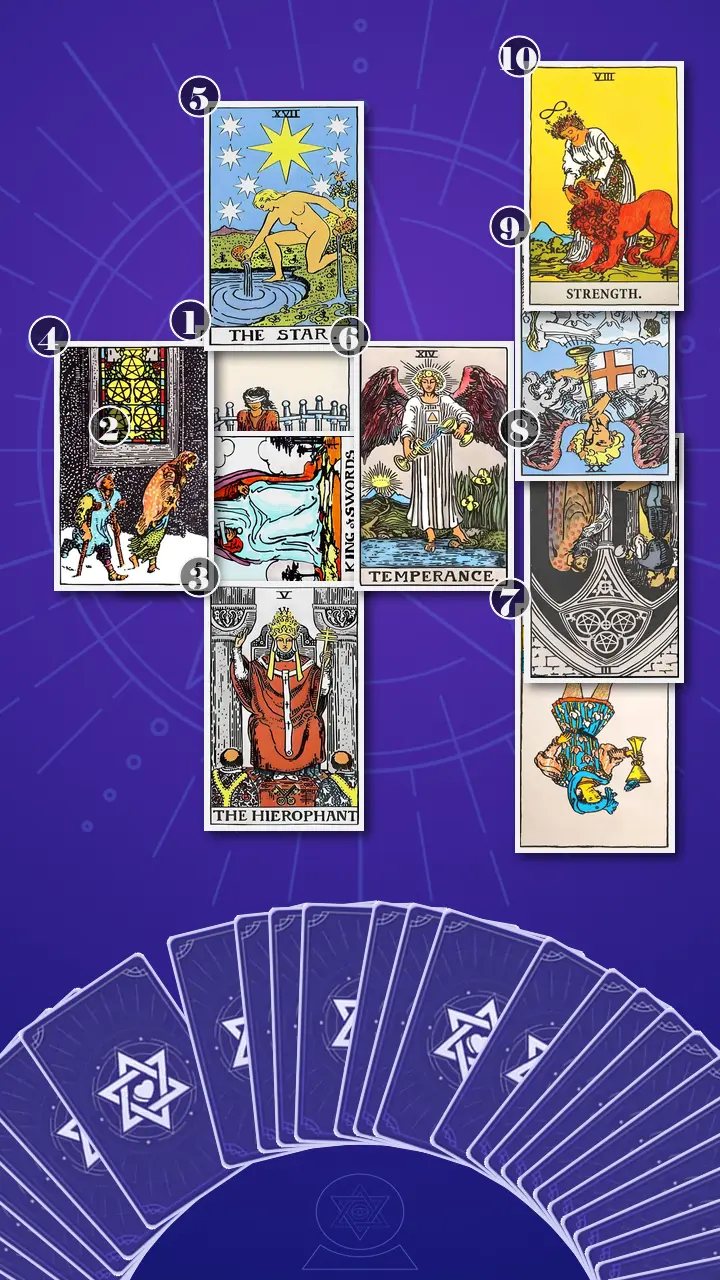
Reading the Map: When the Mirror Becomes a Courtroom
Position 1: Present pattern — Eight of Swords (upright)
“Now turning over,” I said, “is the card that represents your present pattern: how the inner critic shows up in the mirror moment as a concrete lived experience.”
The Eight of Swords, upright.
“This is 8:15 AM,” I told her, keeping my voice calm. “Three outfits on the bed. One sock still off. Phone camera open because the mirror alone doesn’t feel reliable. Every option starts to feel dangerous because your mind keeps asking, ‘What will people notice first?’ You’re technically free to choose—but you feel trapped by imagined judgment.”
The Eight of Swords is restriction—often self-imposed. In energy terms, it’s blockage: your attention becomes a blindfold. You zoom so tightly on one detail that you can’t see the whole truth: you are a capable person getting dressed, not a defendant awaiting sentencing.
Taylor gave a small, bitter laugh—quick, almost polite. “That’s… yeah,” she said. “It’s so accurate it’s kind of mean.”
“Not mean,” I answered. “Precise. The bindings in this card are loose. That matters. It means the mirror feels like evidence, but the trap is maintained by where your attention keeps going.”
Position 2: Primary challenge — King of Swords (reversed)
“Now turning over,” I said, “is the card that represents the primary challenge: the critic’s style and method of protection.”
The King of Swords, in reversed position.
“The challenge isn’t that you lack taste,” I said. “It’s that your inner voice is acting like a judge. It uses ‘professional standards’ language, but it lands like a sentence: ‘cringe,’ ‘unprofessional,’ ‘not serious.’ Then you start policing not just the outfit, but your posture, facial expression, and how you’ll be perceived all day—so you can’t relax into being a person.”
Energy-wise, this is Air (mind) in excess—sharp, overactive, and punitive. The sword becomes a gavel. Clarity turns into a verdict instead of guidance.
I leaned in a little, because this was the part that makes people feel less alone: “Let’s write it like your bathroom turns into a courtroom.”
Prosecution (the critic): “Unacceptable. They’ll notice. You’ll look junior. You’ll look like you’re trying.”
Defense (you, trying to be reasonable): “I’m just being practical. I just want to look put-together. I don’t want to get dismissed.”
Sentence (the behavior): Change the top. Recheck the phone camera. Ask a friend, ‘Is this okay?’ Leave late. Or cancel and call it ‘tired.’
Taylor’s eyes flicked down to her cup. Her shoulders were tight, up near her ears—like her body was bracing for the next ruling.
“That’s literally the script,” she whispered. “Like Grammarly set to hostile mode.”
Position 3: Root cause — The Hierophant (upright)
“Now turning over,” I said, “is the card that represents the root cause: internalized rules, conditioning, belonging logic.”
The Hierophant, upright.
“Under the mirror criticism,” I told her, “there’s an invisible dress code you’re trying to obey: what a ‘serious’ woman in a client-facing NYC role is supposed to look like, what’s ‘respectable,’ what counts as ‘effortless.’ You’re not just choosing clothes—you’re trying to secure belonging through compliance, even when the rules don’t match your values anymore.”
The Hierophant is tradition and approval. In energy terms, it’s structure—but here, it’s structure you didn’t consciously choose. Those keys in his hands? They’re access. If I follow the code, I get in.
And this is where I said the line I’ve learned to say with real respect: “The inner critic isn’t aiming for style. It’s aiming for protection.”
Taylor swallowed. It was like she’d been arguing with the wrong problem.
Position 4: Recent past imprint — Five of Pentacles (upright)
“Now turning over,” I said, “is the card that represents the recent past imprint: the emotional memory that taught being seen can be costly.”
The Five of Pentacles, upright.
“There’s an old memory in the background,” I said softly, “being overlooked, excluded, or subtly mocked—that taught your system: ‘Visibility can be costly.’ So now, before you go out, your brain tries to prevent a repeat by tightening standards and controlling details. It’s not vanity; it’s scarcity logic applied to belonging.”
I let the image do its work: cold street, limping figures, a lit window they can’t quite enter. “This is the ‘outside looking in’ wound,” I told her. “And your critic learned: If I comply, I belong. If I’m flawless, I’m safe.”
Taylor’s hands, which had been fidgeting with her sleeve, went still. Her breath paused for a beat—then came out slower. “Oh,” she said, quieter. “This isn’t random. It started somewhere.”
Position 5: Conscious desire — The Star (upright)
“Now turning over,” I said, “is the card that represents your conscious desire: what you actually want underneath the criticism.”
The Star, upright.
“Your real desire isn’t perfection,” I said. “It’s relief. You want to get ready and feel like yourself, not like you’re bracing for impact. The dream is leaving the apartment with a steady nervous system, trusting your presence more than your polish, and not carrying the mirror’s verdict into the room with you.”
Energy-wise, The Star is balance returning after strain—gentle honesty, not performance. It’s the opposite of the Eight of Swords. It’s the part of you that knows this can be different.
When Temperance Spoke: Information Is Allowed. Sentencing Is Optional.
Position 6: Near-future pivot — Temperance (upright)
I touched the next card like I was steadying a saucer. “Now turning over,” I said, “is the card that represents the near-future pivot: the turning point that changes how you relate to the critic.”
Temperance, upright.
The café felt suddenly quieter—like the espresso machine had paused to listen. This was the bridge card, the one that turns a painful pattern into something workable.
“A turning point looks like this,” I said, and I kept the cadence calm, almost recipe-like. “You choose one purpose for the outfit—authority, comfort, approachability, creativity. You make one adjustment. Then you stop checking. You don’t fire your inner critic—you retrain it into a calmer advisor. Getting dressed becomes a supportive routine, not a debate that eats your morning and your self-respect.”
In energy terms, Temperance is integration. Not ‘I don’t care at all,’ and not ‘I must be flawless.’ The middle path that your nervous system can tolerate.
The Aha Moment
You know that moment—keys in hand, Uber app open—when you take one last look at the mirror like you’re waiting to hear if you’re “allowed” to go.
Stop putting yourself on trial in the mirror and start blending comfort with expression, like Temperance steadily pouring between two cups until ‘good enough’ becomes real enough to live.
She froze first—like her body had hit a brief buffering screen. Her fingers hovered near her cup but didn’t touch it. Then her gaze went slightly unfocused, as if her brain was replaying a dozen mornings at once: the LED buzz, the phone camera heat, the Slack drafts rewritten three times, the Uber delayed, the “I’m just tired” text.
And then the exhale came—low, chest-deep. Her shoulders dropped in a way you can’t fake. Her jaw unclenched, and her eyes got glassy with a kind of anger that was also relief.
“But if I stop…,” she started, voice tightening, “doesn’t that mean I was wrong this whole time? Like I wasted so much time trying to—”
I nodded because that reaction is real. “It doesn’t mean you were wrong,” I said. “It means a part of you was scared. The critic was doing the only job it knew: prevent rejection. We’re not humiliating that part. We’re updating its strategy.”
Then I used the metaphor that’s practically built into my hands after twenty years of serving coffee: “This is like over-extraction,” I told her—my Stress Flavor Profile. “When you pull a shot too long, you don’t get ‘more quality.’ You get bitterness. Your inner critic thinks more scrutiny equals more safety. But it’s just over-extracting your self-worth until everything tastes harsh.”
I watched her latte while I spoke—my Cup Temperature Scan. It had cooled fast, the way it does when someone’s been running hot with adrenaline for too long. “Your system is burning energy just to stand in front of a mirror,” I said. “Temperance is the fix: measured pour, then stop.”
I let a beat of silence land, then asked her, “Now, with this new perspective—can you think of one moment last week where this would’ve changed how you felt? Even by five percent?”
Her eyes flicked up. “Tuesday,” she said. “I was going to a networking thing. I stood there, keys in hand, staring at myself like… like the mirror was going to tell me if I deserved to be there.”
“That’s the shift,” I said. “From shame and self-policing toward cautious self-trust. Presentation as support, not verdict.”
Position 7: Self position — Page of Cups (reversed)
“Now turning over,” I said, “is the card that represents your self position: how you internalize the critic and what it blocks.”
The Page of Cups, reversed.
“Inside, there’s a part of you that wants play—color, softness, a little weirdness,” I said. “But when you reach for it, you hear, ‘Who do you think you are?’ So you edit your personality out of your look and go neutral, then feel oddly invisible or resentful later.”
This is Water (feeling) in deficiency. Not because you don’t have feelings—because you don’t feel safe letting them show.
Taylor nodded once, sharp. “I literally put things back like they’re contraband.”
Position 8: Environment — Three of Pentacles (reversed)
“Now turning over,” I said, “is the card that represents your environment: the perceived audience that intensifies the need to be acceptable.”
The Three of Pentacles, reversed.
“Your environment feels like a review panel,” I said. “Coworkers, peers, social media, the industry vibe. Even when no one is explicitly judging, your nervous system acts like the room is a committee that can grade you.”
In energy terms, this is Earth (real-world feedback) in distortion: you’re treating imagined evaluation like actual data. It’s like getting dressed for an invisible comment section instead of the actual people in front of you.
She made a face. “My feed is basically capsule wardrobe TikTok and ‘quiet luxury’ takes. And I save a million office outfit guides from Who What Wear and still feel… worse.”
“That’s not because you’re weak,” I said. “It’s because your Inner Judge can use any ‘advice’ as more courtroom evidence.”
Position 9: Hopes and fears — Judgement (reversed)
“Now turning over,” I said, “is the card that represents your hopes and fears: what the critic claims it’s preventing, and what you long to be freed from.”
Judgement, reversed.
“This is the fear of being found out,” I said. “And the hope that you could finally stop putting yourself on trial.”
Reversed, Judgement becomes the verdict that never arrives—so you keep searching for it. You replay moments. You zoom in on the ‘disqualifying detail.’ You postpone posting, applying, going—because visibility feels like a trumpet calling you out in public.
Taylor whispered, “I can’t even do a LinkedIn photo without retaking it and deleting it until I hate my face.”
“That’s decision fatigue dressed up as ‘standards,’” I said. “Your mind is trying to guarantee respect by eliminating risk. But it’s costing you your life.”
Position 10: Integration outcome — Strength (upright)
“Now turning over,” I said, “is the card that represents the integration outcome: the empowered relationship to self that becomes available.”
Strength, upright.
“This doesn’t end with you ‘defeating’ your inner critic,” I said. “It ends with you leading it. Firmness without cruelty. Courage without performance.”
Strength is Fire (courage) in balance, held by gentleness. The lion isn’t destroyed—it’s soothed. It’s the part of you that’s afraid of rejection, held with steady hands.
“This is you,” I said, “walking out the door without one last inspection. Trusting you can handle being perceived without self-punishment.”
The One-Page Reset: One Purpose, One Adjustment, Then You Go Live
I leaned back and let the whole spread become one story.
“Here’s why it’s been like this,” I said. “The Eight of Swords shows the mirror loop—your mind narrowing until every outfit feels like a risk. The King of Swords reversed explains the method: an Inner Judge using ‘professional’ language as sentencing. The Hierophant and Five of Pentacles show the history: inherited rules about belonging plus an old outsider wound that taught you visibility can cost you warmth. The Star shows what you actually want—relief, authenticity. Temperance shows the pivot: measured, compassionate practice and a clear stop point. And Strength is the outcome: self-respect that doesn’t require a courtroom.”
“Your cognitive blind spot,” I continued, “is that you’ve been treating criticism as the price of safety. But criticism doesn’t actually create safety—regulation and self-trust do. The direction of change is exactly what Temperance teaches: shift from using criticism to prevent rejection to using curiosity and compassion to build self-trust through small, real-world experiments.”
She frowned, practical. “But I barely have time in the morning. I’m already running late half the time.”
“Perfect,” I said—because that objection meant she was ready for something real. “Then we make this smaller than your brain wants it to be.”
- The 90-Second Temperance ResetBefore you leave, choose one purpose for your outfit (comfort / authority / approachability / creativity). Make one adjustment that supports that purpose (jacket, shoe swap, lipstick, belt). Then physically step away from the mirror and do one “life” action: shoes on, keys in hand, or send the “on my way” text.Expect your brain to say, “This is reckless.” That’s the protection system talking. Treat it like background noise, not a command.
- One Mirror, One CheckPick ONE mirror you’re allowed to use (bathroom mirror only). After you step away, no phone camera re-checks—no selfie mode, no zooming, no “just to be sure.”If it feels impossible, start with “one mirror, two checks max” for three days. We’re building tolerance, not perfection.
- The Notes App Translation (Verdict → Choice)When you hear the critic’s exact line, write it as a quote in Notes. Then translate it into: (1) a neutral observation + (2) one small choice. Example: “This feels loud for me today → I’ll add a blazer and keep the earrings.”No insult words. No “cringe.” No “unacceptable.” Information is allowed. Sentencing is optional.
Before she left, I added one café-specific tool—my 5-Minute Coffee Meditation, adapted for a New York morning that moves too fast. “If you have zero time,” I told her, “do the 45-second version: inhale the coffee aroma once, exhale longer than you inhale, soften your jaw. In Italy, we call it riposo—a tiny rest that returns you to yourself. Not luxury. Maintenance.”

A Week Later: Ownership, Not Certainty
Six days later, Taylor texted me a photo—of her keys in her hand, not of her outfit. The message said: “Did the Temperance Reset. One purpose: approachability. One adjustment: swapped to the loafers. No phone camera. Walked out. Heart still raced for a second, but I didn’t cancel.”
Then, as an afterthought: “Also I didn’t ask my friend if it was okay. I just texted, ‘Running 5 min late, see you at 7.’ Which felt… weirdly grown-up.”
That’s what a Journey to Clarity usually looks like in real life: not a dramatic personality rewrite. A small stop point. A softer jaw. One less trial.
Clarity didn’t make her fearless. It made her self-led. She could care about presentation without putting herself on trial.
And yes—there was a bittersweet edge. She told me she slept through the night for the first time in weeks, but woke up with the thought, “What if I’m wrong?” She paused, then said, almost surprised, “And I didn’t spiral. I just… got up.”
When the mirror turns into a courtroom, it makes sense that you keep trying to eliminate every possible flaw—because part of you is terrified that one wrong detail could cost you respect, belonging, or safety.
If you didn’t need a verdict to be allowed in the room, what’s one tiny choice you’d make this week that feels like you—just 5% more?