From Send-Button Freeze to Clean Truth: A One-Take Voice Note

Streetlight Stripes and the Send-Button Freeze
If your thumb hovers over “send,” your throat tightens, and you suddenly hear your own voice as if it belongs to someone you need to impress—this is that self-worth pattern (hello, comparison fatigue).
Jordan (name changed for privacy) settled into the chair across from me with the careful posture of someone who communicates for a living—and still can’t quite stand the sound of her own honesty. She was 28, a communications specialist in Toronto, the kind of person who could write a perfectly diplomatic email at 2 PM and then spiral over a 45-second WhatsApp voice note at 11 PM like it was a performance review.
She described a Tuesday night in her condo living room: streetlight stripes on the wall, the fridge humming like it had opinions, one earbud in. Her phone was warm in her palm from being held too long. Record. Listen. Wince. Delete. TikTok “for a minute.” Midnight. The blue light made her eyes sting, not from tiredness exactly, but from the way shame keeps the body awake.
“I can say it,” she told me, staring at a spot on the table like it was safer than my eyes. “I just… I don’t want to sound like I’m asking for too much.”
What she was asking was simple: What self-worth pattern keeps me quiet, and what’s one step I can take? But the feeling in her body was anything but simple—her throat tight like her voice had to squeeze past a checkpoint, her jaw clamped as if someone might confiscate the message at the border.
To me, that kind of self-consciousness always looks like trying to swim through cold syrup: every move possible, every move expensive. I let my voice soften. “We’re not here to force anything,” I said. “We’re here to find clarity—one honest rung at a time—so you can send a small, real truth without putting your worth on trial.”

Choosing the Compass: The Four-Layer Insight Ladder for Communication Anxiety
I asked Jordan to take one slow inhale and one slow exhale—not as a ritual to impress the universe, but as a clean handoff from the day’s noise to the truth underneath it. While she breathed, I shuffled, letting the cards make that familiar sound—paper against paper, like footsteps on a path.
“Today,” I said, “we’ll use a spread I call the Four-Layer Insight Ladder · Context Edition.”
To you reading this: when someone asks, “Why do I freeze before hitting send on a voice note?” they’re rarely asking for prediction. They’re asking for a map of the mechanism—what’s happening in the exact 30 seconds before they go quiet, and what inner rule turns a simple message into a high-stakes audition.
This ladder spread is small on purpose. Six positions, one continuous line upward: surface loop, inner critic rule, deeper hook, inner resource, the reframe that breaks the spell, and one practical step. It’s built for deep inner work—especially the kind that looks like “I’m fine” on the outside and “I’m trapped in drafts” on the inside.
I pointed to the spots where the cards would go. “The first card will show the unsent-voice-note loop and how it lives in your body. The second will reveal the self-worth rule policing your tone. And this fifth one—near the top—will be the turning point: the reframe that gives you your voice back.”
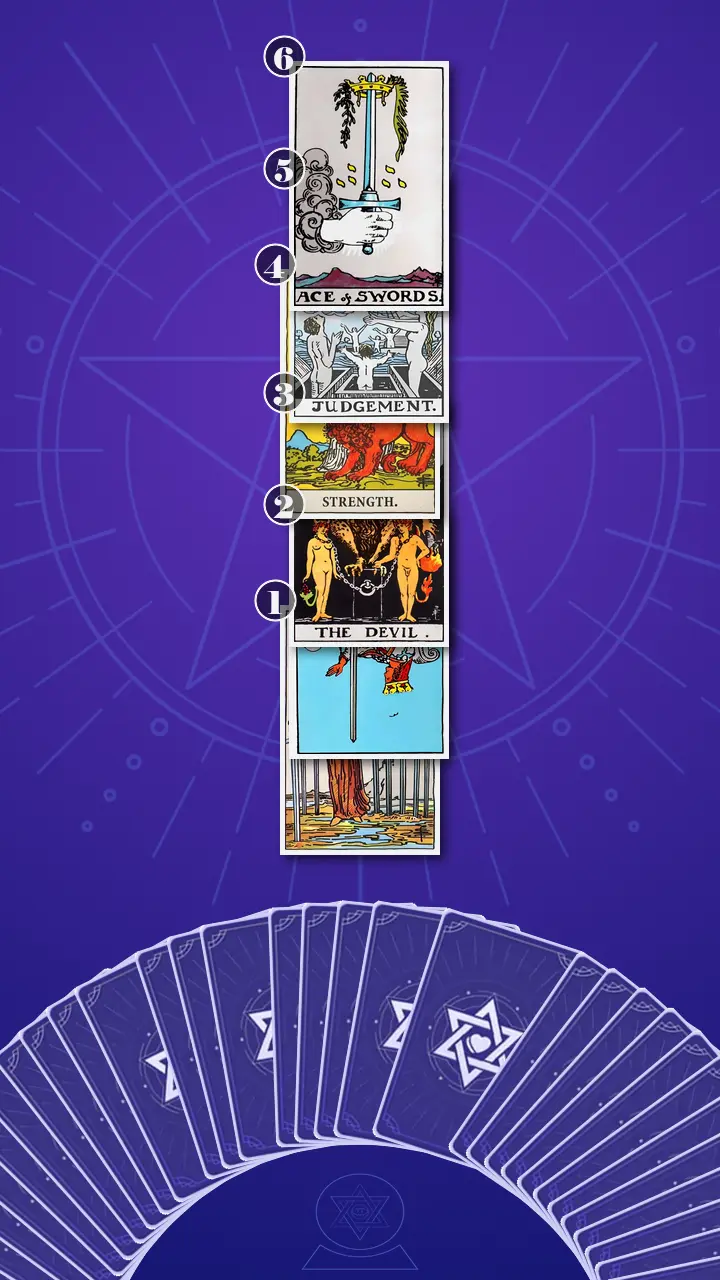
Reading the Ladder: From Contracted Air to Clean Truth
Position 1 — The observable ‘unsent voice note’ loop
I turned over the first card. “Now we open the card that represents the observable ‘unsent voice note’ loop: what you’re doing in the moment you go quiet and how it feels in your body.”
Eight of Swords, upright.
“This is like your exact scene,” I told her. “It’s 11:30 PM and you’ve recorded the note. The room is quiet except for your fridge and the faint buzz of your phone. You listen back once and your throat tightens like you’re trying to squeeze your voice past a security gate. You’re not out of words—you’re out of perceived permission. So you delete it, tell yourself ‘later,’ and trade the discomfort for scrolling.”
In the Eight of Swords, the energy is blocked Air: thoughts aren’t helping you move—they’re fencing you in. The blindfold matters here. It says, “You’re listening, but you’re not hearing yourself with full information.” You hear potential mistakes, not your own intention. And those bindings on the figure? They’re not a knot you can’t undo. They’re a learned rule you keep obeying.
I watched Jordan’s throat move when she swallowed. A small, tight swallow—like her body was trying to keep the words from rising. My family calls that a gate signal. In my work, I call it Body Signal Interpretation: your body tells the truth your mind is still negotiating. A tight throat and clenched jaw aren’t “random anxiety.” They’re the nervous system saying, Speaking feels like exposure.
Jordan gave a tiny laugh that didn’t sound amused. “That’s… brutal,” she said. “Like, yes. It’s exactly that.”
Position 2 — The self-worth rule that polices your voice
I turned over the second card. “Now we open the card that represents the self-worth rule that polices your voice: the internal standard that makes ‘sending’ feel risky.”
Queen of Swords, reversed.
“This is the inner critic as a ‘quality control’ courtroom,” I said, keeping my tone plain—because this card doesn’t need drama; it needs accuracy. “You treat your voice note like a formal statement that can be cross-examined. You flatten warmth, edit out any tremble, and aim for a tone that can’t be criticized. The result sounds ‘controlled’… and also like you disappeared. Reversed, this Queen isn’t protecting your truth—she’s policing it.”
Her energy in reversal is discernment turned into self-censorship: Air in excess but in the worst way—overactive, surveilling, auditing. It’s not “I’m thoughtful.” It’s “I’m unsafe unless I’m un-judgeable.”
I gave her the scene the card was already writing: “It’s like rewriting the same Slack message five times so nobody can question you—except this time it’s your feelings on trial.” I let the inner monologue land, the one I’ve heard a thousand times in different voices: “If my tone is flawless, I can’t be attacked… but if my tone is flawless, I can’t be felt.” Respect vs warmth. Clarity vs self-erasure.
Jordan’s reaction came fast—exactly as the card predicted. She released a sharp exhale through her nose, then went quiet. Her fingers, which had been laced together, loosened as if something in her had stopped defending the system. “I always tell myself I’m just being careful,” she said. “But it really does feel like… court.”
“A voice note isn’t a courtroom transcript,” I said gently. “And you’re not overthinking—you’re auditioning.”
Position 3 — The deeper hook underneath the pattern
I turned over the third card. “Now we open the card that represents the deeper hook underneath the pattern: what you believe could happen that would threaten your worth, belonging, or control.”
The Devil, upright.
“Right before you send,” I said, “a thought hits: ‘If I say what I want, I’m giving them power.’ So you choose silence as leverage. You keep the fantasy that you could deliver it perfectly later, when you’re calmer, when the timing is ideal. But really you’re chained to approval: their response is holding your worth hostage in your mind.”
With The Devil, the energy is attachment—sticky, gripping. It’s not that you don’t have agency. It’s that the fear feels absolute. The chains are loose enough to lift off, but only if you’re willing to admit the bargain: control now, intimacy later. And later never comes.
I’ve seen this pattern in every big city, in every season: people trading their voice for the illusion of safety. In the Highlands, my grandmother used to say winter makes you think you have to hoard warmth. The Devil is that same hoarding—except it’s hoarding control.
Jordan’s mouth tightened. “Silence keeps your leverage,” she said, like she hated that she knew it was true.
“Yes,” I replied. “And it also keeps your needs unpaid.”
Position 4 — The inner capacity you can access to stay present
I turned over the fourth card. “Now we open the card that represents the inner capacity you can access to stay present with discomfort and still speak.”
Strength, upright.
Strength came in like a quieter kind of power than most people expect. “Instead of trying to sound untouchable,” I told her, “you try something steadier: you let your voice be human. You feel the cringe, the heat in your face, the urge to re-record—and you stay. Strength here looks like a steady breath, a relaxed jaw, and choosing to speak while tender, not only when you can perform confidence.”
This card is Fire as steadiness, not Fire as explosion. It’s embodied courage. The kind that doesn’t spike; it holds.
I used my Elemental Balance lens for a moment, because the spread was already telling a clean story. “Notice how we started with heavy Air—thoughts tightening into a cage. Strength brings Fire back to your body. Not to burn anyone. Just to warm you back into yourself.”
Jordan did something small and unmistakable: her jaw unclenched. Her shoulders, which had been subtly lifted toward her ears, dropped a fraction. You could almost see her nervous system test the idea: Maybe I can do this without armoring up.
“Courage here isn’t louder,” I said, giving her the sentence frame the card asked for. “It’s staying present while your body wants to shut the gate.”
When Judgement Spoke: The Notification You Can’t Unhear
Position 5 — The key reframe that dissolves old self-judgement
I let my hand hover over the fifth card for a beat. The room felt quieter—not mystical, just focused, like the moment the TTC doors close and you realize you’re committed to the next stop.
“Now we open the card that represents the key reframe that dissolves the old self-judgement and restores self-definition,” I said. “This is the turning point.”
Judgement, upright.
“This card,” I told Jordan, “is the moment you realize the unsent note isn’t ‘being careful’—it’s living in drafts. Judgement is where you stop treating this message like a verdict on your worth and start treating it like a signal of what’s true right now. The point isn’t guaranteeing a warm reply. The point is answering yourself honestly and letting that be the standard.”
Setup: I could see her stuck in that familiar mental corridor: thumb hovering over send, trying to pre-live every possible reaction so she wouldn’t have to feel the drop of indifference. She was waiting for “calm” like it was a permission slip—when really she was waiting for invulnerability.
You’re not waiting for the perfect moment to be worthy—answer the call now, like Judgement’s trumpet, and let your real voice rise without putting it on trial.
I let the sentence sit between us. Outside, somewhere in the building, a pipe knocked—one clean sound—like punctuation.
Reinforcement: Jordan’s body reacted in a chain, three steps, like weather changing. First, a tiny freeze: her breath paused halfway in, her fingers stopped moving on the edge of her sleeve. Then the cognitive shift: her eyes unfocused for a second, as if she was watching a time-lapse of herself—weeks of saved drafts, the same mic icon pressed and released, the same “later” that never arrives. Then the emotional release, messy and honest: she inhaled, and on the exhale her shoulders sank as though they’d been carrying someone else’s expectations. Her eyes went glossy. She blinked hard.
And then—unexpectedly—her face flashed with a brief, hot annoyance. “But if I stop putting it on trial,” she said, voice sharper, “doesn’t that mean I’ve been wrong this whole time? Like I made it… bigger?”
I nodded. “Not wrong,” I said. “Adaptive. Your system learned: ‘If I can control my tone, I can control my safety.’ That was you trying to protect yourself. Judgement isn’t a gavel. It’s an awakening. It’s you realizing self-worth that depends on a response will always ask you to stay in drafts.”
Then I asked her the question I always ask when Judgement appears, because it makes the insight real. “Now,” I said, “use this new perspective and look back: last week, was there a moment where this message could have been a simple integrity move instead of an audition? Even for ten seconds?”
Jordan stared at the edge of the card and nodded once, slow. “On Thursday,” she whispered. “I had the note recorded. It was… fine. And I deleted it because I thought, ‘If they don’t reply, I’ll look pathetic.’”
“That,” I said softly, “is the step from contraction toward self-trust. Not certainty. Not guaranteed outcomes. Just you choosing integrity over prediction.”
Position 6 — One concrete, doable step this week
I turned over the final card at the top of the ladder. “Now we open the card that represents one concrete, doable step this week that turns insight into a real message.”
Ace of Swords, upright.
“This is the clean headline,” I said. “You send the 15-second version. One feeling, one request. No thesis statement, no legal defense. It’s not dramatic or perfect—it’s clear. This Ace is the moment you stop trying to out-edit vulnerability and instead make one clean cut through the fog: this is what I feel, this is what I’m asking for.”
The Ace is Air again—but now it’s precision instead of surveillance. The same element. A different job. That’s how transformation often works: you don’t delete your mind; you reassign it.
I gave her a concrete script, because “actionable advice” has to sound like something you could actually say in a Toronto condo on a Tuesday night. “Try: ‘I feel overwhelmed lately, and I’m asking for a quick check-in this week.’ Or: ‘I feel distant, and I’m asking if we can talk about it tonight or tomorrow.’”
Jordan’s expression shifted into something like relief—still nervous, but less trapped. Like she could picture it: one sentence, not a whole performance.
From Courtroom to Headline: Actionable Next Steps for Finding Clarity
I leaned back and let the full ladder settle into a single story.
“Here’s what I’m seeing,” I told her. “At the surface, you’re in the Eight of Swords loop: record, listen, tighten, delete. Under that, Queen of Swords reversed turns your self-respect into tone-policing—your inner critic as quality control, running your feelings through a courtroom filter. The Devil underneath is the bargain: ‘If I stay quiet, I keep control.’ Strength is your way out—not by getting louder, but by staying with the body discomfort for ten seconds without erasing yourself. And Judgement reframes the whole thing: this note is not a verdict on your worth. It’s a call to integrity. The Ace of Swords makes it practical: one clean sentence.”
The cognitive blind spot I named for her was simple and sharp: “You’ve been treating being un-judgeable as the same thing as being worthy. That’s why you keep trying to edit yourself into safety.”
“The transformation direction,” I continued, “is moving from polishing your message to protect your worth to sending a small, clear truth that honors your needs without over-explaining. Self-respect becomes a verb.”
Then I offered her the smallest steps—the ones that work when your nervous system is already halfway to ‘no’.
- The One-Line ScriptOpen Notes and write: “I feel ____ and I’m asking for ____.” Copy/paste it into the chat as your script—before you start negotiating with your tone.If your Inner Judge says “too blunt,” shrink it to a 10–15 second message. You’re not required to justify your needs to make them valid.
- The One-Take Voice Note Rule (3 minutes)Set a 3-minute timer. Drop your shoulders, unclench your jaw on purpose, place a hand lightly on your throat, take one slow inhale + exhale. Record ONE take that contains only the two parts: (1) “I feel ___” and (2) “I’m asking for ___.” Listen once only to confirm those two parts are present—then either hit send or save it as a “send-ready” draft with a 24-hour reminder.When you feel the urge to bargain (“just one more take”), label it: “That’s the courtroom.” Then stop. If anxiety spikes, saving is allowed—as long as you don’t re-record.
- The Integrity LabelRight before you delete, say out loud: “I’m turning a message into a judgement.” Then ask: “If my goal was integrity, what’s the one true sentence?” Save the draft titled “Integrity Version.”Keep it factual, not heroic. This isn’t a bravery performance metric—it’s a pattern interrupt.
Before we wrapped, I folded in one of my own practical tools—something my clients remember because it works in real apartments with real nervous systems. “If you can,” I said, “do a 5-minute balcony energy awakening practice before you record—step outside, feel the air on your face, and let your jaw unclench with the cold. If no balcony, a window counts. It’s not about ‘calming down to earn permission to speak.’ It’s about reminding your body you’re here, now, and safe enough to tell one small truth.”

A Week Later: The Quiet Proof
Six days later, Jordan sent me a message. Not a paragraph. Not an essay. Just one line: “I sent the 12-second version. I didn’t re-record. My hands were shaking, but I did it.”
She added, almost as an afterthought: “They didn’t reply immediately. I felt the spiral start. I labeled it—‘courtroom.’ Took a shower and did the water-flow thing you mentioned. The urge to rewrite passed.”
That was the quiet proof: not that the relationship magically fixed itself, but that she stopped using other people’s reaction time as a referendum on her worth. She chose a cleaner kind of power—the kind Strength teaches—and she answered Judgement’s call without putting her voice on trial.
When your thumb hovers over “send” and your throat tightens, it’s not that you don’t have words—it’s that part of you is terrified a human-sounding sentence could be used as proof you’re not worth showing up for.
If you didn’t need your next message to secure approval—only to reflect self-respect—what’s the smallest true sentence you’d be willing to send this week?